|
Size: 2960
Comment:
|
Size: 14171
Comment:
|
| Deletions are marked like this. | Additions are marked like this. |
| Line 1: | Line 1: |
| The State of Chenbao (塵暴國) is an Earth Nation and one of the constituent polities of the Earth Kingdom. As reflected in its designation as a ''guo'' (國) rather than a province, Chenbao was formerly a sovereign state that paid tribute to the Earth King as its suzerain. Straddling the Northern and Western regions of the Earth Kingdom and isolated by formidable mountains, yet ideally positioned to conduct seagoing trade on both the Inner Seas and Northern Ocean, it remains culturally and ethnically distinct from the rest of the region and has a strong sense of national identity. Chenbao has remained relatively isolated from the invasion of the Fire Nation; there are rumors of collaboration between its 'de facto'' hereditary governorate and the Fire Nation. | The State of Chenbao (塵暴國) is an Earth Nation and one of the constituent polities of the Earth Kingdom. As reflected in its designation as a ''guo'' (國) rather than a province, Chenbao was formerly a sovereign state that paid tribute to the Earth King as its suzerain. Straddling the Northern and Western regions of the Earth Kingdom and isolated by formidable mountains, yet ideally positioned to conduct seagoing trade on both the Inner Seas and Northern Ocean, it remains culturally and ethnically distinct from the rest of the region and has a strong sense of national identity. Chenbao has remained relatively untouched from the invasion of the Fire Nation; there are rumors of collaboration between its 'de facto'' hereditary governorate and the Fire Nation. |
| Line 3: | Line 3: |
| WORK IN PROGRESS | === History === The land comprising Chenbao was inhabited since time immemorial by a range of both settled and nomadic peoples. The term Northwestern Tuzhu (西北方土著) or Northwestern Aborigines is somewhat overinclusive, including both coastal groups and mountain-dwelling people with markedly different modes of life. Most of these groups were of Earth Nation stock, though some of the fishing villages on the Northern coast had obvious ethnolinguistic affinity with the Water Tribe. Excluded from classification as Northwestern Tuzhu are the Nogai people (諾蓋族), a nomadic group who mostly live in the semiarid central and southern plains of Chenbao. During the late Di dynasty, around 2000 BG, Chenbao was colonized by "Zhongzu" (it would be more accurate to say that it was colonized by people who were the ancestors of both the modern Zhongzu and the population of Ba Sing Se.) According to the written histories they wrote, they set out without the official blessing of the royal court, under the leadership of Lord Mao Erzi, the second son of a certain Duke Mao. Lord Mao was drawn there by claims of abundant mineral resources and farmland, and pushed away from his family's fief by disputes with neighbors and encroachment from Western barbarians. The colonists were several thousand strong, including 800 men-at-arms and a hundred earthbenders. They passed through nomad lands by hiring Abka guards to escort them. After arriving in Chenbao, they founded their capital Maoshi (毛市) on the Rabaroo river. The land was purchased from local indigenous people, who were permitted to continue living there as well and shelter within the city walls in case of attack; however, relations with the indigenous people not benefiting from these considerations deteriorated within a few years. Mao Erzi and the indigenous chief Yanggu Amiao-Amiao died of sand-cuttlefish poisoning at a diplomatic meeting; a Nogai chef was ostensibly discovered as an assassin attempting to sabotage relations between the colonists and and aboriginal peoples. This event enabled moderate elements within both the Northwestern Tuzhu and Zhongzu colonists to promote cooperation against the unifying threat of the Nogai and build a common identity. Meanwhile, the collapse of the Di dynasty and the removal of the Mao family from their fief by the new Tu dynasty ended any support of the colonization from the Earth Kingdom. Eventually, these proto-Chenbaozu subdued the Nogai and made a treaty with them, promising to respect their customs and reserving certain territory to them, in exchange for peace and trade. Contact with the Earth Kingdom was sporadic for centuries, and Chenbao became an independent state ruled by the Mao royal dynasty. A second wave of Zhongzu settlement happened during the Younger Gong dynasty, when the Throne encouraged settlement of the far West. Many of these settlers passed through Chenbao on their way to settle in the Far West, but some of them stayed. They mostly assimilated into the Chenbaozu population. Additionally, regular relations with the Earth Kingdom were reestablished, and Chenbao recognized the Earth Kingdom as its suzerain. It was included in the tribute system, being entitled to send a tribute mission to Ba Sing Se every two years. Chenbao's tribute included, typically, precious metals and other mineral products including fine pigments, leather goods, and craftworks from the North Water Tribe received in trade. In return, Chenbao received silk products, ceramics, and literary cultural items. Chenbao was also a point of trade contact between the Ganjinese mercantile empire and the Northern Water Tribe; there was even contact with blue-water traders from the Fire Nation. Chenbao submitted to the Ri Dynasty peacefully during the dynastic transition from the Hao, perhaps unsurprisingly as they had enjoyed relatively pacific relations with the Yonggan since the Nara clan came to power; previously, under the Jala khaganate which the Nara replaced, Chenbao had to deal with frequent incursions in its mountain regions by belligerent Montane Yonggan. The kings of Chenbao accepted the dynastic transition to the Hao Ting peacefully, but relations cooled and Chenbao became more independent. Eventually, the central government started attempting to extract more wealth from Chenbao to finance its conflicts with rebel groups. When Qin the Great emerged and prevailed over the Hao Ting in the West, the King of Chenbao defected to Qin, and secured preferential treatment from the hegemon in exchange for providing supplies and transportation. The Royal Chenbao Army supported Qin's war in the North, and after Qin's death, Chenbao was loosely aligned with the Gansanjiao regime, but cut ties when the Ganjinese capital fell to the Hao Ting, even sending troops to attack their erstwhile Yonggan allies during the siege of the Gainan Palace City. Despite his treachery against the Nara and attempts to assure the Hao Ting of his renewed loyalty to the dynasty, the king, Mao Ailun, was deposed and taken to Ba Sing Se in chains along with the royal family; he was later executed, though his family were spared and eventually allowed to live in the Upper Ring in exchange for renouncing their claims to rulership of Chenbao. A governor was appointed for Chenbao, and the era of direct rule by the central government began. Coinciding with the bracing reforms of Avatar Kyoshi and the Earth Sages, the administration of the state was modernized and corruption declined. Unfortunately, as the Hao Ting renaissance (the prosperous period after the defeat of Qin the great) did not persist long after the death of Kyoshi, conditions declined again. After the outbreak of the Hundred Years War, the central government's control slipped, and the governorate of Chenbao became effectively hereditary; the current governor Liu Songling is nine years old, and the great-grandson of the first governor Liu. Notionally, the governor is still appointed by Ba Sing Se, but in practice, they do nothing but ratify the succession to ensure the continued remittance of taxes. The current governor, being a minor, even has a "regency," and is a king in all but name. Songling's regency even "reenacted" the old Mao dynasty enthronement ceremony for the boy on Chenbao History Day. The Fire Nation has never invaded Chenbao, but commercial traffic of non-military Fire Nation ships is openly tolerated. This is, of course, illegal under Earth Kingdom law, but the local authorities seem to have no interest in enforcing the law against the interests of the local administration. The governor's regency has offered the excuse that it is under duress and the feeble state of the Earth Navy precludes enforcing the law. Fire Nationals move freely on the West Coast, unchallenged by the local government except for the arrest the occasional drunkenly belligerent Fire Nation sailor. It is widely believed, but unproven, that the governorate is secretly colluding with the Fire Nation in exchange for continued autonomy and not being invaded. That being said, the Chenbao Army has also been reconstituted and has been increasing in strength in recent years; it is not known what objectives the state government may have in mind for it - perhaps making sure the Fire Nation honors a secret treaty by offering a credible resistance. It has also been proposed that they fear Northern Warlords who may wish to draw much more heavily on the state's resources to prosecute the war. === Anthropology === |
| Line 6: | Line 22: |
| , The Chenbaozu 塵暴族 are the primary inhabitants of [[Avatar/Chenbao|Chenbao]]. They derive from Zhongzu, Western Beituzhu, and Nogoi ethnic stock. The Western Beituzhu, now entirely assimilated into the Chenbaozu, were culturally and genetically distinct from the Eastern Beituzhu who are still a distinct (and fairly populous) people in the North. They have mostly green eyes and Fitzpatrick II skin color. Many Chenbao people have brown hair, which is thought locally to have come from the Western Beituzhu. (Archaeologists from Ba Sing Se University debate this view - the Western Beituzhu are depicted in ancient Yonggan art found in the Nara Ancestral Tombs with an ochre pigment for their hair in contrast to the Eastern Beituzhu and Yonggan whose hair is depicted with lampblack. However, it's uncertain if the ochre was originally mixed with some other, non-light-stable pigment - the art's current location in a grotto shrine was probably not its original location.) | ==== Northwestern Aborigines ==== The Northwestern Aborigines (西北方土著), unlike the Beituzhu to the East, have almost completely assimilated into the general Chenbaozu ethnicity; only a few isolate villages in the mountains carry on their mostly-traditional indigenous lifestyle. There were several tribal confederations of these people, who did not see themselves as a common group until the arrival of Zhongzu colonizers during the Di dynasty. At the time of colonization, the two largest confederations were in the midst of a prolonged, low-grade war with each other; this impaired their ability to resist colonization and made them more vulnerable to Nogai raids. Unfortunately, there is relatively little available in the way of primary sources for the Northwestern Aborigines, as they did not have a written language. Most of what is recorded about them comes from the writings of the colonists from the Central Earth Kingdom, who vary substantially in their objectivity and perspective on the indigenous people. |
| Line 8: | Line 25: |
| The Chenbao language is similar to Common, but with some archaicising characteristics (preserving final consonants lost from Common during the early Tu dynasty, and having a simplified tonal structure). At the nadir of cultural contact, the spoken language was no longer mutually intelligible with Common, although the written language remained so. However, over time - and particularly since the imposition of direct rule in the Era of Kyoshi - the language has drifted back into marginal mutual intelligibility, and Common is the language of administration. (Dialects of dubious intelligibility to common speakers are still spoken in some rural areas.) It also has a number of loanwords (particularly place names)from the Nogoi language. | It is supposed that the Northwestern Aborigines had brown-colored hair, a distinctive trait seen in some people from Chenbao today, but it isn't definitely stated in the documentary sources and is based on uncertain archaeological evidence. Unassimilated aborigines in the mountains of Chenbao mostly have black hair, but as mentioned above, there were several distinct ethnic groups lumped together as "Northwestern Aborigines" and so this is not clearly relevant to the question. |
| Line 10: | Line 27: |
| The Chenbao are mostly settled - the State of Chenbao has nomadic peoples, particularly in is Southern steppes, but they identify as Northern Nogoi more than Chenbao people. | Some compound surnames which are common in Chenbao, but rare elsewhere in the Earth Kingdom, are calques of aboriginal family names. Examples include 興韭 ''Xiangjiu'', 養穀 ''Yanggu'' and 水扁 ''Shuipian.'' |
| Line 12: | Line 29: |
| === Nogoi === | ==== Nogai ==== |
| Line 14: | Line 31: |
| Nogoi nomads still inhabit the southern parts of Chenbao. They ride ostrich horses and practice mounted earthbending; they were the perpetual rivals of the Abka until the coming of Earth Kingdom suzerainty, which brought relative peace. | The Nogai or Nuogezu (諾蓋族) are a mostly-nomadic indigenous group. Unlike the Northwestern Aborigines, there are large numbers of Nogai still practicing their traditional lifestyle in the semiarid parts of Chenbao. They ride ostrich-horses, herding gemsbok-cattle and hunting game such as the rabaroo. Prior to the Earth Kingdom establishing suzerainty over both groups, the Nogai were the perpetual rivals of the Abka people to the East, and the bards of both sides still sing ballads of their legendary battles. The Nogai acknowledge allegiance to the State of Chenbao and the Earth Kingdom, but are largely self-governing and ruled under indigenous customary law, the governor of Chenbao is ''ex officio'' Paramount Chief of the Nogai and his government includes an officer called the Remembrancer of the Horse Peoples (騎馬民紀念官), whose responsibilities include advising the governor on Nogai matters. Despite their long history of antagonism with the Abka, they are sometimes considered to be part of the Abka themselves by early Earth Kingdom sources. This is likely because the Earth Kingdom was nearer the Abka and initially accepted the position of the Abka khagan that the Nogai were his wayward subjects, calling them "Western Abka." The Nogai have many skilled earthbenders and their own customary school of earthbending. While their techniques have contributed to the wider Chenbao school, they maintain a distinct tradition and do not generally teach it to outsiders. They are sometimes described as "dustbenders," and use whirling clouds of dust to confound ranged attacks and conceal their numbers and movement. Although most Nogai know some of the Common language, usually the form spoken in Chenbao. They mostly use it for trade, preferring their own language for other purposes. It is part of the Abkic language family (forming one of the four major divisions, along with Abka, Yonggan, and the Yi indigenous languages.) It is most closely related to Abka. They have conventions for writing their language using Common characters, but since the Di Dynasty, they more frequently use a variant of the Yonggan phonetic writing system. Sometimes, the Nogai in Chenbao distinguish them as ''Beifang Nuogezu'' i.e. Northern Nogai in contrast with the similar Nogaic-language speaking nomadic herders of the eponymous Nogai State (諾蓋國) to the south of Chenbao, who are then either just "Nogai" or are called Southern Nogai. ==== Chenbaozu ==== Most inhabitants of Chenbao identify as Chenbaozu (塵暴族) are the primary inhabitants of [[Avatar/Chenbao|Chenbao]]. They derive from Zhongzu, Western Beituzhu, and Nogai ethnic stock. They have mostly green eyes and Fitzpatrick II skin color. Many Chenbao people have brown hair, which is thought locally to have come from the Western Beituzhu. (Archaeologists from Ba Sing Se University debate this view - the Western Beituzhu are depicted in ancient Yonggan art found in the Nara Ancestral Tombs with an ochre pigment for their hair in contrast to the Eastern Beituzhu and Yonggan whose hair is depicted with lampblack. However, it's uncertain if the ochre was originally mixed with some other, non-light-stable pigment - the art's current location in a grotto shrine was probably not its original location.) The Chenbao language is similar to Common, but with some archaizing characteristics (preserving final consonants lost from Common during the early Tu dynasty, and having a simplified tonal structure). At the nadir of cultural contact, the spoken language was no longer mutually intelligible with Common, although the written language remained so. However, over time - and particularly since the imposition of direct rule in the Era of Kyoshi - the language has drifted back into marginal mutual intelligibility, and Common is the language of administration. (Dialects of dubious intelligibility to Common speakers are still spoken in some rural areas.) It also has a number of loanwords (particularly place names)from the Nogai and other indigenous languages. |
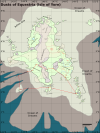
The State of Chenbao (塵暴國) is an Earth Nation and one of the constituent polities of the Earth Kingdom. As reflected in its designation as a guo (國) rather than a province, Chenbao was formerly a sovereign state that paid tribute to the Earth King as its suzerain. Straddling the Northern and Western regions of the Earth Kingdom and isolated by formidable mountains, yet ideally positioned to conduct seagoing trade on both the Inner Seas and Northern Ocean, it remains culturally and ethnically distinct from the rest of the region and has a strong sense of national identity. Chenbao has remained relatively untouched from the invasion of the Fire Nation; there are rumors of collaboration between its 'de facto hereditary governorate and the Fire Nation.
The land comprising Chenbao was inhabited since time immemorial by a range of both settled and nomadic peoples. The term Northwestern Tuzhu (西北方土著) or Northwestern Aborigines is somewhat overinclusive, including both coastal groups and mountain-dwelling people with markedly different modes of life. Most of these groups were of Earth Nation stock, though some of the fishing villages on the Northern coast had obvious ethnolinguistic affinity with the Water Tribe. Excluded from classification as Northwestern Tuzhu are the Nogai people (諾蓋族), a nomadic group who mostly live in the semiarid central and southern plains of Chenbao. During the late Di dynasty, around 2000 BG, Chenbao was colonized by "Zhongzu" (it would be more accurate to say that it was colonized by people who were the ancestors of both the modern Zhongzu and the population of Ba Sing Se.) According to the written histories they wrote, they set out without the official blessing of the royal court, under the leadership of Lord Mao Erzi, the second son of a certain Duke Mao. Lord Mao was drawn there by claims of abundant mineral resources and farmland, and pushed away from his family's fief by disputes with neighbors and encroachment from Western barbarians. The colonists were several thousand strong, including 800 men-at-arms and a hundred earthbenders. They passed through nomad lands by hiring Abka guards to escort them. After arriving in Chenbao, they founded their capital Maoshi (毛市) on the Rabaroo river. The land was purchased from local indigenous people, who were permitted to continue living there as well and shelter within the city walls in case of attack; however, relations with the indigenous people not benefiting from these considerations deteriorated within a few years. Mao Erzi and the indigenous chief Yanggu Amiao-Amiao died of sand-cuttlefish poisoning at a diplomatic meeting; a Nogai chef was ostensibly discovered as an assassin attempting to sabotage relations between the colonists and and aboriginal peoples. This event enabled moderate elements within both the Northwestern Tuzhu and Zhongzu colonists to promote cooperation against the unifying threat of the Nogai and build a common identity. Meanwhile, the collapse of the Di dynasty and the removal of the Mao family from their fief by the new Tu dynasty ended any support of the colonization from the Earth Kingdom. Eventually, these proto-Chenbaozu subdued the Nogai and made a treaty with them, promising to respect their customs and reserving certain territory to them, in exchange for peace and trade. Contact with the Earth Kingdom was sporadic for centuries, and Chenbao became an independent state ruled by the Mao royal dynasty. A second wave of Zhongzu settlement happened during the Younger Gong dynasty, when the Throne encouraged settlement of the far West. Many of these settlers passed through Chenbao on their way to settle in the Far West, but some of them stayed. They mostly assimilated into the Chenbaozu population. Additionally, regular relations with the Earth Kingdom were reestablished, and Chenbao recognized the Earth Kingdom as its suzerain. It was included in the tribute system, being entitled to send a tribute mission to Ba Sing Se every two years. Chenbao's tribute included, typically, precious metals and other mineral products including fine pigments, leather goods, and craftworks from the North Water Tribe received in trade. In return, Chenbao received silk products, ceramics, and literary cultural items. Chenbao was also a point of trade contact between the Ganjinese mercantile empire and the Northern Water Tribe; there was even contact with blue-water traders from the Fire Nation. Chenbao submitted to the Ri Dynasty peacefully during the dynastic transition from the Hao, perhaps unsurprisingly as they had enjoyed relatively pacific relations with the Yonggan since the Nara clan came to power; previously, under the Jala khaganate which the Nara replaced, Chenbao had to deal with frequent incursions in its mountain regions by belligerent Montane Yonggan. The kings of Chenbao accepted the dynastic transition to the Hao Ting peacefully, but relations cooled and Chenbao became more independent. Eventually, the central government started attempting to extract more wealth from Chenbao to finance its conflicts with rebel groups. When Qin the Great emerged and prevailed over the Hao Ting in the West, the King of Chenbao defected to Qin, and secured preferential treatment from the hegemon in exchange for providing supplies and transportation. The Royal Chenbao Army supported Qin's war in the North, and after Qin's death, Chenbao was loosely aligned with the Gansanjiao regime, but cut ties when the Ganjinese capital fell to the Hao Ting, even sending troops to attack their erstwhile Yonggan allies during the siege of the Gainan Palace City. Despite his treachery against the Nara and attempts to assure the Hao Ting of his renewed loyalty to the dynasty, the king, Mao Ailun, was deposed and taken to Ba Sing Se in chains along with the royal family; he was later executed, though his family were spared and eventually allowed to live in the Upper Ring in exchange for renouncing their claims to rulership of Chenbao. A governor was appointed for Chenbao, and the era of direct rule by the central government began. Coinciding with the bracing reforms of Avatar Kyoshi and the Earth Sages, the administration of the state was modernized and corruption declined. Unfortunately, as the Hao Ting renaissance (the prosperous period after the defeat of Qin the great) did not persist long after the death of Kyoshi, conditions declined again. After the outbreak of the Hundred Years War, the central government's control slipped, and the governorate of Chenbao became effectively hereditary; the current governor Liu Songling is nine years old, and the great-grandson of the first governor Liu. Notionally, the governor is still appointed by Ba Sing Se, but in practice, they do nothing but ratify the succession to ensure the continued remittance of taxes. The current governor, being a minor, even has a "regency," and is a king in all but name. Songling's regency even "reenacted" the old Mao dynasty enthronement ceremony for the boy on Chenbao History Day. The Fire Nation has never invaded Chenbao, but commercial traffic of non-military Fire Nation ships is openly tolerated. This is, of course, illegal under Earth Kingdom law, but the local authorities seem to have no interest in enforcing the law against the interests of the local administration. The governor's regency has offered the excuse that it is under duress and the feeble state of the Earth Navy precludes enforcing the law. Fire Nationals move freely on the West Coast, unchallenged by the local government except for the arrest the occasional drunkenly belligerent Fire Nation sailor. It is widely believed, but unproven, that the governorate is secretly colluding with the Fire Nation in exchange for continued autonomy and not being invaded. That being said, the Chenbao Army has also been reconstituted and has been increasing in strength in recent years; it is not known what objectives the state government may have in mind for it - perhaps making sure the Fire Nation honors a secret treaty by offering a credible resistance. It has also been proposed that they fear Northern Warlords who may wish to draw much more heavily on the state's resources to prosecute the war.
The Northwestern Aborigines (西北方土著), unlike the Beituzhu to the East, have almost completely assimilated into the general Chenbaozu ethnicity; only a few isolate villages in the mountains carry on their mostly-traditional indigenous lifestyle. There were several tribal confederations of these people, who did not see themselves as a common group until the arrival of Zhongzu colonizers during the Di dynasty. At the time of colonization, the two largest confederations were in the midst of a prolonged, low-grade war with each other; this impaired their ability to resist colonization and made them more vulnerable to Nogai raids. Unfortunately, there is relatively little available in the way of primary sources for the Northwestern Aborigines, as they did not have a written language. Most of what is recorded about them comes from the writings of the colonists from the Central Earth Kingdom, who vary substantially in their objectivity and perspective on the indigenous people. It is supposed that the Northwestern Aborigines had brown-colored hair, a distinctive trait seen in some people from Chenbao today, but it isn't definitely stated in the documentary sources and is based on uncertain archaeological evidence. Unassimilated aborigines in the mountains of Chenbao mostly have black hair, but as mentioned above, there were several distinct ethnic groups lumped together as "Northwestern Aborigines" and so this is not clearly relevant to the question. Some compound surnames which are common in Chenbao, but rare elsewhere in the Earth Kingdom, are calques of aboriginal family names. Examples include 興韭
The Nogai or Nuogezu (諾蓋族) are a mostly-nomadic indigenous group. Unlike the Northwestern Aborigines, there are large numbers of Nogai still practicing their traditional lifestyle in the semiarid parts of Chenbao. They ride ostrich-horses, herding gemsbok-cattle and hunting game such as the rabaroo. Prior to the Earth Kingdom establishing suzerainty over both groups, the Nogai were the perpetual rivals of the Abka people to the East, and the bards of both sides still sing ballads of their legendary battles. The Nogai acknowledge allegiance to the State of Chenbao and the Earth Kingdom, but are largely self-governing and ruled under indigenous customary law, the governor of Chenbao is Despite their long history of antagonism with the Abka, they are sometimes considered to be part of the Abka themselves by early Earth Kingdom sources. This is likely because the Earth Kingdom was nearer the Abka and initially accepted the position of the Abka khagan that the Nogai were his wayward subjects, calling them "Western Abka." The Nogai have many skilled earthbenders and their own customary school of earthbending. While their techniques have contributed to the wider Chenbao school, they maintain a distinct tradition and do not generally teach it to outsiders. They are sometimes described as "dustbenders," and use whirling clouds of dust to confound ranged attacks and conceal their numbers and movement. Although most Nogai know some of the Common language, usually the form spoken in Chenbao. They mostly use it for trade, preferring their own language for other purposes. It is part of the Abkic language family (forming one of the four major divisions, along with Abka, Yonggan, and the Yi indigenous languages.) It is most closely related to Abka. They have conventions for writing their language using Common characters, but since the Di Dynasty, they more frequently use a variant of the Yonggan phonetic writing system. Sometimes, the Nogai in Chenbao distinguish them as
Most inhabitants of Chenbao identify as Chenbaozu (塵暴族) are the primary inhabitants of Chenbao. They derive from Zhongzu, Western Beituzhu, and Nogai ethnic stock. They have mostly green eyes and Fitzpatrick II skin color. Many Chenbao people have brown hair, which is thought locally to have come from the Western Beituzhu. (Archaeologists from Ba Sing Se University debate this view - the Western Beituzhu are depicted in ancient Yonggan art found in the Nara Ancestral Tombs with an ochre pigment for their hair in contrast to the Eastern Beituzhu and Yonggan whose hair is depicted with lampblack. However, it's uncertain if the ochre was originally mixed with some other, non-light-stable pigment - the art's current location in a grotto shrine was probably not its original location.) The Chenbao language is similar to Common, but with some archaizing characteristics (preserving final consonants lost from Common during the early Tu dynasty, and having a simplified tonal structure). At the nadir of cultural contact, the spoken language was no longer mutually intelligible with Common, although the written language remained so. However, over time - and particularly since the imposition of direct rule in the Era of Kyoshi - the language has drifted back into marginal mutual intelligibility, and Common is the language of administration. (Dialects of dubious intelligibility to Common speakers are still spoken in some rural areas.) It also has a number of loanwords (particularly place names)from the Nogai and other indigenous languages. History
Anthropology
Northwestern Aborigines
Nogai
Chenbaozu