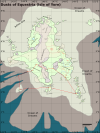
The State of Chenbao (塵暴國) is an Earth Nation and one of the constituent polities of the Earth Kingdom. As reflected in its designation as a guo (國) rather than a province, Chenbao was formerly a sovereign state that paid tribute to the Earth King as its suzerain. Straddling the Northern and Western regions of the Earth Kingdom and isolated by formidable mountains, yet ideally positioned to conduct seagoing trade on both the Inner Seas and Northern Ocean, it remains culturally and ethnically distinct from the rest of the region and has a strong sense of national identity. Chenbao has remained relatively untouched from the invasion of the Fire Nation; there are rumors of collaboration between its 'de facto hereditary governorate and the Fire Nation.
The land comprising Chenbao was inhabited since time immemorial by a range of both settled and nomadic peoples. The term Northwestern Tuzhu (西北方土著) or Northwestern Aborigines is somewhat overinclusive, including both coastal groups and mountain-dwelling people with markedly different modes of life. Most of these groups were of Earth Nation stock, though some of the fishing villages on the Northern coast had obvious ethnolinguistic affinity with the Water Tribe. Excluded from classification as Northwestern Tuzhu are the Nogai people (諾蓋族), a nomadic group who mostly live in the semiarid central and southern plains of Chenbao.
The Northwestern Aborigines, unlike the Beituzhu to the East, have almost completely assimilated into the general Chenbaozu ethnicity; only a few isolate villages in the mountains carry on their mostly-traditional indigenous lifestyle. There were several tribal confederations of these people, who did not see themselves as a common group until the arrival of Zhongzu colonizers during the Di dynasty. At the time of colonization, the two largest confederations were in the midst of a prolonged, low-grade war with each other; this impaired their ability to resist colonization and made them more vulnerable to Nogai raids. Unfortunately, there is relatively little available in the way of primary sources for the Northwestern Aborigines, as they did not have a written language. Most of what is recorded about them comes from the writings of the colonists from the Central Earth Kingdom, who vary substantially in their objectivity and perspective on the indigenous people. It is supposed that the Northwestern Aborigines had brown-colored hair, a distinctive trait seen in some people from Chenbao today, but it isn't definitely stated in the documentary sources and is based on uncertain archaeological evidence. Unassimilated aborigines in the mountains of Chenbao mostly have black hair, but as mentioned above, there were several distinct ethnic groups lumped together as "Northwestern Aborigines" and so this is not clearly relevant to the question. Some compound surnames common in Chenbao, but rare elsewhere in the Earth Kingdom, are loan translations of aboriginal family names. Examples include 興韭 henbao school is sometimes considered a Middle Way school. It combines the earthbending practices of Di Dynasty Zhongzu settlers with the earthbending traditions of the Nogoi people of the West. As the name implies, it has many techniques for moving and using flying dirt; the whirling dust devils and clouds of dust conjured by mounted Nogoi shamans were an important defense against Abka archery when these two nomadic people battled for control of the Western Steppes. There are institutionalized schools of Chenbao Earthbending in the state of the same name; some groups of Nogoi nomads still carry on their traditional lifestyle and also teach the techniques, usually only to their own people. WORK IN PROGRESS , The Chenbaozu 塵暴族 are the primary inhabitants of Chenbao. They derive from Zhongzu, Western Beituzhu, and Nogoi ethnic stock. The Western Beituzhu, now entirely assimilated into the Chenbaozu, were culturally and genetically distinct from the Eastern Beituzhu who are still a distinct (and fairly populous) people in the North. They have mostly green eyes and Fitzpatrick II skin color. Many Chenbao people have brown hair, which is thought locally to have come from the Western Beituzhu. (Archaeologists from Ba Sing Se University debate this view - the Western Beituzhu are depicted in ancient Yonggan art found in the Nara Ancestral Tombs with an ochre pigment for their hair in contrast to the Eastern Beituzhu and Yonggan whose hair is depicted with lampblack. However, it's uncertain if the ochre was originally mixed with some other, non-light-stable pigment - the art's current location in a grotto shrine was probably not its original location.) The Chenbao language is similar to Common, but with some archaicising characteristics (preserving final consonants lost from Common during the early Tu dynasty, and having a simplified tonal structure). At the nadir of cultural contact, the spoken language was no longer mutually intelligible with Common, although the written language remained so. However, over time - and particularly since the imposition of direct rule in the Era of Kyoshi - the language has drifted back into marginal mutual intelligibility, and Common is the language of administration. (Dialects of dubious intelligibility to common speakers are still spoken in some rural areas.) It also has a number of loanwords (particularly place names)from the Nogoi language. The Chenbao are mostly settled - the State of Chenbao has nomadic peoples, particularly in is Southern steppes, but they identify as Northern Nogoi more than Chenbao people.
Nogoi nomads still inhabit the southern parts of Chenbao. They ride ostrich horses and practice mounted earthbending; they were the perpetual rivals of the Abka until the coming of Earth Kingdom suzerainty, which brought relative peace. History
Anthropology
Northwestern Aborigines
Nogoi
Revision 2 as of 2023-05-29 19:39:55
Clear message