|
Size: 884
Comment:
|
Size: 5575
Comment:
|
| Deletions are marked like this. | Additions are marked like this. |
| Line 8: | Line 8: |
| {{attachment:greater_earth_kingdom.png||width=600}} | {{attachment:greater_earth_kingdom_regions.png||width=600}} |
| Line 10: | Line 10: |
| == Mythic History == | |
| Line 11: | Line 12: |
| 穩 Wen | The first dynasty of the Earth Kingdom was supposedly the Wen (穩) which ruled the Central Continent from 4912-3802 BG, a duration of 1110 years (supposedly), all under two kings who lived purportedly for a very long time. Archaeological evidence has not revealed any proof for the first king; the name of the second has been found in a few scattered places, and that among many other rulers. Written descriptions of them appear only in the 25th century BG when historians of the Elder Gong wrote the first official histories of the Earth Kingdom. It's generally thought that there were many rival states in the Central Continent during this era, and the Wen were merely heads of one of the more powerful; the last Wen king may or may not have unified them. (Alternately, the early monarchs of the Elder Gong may have done this.) |
| Line 13: | Line 14: |
| 前鞏 Elder Gong | Ba Sing Se is mentioned, by a different name, in the Official History of the Wen and Gong (a mythic and historical work that was started in the 25th century BG, and completed under the auspices of the first king of the Great Di), though it had neither inner nor outer walls at the time. While the area of Ba Sing Se is of undoubtedly very ancient habitation, the references to its existence as a city of significance during the Wen dynasty are probably not historically accurate. |
| Line 15: | Line 16: |
| 地 Di | == Early History to High Antiquity == |
| Line 17: | Line 18: |
| 土 Tu | The second dynasty is the Elder Gong (前鞏), which according to the Official History of the Wen and Gong ruled 3802-2691 BG, a total of 1111 years. Unlike the situation with the Wen, many of the Elder Gong monarchs are attested historically, and all of them from the 20nd Century BG onward have been confirmed to have existed independently of the Official History. The Gong was suzerain over the East and North, but the Southern Continent remained independent and the Western Plains were at most intermittently subdued. Ba Sing Se, still under its old name, was made the capital during this period, though its remarkable walls were not built, and there was nothing like the agricultural zone (which was simply its dependent countryside and outlying provinces.) |
| Line 19: | Line 20: |
| 東土 Eastern Tu | The Di (地), a noble family arising in the Southeast of the Center Continent, rose up against the Gong and established a new dynasty, which ruled from 2691-2011 BG, 680 years. The Di heavily valued scholarship and compiled histories of their predecessors, as well as establishing an Office of the Grand Historian. The Di subdued the Western Plains and sent exploratory missions to the Western Continent and the Fire Nation. Ultimately, the dynasty went into decline as it fixed its imperial ambitions on the Southern Continent and made war on the Kings of Omashu. Strained by half a century of conflict, rebels from the East and raiding nomads from the West ravaged the kingdom, leading the Di to fortify Ba Sing Se and give it its present name. In the end, the last ten kings of the Great Di controlled only Ba Sing Se as a city-state surrounded by independent polities. |
| Line 21: | Line 23: |
| 後鞏 Younger Gong | == Late Antiquity == |
| Line 23: | Line 25: |
| 前霆 Elder Ting | In 2011 BG, the last Earth King of the Great Di died, and the badgermole throne was seized by a powerful family of Ba Sing Se nobility, who proclaimed the Tu (土) dynasty. The Tu ruled from 2011-1742, 269 years. They reunited the Central Continent and made the Western Plains, North, and East organic parts of the Kingdom. The Nations of the West and the Northern Water Tribe sent tribute missions to Ba Sing Se under the Great Tu, and there was peace with Omashu and the Far South thanks to the shrewd diplomacy of the Yaoshi Avatar. However, after the death of the Yaoshi Avatar, there was significant turmoil in the Kingdom, and these tributary relationships broke down. Northern and Western nomadic peoples again began to raid the Central Plains, and after turning them back, the Tu began an immense wall-building project to protect Ba Sing Se and enough agricultural land to sustain it indefinitely. |
| Line 25: | Line 27: |
| 豪 Hao | A succession crisis resulted in the division of the Kingdom into parts controlled by the Western Tu and Eastern Tu. The Western Tu, ruled by a Ganjinese monarch and supported by the vast trading network of Gan Jin, controlled the Earth Kingdom colonies and paid for large armies of Zhangs, Yonggan and Abka people. |
| Line 27: | Line 29: |
| 日 Ri | The new walls of Ba Sing Se managed to protect the city from the rivals of the Eastern Tu (東土), who continued to rule another 73 years from 1742-1669 BG, controlling the Eastern two-thirds of the Central Continent and the East. |
| Line 29: | Line 31: |
| 豪霆 Hao-Ting | == Pre-Modern Era == 後鞏 Younger Gong 1669-1185 BG, 484 years 前霆 Elder Ting 1185-1064 BG, 120 years == Modern History == Eras of the Avatars Szeto, Yangchen, Kuruk, Kyoshi and Roku 豪 Hao 1064-788 BG, 276 years 日 Ri 788-620 BG, 168 years 豪霆 Hao-Ting, 620 BG-present, 521 years (and ongoing) |
Pending GM approval
This page lists the major dynasties of the Earth Kingdom. The Earth Kingdom has many constituent parts, many of which have at times been divided into separate polities or ruled centrally from one or a few; this page will necessarily focus only on the major entities.
Geohistorical Context
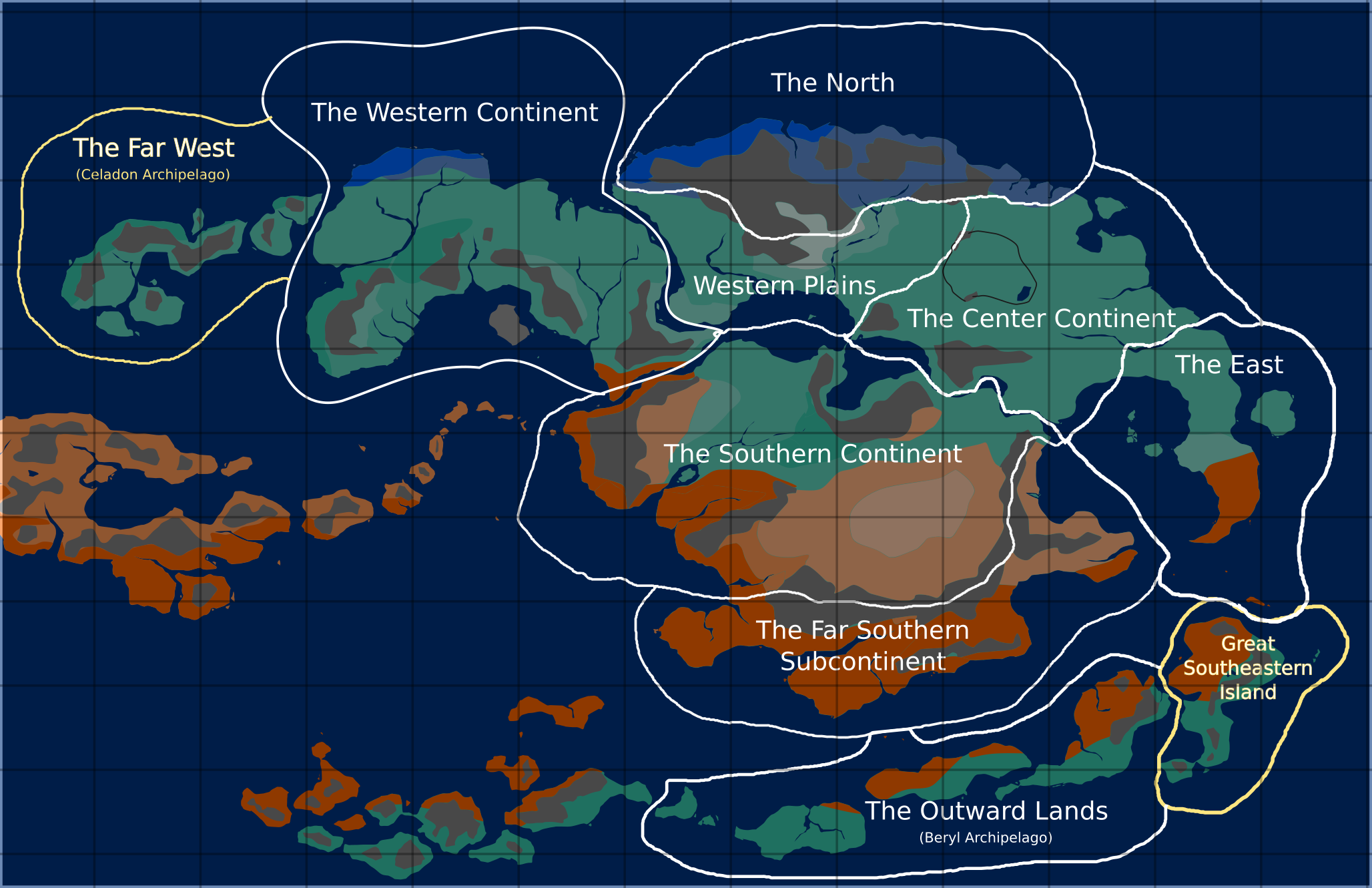
Broadly speaking, the lands that compose the modern Earth Kingdom were only united under one banner in the days of the Great Ri, and some lands controlled by prior dynasties are no longer controlled or even claimed by the present Hao-Ting regime. For reference, the image below highlights geographical regions that will be mentioned below.
Mythic History
The first dynasty of the Earth Kingdom was supposedly the Wen (穩) which ruled the Central Continent from 4912-3802 BG, a duration of 1110 years (supposedly), all under two kings who lived purportedly for a very long time. Archaeological evidence has not revealed any proof for the first king; the name of the second has been found in a few scattered places, and that among many other rulers. Written descriptions of them appear only in the 25th century BG when historians of the Elder Gong wrote the first official histories of the Earth Kingdom. It's generally thought that there were many rival states in the Central Continent during this era, and the Wen were merely heads of one of the more powerful; the last Wen king may or may not have unified them. (Alternately, the early monarchs of the Elder Gong may have done this.)
Ba Sing Se is mentioned, by a different name, in the Official History of the Wen and Gong (a mythic and historical work that was started in the 25th century BG, and completed under the auspices of the first king of the Great Di), though it had neither inner nor outer walls at the time. While the area of Ba Sing Se is of undoubtedly very ancient habitation, the references to its existence as a city of significance during the Wen dynasty are probably not historically accurate.
Early History to High Antiquity
The second dynasty is the Elder Gong (前鞏), which according to the Official History of the Wen and Gong ruled 3802-2691 BG, a total of 1111 years. Unlike the situation with the Wen, many of the Elder Gong monarchs are attested historically, and all of them from the 20nd Century BG onward have been confirmed to have existed independently of the Official History. The Gong was suzerain over the East and North, but the Southern Continent remained independent and the Western Plains were at most intermittently subdued. Ba Sing Se, still under its old name, was made the capital during this period, though its remarkable walls were not built, and there was nothing like the agricultural zone (which was simply its dependent countryside and outlying provinces.)
The Di (地), a noble family arising in the Southeast of the Center Continent, rose up against the Gong and established a new dynasty, which ruled from 2691-2011 BG, 680 years. The Di heavily valued scholarship and compiled histories of their predecessors, as well as establishing an Office of the Grand Historian. The Di subdued the Western Plains and sent exploratory missions to the Western Continent and the Fire Nation. Ultimately, the dynasty went into decline as it fixed its imperial ambitions on the Southern Continent and made war on the Kings of Omashu. Strained by half a century of conflict, rebels from the East and raiding nomads from the West ravaged the kingdom, leading the Di to fortify Ba Sing Se and give it its present name. In the end, the last ten kings of the Great Di controlled only Ba Sing Se as a city-state surrounded by independent polities.
Late Antiquity
In 2011 BG, the last Earth King of the Great Di died, and the badgermole throne was seized by a powerful family of Ba Sing Se nobility, who proclaimed the Tu (土) dynasty. The Tu ruled from 2011-1742, 269 years. They reunited the Central Continent and made the Western Plains, North, and East organic parts of the Kingdom. The Nations of the West and the Northern Water Tribe sent tribute missions to Ba Sing Se under the Great Tu, and there was peace with Omashu and the Far South thanks to the shrewd diplomacy of the Yaoshi Avatar. However, after the death of the Yaoshi Avatar, there was significant turmoil in the Kingdom, and these tributary relationships broke down. Northern and Western nomadic peoples again began to raid the Central Plains, and after turning them back, the Tu began an immense wall-building project to protect Ba Sing Se and enough agricultural land to sustain it indefinitely.
A succession crisis resulted in the division of the Kingdom into parts controlled by the Western Tu and Eastern Tu. The Western Tu, ruled by a Ganjinese monarch and supported by the vast trading network of Gan Jin, controlled the Earth Kingdom colonies and paid for large armies of Zhangs, Yonggan and Abka people.
The new walls of Ba Sing Se managed to protect the city from the rivals of the Eastern Tu (東土), who continued to rule another 73 years from 1742-1669 BG, controlling the Eastern two-thirds of the Central Continent and the East.
Pre-Modern Era
後鞏 Younger Gong 1669-1185 BG, 484 years
前霆 Elder Ting 1185-1064 BG, 120 years
Modern History
Eras of the Avatars Szeto, Yangchen, Kuruk, Kyoshi and Roku
豪 Hao 1064-788 BG, 276 years
日 Ri 788-620 BG, 168 years
豪霆 Hao-Ting, 620 BG-present, 521 years (and ongoing)