|
Size: 12467
Comment:
|
Size: 20936
Comment:
|
| Deletions are marked like this. | Additions are marked like this. |
| Line 14: | Line 14: |
| Ba Sing Se is mentioned, by a different name, in the Official History of the Wen and Gong (a mythic and historical work that was started in the 25th century BG, and completed under the auspices of the first king of the Great Di), though it had neither inner nor outer walls at the time. While the area of Ba Sing Se is of undoubtedly very ancient habitation, the references to its existence as a city of significance during the Wen dynasty are probably not historically accurate. | Ba Sing Se is mentioned, by a different name, in the ''Official History of the Wen and Gong'' (a mythic and historical work that was started in the 25th century BG, and completed under the auspices of the first king of the Great Di), though it had neither inner nor outer walls at the time. While the area of Ba Sing Se is of undoubtedly very ancient habitation, the references to its existence as a city of significance during the Wen dynasty are probably not historically accurate. |
| Line 19: | Line 19: |
| ||口口 '' ?? '' || 00 - 00 BG || | |
| Line 22: | Line 23: |
| The second dynasty is the Elder Gong (前鞏), which according to the Official History of the Wen and Gong ruled 3802-2691 BG, a total of 1111 years. Unlike the situation with the Wen, many of the Elder Gong monarchs are attested historically, and all of them from the 20nd Century BG onward have been confirmed to have existed independently of the Official History. The Gong was suzerain over the East and North, but the Southern Continent remained independent and the Western Plains were at most intermittently subdued. Ba Sing Se, still under its old name, was made the capital during this period, though its remarkable walls were not built, and there was nothing like the agricultural zone (which was simply its dependent countryside and outlying provinces.) ||||''' The Former Gong Dynasty '''|| ||Era Name||Reign Years|| |
The second dynasty is the Elder Gong (前鞏), which according to the ''Official History of the Wen and Gong'' ruled 3802-2691 BG, a total of 1111 years. Unlike the situation with the Wen, many of the Elder Gong monarchs are attested historically, and all of them from the 20th Century BG onward have been confirmed to have existed independently of the ''Official History''. The Gong was suzerain over the East and North, but the Southern Continent remained independent and the Western Plains were at most intermittently subdued. Ba Sing Se, still under its old name, was made the capital during this period, though its remarkable walls were not built, and there was nothing like the agricultural zone (which was simply its dependent countryside and outlying provinces.) Only monarchs of undisputed historicity and confident date are included in this list. ||||''' The Former Gong Dynasty (Historical) '''|| ||Era Name||Reign Years|| ||口口 '' ?? '' || 00 - 00 BG || ||口口 '' ?? '' || 00 - 00 BG || ||口口 '' ?? '' || 00 - 00 BG || ||口口 '' ?? '' || 00 - 00 BG || ||口口 '' ?? '' || 00 - 00 BG || ||口口 '' ?? '' || 00 - 00 BG || ||口口 '' ?? '' || 00 - 00 BG || ||口口 '' ?? '' || 00 - 00 BG || ||口口 '' ?? '' || 00 - 00 BG || ||口口 '' ?? '' || 00 - 00 BG || ||口口 '' ?? '' || 00 - 00 BG || ||口口 '' ?? '' || 00 - 00 BG || ||口口 '' ?? '' || 00 - 00 BG || ||口口 '' ?? '' || 00 - 00 BG || ||口口 '' ?? '' || 00 - 00 BG || ||口口 '' ?? '' || 00 - 00 BG || ||口口 '' ?? '' || 00 - 00 BG || ||口口 '' ?? '' || 00 - 00 BG || ||口口 '' ?? '' || 00 - 00 BG || ||口口 '' ?? '' || 00 - 00 BG || ||口口 '' ?? '' || 00 - 00 BG || ||口口 '' ?? '' || 00 - 00 BG || ||口口 '' ?? '' || 00 - 00 BG || ||口口 '' ?? '' || 00 - 00 BG || ||口口 '' ?? '' || 00 - 00 BG || ||口口 '' ?? '' || 00 - 00 BG || |
| Line 34: | Line 63: |
| ||口口 '' ?? '' || 00 - 00 BG || ||口口 '' ?? '' || 00 - 00 BG || ||口口 '' ?? '' || 00 - 00 BG || ||口口 '' ?? '' || 00 - 00 BG || ||口口 '' ?? '' || 00 - 00 BG || ||口口 '' ?? '' || 00 - 00 BG || ||口口 '' ?? '' || 00 - 00 BG || ||口口 '' ?? '' || 00 - 00 BG || ||口口 '' ?? '' || 00 - 00 BG || ||口口 '' ?? '' || 00 - 00 BG || ||口口 '' ?? '' || 00 - 00 BG || ||口口 '' ?? '' || 00 - 00 BG || ||口口 '' ?? '' || 00 - 00 BG || ||口口 '' ?? '' || 00 - 00 BG || ||口口 '' ?? '' || 00 - 00 BG || ||口口 '' ?? '' || 00 - 00 BG || ||口口 '' ?? '' || 00 - 00 BG || ||口口 '' ?? '' || 00 - 00 BG || ||口口 '' ?? '' || 00 - 00 BG || ||口口 '' ?? '' || 00 - 00 BG || ||口口 '' ?? '' || 00 - 00 BG || |
|
| Line 37: | Line 87: |
| In 2011 BG, the last Earth King of the Great Di died, and the badgermole throne was seized by a powerful family of Ba Sing Se nobility, who proclaimed the Tu (土) dynasty. The Tu ruled from 2011-1742, 269 years. They reunited the Central Continent and made the Western Plains, North, and East organic parts of the Kingdom. The Nations of the West and the Northern Water Tribe sent tribute missions to Ba Sing Se under the Great Tu, and there was peace with Omashu and the Far South thanks to the shrewd diplomacy of the Yaoshi Avatar. However, after the death of the Yaoshi Avatar, there was significant turmoil in the Kingdom, and these tributary relationships broke down. Northern and Western nomadic peoples again began to raid the Central Plains, and after turning them back, the Tu began an immense wall-building project to protect Ba Sing Se and enough agricultural land to sustain it indefinitely. A succession crisis resulted in the division of the Kingdom into parts controlled by the Western Tu and Eastern Tu. The Western Tu, ruled by a Ganjinese monarch and supported by the vast trading network of Gan Jin, controlled the Earth Kingdom colonies and paid for large armies of Zhangs, Yonggan and Abka people. |
In 2011 BG, the last Earth King of the Great Di died, and the badgermole throne was seized by a powerful family of Ba Sing Se nobility, with affiliations to the Earth Sages, who proclaimed the Tu (土) dynasty. The Tu ruled from 2011-1742, 269 years. They reunited the Central Continent and made the Western Plains, North, and East organic parts of the Kingdom. The Nations of the West and the Northern Water Tribe sent tribute missions to Ba Sing Se under the Great Tu, and there was peace with Omashu and the Far South thanks to the shrewd diplomacy of the Yaoshi Avatar, who exercised great influence over the dynasty and was sometimes accused of having effectively usurped the power of the monarchy. (She was also married to a prince of the blood royal.) After the death of the Yaoshi Avatar, there was significant turmoil in the Kingdom, and the stable tributary relationships broke down. Northern and Western nomadic peoples again began to raid the Central Plains, and after turning them back, the Tu began an immense wall-building project to protect Ba Sing Se and enough agricultural land to sustain it indefinitely. A succession crisis resulted in the division of the Kingdom into parts controlled by the Western Tu and Eastern Tu. The Western Tu, ruled by a Ganjinese monarch and supported by the vast trading network of Gan Jin, controlled the Earth Kingdom's Western colonies and paid for large armies of Zhangs, Yonggan and Abka people. |
| Line 43: | Line 93: |
| ||口口 '' ?? '' || 00 - 00 BG || The new walls of Ba Sing Se managed to protect the city from the rivals of the Eastern Tu (東土), who continued to rule another 73 years from 1742-1669 BG, controlling the Eastern two-thirds of the Central Continent and the East. |
||口口 '' ?? '' || 2011 - 1986 BG || ||口口 '' ?? '' || 1986 - 1965 BG || ||口口 '' ?? '' || 1965 - 1953 BG || ||口口 '' ?? '' || 1953 - 1948 BG || ||口口 '' ?? '' || 1948 - 1936 BG || ||口口 '' ?? '' || 1936 - 1898 BG || ||口口 '' ?? '' || 1898 - 1875 BG || ||口口 '' ?? '' || 1875 - 1812 BG || ||口口 '' ?? '' || 1812 - 1769 BG || ||口口 '' ?? '' || 1769 - 1742 BG || The new walls of Ba Sing Se managed to protect the city from the rivals of the Eastern Tu (東土), who continued to rule another tumultuous 73 years from 1742-1669 BG, controlling the Eastern two-thirds of the Central Continent and the East. |
| Line 49: | Line 108: |
| ||口口 '' ?? '' || 00 - 00 BG || | ||口口 '' ?? '' || 1742 - 1718 BG || ||口口 '' ?? '' || 1718 - 1718 BG || ||口口 '' ?? '' || 1718 - 1697 BG || ||口口 '' ?? '' || 1697 - 1688 BG || ||口口 '' ?? '' || 1688 - 1668 BG || ||口口 '' ?? '' || 1668 - 1669 BG || |
| Line 53: | Line 117: |
| In many ways, the second founders of the Earth Kingdom were the Younger Gong (後鞏) who ruled 1669-1185 BG, a total of 484 years. The Last Earth King of the Eastern Tu sold his throne to a fantastically wealthy Ganjinese plutocrat, who named his new dynasty the Younger Gong. He married the daughter of the king of the Western Tu and unified the thrones in his successor. From the Far West to the East, all of the modern Earth Kingdom (and then some), excepting the South, came to be ruled by the Ganjinese dynasty in Ba Sing Se. The Younger Gong was an era of high culture and great national power. Not hearkening to the fate of the Di, however, the later rulers of the Younger Gong fought low-grade border wars with the Kingdom of Omashu and attempted to seize their tributaries in the Far South. The Zhiyuan avatar (1270-1181), after decades of attempts at diplomatic solutions, survived an assassination attempt by the Southern dynasty during negotiations - they felt she was biased toward the North, where she was born - and accidentally killed the King of Omashu in the fighting. The Avatar went into seclusion and a full-scale war erupted. As a consequence of this disaster, the Ganjinese Younger Gong dynasty was overthrown by an indigenous dynasty of Ba Sing Se. | In many ways, the second founders of the Earth Kingdom were the Younger Gong (後鞏) who ruled 1669-1185 BG, a total of 484 years. The Last Earth King of the Eastern Tu sold his throne to a fantastically wealthy Ganjinese plutocrat, who named his new dynasty the Younger Gong in imitation of the former dynasty of that name. He married the daughter of the king of the Western Tu and unified the thrones in his successor. From the Far West to the East, all of the modern Earth Kingdom (and then some), excepting the South, came to be ruled by the Ganjinese dynasty in Ba Sing Se. Despite its origins, the Younger Gong became an era of high culture and great national power. Not hearkening to the fate of the Di, however, the later rulers of the Younger Gong fought low-grade border wars with the Kingdom of Omashu and attempted to seize their tributaries in the Far South. The Zhiyuan avatar (1270-1181), after decades of attempts at diplomatic solutions, survived an assassination attempt by the Southern dynasty during negotiations - they felt she was biased toward the North, where she was born - and accidentally killed the King of Omashu in the fighting. The Avatar went into seclusion and a full-scale war erupted. As a consequence of this disaster, the Ganjinese Younger Gong dynasty was overthrown by an indigenous dynasty of Ba Sing Se. |
| Line 57: | Line 121: |
| ||口口 '' ?? '' || 00 - 00 BG || | ||口口 '' ?? '' || 1669 - 1660 BG || ||口口 '' ?? '' || 1660 - 1656 BG (unification with Ganjinese Empire) || ||口口 '' ?? '' || 1656 - 1628 BG || ||口口 '' ?? '' || 1628 - 1574 BG || ||口口 '' ?? '' || 1574 - 1544 BG || ||口口 '' ?? '' || 1544 - 1530 BG || ||口口 '' ?? '' || 1530 - 1502 BG || ||口口 '' ?? '' || 1502 - 1440 BG || ||口口 '' ?? '' || 1440 - 1431 BG || ||口口 '' ?? '' || 1431 - 1397 BG || ||口口 '' ?? '' || 1397 - 1386 BG || ||口口 '' ?? '' || 1386 - 1369 BG || ||口口 '' ?? '' || 1369 - 1325 BG || ||口口 '' ?? '' || 1325 - 1277 BG || ||口口 '' ?? '' || 1277 - 1249 BG || ||口口 '' ?? '' || 1249 - 1229 BG || ||口口 '' ?? '' || 1229 - 1185 BG || |
| Line 61: | Line 141: |
| The Ting dynasty started the practice of numbering Earth Monarchs, and referring to them by number instead of personal or era name. They did however continue to make era names for ritual purposes. | Coincident with their construction of the modern inner city and palace in Ba Sing Se, in which the original throne of Wen was purportedly found and restored to use, the Ting dynasty started the practice of numbering Earth Monarchs, with the dynastic founder retroactively becoming the "First Successor Earth Monarch." This happened in the reign of the third Ting monarch. They typically referred to their kings by number instead of personal or era name. They did however continue to make era names for ritual purposes. (Later, the Ri would continue the use of numbers but used Era Names much more.) |
| Line 65: | Line 145: |
| || 0 || 口口 '' ?? '' || 00 - 00 BG || 口口 '' ?? '' || 00 - 00 BG || | || 1 (retroactive) || 口口 '' ?? '' || 1185 - 1170 BG || 口口 '' ?? '' || 00 - 00 BG || || 2 (retroactive) || 口口 '' ?? '' || 1170 - 1155 BG || 口口 '' ?? '' || 00 - 00 BG || || 3 || 口口 '' ?? '' || 1155 - 1149 BG || 口口 '' ?? '' || 00 - 00 BG || || 4 || 口口 '' ?? '' || 1149 - 1119 BG || 口口 '' ?? '' || 00 - 00 BG || || 5 || 口口 '' ?? '' || 1119 - 1099 BG || 口口 '' ?? '' || 00 - 00 BG || || 6 || 口口 '' ?? '' || 1099 - 1064 BG || 口口 '' ?? '' || 00 - 00 BG || |
| Line 70: | Line 155: |
| The Hao (豪 also sometimes the Former Hao 前霆) dynasty was in many ways a continuation of the Elder Ting. After the last Earth King of the Ting died without issue (he was evidently sterile, as he had sixteen wives and concubines), with none of his siblings fit for the throne, a cadet branch of the royal family ascended the Badgermole throne under the mediation of the Yunzhen Avatar, avoiding a bloody power struggle between the king's distant relations. The Hao ruled from 1064-788 BG, 276 years. Late Hao monarchs became increasingly oppressive and provoked uprisings, even in the agricultural zone of Ba Sing Se itself. The last Hao monarch (the fifteenth Earth King according to the Official Enumeration of the Hao and Ting) invited the Nara clan of Yonggan into the impregnable city to suppress the revolt. They did, but ended up overthrowing the Hao instead. | The Hao (豪 also sometimes the Former Hao 前霆) dynasty was in many ways a continuation of the Elder Ting. After the last Earth King of the Ting died without issue (he was evidently sterile, as he had sixteen wives and concubines), with none of his siblings fit for the throne, a cadet branch of the royal family ascended the Badgermole throne under the mediation of the Yunzhen Avatar, avoiding a bloody power struggle between the king's distant relations. The Hao ruled from 1064-788 BG, 276 years. Late Hao monarchs became increasingly oppressive and provoked uprisings, even in the agricultural zone of Ba Sing Se itself. The last Hao monarch (the fifteenth Earth King according to the Official Enumeration of the Hao and Ting) invited the Nara clan of Yonggan into the impregnable city to suppress the revolt. They did, but ended up overthrowing the Hao as well. |
| Line 74: | Line 159: |
| || 0 || 口口 '' ?? '' || 00 - 00 BG || 口口 '' ?? '' || 00 - 00 BG || | || 7 || 口口 '' ?? '' || 1064 - 1030 BG || 口口 '' ?? '' || 00 - 00 BG || || 8 || 口口 '' ?? '' || 1030 - 1015 BG || 口口 '' ?? '' || 00 - 00 BG || || 9 || 口口 '' ?? '' || 1015 - 1006 BG || 口口 '' ?? '' || 00 - 00 BG || || 10 || 口口 '' ?? '' || 1006 - 943 BG || 口口 '' ?? '' || 00 - 00 BG || || 11 || 口口 '' ?? '' || 943 - 909 BG || 口口 '' ?? '' || 00 - 00 BG || || 12 || 口口 '' ?? '' || 909 - 867 BG || 口口 '' ?? '' || 00 - 00 BG || || 13 || 口口 '' ?? '' || 867 - 838 BG || 口口 '' ?? '' || 00 - 00 BG || || 14 || 口口 '' ?? '' || 838 - 805 BG || 口口 '' ?? '' || 00 - 00 BG || || 15 || 口口 '' ?? '' || 805 - 788 BG || 口口 '' ?? '' || 00 - 00 BG || |
| Line 80: | Line 173: |
| || 0 || 口口 '' ?? '' || 00 - 00 BG || 口口 '' ?? '' || 00 - 00 BG || | || 16 || 建恩 ''Jianen'' || 788 - 745 BG || 納喇·鈕祜祿 NARA Niohuru || 822 - 745 BG || || 17 || 仁顯 '' Renxian '' || 745 - 712 BG || 鈕祜祿納喇·阿尔津 NIOHURU-NARA Arjin || 799 - 712 BG || || 18 || 永光 '' Yongguang '' || 712 - 710 BG || 鈕祜祿納喇·图海 NIOHURU-NARA Tuhai || 761 - 710 BG || || 19 || 神興 '' Shenxing '' || 710 - 691 BG || 鈕祜祿納喇·噶盖 NIOHURU-NARA Gagai || 769 - 691 BG || || 20 || 建順 '' Jianshun '' || 691 - 699 BG || 鈕祜祿納喇·伊桑阿 NIOHURU-NARA Isangga || 741 - 661 BG || || 21 || 活王 '' Huowang '' || 699 - 640 BG || 鈕祜祿納喇·夸札 NIOHURU-NARA Kuazha || 715 - 640 BG || || 22 || 太改 '' Taigai '' || 640 - 620 BG || 鈕祜祿納喇·图鲁什 NIOHURU-NARA Turusi || 698 - 620 BG || Note: Nara Jaikan, the Wuye emperor, is not included in the enumeration of Earth Monarchs, having never actually ascended the Badgermole throne himself: he was retroactively emperor of the Great Ri but he was never Earth King, neither in his lifetime or posthumously. See the [[Avatar/Ri Dynasty|Ri Dynasty]] page for details. |
| Line 84: | Line 185: |
| In their dynastic rules, the Hao-Ting founder forbade his heirs from ever leaving Ba Sing Se, a stricture which was (at least officially) adhered to until the present. Of course, some of them had been outside the city before they ascended the throne. |
|
| Line 86: | Line 189: |
| || 0 || 口口 '' ?? '' || 00 - 00 BG || 口口 '' ?? '' || 00 - 00 BG || | || 23 || 口口 '' ?? '' || 620 - 597 BG || 口口 '' ?? '' || 00 - 00 BG || || 24 || 口口 '' ?? '' || 597 - 577 BG || 口口 '' ?? '' || 00 - 00 BG || || 25 || 口口 '' ?? '' || 577 - 509 BG || 口口 '' ?? '' || 00 - 00 BG || || 26 || 口口 '' ?? '' || 509 - 481 BG || 口口 '' ?? '' || 00 - 00 BG || || 27 || 口口 '' ?? '' || 481 - 436 BG || 口口 '' ?? '' || 00 - 00 BG || || 28 || 口口 '' ?? '' || 436 - 433 BG || 口口 '' ?? '' || 00 - 00 BG || || 29 || 口口 '' ?? '' || 433 - 410 BG || 口口 '' ?? '' || 00 - 00 BG || || 30 || 口口 '' ?? '' || 410 - 392 BG || 口口 '' ?? '' || 00 - 00 BG || || 31 || 口口 '' ?? '' || 392 - 370 BG || 口口 '' ?? '' || 00 - 00 BG || || 32 || 口口 '' ?? '' || 370 - 366 BG || 口口 '' ?? '' || 00 - 00 BG || || 33 || 口口 '' ?? '' || 366 - 366 BG || 口口 '' ?? '' || 00 - 00 BG || || 34 || 口口 '' ?? '' || 366 - 366 BG || 口口 '' ?? '' || 00 - 00 BG || || 35 || 口口 '' ?? '' || 367 - 352 BG || 口口 '' ?? '' || 00 - 00 BG || || 36 || 口口 '' ?? '' || 352 - 333 BG || 口口 '' ?? '' || 00 - 00 BG || || 37 || 口口 '' ?? '' || 333 - 310 BG || 口口 '' ?? '' || 00 - 00 BG || || 38 || 口口 '' ?? '' || 310 - 294 BG || 口口 '' ?? '' || 00 - 00 BG || || 39 || 口口 '' ?? '' || 294 - 296 BG || 口口 '' ?? '' || 00 - 00 BG || || 40 || 口口 '' ?? '' || 296 - 296 BG || 口口 '' ?? '' || 00 - 00 BG || || 41 || 口口 '' ?? '' || 296 - 227 BG || 口口 '' ?? '' || 00 - 00 BG || || 42 || 口口 '' ?? '' || 227 - 158 BG || 口口 '' ?? '' || 00 - 00 BG || || 43 || 口口 '' ?? '' || 158 - 137 BG || 口口 '' ?? '' || 00 - 00 BG || || 44 || 口口 '' ?? '' || 137 - 101 BG || 口口 '' ?? '' || 00 - 00 BG || || 45 || 口口 '' ?? '' || 101 - 79 BG || 口口 '' ?? '' || 00 - 00 BG || || 46 || 口口 '' ?? '' || 79 - 34 BG || 口口 '' ?? '' || 00 - 00 BG || || 47 || 口口 '' ?? '' || 34 - 15 BG || 口口 '' ?? '' || 00 - 00 BG || || 48 || 口口 '' ?? '' || 15 BG - 2 AG || 口口 '' ?? '' || 00 - 00 BG || || 49 || 口口 '' ?? '' || 2 - 21 AG || 口口 '' ?? '' || 00 - 00 BG || || 50 || 口口 '' ?? '' || 21 - 55 AG || 口口 '' ?? '' || 00 - 00 BG || || 51 || 口口 '' ?? '' || 55 - 76 AG || 口口 '' ?? '' || 00 - 00 BG || || 52 || 永無 '' Yongwu '' || 76 AG - present || 傀 '' Kui '' || 72 AG - present || |
Pending GM approval
This page lists the major dynasties of the Earth Kingdom. The Earth Kingdom has many constituent parts, many of which have at times been divided into separate polities or ruled centrally from one or a few; this page will necessarily focus only on the major entities.
Geohistorical Context
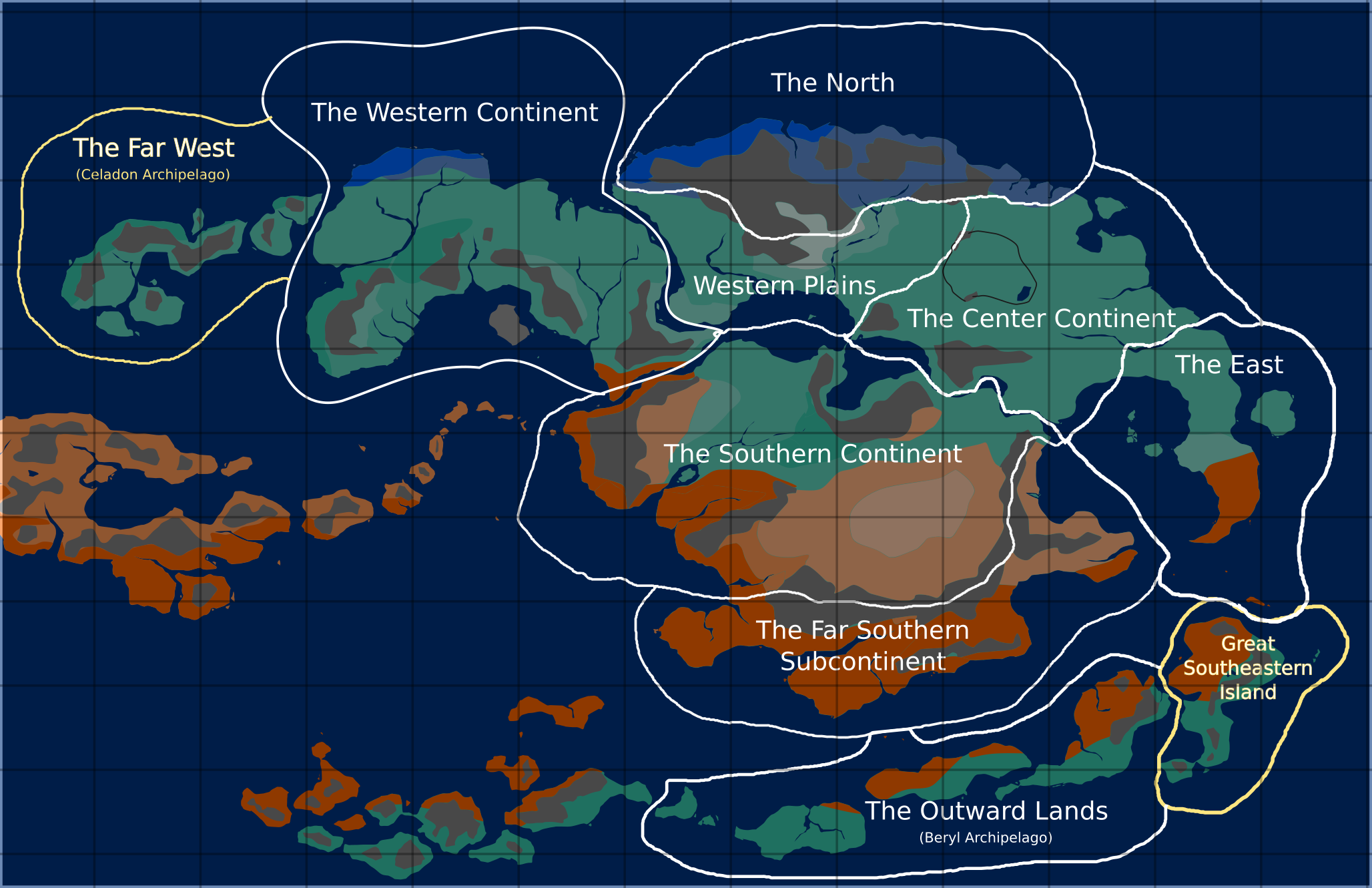
Broadly speaking, the lands that compose the modern Earth Kingdom were only united under one banner in the days of the Great Ri, and some lands controlled by prior dynasties are no longer controlled or even claimed by the present Hao-Ting regime. For reference, the image below highlights geographical regions that will be mentioned below.
Mythic History
The first dynasty of the Earth Kingdom was supposedly the Wen (穩) which ruled the Central Continent from 4912-3802 BG, a duration of 1110 years (supposedly), all under two kings who lived purportedly for a very long time. Archaeological evidence has not revealed any proof for the first king; the name of the second has been found in a few scattered places, and that among many other rulers. Written descriptions of them appear only in the 25th century BG when historians of the Elder Gong wrote the first official histories of the Earth Kingdom. It's generally thought that there were many rival states in the Central Continent during this era, and the Wen were merely heads of one of the more powerful; the last Wen king may or may not have unified them. (Alternately, the early monarchs of the Elder Gong may have done this.)
Ba Sing Se is mentioned, by a different name, in the Official History of the Wen and Gong (a mythic and historical work that was started in the 25th century BG, and completed under the auspices of the first king of the Great Di), though it had neither inner nor outer walls at the time. While the area of Ba Sing Se is of undoubtedly very ancient habitation, the references to its existence as a city of significance during the Wen dynasty are probably not historically accurate.
The Wen Dynasty |
|
Era Name |
Reign Years |
口口 ?? |
00 - 00 BG |
口口 ?? |
00 - 00 BG |
Early History to High Antiquity
The second dynasty is the Elder Gong (前鞏), which according to the Official History of the Wen and Gong ruled 3802-2691 BG, a total of 1111 years. Unlike the situation with the Wen, many of the Elder Gong monarchs are attested historically, and all of them from the 20th Century BG onward have been confirmed to have existed independently of the Official History. The Gong was suzerain over the East and North, but the Southern Continent remained independent and the Western Plains were at most intermittently subdued. Ba Sing Se, still under its old name, was made the capital during this period, though its remarkable walls were not built, and there was nothing like the agricultural zone (which was simply its dependent countryside and outlying provinces.)
Only monarchs of undisputed historicity and confident date are included in this list.
The Former Gong Dynasty (Historical) |
|
Era Name |
Reign Years |
口口 ?? |
00 - 00 BG |
口口 ?? |
00 - 00 BG |
口口 ?? |
00 - 00 BG |
口口 ?? |
00 - 00 BG |
口口 ?? |
00 - 00 BG |
口口 ?? |
00 - 00 BG |
口口 ?? |
00 - 00 BG |
口口 ?? |
00 - 00 BG |
口口 ?? |
00 - 00 BG |
口口 ?? |
00 - 00 BG |
口口 ?? |
00 - 00 BG |
口口 ?? |
00 - 00 BG |
口口 ?? |
00 - 00 BG |
口口 ?? |
00 - 00 BG |
口口 ?? |
00 - 00 BG |
口口 ?? |
00 - 00 BG |
口口 ?? |
00 - 00 BG |
口口 ?? |
00 - 00 BG |
口口 ?? |
00 - 00 BG |
口口 ?? |
00 - 00 BG |
口口 ?? |
00 - 00 BG |
口口 ?? |
00 - 00 BG |
口口 ?? |
00 - 00 BG |
口口 ?? |
00 - 00 BG |
口口 ?? |
00 - 00 BG |
口口 ?? |
00 - 00 BG |
口口 ?? |
00 - 00 BG |
The Di (地), a noble family arising in the Southeast of the Center Continent, rose up against the Gong and established a new dynasty, which ruled from 2691-2011 BG, 680 years. The Di heavily valued scholarship and compiled histories of their predecessors, as well as establishing an Office of the Grand Historian. The Di subdued the Western Plains and sent exploratory missions to the Western Continent and the Fire Nation. Ultimately, the dynasty went into decline as it fixed its imperial ambitions on the Southern Continent and made war on the Kings of Omashu. Strained by half a century of conflict, rebels from the East and raiding nomads from the West ravaged the kingdom, leading the Di to fortify Ba Sing Se and give it its present name. In the end, the last ten kings of the Great Di controlled only Ba Sing Se as a city-state surrounded by independent polities.
The Di Dynasty |
|
Era Name |
Reign Years |
口口 ?? |
00 - 00 BG |
口口 ?? |
00 - 00 BG |
口口 ?? |
00 - 00 BG |
口口 ?? |
00 - 00 BG |
口口 ?? |
00 - 00 BG |
口口 ?? |
00 - 00 BG |
口口 ?? |
00 - 00 BG |
口口 ?? |
00 - 00 BG |
口口 ?? |
00 - 00 BG |
口口 ?? |
00 - 00 BG |
口口 ?? |
00 - 00 BG |
口口 ?? |
00 - 00 BG |
口口 ?? |
00 - 00 BG |
口口 ?? |
00 - 00 BG |
口口 ?? |
00 - 00 BG |
口口 ?? |
00 - 00 BG |
口口 ?? |
00 - 00 BG |
口口 ?? |
00 - 00 BG |
口口 ?? |
00 - 00 BG |
口口 ?? |
00 - 00 BG |
口口 ?? |
00 - 00 BG |
口口 ?? |
00 - 00 BG |
Late Antiquity
In 2011 BG, the last Earth King of the Great Di died, and the badgermole throne was seized by a powerful family of Ba Sing Se nobility, with affiliations to the Earth Sages, who proclaimed the Tu (土) dynasty. The Tu ruled from 2011-1742, 269 years. They reunited the Central Continent and made the Western Plains, North, and East organic parts of the Kingdom. The Nations of the West and the Northern Water Tribe sent tribute missions to Ba Sing Se under the Great Tu, and there was peace with Omashu and the Far South thanks to the shrewd diplomacy of the Yaoshi Avatar, who exercised great influence over the dynasty and was sometimes accused of having effectively usurped the power of the monarchy. (She was also married to a prince of the blood royal.) After the death of the Yaoshi Avatar, there was significant turmoil in the Kingdom, and the stable tributary relationships broke down. Northern and Western nomadic peoples again began to raid the Central Plains, and after turning them back, the Tu began an immense wall-building project to protect Ba Sing Se and enough agricultural land to sustain it indefinitely.
A succession crisis resulted in the division of the Kingdom into parts controlled by the Western Tu and Eastern Tu. The Western Tu, ruled by a Ganjinese monarch and supported by the vast trading network of Gan Jin, controlled the Earth Kingdom's Western colonies and paid for large armies of Zhangs, Yonggan and Abka people.
The Tu Dynasty |
|
Era Name |
Reign Years |
口口 ?? |
2011 - 1986 BG |
口口 ?? |
1986 - 1965 BG |
口口 ?? |
1965 - 1953 BG |
口口 ?? |
1953 - 1948 BG |
口口 ?? |
1948 - 1936 BG |
口口 ?? |
1936 - 1898 BG |
口口 ?? |
1898 - 1875 BG |
口口 ?? |
1875 - 1812 BG |
口口 ?? |
1812 - 1769 BG |
口口 ?? |
1769 - 1742 BG |
The new walls of Ba Sing Se managed to protect the city from the rivals of the Eastern Tu (東土), who continued to rule another tumultuous 73 years from 1742-1669 BG, controlling the Eastern two-thirds of the Central Continent and the East.
The Eastern Tu Dynasty |
|
Era Name |
Reign Years |
口口 ?? |
1742 - 1718 BG |
口口 ?? |
1718 - 1718 BG |
口口 ?? |
1718 - 1697 BG |
口口 ?? |
1697 - 1688 BG |
口口 ?? |
1688 - 1668 BG |
口口 ?? |
1668 - 1669 BG |
Pre-Modern Era
In many ways, the second founders of the Earth Kingdom were the Younger Gong (後鞏) who ruled 1669-1185 BG, a total of 484 years. The Last Earth King of the Eastern Tu sold his throne to a fantastically wealthy Ganjinese plutocrat, who named his new dynasty the Younger Gong in imitation of the former dynasty of that name. He married the daughter of the king of the Western Tu and unified the thrones in his successor. From the Far West to the East, all of the modern Earth Kingdom (and then some), excepting the South, came to be ruled by the Ganjinese dynasty in Ba Sing Se. Despite its origins, the Younger Gong became an era of high culture and great national power. Not hearkening to the fate of the Di, however, the later rulers of the Younger Gong fought low-grade border wars with the Kingdom of Omashu and attempted to seize their tributaries in the Far South. The Zhiyuan avatar (1270-1181), after decades of attempts at diplomatic solutions, survived an assassination attempt by the Southern dynasty during negotiations - they felt she was biased toward the North, where she was born - and accidentally killed the King of Omashu in the fighting. The Avatar went into seclusion and a full-scale war erupted. As a consequence of this disaster, the Ganjinese Younger Gong dynasty was overthrown by an indigenous dynasty of Ba Sing Se.
The Later Gong Dynasty |
|
Era Name |
Reign Years |
口口 ?? |
1669 - 1660 BG |
口口 ?? |
1660 - 1656 BG (unification with Ganjinese Empire) |
口口 ?? |
1656 - 1628 BG |
口口 ?? |
1628 - 1574 BG |
口口 ?? |
1574 - 1544 BG |
口口 ?? |
1544 - 1530 BG |
口口 ?? |
1530 - 1502 BG |
口口 ?? |
1502 - 1440 BG |
口口 ?? |
1440 - 1431 BG |
口口 ?? |
1431 - 1397 BG |
口口 ?? |
1397 - 1386 BG |
口口 ?? |
1386 - 1369 BG |
口口 ?? |
1369 - 1325 BG |
口口 ?? |
1325 - 1277 BG |
口口 ?? |
1277 - 1249 BG |
口口 ?? |
1249 - 1229 BG |
口口 ?? |
1229 - 1185 BG |
The Ting (now known as the Elder Ting 前霆) ruled the Earth Kingdom from 1185-1064 BG, 120 years. With the Zhiyuan Avatar in seclusion until her death in 1181, and the South in factitious disarray with the fall of the dynasty in Omashu, the Ting conquered the South even as their influence in the West waned; many states in the North and Western Plains remained loyal to a rump Ganjinese regime. However, it must be conceded that the Ting did unify the Central and Southern Continents for the first time. As a concession to the importance of Omashu, its ruler was allowed to also keep the title of King, and was permitted to address the Earth King as "Elder Brother King" rather than "Father King" as with other important local rulers. The Fire Nation began to establish a rival colonization effort in the Far West, leading to conflict with the Ganjinese empire and its fall. The particularly powerful Jiongyu Avatar brought peace to the West by organizing the donation of the disputed lands to the Air Nomads, the so-called Great Treasure Endowment of Fire Lord Mokutan, and arranged a marriage alliance that unified the crumbling Ganjinese empire with the Earth Kingdom proper.
Coincident with their construction of the modern inner city and palace in Ba Sing Se, in which the original throne of Wen was purportedly found and restored to use, the Ting dynasty started the practice of numbering Earth Monarchs, with the dynastic founder retroactively becoming the "First Successor Earth Monarch." This happened in the reign of the third Ting monarch. They typically referred to their kings by number instead of personal or era name. They did however continue to make era names for ritual purposes. (Later, the Ri would continue the use of numbers but used Era Names much more.)
The Ting Dynasty |
||||
Numbering |
Era Name |
Reign Years |
Personal Name |
Lived Years |
1 (retroactive) |
口口 ?? |
1185 - 1170 BG |
口口 ?? |
00 - 00 BG |
2 (retroactive) |
口口 ?? |
1170 - 1155 BG |
口口 ?? |
00 - 00 BG |
3 |
口口 ?? |
1155 - 1149 BG |
口口 ?? |
00 - 00 BG |
4 |
口口 ?? |
1149 - 1119 BG |
口口 ?? |
00 - 00 BG |
5 |
口口 ?? |
1119 - 1099 BG |
口口 ?? |
00 - 00 BG |
6 |
口口 ?? |
1099 - 1064 BG |
口口 ?? |
00 - 00 BG |
Modern History
Eras of the Avatars Szeto, Yangchen, Kuruk, Kyoshi and Roku
The Hao (豪 also sometimes the Former Hao 前霆) dynasty was in many ways a continuation of the Elder Ting. After the last Earth King of the Ting died without issue (he was evidently sterile, as he had sixteen wives and concubines), with none of his siblings fit for the throne, a cadet branch of the royal family ascended the Badgermole throne under the mediation of the Yunzhen Avatar, avoiding a bloody power struggle between the king's distant relations. The Hao ruled from 1064-788 BG, 276 years. Late Hao monarchs became increasingly oppressive and provoked uprisings, even in the agricultural zone of Ba Sing Se itself. The last Hao monarch (the fifteenth Earth King according to the Official Enumeration of the Hao and Ting) invited the Nara clan of Yonggan into the impregnable city to suppress the revolt. They did, but ended up overthrowing the Hao as well.
The Hao Dynasty |
||||
Numbering |
Era Name |
Reign Years |
Personal Name |
Lived Years |
7 |
口口 ?? |
1064 - 1030 BG |
口口 ?? |
00 - 00 BG |
8 |
口口 ?? |
1030 - 1015 BG |
口口 ?? |
00 - 00 BG |
9 |
口口 ?? |
1015 - 1006 BG |
口口 ?? |
00 - 00 BG |
10 |
口口 ?? |
1006 - 943 BG |
口口 ?? |
00 - 00 BG |
11 |
口口 ?? |
943 - 909 BG |
口口 ?? |
00 - 00 BG |
12 |
口口 ?? |
909 - 867 BG |
口口 ?? |
00 - 00 BG |
13 |
口口 ?? |
867 - 838 BG |
口口 ?? |
00 - 00 BG |
14 |
口口 ?? |
838 - 805 BG |
口口 ?? |
00 - 00 BG |
15 |
口口 ?? |
805 - 788 BG |
口口 ?? |
00 - 00 BG |
The Nara clan overthrew the Hao and proclaimed the Ri (日) dynasty not as Earth Kings, but as Emperors, using the title that the Ganjinese Empire in the West had used to describe their multiethnic polity. The Ri ruled from 788-620 BG, 168 years. The Ri fought the Nara-Ting campaigns to firmly establish their conquest dynasty, with the Yunzhen Avatar's non-interventionalist policies leading him to stay out of the conflict. Thus, the Great Ri extended the boundaries of the Earth Kingdom to their modern extent. In the end, the Ri were overthrown by a conspiracy of indigenous scholar-officials in Ba Sing Se, when the last Nara emperor attempted to reform the bureaucracy. Their successors abolished the title of emperor, ending this phase of explicit acknowledgement of the Earth Kingdom's nature as a heterogeneous multi-ethnic region. The Northern Ri held on in the North and Western plains for a few more years before being conquered by the Hao-Ting.
The Ri Dynasty |
||||
Numbering |
Era Name |
Reign Years |
Personal Name |
Lived Years |
16 |
建恩 Jianen |
788 - 745 BG |
納喇·鈕祜祿 NARA Niohuru |
822 - 745 BG |
17 |
仁顯 Renxian |
745 - 712 BG |
鈕祜祿納喇·阿尔津 NIOHURU-NARA Arjin |
799 - 712 BG |
18 |
永光 Yongguang |
712 - 710 BG |
鈕祜祿納喇·图海 NIOHURU-NARA Tuhai |
761 - 710 BG |
19 |
神興 Shenxing |
710 - 691 BG |
鈕祜祿納喇·噶盖 NIOHURU-NARA Gagai |
769 - 691 BG |
20 |
建順 Jianshun |
691 - 699 BG |
鈕祜祿納喇·伊桑阿 NIOHURU-NARA Isangga |
741 - 661 BG |
21 |
活王 Huowang |
699 - 640 BG |
鈕祜祿納喇·夸札 NIOHURU-NARA Kuazha |
715 - 640 BG |
22 |
太改 Taigai |
640 - 620 BG |
鈕祜祿納喇·图鲁什 NIOHURU-NARA Turusi |
698 - 620 BG |
Note: Nara Jaikan, the Wuye emperor, is not included in the enumeration of Earth Monarchs, having never actually ascended the Badgermole throne himself: he was retroactively emperor of the Great Ri but he was never Earth King, neither in his lifetime or posthumously. See the Ri Dynasty page for details.
The Hao-Ting (豪霆) ruled from 620 BG down to the present, 521 years (and ongoing.) The royal family descend from both the royal lines of the Hao and the Ting. They centralized power and attempted to create a unified Earth Kingdom identity and values in the first part of their dynasty. In the 260s, the Earth Kingdom fell into disarray and the Hao Ting were thought likely to fall, with the warlord Qin (秦) the Great arising in the Northwest and drawing most of the Earth Kingdom to his side. However, he did not create a durable government that would survive his death in a battle with Avatar Kyoshi, and the resurgent Hao Ting once again reasserted control over the Earth Kingdom, leading to the so-called Hao-Ting Renaissance. After a few decades of revitalization, however, the Hao Ting went into a protracted decline. The central power of the state faded as the Earth Kingdom's provinces became increasingly independent, with regional governors beginning to form dynasties of their own. Eventually, the Earth Kingdom was unable to mount an effective resistance to the invasion of the Fire Nation, and major Earth Army generals functional as warlords, only nominally loyal to the commands of the throne as they prosecute the war and extract taxes largely on their own terms.
In their dynastic rules, the Hao-Ting founder forbade his heirs from ever leaving Ba Sing Se, a stricture which was (at least officially) adhered to until the present. Of course, some of them had been outside the city before they ascended the throne.
The Hao Ting Dynasty |
||||
Numbering |
Era Name |
Reign Years |
Personal Name |
Lived Years |
23 |
口口 ?? |
620 - 597 BG |
口口 ?? |
00 - 00 BG |
24 |
口口 ?? |
597 - 577 BG |
口口 ?? |
00 - 00 BG |
25 |
口口 ?? |
577 - 509 BG |
口口 ?? |
00 - 00 BG |
26 |
口口 ?? |
509 - 481 BG |
口口 ?? |
00 - 00 BG |
27 |
口口 ?? |
481 - 436 BG |
口口 ?? |
00 - 00 BG |
28 |
口口 ?? |
436 - 433 BG |
口口 ?? |
00 - 00 BG |
29 |
口口 ?? |
433 - 410 BG |
口口 ?? |
00 - 00 BG |
30 |
口口 ?? |
410 - 392 BG |
口口 ?? |
00 - 00 BG |
31 |
口口 ?? |
392 - 370 BG |
口口 ?? |
00 - 00 BG |
32 |
口口 ?? |
370 - 366 BG |
口口 ?? |
00 - 00 BG |
33 |
口口 ?? |
366 - 366 BG |
口口 ?? |
00 - 00 BG |
34 |
口口 ?? |
366 - 366 BG |
口口 ?? |
00 - 00 BG |
35 |
口口 ?? |
367 - 352 BG |
口口 ?? |
00 - 00 BG |
36 |
口口 ?? |
352 - 333 BG |
口口 ?? |
00 - 00 BG |
37 |
口口 ?? |
333 - 310 BG |
口口 ?? |
00 - 00 BG |
38 |
口口 ?? |
310 - 294 BG |
口口 ?? |
00 - 00 BG |
39 |
口口 ?? |
294 - 296 BG |
口口 ?? |
00 - 00 BG |
40 |
口口 ?? |
296 - 296 BG |
口口 ?? |
00 - 00 BG |
41 |
口口 ?? |
296 - 227 BG |
口口 ?? |
00 - 00 BG |
42 |
口口 ?? |
227 - 158 BG |
口口 ?? |
00 - 00 BG |
43 |
口口 ?? |
158 - 137 BG |
口口 ?? |
00 - 00 BG |
44 |
口口 ?? |
137 - 101 BG |
口口 ?? |
00 - 00 BG |
45 |
口口 ?? |
101 - 79 BG |
口口 ?? |
00 - 00 BG |
46 |
口口 ?? |
79 - 34 BG |
口口 ?? |
00 - 00 BG |
47 |
口口 ?? |
34 - 15 BG |
口口 ?? |
00 - 00 BG |
48 |
口口 ?? |
15 BG - 2 AG |
口口 ?? |
00 - 00 BG |
49 |
口口 ?? |
2 - 21 AG |
口口 ?? |
00 - 00 BG |
50 |
口口 ?? |
21 - 55 AG |
口口 ?? |
00 - 00 BG |
51 |
口口 ?? |
55 - 76 AG |
口口 ?? |
00 - 00 BG |
52 |
永無 Yongwu |
76 AG - present |
傀 Kui |
72 AG - present |