|
Size: 3515
Comment:
|
Size: 5057
Comment:
|
| Deletions are marked like this. | Additions are marked like this. |
| Line 15: | Line 15: |
| ||||'''Capital Region'''|| ||||Coterminous with the region defined by the outer wall of Ba Sing Se|| ||''Name''||''Note''|| ||1 Yonggucheng (永固城) || Ba Sing Se || ||||'''Central Region'''|| ||''Name''||''Note''|| ||2 || || ||3 || || ||4 || || ||5 || || ||6 || || ||7 || In the southeast, speaks a different dialect, trade contact with the south, provided the Di dynasty.|| ||54|| || ||||'''Eastern Region'''|| ||''Name''||''Note''|| ||8 || || ||9 || || ||10 || || ||||'''Southern Region'''|| ||''Name''||''Note''|| ||11 || || ||12 || || ||13 || || ||14 || || ||15 || || ||16 Gintong |||| ||17 || || ||52 South Hu Xin || || ||53 || || ||||'''Western Region'''|| ||''Name''||''Note''|| ||18 Marenguo || || ||19 Ganjingguo || || ||20 Zangguo || || ||21 Yi || in the west || ||22 Yongganguo|| || ||23 North Hu Xin || || ||55 || || ||||'''Northern Region'''|| ||''Name''||''Note''|| ||24 || || ||25 || || ||26 || || ||27 ||Chenbao || ||||'''Far Western Region'''|| ||||Not to be confused with the previous Far West ceded to the Air Nation|| ||''Name''||''Note''|| ||28 || || ||29 || || ||30 || || ||31 || || ||32 || || ||33 || || ||34 || || ||35 || || ||36 || || ||37 || || ||||'''Far Southern Region'''|| ||''Name''||''Note''|| ||38 Gaoling || || ||39 || || ||40 || || ||41 || || ||42 || || ||43 || || ||44 ||Zeizhou || ||||'''Outward Region'''|| ||''Name''||''Note''|| ||45 || || ||46 || || ||47 || || ||48 || || ||49 || || ||50 || || ||51 || || |
The Earth Kingdom is the largest and most populous country in the known world, and encompasses the overwhelming majority of Earth Nation polities. Its inhabitants are primarily of Earth National elemental ethnicities and hence its culture and history have been heavily influenced by the development of Earthbending.
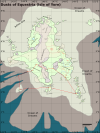
The Earth Kingdom is vast and diverse, with 51 provinces and four constituent states. It controlled substantially all of its claimed territory at the start of the Fire Nation invasion, but now some provinces are controlled by the Fire Nation colonial government and others have attained de facto independence after neglect or perceived abuse from the Ba Sing Se government.
The Earth Kingdom is divided into nine regions, eight of which have regional capitals and the other of which is coterminous with the outer barrier wall of the royal capital, Ba Sing Se.
Many of the political subdivisions of the Earth Kingdom have histories as independent countries that were tributaries of the Central Earth Kingdom government in Ba Sing Se, and which were later incorporated as organic parts of the kingdom. Four of these subdivisions, originating as vassal kingdoms, are termed states rather than provinces, with leaders who are "prince" or "king / sovereign" (王), the latter term also being used for the Earth Monarch in Ba Sing Se. For historical reasons, many of the provinces are still called countries (國) even though their leaders are not allowed to call themselves kings/princes (or queens/princesses.) The Earth Monarch is usually an Earth King (), though sometimes there have been Earth Queens regnant who use the same title as when the Earth Monarch is male, and under the Great Ri the Earth Monarch was titled Emperor of the Great Ri in most contexts, being called "Earth King" only in the context of his rule in Ba Sing Se.
Geography
Ethnic Groups
Political Subdivisions
Capital Region |
|
Coterminous with the region defined by the outer wall of Ba Sing Se |
|
Name |
Note |
1 Yonggucheng (永固城) |
Ba Sing Se |
Central Region |
|
Name |
Note |
2 |
|
3 |
|
4 |
|
5 |
|
6 |
|
7 |
In the southeast, speaks a different dialect, trade contact with the south, provided the Di dynasty. |
54 |
|
Eastern Region |
|
Name |
Note |
8 |
|
9 |
|
10 |
|
Southern Region |
|
Name |
Note |
11 |
|
12 |
|
13 |
|
14 |
|
15 |
|
16 Gintong |
|
17 |
|
52 South Hu Xin |
|
53 |
|
Western Region |
|
Name |
Note |
18 Marenguo |
|
19 Ganjingguo |
|
20 Zangguo |
|
21 Yi |
in the west |
22 Yongganguo |
|
23 North Hu Xin |
|
55 |
|
Northern Region |
|
Name |
Note |
24 |
|
25 |
|
26 |
|
27 |
Chenbao |
Far Western Region |
|
Not to be confused with the previous Far West ceded to the Air Nation |
|
Name |
Note |
28 |
|
29 |
|
30 |
|
31 |
|
32 |
|
33 |
|
34 |
|
35 |
|
36 |
|
37 |
|
Far Southern Region |
|
Name |
Note |
38 Gaoling |
|
39 |
|
40 |
|
41 |
|
42 |
|
43 |
|
44 |
Zeizhou |
Outward Region |
|
Name |
Note |
45 |
|
46 |
|
47 |
|
48 |
|
49 |
|
50 |
|
51 |
|
Monarchy and Symbolism
See Dynastic History of the Earth Kingdom for the historical development and key points of the history of the monarchy.
The Earth Kingdom is ruled by the Earth King, who reigns from the Badgermole Throne in the Hall of Invincible Stability, part of the innermost palace complex in Ba Sing Se. Earth Monarchs assume rulership by "ascending the throne" and issuing an edict stating this fact and proclaiming an Era Name to be used on the new year. (Thus, an Earth King first rules during the last year of the era of his predecessor; interregnums are normally very short unless the former Earth King has died close to the new year, in which case the official ascension would be delayed lest confusion about the current era name be created in the far-flung corners of the Kingdom.)
Iconography of the monarchy varied by dynasty. The current Hao Ting favors a circular symbol with a central square hole, somewhat resembling a cash coin. The preceding Ri dynasty used a stylized badgermole and a quadripartite symbol similar to the yin-yang (࿌). The Hao dynasty immediately preceding the Ri also used badgermole symbolism; the austere Ting used a circular symbol more similar to the current emblem until the recovery of the ancient badgermole throne.
Green is the national color of the Earth Kingdom. Traditionally, the color of the Earth Monarch's regalia was described as "celadon," though the current regalia no longer closely fit that color description.