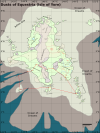
The Fire Nation (烈火國) is a major state that identifies as the sole legitimate national authority of firebending peoples. It is by far the predominant of the Fire Nations sensu lato and the only one that operates on the international stage. The Fire Nation is ruled by a hereditary autocrat, the Fire Lord, and is currently engaged in a global conflict to assert its hegemony over the world, which began nearly a hundred years ago during the reign of Fire Lord Sozin.
Geography and Climate
The Fire Nation's historic territory is a largely equatorial volcanic archipelago, the Fire Islands, consisting of ten major islands and hundreds of smaller ones. The environment is rigorous and there is a significant degree of active volcanism, accompanied by earthquakes, mudslides and tsunamis. These environmental challenges have been met by architectural adaptation and a robust investment in civil firebending.
Soils rich in volcanic ash are highly fertile - the Fire Nation produces three crops of rice a year. With a year-round growing season and many areas with a wet climate, the Fire Nation has a tremendous agricultural output, sustaining a large population.
The northeastern Fire Islands enjoy a somewhat less tropical climate, with more of a dry season. The Fire Nation's continental holdings, taken from the Earth Nations, have a variety of climates.
Being a very mountainous country, there are some cooler areas of the Fire Nation at higher altitudes, some of which are significant population centers.
History
The Fire Islands were first unified in High Antiquity, following cultural contact with the Di dynasty of the Earth Kingdom. The first Fire Lord to unite the Fire Islands was Yanhuo (彦火, 2520-2445 BG), who ended centuries of warlordism in the Unification Wars. He organized his defeated rivals, formerly the lords of individual islands or smaller polities, into noble houses, each named for a flower.
Over time, Fire Nation history has been marked by political (and sometimes violent) conflict between the noble houses and the royal family. Unlike the Earth Kingdom, the Fire Nation has never undergone a recognized change in dynasty; though the throne has been usurped many times, the usurpation has always been performed by another member of the existing royal family or else the usurper has subsequently married into them and claimed family identity as part of their legitimacy.
Although the Fire Lord traditionally ruled in council with his nobles and the religious authorities, represented by the Fire Sages, in modern times, the Nation has been increasingly autocratic, with the Fire Lord ruling by decree and his counselors providing only non-binding advice.
The present conflict with the Earth Kingdom is not the first conflict between them; for example, a previous conflict over rival territorial claims during the Ting Dynasty of the Earth Kingdom was resolved with the mediation of the Avatar.
Economy
The Fire Nation has a prosperous and diverse economy, and is the first national economy to industrialize. Its large population and agricultural productivity have historically led to a large surplus population for technical specialization and war.
Agriculture and Fishing
The home islands have, for the most part, a year-round growing season; farmers using wet rice cultivation produce three crops per year throughout most of the country. Terraced rice cultivation, introduced from the Earth Kingdom during the Di dynasty, allows the agricultural use of the Fire Nation's extensive, hilly volcanic uplands. Some areas of the Fire Nation also practice swidden agriculture, and forest products are also important to the economy, particularly in rural areas.
Being an island nation, fishing and ocean products are important to the Fire Nation, though not to the same extent as the Water Tribes who are not blessed with its abundant arable land. Historically, the equatorial dragonshark is considered the most culturally important marine life-form of culinary significance, but it has been hunted to near-extinction and is now reserved only to the royal family.
Industry
Probably by dint of the availability of firebending, the Fire Nation has long been preeminent in the development of metallurgy and smithy. During the modern era, the Fire Nation has developed the industrial and military use of steam power, which has become very significant to its economy.
The Fire Nation has abundant mineral resources, often but not exclusively associated with vulcanism.
Trade
Prior to the outbreak of war, the Fire Nation enjoyed extensive trading contacts with the Earth Kingdom, the settled Air Nations of the west, and the Water Tribes. Nowadays, external trade is much diminished, except with Chenbao and a few neutral Earth Nations in the Outward Islands of the southern Earth Kingdom. Most of the merchant navy of the Fire Nation is nowadays occupied with the colonial trade.
Anthropology
Physical Anthropology
The Fire Nation is more physically homogeneous than the other nations, though there is still diversity among them. Ethnic Fire Nationals tend to have light skin, yellow to brown eyes, and dark hair.
Ethnicities and Migrations
In remote prehistory, the Fire Islands were colonized by humans, who evidently arrived by the sea and gradually settled the interior. Although long homogenized by extensive cultural contact and intermarriage, there were at one time (in high antiquity) three major ethnic groups of the Fire Nation - one mainly coastal and sustaining itself by fishing, one primarily arboreal and dwelling in the interior with limited practice of horticulture, and one settled agricultural people practicing shifting cultivation in the river valleys.
Although different regional populations of the Fire Nation have some degree of genetic and phenotypic distinction, likely rooted in these aboriginal ethnic groups, such differences are deemphasized by the state and anthropologists are discouraged from studying them, as it is considered to be undermining aggregate "Fire Nation" identity. There are small minorities of non-firebending people in the territory of the Fire Nation, which were larger before the outbreak of the war. Notably, a community of Earth Kingdom expatriates and diplomats, many ethnic Yonggan, existed during the Ri Dynasty; for centuries the Fire Nation employed many of them as civil earthbenders. However, with increasing xenophobia, most of them left for the Fire Nation colonies or de facto independent Earth Nations. There was formerly a community of Air Nomads and settled airbending people living in the Fire Nation, engaged in cultural activities primarily, but they were expelled as Angjiao fell out of favor with the court, well in advance of the air nomad genocide. No full-blooded air nationals were believed to be living in the capital at the outbreak of the war.
Languages
Nowadays, literacy in the common language is universal among the upper classes, and relatively common amongst others. In the past century, the Fire Nation has attempted to switch to the court dialect of its own language as a language of administration, seeing the common literate culture as somewhat tainted by its association with the Earth Kingdom, but the effort has been halfhearted; some Fire Nation officials prefer instead to assert an origin for the Common language as a pidgin between the Earth Kingdom and Fire Nation and thereby assert a claim to it.
Government and Politics
The modern Fire Nation is an absolute hereditary monarchy under the Fire Lords.
Fire Sages
The Fire Sages are the spiritual leaders of the Fire Nation. In the past, the Fire Lord was necessarily a Fire Sage and ruled with them in council, but in modern times, temporal power has been fully centralized with the Fire Lord and the bureaucratic administration which he appoints. The Fire Sages continue to exist as an independent body, but their domain is limited to spiritual matters, and, even there, they are heavily influenced by their perception of the Fire Lord's desires.
Fire Lords
The Fire Lord is the hereditary autocrat of the Fire Nation. The incumbent Fire Lord is Azulon, and he has two sons, the crown prince Iroh and his younger brother, Ozai.
Arts and Culture
Various forms of theater are culturally important to the Fire Nation. Firebending is practiced as a form of entertainment, besides its practical uses, and the artistic use of pyrotechnics is widely appreciated.