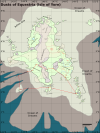
The Nara clan of the Yonggan people have a rich tradition of divination, carried forward by their mantic priesthood. Yonggan diviners, historically practitioners of Yonggan traditional shamanism, have long be sought as counselors in the Earth Kingdom. The Nara tradition of divination was enhanced and formalized through intensive contact with the divinatory traditions of the Central Earth Kingdom during the Ri Dynasty's rule in Ba Sing Se. Mantic priests of the state religion codified these techniques in books such as the Eight Noble Means of Divination. As the Great Ri were also patrons of the Air Nomad religion, Nara divination also incorporates concepts derived from Air Nomad thought.
Plastromancy and Scapulimancy
These arts encompass divination by interpreting the cracks in bones or shells; the shell of the turtle-duck is especially favored and during the Great Ri, the state mantic priesthood even developed a special breed of them for the purpose in Ba Sing Se. With appropriate ritual preparation, the diviner touches the object with a hot metal poker and compares the pattern of cracks formed to tables in a book. Traditional implements include an oil lamp (for heating the poker), and the poker itself. This art is developed from Yonggan traditions, though antecedents are practiced throughout the Northern Earth Kingdom and the Fire Nation, where it may have ultimately originated. It is considered most useful for predicting the outcome of future undertakings.
Aeromancy and Meteorology
This art was, unsurprisingly, developed by the Air Nomads, and consists of interpreting weather-related omens and daytime celestial phenomena. Texts contain information about the meaning of cloud formations, wind direction, and so forth. It also encompasses much of what might be considered non-supernatural meteorology. It is considered most useful for predicting the weather (unsurprisingly), the longer-term climate, and agricultural decisions for the coming season. It is also thought to provide useful information about natural disasters, droughts, famines, volcanic eruptions, and the like.
Astrology and Astronomy
Astrology and Astronomy developed to a very high degree under the Great Ri, and continues to be practiced in Ba Sing Se along similar lines today. The mantic priesthood was especially interested in predicting eclipses and celestial convergences which had immediate practical importance for elemental benders. Apart from predicting the motions of heavenly bodies, eclipses, and suchlike, it is thought to be useful for predicting the destinies of nations, empires, and international relations; the individual horoscope was considered useful only for people who were likely to be important to the course of global events. (Indeed, sumptuary laws under the Great Ri governed who could have a horoscope cast for them.)
Necromancy
Geomancy and Geology
This art is broadly similar to Feng sui, insofar as practitioners use geographical and geological features, their proximity, orientation, and size, to determine auspicious sites for construction. It is also thought to be good for organizing the internal spaces of buildings, the composition of artwork, and even the organization of bureaucratic and family structures by means of codified metaphors. Sometimes, servants and children are shifted among nearby kinfolk households on the basis of "geomantic" considerations. (For example, it is considered inauspicious to have only sons or only daughters in a household, as this would be considered a condition of imbalance; the Nara fondness for eunuch servants was founded not only on practical dynastic concerns, but on their "neutral energy" effect.) Also part of this art is what would be considered proto-scientific geology, i.e. where to build things so they do not fall over when it rains and what kind of rocks are good for construction. Overall, this art is not so much concerned with predicting the future sensu stricto but with ensuring a good outcome through attention to the arrangements of things with respect to each other and the natural world.
Cleromancy and Rhabdomancy
Abacomancy