|
Size: 629
Comment:
|
Size: 8221
Comment:
|
| Deletions are marked like this. | Additions are marked like this. |
| Line 3: | Line 3: |
| When the [[Bryce/Scratch/Nara Clan|Nara]] were banished to the Si Wong desert, the Earth Kingdom defined a "pale of banishment" to which they would be confined. This exile was on pain of death, and the Nara who went into exile were, additionally, branded with a 亡 on their foreheads. (Some Nara did indeed choose to fight to the last or attempt to evade the exile, with more or less success at integrating with other Yonggan; it is estimated that up to 20% of their population at the time of the exile edict chose to give up their identity and integrate with other Yonggan or Abka groups. Few were caught.) | When the [[Bryce/Scratch/Nara Clan|Nara]] were banished to the Si Wong desert, the Earth Kingdom defined a "pale of banishment" to which they would be confined. This exile was on pain of death, and the Nara who went into exile were, additionally, branded with a 亡 on their foreheads to make them more recognizable if they tried to leave the pale. Some Nara choose to fight to the last instead of going into exile. Others attempted to evade the exile. It is estimated that up to 20% of their population at the time of the exile edict chose to give up their identity and integrate with other Yonggan or Abka groups instead of fighting or obeying. Most were never caught, though some were; they were either executed or escorted to the pale, depending on the particular circumstances.) == Zones of the Pale == The Nara pale of banishment is comprised of two zones, the "zone of residence" and the "zone of transience." The zone of residence is where the Nara may permanently reside, without restriction. The zone of transience is an area on the margins of the pale, often including settlements and trading posts. For example, the Misty Palms Oasis is located in the zone of transience. The Nara are permitted to visit the zone of transience, e.g. to trade, but not to reside there; the specifics of what constitutes "residing" vary from settlement to settlement. Generally, the Nara are forbidden to camp in the zone of transience, and may not build, rent, or own dwellings there. Government trading posts simply have a curfew; the Nara are not allowed to be there at night. == Punishments for Defying Exile == Originally the exile was on pain of death, and was enforced by beheading any Nara caught outside the pale of banishment. More recently, infractions have been usually dealt with more leniently; first-time offenders are branded and returned to the pale and only flagrant repeated violators are executed. Nara violating the zone of transience regulations are generally just expelled, repeat offenders might be jailed briefly or flogged, depending on the circumstances and disposition of the governing authority. == Changes over Time == The boundaries of the pale, and in particular the zone of transience, were set so as to allow the Nara to trade (and hence be economically exploited), but not to avail themselves of the comfort of urban oasis life. Notably, most of the oases of the Si Wong, even deep within the desert, are enclaves of the zone of transience within the zone of residence. (It should be noted that enforcement of the prohibition on Nara residence within most of these enclaves was only sporadically enforced, as the Earth Kingdom's control over the Si Wong tribes has rarely been so complete as to interest them in the matter.) A few settlements have shifted and grown to such an extent that they now extend into the zone of residence, and indeed some Nara have taken advantage of this and settled there; the matter does not seem to be of much interest to the current government in Ba Sing Se. == Markings == The boundaries of the pale and its zones are marked with stele, concentrated in settlements and along common routes; the stele may be extremely far apart on the trackless borders of the Si Wong. The stele contain a description of the zones, the penalties for defying exile, and, notably, a rather mean-spirited denunciation of the Nara: This is the written decree of the 46th Earth King: In the days of the Great Hao and the Elder Ting, our Kingdom treated favorably the Yonggan barbarians of the North, favoring them with great gifts and honoring them with titles. Our illustrious collateral ancestor, the 15th Earth King, of the Elder Ting, honored the barbarian leader Nara so-called lord of lords, with the title of Duke Guarding the Northern Frontier and with great wealth. And yet, when rebels rose in the Impregnable City, and his majesty called on the Nara lord to assist in the suppression of the rebels, the Nara committed the most terrible crime imaginable: they m-rdered his majesty in treacherous collusion with the rebels. As if their odious and infamous act of treachery was not a sufficient offense to Heaven, the Nara defiled the temples with barbaric rites, and purported to ascend the Badgermole Throne, pretending themselves emperors and slaughtering those righteous people of the our Kingdom and the vassal states who dared speak out against their blasphemy and hubris. What is more, they impr-soned the royal family of the Elder Ting, and let them die in exile in the frozen and desolate lands from whence the Yonggan barbarians had emerged. After some years in which the Nara plundered the bounty of our Kingdom and flogged the people with their brutal rule, the stench of Nara hubris and mismanagement reached Heaven. When the divine forbearance was exhausted, certain righteous scholar-officials, hitherto forced to labor under the Gr-at Ri Dynasty (as it was falsely so-called), were made to feel such indignation at the crimes of the Nara and the suffering of the people, that they could not but rise against their corrupt and decadent barbarian overlords and cast off their illegitimate dominion. Accepting the Will of Heaven and the good council of the righteous scholar-officials, our illustrious ancestor the 23rd Earth King drove the Nara from the the Hall of Invincible Stability and expelled the Yonggan barbarians from the Impregnable City. His majesty purified the Ancestral Temples and visited righteous judgement upon the collaborators who had mistreated the people and enriched the Nara. In his great mercy, his majesty did not exterminate the wicked Nara, but allowed them to return peacefully to their own proper territory upon giving their submission, which they did. Indeed, we note that the so-called Prince of Jin, prominent among the Nara and a great man of the deposed regime, groveled before the Badgermole throne for his wretched life and submitted to his majesty with three prostrations and nine knockings of the head; seeing this display of apparent contrition, his majesty, a ruler of great humanity, showed undeserved mercy by sparing his wayward subject and allowing him to return to his own ancestral land of Nemu with the dignity of a native beile. Yet, despite the kindness of our illustrious ancestor, the Nara quickly forgot the mercy that had been shown to them, and proved unworthy of such consideration in the future; for when the rebel Chin, the so-called conqueror, rose against us in the late war, the treacherous Nara fomented some other Yonggan and Abka against the Kingdom and supported the violent rebellion. Though, by the Will of Heaven, these rebels were nonetheless defeated, the war was made bloodier and protracted by the Nara. Once again, the stench of their crimes rises to Heaven and demands punishment in the name of justice, and to avenge the fallen millions of the late war. It would be just and appropriate to condemn the Nara to extermination, as they have time and again proven themselves to be a wicked and treacherous lineage devoid of human quality, and yet, we would not taint the honor of any of our righteous forces by having them act as mere butchers of animals. Instead, we shall rely upon Heaven to mete out its righteous sentence upon these traitors. Let it be known: We, by the Will of Heaven the 46th Earth King, hereby establish a pale of banishment in the Si Wong Desert in which the Nara must henceforth dwell. We banish the Nara from the remainder Earth Kingdom. Further, let it be known: we confiscate all the real property of the Nara, including that associated with dowries, for the throne. Further, let it be known: we condemn the entire Nara barbarian clan, along with their spouses, children, retainers and slaves, and all their descendants in perpetuity, to suffer the penalty of execution should they ever leave the pale of banishment established for them. Signed in council, 46th Earth King In the name of his majesty the 46h Earth King, by order of the Ministry of Works, this monument is established to mark the boundary of the zone of transience of the Nara pale of banishment. |
When the Nara were banished to the Si Wong desert, the Earth Kingdom defined a "pale of banishment" to which they would be confined. This exile was on pain of death, and the Nara who went into exile were, additionally, branded with a 亡 on their foreheads to make them more recognizable if they tried to leave the pale. Some Nara choose to fight to the last instead of going into exile. Others attempted to evade the exile. It is estimated that up to 20% of their population at the time of the exile edict chose to give up their identity and integrate with other Yonggan or Abka groups instead of fighting or obeying. Most were never caught, though some were; they were either executed or escorted to the pale, depending on the particular circumstances.)
Zones of the Pale
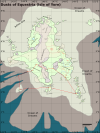
The Nara pale of banishment is comprised of two zones, the "zone of residence" and the "zone of transience." The zone of residence is where the Nara may permanently reside, without restriction. The zone of transience is an area on the margins of the pale, often including settlements and trading posts. For example, the Misty Palms Oasis is located in the zone of transience. The Nara are permitted to visit the zone of transience, e.g. to trade, but not to reside there; the specifics of what constitutes "residing" vary from settlement to settlement. Generally, the Nara are forbidden to camp in the zone of transience, and may not build, rent, or own dwellings there. Government trading posts simply have a curfew; the Nara are not allowed to be there at night.
Punishments for Defying Exile
Originally the exile was on pain of death, and was enforced by beheading any Nara caught outside the pale of banishment. More recently, infractions have been usually dealt with more leniently; first-time offenders are branded and returned to the pale and only flagrant repeated violators are executed. Nara violating the zone of transience regulations are generally just expelled, repeat offenders might be jailed briefly or flogged, depending on the circumstances and disposition of the governing authority.
Changes over Time
The boundaries of the pale, and in particular the zone of transience, were set so as to allow the Nara to trade (and hence be economically exploited), but not to avail themselves of the comfort of urban oasis life. Notably, most of the oases of the Si Wong, even deep within the desert, are enclaves of the zone of transience within the zone of residence. (It should be noted that enforcement of the prohibition on Nara residence within most of these enclaves was only sporadically enforced, as the Earth Kingdom's control over the Si Wong tribes has rarely been so complete as to interest them in the matter.) A few settlements have shifted and grown to such an extent that they now extend into the zone of residence, and indeed some Nara have taken advantage of this and settled there; the matter does not seem to be of much interest to the current government in Ba Sing Se.
Markings
The boundaries of the pale and its zones are marked with stele, concentrated in settlements and along common routes; the stele may be extremely far apart on the trackless borders of the Si Wong. The stele contain a description of the zones, the penalties for defying exile, and, notably, a rather mean-spirited denunciation of the Nara:
- This is the written decree of the 46th Earth King: In the days of the Great Hao and the Elder Ting, our Kingdom treated favorably the Yonggan barbarians of the North, favoring them with great gifts and honoring them with titles. Our illustrious collateral ancestor, the 15th Earth King, of the Elder Ting, honored the barbarian leader Nara so-called lord of lords, with the title of Duke Guarding the Northern Frontier and with great wealth. And yet, when rebels rose in the Impregnable City, and his majesty called on the Nara lord to assist in the suppression of the rebels, the Nara committed the most terrible crime imaginable: they m-rdered his majesty in treacherous collusion with the rebels. As if their odious and infamous act of treachery was not a sufficient offense to Heaven, the Nara defiled the temples with barbaric rites, and purported to ascend the Badgermole Throne, pretending themselves emperors and slaughtering those righteous people of the our Kingdom and the vassal states who dared speak out against their blasphemy and hubris. What is more, they impr-soned the royal family of the Elder Ting, and let them die in exile in the frozen and desolate lands from whence the Yonggan barbarians had emerged. After some years in which the Nara plundered the bounty of our Kingdom and flogged the people with their brutal rule, the stench of Nara hubris and mismanagement reached Heaven. When the divine forbearance was exhausted, certain righteous scholar-officials, hitherto forced to labor under the Gr-at Ri Dynasty (as it was falsely so-called), were made to feel such indignation at the crimes of the Nara and the suffering of the people, that they could not but rise against their corrupt and decadent barbarian overlords and cast off their illegitimate dominion. Accepting the Will of Heaven and the good council of the righteous scholar-officials, our illustrious ancestor the 23rd Earth King drove the Nara from the the Hall of Invincible Stability and expelled the Yonggan barbarians from the Impregnable City. His majesty purified the Ancestral Temples and visited righteous judgement upon the collaborators who had mistreated the people and enriched the Nara. In his great mercy, his majesty did not exterminate the wicked Nara, but allowed them to return peacefully to their own proper territory upon giving their submission, which they did. Indeed, we note that the so-called Prince of Jin, prominent among the Nara and a great man of the deposed regime, groveled before the Badgermole throne for his wretched life and submitted to his majesty with three prostrations and nine knockings of the head; seeing this display of apparent contrition, his majesty, a ruler of great humanity, showed undeserved mercy by sparing his wayward subject and allowing him to return to his own ancestral land of Nemu with the dignity of a native beile. Yet, despite the kindness of our illustrious ancestor, the Nara quickly forgot the mercy that had been shown to them, and proved unworthy of such consideration in the future; for when the rebel Chin, the so-called conqueror, rose against us in the late war, the treacherous Nara fomented some other Yonggan and Abka against the Kingdom and supported the violent rebellion. Though, by the Will of Heaven, these rebels were nonetheless defeated, the war was made bloodier and protracted by the Nara. Once again, the stench of their crimes rises to Heaven and demands punishment in the name of justice, and to avenge the fallen millions of the late war. It would be just and appropriate to condemn the Nara to extermination, as they have time and again proven themselves to be a wicked and treacherous lineage devoid of human quality, and yet, we would not taint the honor of any of our righteous forces by having them act as mere butchers of animals. Instead, we shall rely upon Heaven to mete out its righteous sentence upon these traitors. Let it be known: We, by the Will of Heaven the 46th Earth King, hereby establish a pale of banishment in the Si Wong Desert in which the Nara must henceforth dwell. We banish the Nara from the remainder Earth Kingdom. Further, let it be known: we confiscate all the real property of the Nara, including that associated with dowries, for the throne. Further, let it be known: we condemn the entire Nara barbarian clan, along with their spouses, children, retainers and slaves, and all their descendants in perpetuity, to suffer the penalty of execution should they ever leave the pale of banishment established for them. Signed in council,
- 46th Earth King