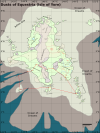
The Northern Water Tribes are culture inhabiting the Northern Polar Continent. It is the larger and more populous of the three constituent tribes of the ethnic Water Nation. The Northern Tribal Confederation is one of the two polities comprising the political Water Nation, the other being the Southern Water Tribes.
The language of the Water Tribes marks a distinction between plurals and singulars, but the common language of diplomacy and international trade generally does not. In that language, the term "Northern Water Tribe" (北方水族) is used to refer to the overall culture. Internally, though, the Northern Water Tribes consider themselves a confederation of tribes, with seventeen major tribes, and forty-one minor tribes. They do sometimes use "Northern Water Tribe" with "Tribe" in the singular form when presenting themselves as a united front to outsiders or when rhetorically building pan-tribal sentiment e.g. in political speeches about Confederation matters. Among themselves, though, they often introduce themselves by their particular tribe.
The carrying capacity of the land is limited, as tundra vegetation grows slowly and the environment can sustain only limited numbers of animals and edible plants. The population is concentrated on the coasts and rivers, where fishing and the gathering of sea vegetables is available, and in the area of warmer, wetter boreal forest in the southwest. Before the advent of trade and urbanization, and especially before the Tribes developed tools to hunt the mighty leviathan whelk and elephant-whale, the population was extremely concentrated in the boreal forest biome.
The capital of the Confederation is Agna Qel'a, a large city. There are a few other cities and large settlements, but most of the population lives as nomads in camps, or in small villages. Agriculture is limited by the very short growing season, but is practiced some in the far southwestern corner of the Confederation's territory.
The Igigkaraat, Qengartaraak, Negcik, and Ayarua were the founders of the tribal confederation.
The Major Confederated Northern Water Tribes |
|
In the Traditional Order of Precedence |
|
Name |
Note |
Igigkaraat () |
A settled tribe of the boreal forests, who provide the hereditary high chief of the Northern Water Tribes, now mainly urban. |
Qengartaraak |
A nomadic tribe once of the interior highlands but now mainly urban and martial, stereotyped as legendary for their bodily fortitude and bending prowess. Provides the hereditary high war-chief. |
Negcik |
A settled tribe, mainly fishers. Provides the hereditary high lorekeeper of the confederation. |
Ayarua |
A settled tribe of the southwestern Boreal forests, known for its powerful waterbenders. Engages in some agriculture with a short-season arctic buckwheat landrace. Provides the hereditary high waterbending chief. |
Ilulirat |
A settled tribe of the northwestern river and bay, skilled in trap-fishing and whaling primarily. |
Qaluurin |
A settled tribe of the Great Interior Bay, known as tool-makers and metalworkers. |
Taluyat |
A prosperous settled fishing tribe of the southwestern coast of the Northern Polar Continent, many now living in Agna Qel'a. |
Kaviaraat |
A nomadic tribe of the east, very wide-ranging. |
Qavlunguaq |
A nomadic tribe, sustaining itself by trading and fishing, many now settled in cities. |
Kinguqerrat |
A nomadic tribe, hunters and gatherers in the hinterland tundra, claim to have invented snowshoes. |
Tuntuq |
A nomadic tribe, mostly traders (and historically, raiders.) |
Tunturyuk |
A nomadic tribe that sustains itself in the interior by hunting the caribou-bear packs. |
Nayiparaq |
A semi-nomadic hunting tribe with some permanent settlements in the Great Interior Bay. Totem animal is the catseal. |
Siqupsiqqat |
A tribe, long separated from the other Northern Water Tribes, who later migrated to join the confederation. Nomadic traders. |
Uuyurat |
A kin-tribe of the Siqupisiqqat who joined their migration. Nomadic whalers and mercenaries. |
Sagquralriit |
A nomadic tribe initially hostile to the Confederation, now sustaining themselves mainly by fishing. |
Cagquralriit |
A nomadic tribe, late to be brought into the Confederation, and stereotyped as crude and flighty. |
Tribe is inherited from the father. Unacknowledged illegitimate children or those of unknown fathers are all considered to belong to the mother's tribe, though they are ineligible for some ceremonial roles with their tribe and are generally in a poor social position unless formally adopted by e.g. their mother's subsequent spouse. Outsider men marrying into a water tribe are generally adopted by their spouse's tribe as a prerequisite for such a union.