|
Size: 6028
Comment:
|
← Revision 7 as of 2022-07-28 22:28:50 ⇥
Size: 6598
Comment:
|
| Deletions are marked like this. | Additions are marked like this. |
| Line 5: | Line 5: |
| The Earth Kingdom began colonizing the West of the archipelago on which the Western Air Temple is situated around 1380 BG, though the colonies did not thrive and remained small. The Fire Nation began a rival colonization effort around 1290 BG, on the South of the archipelago. The Earth Kingdom (under the Ting dynasty) ramped up its colonial ambitions in response over the next several decades. These colonies mostly remained coastal, and had relatively minimal impact on the grazing lands of the Air Nomads, but their gradual expansion led to local conflict between the Fire Nation and Earth Kingdom colonies. This threatened escalation to a broader war between the Fire Nation and Earth Kingdom in the 1140s. Efforts of the local Air Nomads to achieve a peace deal were only partially successful, but the Jiongyu Avatar intervened and negotiated a Four-Nations Settlement that resulted in the contested lands becoming the [[Avatar/Great Treasure Donation|Great Treasure Donation]] to the Western Air Temple's endowment in 1140 BG. | Around 1380 BG, the Earth Kingdom began colonizing the West of the archipelago on which the Western Air Temple is situated, which they called the Celadon Islands after the Ganjinese ceramics industry which bankrolled the initial efforts. The colonies did not initially thrive, often being beset by feral spirit attacks, and remained small. Many of the Air Nomads cautiously welcomed them, and taught them how to be less provocative to the indigenous spirits. The Fire Nation began a rival colonization effort around 1290 BG, on the South of the archipelago. The Earth Kingdom (under the Ting dynasty) ramped up its colonial ambitions in response over the next several decades. These colonies mostly remained coastal, and had relatively minimal impact on the grazing lands of the Air Nomads, but their gradual expansion led to local conflict between the Fire Nation and Earth Kingdom colonies. This threatened escalation to a broader war between the Fire Nation and Earth Kingdom in the 1140s. Efforts of the local Air Nomads to achieve a peace deal were only partially successful, but the Jiongyu Avatar intervened and negotiated a Four-Nations Settlement that resulted in the contested lands becoming the [[Avatar/Great Treasure Donation|Great Treasure Donation]] to the Western Air Temple's endowment in 1140 BG. |
| Line 12: | Line 12: |
As a state, the lands ultimately administered by the Western Air Temple were sometimes called the "Western Air Nation." This was mostly a legal term with little day to day use by the people who lived there, who thought of themselves as either Air Nomads, or as Celadonians (青瓷人). |
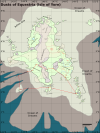
The Western Air Temple (西氣寺) was an Air Nation monastic complex located north of the Fire Nation. It is the second oldest of the Cardinal Air Temples, having been established in 1802 BG as a remote monastery that focused on the spiritual and educational needs of Air Nomads who wanted to leave the Southern Air Temple's lands because they felt they were too overpopulated. At the time, the so-called Chalcedony Archipelago was not inhabited by humans, except for a few seasonally-inhabited fishing villages on the Northern coast, belonging to the Northern Water Tribe. Notably, the interior had significant uninhabited grazing lands suitable for Sky Bison. The monastery came to be a spiritual hub, and as the air Nomad population grew (very slowly) at expanded. A lineage of reincarnated lamas, the Lungspre Great Sages (翼猴大聖), came to be established at the monastery (with the founder of the lineage being Rolha, a skilled airbending nun known for her clever koans and practical jokes). In recognition of its growing importance, it was established as the Western Air Temple in 1246 BG. It was made a female-only monastery at the time of the Great Monastic Division in 1166 (prior to that, it had hosted both monks and nuns, although they did have separate residential quarters and meditation halls.)
The architecture of the Temple is unique, featuring buildings under a cliffside. This was made possible by Airbenders and Earthbenders working together after the Great Treasure Donation (see below); before that, the much smaller complex had a more conventional design.
Around 1380 BG, the Earth Kingdom began colonizing the West of the archipelago on which the Western Air Temple is situated, which they called the Celadon Islands after the Ganjinese ceramics industry which bankrolled the initial efforts. The colonies did not initially thrive, often being beset by feral spirit attacks, and remained small. Many of the Air Nomads cautiously welcomed them, and taught them how to be less provocative to the indigenous spirits. The Fire Nation began a rival colonization effort around 1290 BG, on the South of the archipelago. The Earth Kingdom (under the Ting dynasty) ramped up its colonial ambitions in response over the next several decades. These colonies mostly remained coastal, and had relatively minimal impact on the grazing lands of the Air Nomads, but their gradual expansion led to local conflict between the Fire Nation and Earth Kingdom colonies. This threatened escalation to a broader war between the Fire Nation and Earth Kingdom in the 1140s. Efforts of the local Air Nomads to achieve a peace deal were only partially successful, but the Jiongyu Avatar intervened and negotiated a Four-Nations Settlement that resulted in the contested lands becoming the Great Treasure Donation to the Western Air Temple's endowment in 1140 BG.
The Endowment brought two thriving but antagonistic groups under the control of the Western Air Temple, and there were some inevitable difficulties. Although both now enjoyed effectively lower taxation and generally accepted the mediation of the Air Nation as a neutral party to settle their territorial disputes, there was still significant unrest associated with the transfer, and the abbess Yeshe XII was deposed by the Western Council of Elders for her advocacy of the Air Temple's role in the settlement. Nonetheless, subsequent leadership did not attempt to back out of the agreement, and, together with the Avatar, forged a peaceful, if not especially cohesive, state. The Air Nomads were governed (loosely) by the Western Air Temple theocracy, and collected some of the revenue from the colonies that was previously sent to the colonizing powers - though only about a third of the amount, with the rest of the reduction being split between an effective "tax cut" for the inhabitants. The Air Temple saw to the establishment of free schools for the people of settled cultures in return, modeling their system of governance on that of the temple endowment lands of the Southern Air Temple. Over time, a thriving fusion culture developed. The Air Temple, to protect the environment of the island and its ability to support Air Nomads, limited private ownership of land to minor islands, land within 100 li of the shore, land within 50 li of the walls of settlements existing at the time of the Donation, or land within 20 li of the shores of certain major rivers. The rest of the lands - designated as Sacred Grazing Lands - were used in the traditional manner by the Air Nomad population (who, for their part, sent tithes to the Temple and received various social and spiritual services in return.)
In the 882 BG, the Western Air Temple devolved most of its temporal power over the settled communities of its endowed lands onto local governments. Monk-officials continued to be appointed in these lands, but only as inspectors-general and to supervise the Air Temple's social program. Some of the local communities experimented with democratic concepts of local government, with varying success, under this system. The overall leadership of the temple remained with its council of elders, which was headed by either the reincarnate Lungspre Great Sage, or by a caretaker abbess in the years in which the Great Sage was a minor.
The Air Temple did not try to force its values on the settled populations it inherited, for example, raising of animals for meat was permitted for communities that had a tradition of carnivorous diets. (Though it was a preoccupation of many monk-officials to ensure that none of the Temple money being spent on settled communities in any way funded the meat industry, sometimes leading to minor tensions.) There was also no interference with traditional religious practices, and syncretism exploded in the Celadon archipelago from the time of the Great Treasure Donation. Many people of non-Air-Nation ethnic descent did convert to the Air Nomad Religion, though, over the years, such that about 60% of the population professed it as their religious belief at the time of the Air Nomad Genocide, with another 30% being part of some form of syncretic faith tradition incorporating Air-Nomad-influenced beliefs.
As a state, the lands ultimately administered by the Western Air Temple were sometimes called the "Western Air Nation." This was mostly a legal term with little day to day use by the people who lived there, who thought of themselves as either Air Nomads, or as Celadonians (青瓷人).