|
Size: 434
Comment:
|
Size: 2927
Comment:
|
| Deletions are marked like this. | Additions are marked like this. |
| Line 6: | Line 6: |
Rosmertine Fleet yards is equatorial and has space elevators. Rosmerta's diameter is 6161 km at the equator. Its gravity is 21%g. Equatorial District, Hesselland, Rosmerta. Hesselland is a continent that runs in a roughly north-south direction. A ridge of mountains running north-south, extensive low plains that are covered by the complicated tides. An area the size of New Jersey is inundated at high tide and exposed at low, the Hesselland Shallows. Rosmerta has a modest magnetic field. Lighting is about as bright as twilight on earth during the Rosmertine day. The atmospheric pressure at sea level is 1.62 bar. The atmosphere is mainly nitrogen with hydrocarbons and organics and is characterized as dominantly reducing. The average temperature is -20C; temperatures range from -35 - +5C throughout the moon's surface. Rosmerta is modestly volcanically active. The oceans are liquid butane and pentane and isomers. Butane rain is sometimes observed. The atmosphere is poisonous due to naturally-occurring cyanogen and hydrogen cyanide. Environmental equipment for outdoor work is widely used, consisting of airtight insulating suits with layers impermeable to organic chemicals. The suits can be quite lightweight because they are not pressure suits. Habitats on Rosmerta are kept at atmospheric pressure (1.62 bar); visiting spacecraft must be either able to withstand +1.62 bar and pressurize before landing, or be able to withstand -0.62 bar and pressurize occupants using a spaceport airlock. The former is more common; most landing craft are somewhat overbuilt anyhow, but it is something for which they must be certified and which must be logged for pressure hull fatigue life reasons. The sky is a hazy brown, with clouds of butane and other organics. New Europa is visible as a bright spot in the haze. The faintly-ringed gas planet Carlisle is visible from the surface only under certain lighting conditions, under which it appears as a diffuse bright region in the sky. (i.e. New Europa is shining on Carlisle and it is star-night at the observer's location on Rosmerta, in which case the reflected light from Carlisle is the primary light source.) The other major moons of New Europa VII may be similarly faintly visible to careful observers, but never as a sharp image, just as brighter areas of the always-'overcast' night sky. Light pollution prevents anything but New Europa and Carlisle from being seen with the naked eye near urban centers. |
Somebody blew up a couple of drone chemical freighters leaving Rosmerta with loads of helium separator resins (check) for the AWSF. Pirates had made a threat but had been paid off by the shipping company and now deny responsibility. Figure out what happened. Also, the attacker had military-grade chemical engines made by the now-defunct rosmertine fleet yards.
People on Rosmerta are bitter about that, still.
Rosmertine Fleet yards is equatorial and has space elevators.
Rosmerta's diameter is 6161 km at the equator. Its gravity is 21%g.
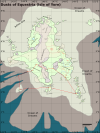
Equatorial District, Hesselland, Rosmerta.
Hesselland is a continent that runs in a roughly north-south direction.
A ridge of mountains running north-south, extensive low plains that are covered by the complicated tides. An area the size of New Jersey is inundated at high tide and exposed at low, the Hesselland Shallows.
Rosmerta has a modest magnetic field. Lighting is about as bright as twilight on earth during the Rosmertine day. The atmospheric pressure at sea level is 1.62 bar. The atmosphere is mainly nitrogen with hydrocarbons and organics and is characterized as dominantly reducing. The average temperature is -20C; temperatures range from -35 - +5C throughout the moon's surface. Rosmerta is modestly volcanically active. The oceans are liquid butane and pentane and isomers. Butane rain is sometimes observed. The atmosphere is poisonous due to naturally-occurring cyanogen and hydrogen cyanide.
Environmental equipment for outdoor work is widely used, consisting of airtight insulating suits with layers impermeable to organic chemicals. The suits can be quite lightweight because they are not pressure suits. Habitats on Rosmerta are kept at atmospheric pressure (1.62 bar); visiting spacecraft must be either able to withstand +1.62 bar and pressurize before landing, or be able to withstand -0.62 bar and pressurize occupants using a spaceport airlock. The former is more common; most landing craft are somewhat overbuilt anyhow, but it is something for which they must be certified and which must be logged for pressure hull fatigue life reasons.
The sky is a hazy brown, with clouds of butane and other organics. New Europa is visible as a bright spot in the haze. The faintly-ringed gas planet Carlisle is visible from the surface only under certain lighting conditions, under which it appears as a diffuse bright region in the sky. (i.e. New Europa is shining on Carlisle and it is star-night at the observer's location on Rosmerta, in which case the reflected light from Carlisle is the primary light source.) The other major moons of New Europa VII may be similarly faintly visible to careful observers, but never as a sharp image, just as brighter areas of the always-'overcast' night sky. Light pollution prevents anything but New Europa and Carlisle from being seen with the naked eye near urban centers.