|
Size: 499
Comment:
|
Size: 4184
Comment:
|
| Deletions are marked like this. | Additions are marked like this. |
| Line 2: | Line 2: |
CANT HAVE SPACE ELEVATOR TO SYNCHRONOUS ORBIT ON TIDALLY LOCKED BODY. LAGRANGE POINTS OR SPACE FOUNTAIN> |
|
| Line 7: | Line 10: |
| Rosmertine Fleet yards is equatorial and has space elevators. | Environmental equipment for outdoor work is widely used, consisting of airtight insulating suits with layers impermeable to organic chemicals. The suits can be quite lightweight because they are not pressure suits. Habitats on Rosmerta are kept at slightly above atmospheric pressure (1.7 bar) to exclude the poisonous atmosphere in case of leaks; visiting standard-pressure human spacecraft must be either able to withstand +1.7 bar and pressurize before landing, or be able to withstand -0.62 bar and pressurize occupants using a spaceport airlock. The former is more common; most landing craft are somewhat overbuilt anyhow, but it is something for which they must be certified and which must be logged for pressure hull fatigue life reasons. The sky is a hazy brown, with clouds of butane and other organics. New Europa is visible as a bright spot in the haze. The extensively-ringed gas planet Carlisle is visible from the surface only under certain lighting conditions, under which it appears as a diffuse bright region in the sky. (i.e. New Europa is shining on Carlisle and it is star-night at the observer's location on Rosmerta, in which case the reflected light from Carlisle is the primary light source.) The other major moons of New Europa VII may be similarly faintly visible to careful observers, but never as a sharp image, just as brighter areas of the always-'overcast' night sky. Light pollution prevents anything but New Europa and Carlisle from being seen with the naked eye near urban centers. Rosmertine Fleet Yards is a complex of structures in orbit. Large ship structures were often built on the surface from graphite-reenforced composites and lofted with big thermal fusion space planes (due to the thick atmosphere and low gravity, they are a huge win, esp since space elevators were unavailable due to tidal locking); polymers being produced by the huge indigenous chemical industry. (They were of course built up thrustwise, between that, the lower gravity, and the fact that they were not supporting heavy equipment just their own weight, it was not a problem.) The space planes would take off from the tidal flats when the tide was out. The huge space planes remain, sitting idle, some touched by the occasional high tide. Unrusting, of course, bathed in oils, and being mostly made of polymer matrix composites anyway. There are big 3D printers here, basically, though they are 5-axis to lay re-enforced filament in a variety of directions. Their printing area is about 20m x 10m x 100m tall, and there are several. There are some tanks and pump houses nearby that supply them with the matrix materials, and some spools of unused graphitic fiber. Skeletal towers rise a hundred meters into the air. There's one of the print heads nearby, about a cubic meter in size, derelict. (It contains the rotational axes.) There are lots of warehouses, mainly light cylindrical composite structures. They're pretty huge, and built of large sections that would be crushed easily under their own weight on a planet. Most people still live in the imperial-era worldhouse, which extends nearly to the shores of Hesselland not far from RFY's ground complex. The worldhouse is a lightly pressurized tensile structure with transparent ceiling domes and is an earth-sheltered construction. Radiation levels on Rosmerta are modest given its atmosphere and magnetic field, but sleeping areas are always customarily low in the structure. The ceilings are two-layered, for insulation purposes. Power is mostly by fusion reactors, as elsewhere. Ramses Stallone, "BUT WE CAN MOVE DIRT, CAN'T WE?" |
CANT HAVE SPACE ELEVATOR TO SYNCHRONOUS ORBIT ON TIDALLY LOCKED BODY. LAGRANGE POINTS OR SPACE FOUNTAIN>
Somebody blew up a couple of drone chemical freighters leaving Rosmerta with loads of helium separator resins (check) for the AWSF. Pirates had made a threat but had been paid off by the shipping company and now deny responsibility. Figure out what happened. Also, the attacker had military-grade chemical engines made by the now-defunct rosmertine fleet yards.
People on Rosmerta are bitter about that, still.
Environmental equipment for outdoor work is widely used, consisting of airtight insulating suits with layers impermeable to organic chemicals. The suits can be quite lightweight because they are not pressure suits. Habitats on Rosmerta are kept at slightly above atmospheric pressure (1.7 bar) to exclude the poisonous atmosphere in case of leaks; visiting standard-pressure human spacecraft must be either able to withstand +1.7 bar and pressurize before landing, or be able to withstand -0.62 bar and pressurize occupants using a spaceport airlock. The former is more common; most landing craft are somewhat overbuilt anyhow, but it is something for which they must be certified and which must be logged for pressure hull fatigue life reasons.
The sky is a hazy brown, with clouds of butane and other organics. New Europa is visible as a bright spot in the haze. The extensively-ringed gas planet Carlisle is visible from the surface only under certain lighting conditions, under which it appears as a diffuse bright region in the sky. (i.e. New Europa is shining on Carlisle and it is star-night at the observer's location on Rosmerta, in which case the reflected light from Carlisle is the primary light source.) The other major moons of New Europa VII may be similarly faintly visible to careful observers, but never as a sharp image, just as brighter areas of the always-'overcast' night sky. Light pollution prevents anything but New Europa and Carlisle from being seen with the naked eye near urban centers.
Rosmertine Fleet Yards is a complex of structures in orbit. Large ship structures were often built on the surface from graphite-reenforced composites and lofted with big thermal fusion space planes (due to the thick atmosphere and low gravity, they are a huge win, esp since space elevators were unavailable due to tidal locking); polymers being produced by the huge indigenous chemical industry. (They were of course built up thrustwise, between that, the lower gravity, and the fact that they were not supporting heavy equipment just their own weight, it was not a problem.)
The space planes would take off from the tidal flats when the tide was out. The huge space planes remain, sitting idle, some touched by the occasional high tide. Unrusting, of course, bathed in oils, and being mostly made of polymer matrix composites anyway.
There are big 3D printers here, basically, though they are 5-axis to lay re-enforced filament in a variety of directions. Their printing area is about 20m x 10m x 100m tall, and there are several. There are some tanks and pump houses nearby that supply them with the matrix materials, and some spools of unused graphitic fiber. Skeletal towers rise a hundred meters into the air. There's one of the print heads nearby, about a cubic meter in size, derelict. (It contains the rotational axes.)
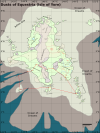
There are lots of warehouses, mainly light cylindrical composite structures. They're pretty huge, and built of large sections that would be crushed easily under their own weight on a planet. Most people still live in the imperial-era worldhouse, which extends nearly to the shores of Hesselland not far from RFY's ground complex. The worldhouse is a lightly pressurized tensile structure with transparent ceiling domes and is an earth-sheltered construction. Radiation levels on Rosmerta are modest given its atmosphere and magnetic field, but sleeping areas are always customarily low in the structure.
The ceilings are two-layered, for insulation purposes. Power is mostly by fusion reactors, as elsewhere.
Ramses Stallone, "BUT WE CAN MOVE DIRT, CAN'T WE?"