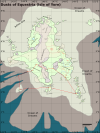
The Hesselland Worldhouse is a megastructure of 123,800 square km indoor area in Western Hesselland. The structure dates from the initial colonization of the planet in the Imperial era, and it has been expanded since then. It consists of many interconnected subunits, generally characterized by transparent air-pressure-supported domes and cylindrical shapes containing agricultural facilities, the base of which is approximately flush with the local terrain level, and several levels of underground development below. The upper level contains mostly agricultural and community recreational space. The middle levels contain industrial and habitation spaces, and the bottom levels contain machinery space. This was a common Imperial design and is not especially well-suited for Rosmerta, where the insolation is insufficient for most agriculture without artificial light; later additions and repairs to the worldhouse have sometimes featured fully or partly opaque pressure structures. Similarly, though radiation levels on the surface of Rosmerta are moderate, the housing units are underground, in keeping with culturally-ingrained Imperial practice for gas giant moon colonies.
Because of the low gravity and relative vulnerability of the pressure structures to damage, throwing objects is a cultural taboo on Rosmerta. That being said, the pressure structures are not actually all that fragile; the taboo originated more out of fear in the dark age, probably after some incident of failed repairs - various problems have led to sections of the worldhouse being abandoned in the past, though it is currently almost entirely in use and in good repair, as population growth has outpaced additional construction and created very large social and economic rewards for making new inhabitable space available.
Of Rosmerta's 660 million inhabitants, the great majority, 642 million, live in the Hesselland Worldhouse. For the sake of a 21st century example, its population density is about the same as the Gaza Strip but is the size of North Korea, and it has about twice the population of the United States. One may naturally wonder why anyone would want to live there. While Rosmerta does have resources and products valuable enough to export (especially to nearby worlds in the New Europa system), it's important to note that like most any other inhabited world, Rosmerta exists for its own sake. People live on Rosmerta because they were born here. They live in the Worldhouse because that's where other people are, and it's much cheaper to add on to the worldhouse than it is to build a new colony elsewhere on the planet's surface, which would have much less redundancy and safety. (There are other settlements, but none have more than a few hundred thousand inhabitants, and most exist for economic reasons - exploitation of natural resources.)
The Worldhouse is currently overcrowded, though not to an extreme degree. Virtually all habitation units are occupied, and dual-use habitation and industry ares have become more common, with more Rosmertines living and working in the same module than has historically been common. Expansion of the worldhouse to meet habitation needs has been slowed by a moderate economic recession and a lag in increasing electrical power generation capacity, though some growth is ongoing. The Rosmertine State has instituted strict population controls, but these are unpopular and considered politically nonviable as a long-term solution.
The Worldhouse obtains its energy partly from fusion reactors (some of them dating back to the Imperial era, though it is noted that Rosmertine schoolchildren discuss "Ramses' Reactor" rather than the "Ship of Theseus") and partly from tidal hydropower. A vast system of earthen dams, reservoirs, tunnels and floodgates allow for the continuous generation of hydroelectric power from the movement of the hydrocarbon oceans. The tidal power system originated in the Dark Age, and saved Rosmertine civilization from total collapse in the face of failing imperial-era fusion infrastructure. Nowadays, new reactors and replacement parts can be fabricated again, but the tidal power system is in many cases more economical.