|
Size: 2351
Comment:
|
Size: 2442
Comment:
|
| Deletions are marked like this. | Additions are marked like this. |
| Line 1: | Line 1: |
| #acl Bryce:read | Iridia is a star system, and the common name of a planet in that system, Iridia III. |
| Line 3: | Line 3: |
| ==== Iridia ==== A terrestrial planet, Iridia III. Notable as the location of a its ''mountain ranges'' and plains of native metal, the so-called Glories of Iridia, which were formed when a the planet captured a metallic asteroid into a decaying orbit. |
Iridia III is one of the [[BTW/Allied Worlds|Allied Worlds]], famous as the location of ''mountain ranges'' and plains of native metal, the so-called Glories of Iridia, which were formed when a the planet captured a metallic asteroid into a decaying orbit. |
| Line 10: | Line 9: |
| In the turmoil following the collapse of the Empire, Iridia suffered a population die-off and was abandoned for a century, before being recolonized by settlers from New Iridia, a more hospitable planet in the same system. These new settlers inherited a great deal of repairable infrastructure, and Iridia has for centuries been an economic powerhouse of the Allied Worlds. | In the turmoil following the collapse of the Empire, Iridia suffered a population die-off and was abandoned for a century, before being recolonized by settlers from [[BTW/New Iridia|New Iridia]], a more hospitable planet in the same system. These new settlers inherited a great deal of repairable infrastructure, and Iridia has for centuries been an economic powerhouse of the Allied Worlds. |
Iridia is a star system, and the common name of a planet in that system, Iridia III.
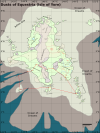
Iridia III is one of the Allied Worlds, famous as the location of mountain ranges and plains of native metal, the so-called Glories of Iridia, which were formed when a the planet captured a metallic asteroid into a decaying orbit.
Iridia is tectonically active, with violent volcanism. It has an atmosphere of carbon dioxide, nitrogen, water vapor and traces of sulfur volatiles, carbon monoxide and metal carbonyls at a pressure of 1.7 bar at sea level. The atmosphere is deadly poisonous because of the dangerous concentrations of nickel tetracarbonyl and iron pentacarbonyl. It has reasonable surface temperatures over much of the land mass (-15 - 70C), truly abundant mineral resources, convenient orbit and 0.85g surface gravity. The weather is often exciting and features acid rain. The planet has a striking yellow color from diiron nonacarbonyl formed by the photodecomposition of the pentacarbonyl in the upper atmosphere.
Thus, much like Australia, Iridia is a place with abundant natural resources that actively resists human inhabitation. However, the lure of the Glories was such that humans did come, thinking that Iridia could be made an industrial powerhouse, processing its abundant metals into all sorts of high-value products to export far and wide. The colonists learned to live with their temperamental planet, building towering sealed cities of gleaming metal - nickel-iron cost less than concrete on Iridia. They harnessed their planet's truly abundant wind and geothermal energy, and began to build industrial and transport facilities. A space fountain was built, and Iridia began to export its products, as hoped for, though perhaps not at such prices or in such volume as the founders of the colonial enterprise had hoped for. Unfortunately, scant decades later, the Susan wormhole was destroyed, cutting Iridia and its neighbors off from the rest of connected space.
In the turmoil following the collapse of the Empire, Iridia suffered a population die-off and was abandoned for a century, before being recolonized by settlers from New Iridia, a more hospitable planet in the same system. These new settlers inherited a great deal of repairable infrastructure, and Iridia has for centuries been an economic powerhouse of the Allied Worlds.