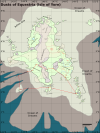
The Kingdom of Heghom [ˈhɛːɡ.hom] is an island nation in the Middlesea. A maritime great power, it has a long history of trade with the various peoples of Selt. It is named after its ancient ruling House of Heg, the first royal house to rule the substantially modern territory of the kingdom.
History
Presented here is a brief historical sketch of the national history of the Kingdom of Heghom.
Early History
The islands that make up the kingdom were inhabited from prehistorical times, by people of the same genetic stock as the settled peoples of the southwestern coast of the the Northern Continent who settled the land at least 2000 years Ante Descensum. They had a tribal civilization, with two rival tribal confederacies emerging around modern Reynom and Great Vetby respectively. A state of low-grade inter-tribal warfare and raiding prevailed for centuries. Tenuous trading contacts existed between Heghom and the mainland, as evidenced by the appearance of ceramic wares from as far away as Murina and East Bel in high-status burials.
In 47 PD, apostles of the Prophet Ardamar reached Heghom from the Northern Continent, knowing the isles as the Walserane "Woody Islands." They introduced literacy, feudalism, and the Solar religion to the indigenous peoples. The tribal confederacy in the South embraced the Solar religion, but that of the North rejected it, as did most of the tribes of the smaller islands. A series of cultural-religious wars broke out, with the southern tribal confederacy prevailing and driving followers of the indigenous religion to the islands of Morile and Chenile by 150s PD.
Trading contacts expanded greatly under the Solar tribal confederacy, and the Walserane moved closer culturally to the First Illuminant. Centralization of authority increased during the second and third centuries, with the leader of the tribal confederacy becoming a de facto king, albeit one elected for life by tribal chiefs, who kept to a rotation of the crown between the three most dominant and powerful tribes. In 382 PD, Bremard the Just conquered Chenile and oversaw its conversion to the Solar religion at swordpoint. Ten years later, he died leading a disastrous expedition to Morile, attempting to repeat his success there.
With the fall of the Illuminant in 440 to the Iron Horde, oceanic trade with the North languished for a time. In advance of the fall, a number of refugees came to Heghom, greatly enhancing the diversity of the material culture and bringing about a period of social turmoil.
Hegian Conquest
In 429, the Kingdom of Heg, a prosperous nation on the Northern Continent in the area of what is now the Maritimes, had been defeated by the Iron Horde and driven from its continental holdings to one of its island colonies offshore. Its King Hulmen II, seeing many other (and stronger) kingdoms fall to the Horde, had seen the writing on the wall and begun preparing for evacuation years in advance. With his military forces largely intact, but facing a long-term revenue problem, he in 438 PD sent his second son Fendic and much of his army on a war of conquest against the Woody Islands. Fendic and his army landed in Aurby on Chenile, taking the poorly-defended island by storm - it had few fortifications because of a persistent fear of rebellion.
After wresting control of Chenile and reenforcing his armies with many disaffected Chenile indigenes, Fendic began his conquest of the main island. Some tribes rejected the leadership of the dominant tribes in the tribal confederacy, and supported Fendic. After the paramount chief of the Walserane fell in battle with the army of the Heg at Tasfen, there was a coup against the surviving tribal confederacy leadership, and a majority of tribes negotiated a peace with Fendic, accepting him as hereditary paramount chief in 441. Fendic was acclaimed as Crown Prince in the same year, as his older brother died of a fever.
Unfortunately for the Kingdom of Heg, the Iron Horde - now controlling a number of tributary nations with seafaring capabilities - set its sights on the Maritimes, and invaded in 444. The royal court evacuated once more, with the king and his household arriving in the Walserane in the same year. Whereas Fendic had been conciliatory to the the native culture and structures of power, Hulmen II was set on imposing the customs of the Heg on their new colony. Hulmen's actions alienated their tribal allies, and Fendic's deference to his father made him appear weak to some indigenous leaders. A rival paramount chief, Halsermane, was elected by the tribal confederacy in 447, implicitly deposing Fendic, and the Walserane Rebellion began. Six bloody years of civil war between supporters of the Heg and those of Halsermane and the resurgent tribal confederacy followed. In the Spring of 450, King Hulmen died of dysentery while on campaign in the northern marshlands; Fendic succeeded him as king. Despite this loss and many setbacks, the better-trained and better-equipped Hegian armies ultimately prevailed, and Fendic the Conqueror established himself as king, with his capital in Tasfen. The tribal confederacy was formally abolished. Tribal leaders who supported Fendic were, pragmatically, ennobled by him, a measure that Hulmen had refused to countenance. Conversely, the tribal leaders who had failed to support the Heg were deposed, their lands being given to Hegian nobles who had accompanied the royal family. As a further measure of conciliation, Fendic married his eldest son, also named Fendic to a daughter of Halsermane himself. (This action was rather controversial, because Fendic's son was already married, and bigamy was unusual among the Heg.)
In winter of 453, King Fendic I renamed the Walserane to Heghom, and declared himself King of Heghom (in addition to being king of the Heg.)
Development as a Trading Power
With the collapse of the Iron Horde following the death of Shandak Isjanmadar, and the subsequent chaotic years of infighting among his former generals on the continent, many coastal nations became available as trading partners again. Though this time is remembered as a Dark Age for the Northern Continent, mired in seemingly endless conflict, Heghom was spared by its geography. The Kingdom of Heghom positioned itself as a gateway between the Northern continent and the Southern. Heghomic seafaring made great progress in the Dark Age. Heghomic sailors adopted the seafaring techniques and principles of naval architecture of the Murina, which were then the most advanced in the world, and improved upon them. These skills served them well in a war with the Belites from 690-693, who sought to invade Heghom. The Belites established a foothold in Morile, but their supply lines were cut by the Heghomic Navy, and they were eventually defeated, along with their native allies on Morile. Morile came under the dominion of the Heghomic crown.
Though the Maritime Principalities and the Belites - and later, their colony of South Bel - all rivaled Heghom as maritime powers, Heghom became clearly preeminant in trade. This was especially true in relation to the Empire of Atsef, with which Heghom was able to establish peaceful relations. Indeed, Heghomic merchant ships were chartered to expand Atsef's fleet during his 877 invasion of the lands that would someday become his Western Throne.
In 921, Uldic V, king of Heghom, died without an heir. A brief succession crisis ended with another branch of the royal family coming to power, the House of Cherbes. The first Cherbes king, Martenein II, was forced to accept an increased role for his parliament of knights as part of the settlement, with the kingdom taking its first definitive step away from absolute monarchy.
Conquest and Re-emergence as a Great Power
The Empire of Atsef fell into terminal decline in the 1100s, culminating its Division in 1115 PD. Heghom continued in its capacity as a maritime power, but its supremacy was repeatedly challenged, sometimes successfully. An alliance between the Kingdom of the Belites and several of the Maritime Principalities invaded Heghom in 1152, overthrowing the Cherbes king and installing a Morilian puppet ruler on the throne of Heghom. However, the heir, Crown Prince Harbist, escaped to the Northern Continent and grew up there in exile. With support of the Patriarch of Pustile and many of the Aelian States, rivals of the Maritimes, Harbist returned to Heghom at the head of a continental army. Heghom's overlords having extracted very heavy taxes in the preceding ten years, Harbist and the Cherbes were greeted as liberators by many of the inhabitants. With both sides funded by powerful outside forces, the war dragged on for many years, with the Belite and Maritime forces being driven out in 1176. Harbist was crowned King of Heghom, but was assassinated the same year by a Belite fanatic. As the Belites were not monotheists, this event further inflamed religious tensions, leading to a genocide and attempted expulsion of all subjects of the Kingdom who did not profess the Solar religion.
Heghom went into a period of decline, during which Morile successfully rebelled and established an independent Kingdom of Morile in 1217. In the thirteen and fourteenth century, the Maritimes and Aelian states came to dominate trade and transport on the Middlesea more than Heghom. Late kings of the House of Cherbes antagonised the nobility, and a civil war in 1386 deposed the corrupt ancient royal family, replacing them with another distant house of Hegian blood, the House of Shenone and Tates. The nobility made it clear in the settlement that the new king would rule more than ever only with their cooperation, and the barons greatly expanded their power, further fragmenting the country.
in 1440, the King of Morile, Glofer, invaded Heghom with the support of rebellious northern barons and the Belites. A hard-fought war between the House of Shenone and Tates and their loyal nobles with the invaders ensued. After Belite support for the conflict abruptly evaporated - leaders in South Bel saw an opportunity to declare their independence - the war ended with a decisive victory for the Kingdom of Heghom. The Kingdom of Morile fell into disorder in the wake of the military disaster, and in 1445, it was conquered and subjugated by the King of Heghom, becoming a private crown dominion. Though the King of Heghom ruled in Heghom and Chenile only with the consent of the Parliament of Knights and Council of Nobles, he would rule as absolute monarch in Morile. The House of Shenone and Tates proved harsh masters for Morile, greatly enriching themselves with its resources.
The Kingdom of Heghom underwent a renaissance in the 16th century, regaining much ground in oceanic trade and military sophistication. The kingdom began to enforce a monopoly on trade with the Far South, leading to wars with the Maritimes and various princes of the Eastern Throne. The Kingdom of Heghom emerged victorious, cowing the Eastern princes and launching an invasion of the Maritimes. The Maritime Wars (1541-1549), in which the Kingdom allied with the Aelian States, saw the installation of friendly regimes there.
A final war with the Belites, 1597-1601, ended less conclusively with a peace treaty on favorable terms, but clearly established Heghomic dominance at sea, and its position as a Great Power in the Middlesea.
Religious Conflict
In 1617, the Patriarch Vesten of Pustile claimed Illumination. The Solar Temple hierarchy on Heghom, and the Royal House of Shenone and Tates, mostly supported the Patriarch, acknowledging the Illumination. However, it was deeply unsettling to other clerics and many of the common people, and religious strife broke out. The queen regnant, Istale II, tried to impose recognition of the Illumination with a loyalty oath, as the Kingdom of Heghom was aligned with the Aelian States (and hence the Patriarchy of Pustile) and against the Maritimes (none of which recognized the Illumination of Vesten, having drifted out of Heghomic religious influence.) This precipitated a popular revolt, and the Queen backed down after relatively minor bloodshed, affording the people freedom of conscience in the matter. However, this settlement did not last. In 1619, a firebrand preacher, Lorus of Tanton, led a schismatic popular movement rejecting Vesten's claimed illumination and attempting to revive an older, authentic strain of the Solar Temple, the Old Temple. In 1620, the queen died without an immediate heir, under circumstances considered suspicious for divine judgement. Lorus' followers stormed a meeting of the Noble Council, and succeeded in getting the council to place a sympathetic monarch on the throne, the young Fendic VIII of the House Chentes.
Under Fendic VIII (1620-1645) the religious situation was violently reversed; clergy who did not recant their recognition of Vesten's illumination were deposed, and, in a few cases, martyred. Its praxis and orthodoxy defined by a 1624 synod led by Lorus, the Old Temple was established firmly as the state religion; the Presently Guided Temple was proscribed, and its clergy banned from entering the Kingdom on pain of death. While parliament restrained some of the excesses of religious zeal Lorus and his followers proposed, he had the ear of the young king, who still ruled as absolute monarch on Morile. There, supporters of Vesten and his successors in the patriarchate of Pustile were put to death if they would not convert to the Old Temple. On Heghom itself, they suffered increasing civil debilities from the 1630s until midcentury, when some of the more onerous restrictions were relaxed. (Presently Guided Temple clergy and public worship remained banned, however, until the 18th century.) Many of these supporters relocated to the minor Walserane islands, and in particular to Walby, where a succession of sympathetic dukes turned a blind eye to heterodoxy.
In 1686, the Kingdom of Heghom, allied with the Maritimes, went to war with the Aelian States. The campaign established a foothold on the Continent, but it was lost before the turn of the century.
War and Succession Crisis
In 1721, King Mater (1667-1733?) of the House Chentes came to the throne at the age of fifty-four. In 1728, another patriarch of Pustile, Desite, claimed illumination; this was the casus belli the Kingdom, its allies in the Maritimes, and the Noromane Republic needed to launch a war to topple to Patriarchate (and, undoubtedly, to greatly enrich themselves with its land and spoils.) Mater had no children, and thought that he would be rewarded by God with a desperately-sought heir if he became a great champion of the true Temple. Accordingly, he went on campaign himself. Lacking a crown prince, he left five Lords Commissioners to exercise royal power in his absence. The coalition invaded through the Noromane Republic, catching the Patriarch in a difficult position because he and his army were confronting further schismatic uprisings in the Aelian States. Despite early successes, however, the war soon turned against the coalition, who keenly felt the advancement in the state of Aelian magical arts since the first war. They were once again repulsed, with some of the holdings of the Noromane Republic being lost to the advancing patriarchal armies. In 1733, King Mater was definitely seen for the last time, boarding a ship to return to Heghom from the Republic to rally reinforcements. The war concluded with an uneasy peace between the belligerents, though in the intervening years, the Aelian States have repeatedly encroached on the territory of states supporting the Old Temple.
In the 1730s, a new religious movement, the Unsullied Temple emerged in an atmosphere of religious enthusiasm on Heghom. It has gained adherents mostly at the expense of the state religion. More rationalist in its outlook and emphasizing clean moral living, it mainly appeals to the middle classes. It is officially tolerated, but adherents are still required to pay the temple tax to the state religion.
Of note, King Mater remains the de jure King of Heghom. The Lords Commissioners continue to exercise royal power on behalf of the absent king, who would now be well into his ninth decade of life. When a Lord Commissioner has died or retired, his colleagues have replaced him, insisting on their ability to do so, since they hold the king's plenary commission. In practice, under the Lords Commissioners, the Kingdom of Heghom has become a fully constitutional state; further democratic reforms were pursued with the aim of increasing the perceived legitimacy of the Royal Commission. With no clear succession if King Mater were to be declared dead, and the potential for a succession crisis, most of the nobility support the status quo. Nontheless, there is concern that the situation will come to a head when the legal fiction of King Mater's continued reign becomes completely untenable in the next few decades.
Culture and Demographics
Languages
The main language of Heghom is called by scholars Heghomic, but the popular word for the language is simply Hegian, the same as the proper Hegian language of the original Hegian kingdom. However, Heghomic is no longer mutually intelligible with Hegian or the other Maritime languages. Heghomic grammar derives more from the Walserane language. Vocabulary, especially in more prestigious language registers, derives from Hegian. The vocabulary of the language borrows from many languages besides, especially the Aelian languages.
Language |
% First Language Speakers |
Approximate fraction also speaking Heghomic proficiently |
Heghomic |
69% |
N/A |
Maritime |
9% |
60% |
Indigenous Languages - Total 17% |
||
Morilian |
6.5% |
50% |
Eastern Language / Walbian |
4% |
60% |
Kelverian |
3% |
55% |
Chenilian |
2.5% |
80% |
Other indigenous languages |
1% |
70% |
Aelian Languages - Total 2.5% |
||
Noromanian |
2% |
60% |
Other Aelian Languages |
0.5% |
90% |
Other languages - Total 2.5% |
||
Imperial |
1.5% |
80% |
Belese |
0.50 |
90% |
Murinali |
0.25% |
90% |
Others |
0.25% |
90% |
Religions
Religion |
Adherents |
Note |
Solar Monotheism |
||
Old Temple (State Religion) |
58.1% |
|
Presently Guided Temple (Partially Banned) |
10% |
True numbers probably higher |
18% |
||
1.2% |
||
Traditional Indigenous Religion |
||
2% |
||
5% |
True numbers probably higher |
|
Others |
||
Belvestianism (Banned) |
0.1% |
|
0.3% |
||
0.1% |
||
Deism, Atheism, and Agnosticism |
5% |
|
All Others |
0.2% |
|
Peoples
Ethnic Category |
Percentage of population |
Typical Heghomic (Mixed Hegian and Walserane stock) |
64% |
Ostensibly "Pure" Hegian |
8% |
Other Northern Continentals |
3% |
Indigenous Walseranes |
11% |
Imperials |
2% |
Belites |
1.5% |
Murini |
1% |
Mixed |
9% |
Others |
0.5% |
Culture
Arts and Entertainment
Holidays
Civil Holidays |
||
Date |
Name |
Origin |
1 Brilliance |
Winter Solstice |
|
17 Effulgence |
Historical day for royal tax assessments, a sort of ritual inversion day, on which citizens feign poverty. |
|
26-36 Shine |
Semi-secular "Summer Vacation" holiday mostly coninciding with the Sonnetide. |
|
21 Sunbursting |
Celebrates naval power of the Kingdom, victory in the Maritime Wars (1541-1549) |
|
6 Waterlifting |
Conquest of Morile in 1445. |
|
1 Mirage-Making |
Victories over the Belites (1176 and 1601) |
|
34 Mirage-Making |
Birthday of King Mater |
|
Official Holidays of the Established Religion |
||
Date |
Name |
Origin |
1 Brilliance |
Commemorates the Descent of the Sun onto the Prophet Ardamar |
|
31 Warmth |
Commemorates probably-mythical patron saint |
|
16 Shine |
Arrivial of Solar missionaries on the Walserane |
|
36 Shine |
Summer Solstice, midsummer festival, last day of the Sonnetide (30-36 Shine) |
|
18 Shimmering |
Assimilation of indigenous harvest festival; Autumn equinox |
|
21 Greenmaking |
First Day of the Ashentide (21-27 Greenmaking) |
Memorial of the Fall of the First Illuminant |
27 Greenmaking |
Breaking of Ashentide fasting |
|
Selected Unofficial Holidays |
|||
Date |
Name |
Origin |
Celebrated by |
1 Brilliance |
(Purported) birthday of Matriarch Matelie |
Presently Guided Temple |
|
7 Radiance |
Assimilated indigenous fire-festival |
Many people |
|
17 Effulgence |
Spring Equinox fertility festival |
Practitioners of Walserane Heathenry and syncretics |
|
Variable (Lunar Calendar) |
Commemorates creation of the world |
Murinalis primarily |
|
20 Effulgence |
Customary day for the holding of a popular tournament |
Secular |
|
28 Shine |
Formation of the Unsullied Temple |
Unsullied Temple |
|
Variable (Weather-Dependent) |
Coming of the Monsoon Season in Murina |
Murinalis primarily |
|
Variable (Lunar Calendar) |
New Year's festival |
Murinalis (secular and religious), urban people of all religions in some cities |
|
12 Greenmaking |
Day of merry-making |
Many Solar Temple practitioners |
|
36 Greenmaking |
Public repentance holiday |
Belites |
|
Politics
The Kingdom of Heghom is a constitutional monarchy with mixed democratic and aristocratic features. Notably, the control of the public purse is mostly democratic.
Institutions of State
The Monarch and Royal Commission
The king or queen of the Kingdom of Heghom is the head of state, but not head of government, a role which has for centuries fallen to the Premier of the Noble Council. However, the monarch does continue to exercise real influence and power in government affairs. Royal assent is required to make law in the Kingdom, and the monarch on occasion withholds it - though by custom, only on certain types of law relating to foreign policy, religion, succesion, and nobility. For the royal assent to be withheld from, e.g. a purely commercial bill approved by the Noble Council and Knights Parliament, would provoke a constitutional crisis in the present day.
The Lords Commissioners hold the Royal Commission, a plenary delegation of Royal powers, from King Mater, who remains the de jure king despite his likely death almost twenty years ago. The Commissioners have interpreted their commission to be inclusive of all of the powers of the monarch, including the power to replace those of their own number who have died in that time. The King originally commissioned five members of the Noble Council, and since deciding that they could appoint new commisioners, they have maintained that number.
Great Officers of State
The Great Officers of State are, in descending order of precedence, the Premier of the Noble Council, Premier of the Lords Treasurers, Premier of the Lords Martial, the Royal Chancellor, the Patriarch of Great Veltby, the Royal Constable, the Royal Herald, the Royal Warden and the Royal Constable.
Office |
Principle Functions |
How Obtained |
How Lost |
Premier of the Noble Council |
Chairman of the Noble Council, chief advisor to the monarch |
Elected by the Noble Council |
Expiration of term or expulsion from the Noble Council |
Premier of the Lords Justices |
Chairman of the Judicial Council |
Elected annually by the Lords Justices |
Expiration of term or expulsion from the Noble Council |
Premier of the Lords Treasurers |
Chairman of the Council of Lords Treasurers, ultimately responsible for all public finances |
Elected annually by the Lords Treasurers |
Expiration of term or expulsion from the Noble Council |
Premier of the Lords Martial |
Chairman of the Council of Lords Martial, commander-in-chief of the Kingdom's armed forces |
Elected annually by the Lords Martial |
Expiration of term or expulsion from the Noble Council |
Royal Chancellor |
Responsible for records, publication of laws; advocate for the Crown in legal matters |
Nominated by monarch and confirmed by Knights Parliament |
Loss of the confidence of parliament |
Patriarch of Great Veltby |
Religious leader of the established religion (the Old Temple) in the Kingdom of Heghom |
Appointed by a conclave |
Debility or heresy |
Royal Steward |
Represents the monarch to the Parliament of Knights, nominal head of the Royal Household |
Appointed by the monarch |
Dismissed by the monarch |
Royal Herald |
Keeps records of titles of nobility |
Appointed by the monarch |
Dismissed by the monarch |
Royal Warden |
Oversees crown lands and properties, other land records |
Nominated by monarch and confirmed by Knights Parliament |
Loss of the confidence of parliament |
Royal Constable |
Chief civil law-enforcement officer of the Kingdom |
Nominated by monarch and confirmed by Knights Parliament |
Loss of the confidence of parliament |
The Noble Council
The Noble Council consists of the monarch's advisors and the various Great Officers of State, termed Counselors. In the past, the monarch selected his or her great officers and advisors, but as the Heghomic system of constitutional monarchy developed, all high-ranking nobles became members of the council as a matter of course; currently, all counts and higher-ranked nobles of the realm are entitled de jure to a seat on the Noble Council. Appointment of some of the great officers now requires the approval of the Parliament of Knights, so the monarch no longer has full discretionary control over their choice. The Noble Council may expel a member with a supermajority vote, so there are sometimes high-ranking nobles who are not counselors. Barons are not entitled automatically to be noble councilors, but are often rewarded with such a position for noteworthy service to the kingdom.
The Noble Council traditionally concerns itself with matters of foreign policy, including the prosecution of war, religious and cultural matters, constitutional matters, and the succession. Historically, the Noble Council supervised the interregnum after the death of a monarch, and elected the new monarch. For most of Heghomic history, this new monarch was the monarch's eldest son, but the institution of the Noble Council and its election of the new monarch smoothed over many edge cases (intellectually disabled heirs, succession to daughters, brothers or nephews in the absence of sons, and even transitions between houses of royal blood), usually without violence.
Most members of the Noble Council are men, but there are some women counselors, all of whom are there because they hold a position of high-ranking nobility in their own right, or are the widows of high-ranking male nobles who died and had noble titles which pass to the widow/widower before the next generation, which is the ancient custom applicable to some titles. (In particular, to the indigenous Walserane nobility who supported the Heg in the rebellion and were ennobled by Fendic the Conqueror as King of Heghom.)
The Premier of the Noble Council is the chairman of that body, and is elected every year by a series of votes in the Council. He is also the de facto head of government. The same counselor cannot serve as premier in consecutive years.
Some of the Noble Counselors are Lords Treasurers, nominated by the monarch and confirmed by the Parliament of Knights. The Lords Treasurers are responsible for the tax collection and other public financial matters of the Kingdom.
There are also Noble Counselors who are Lords Martial, nominated by the monarch and confirmed by the Parliament of Knights. They are the monarch's "war council," developing military policy on a strategic level and carrying out the military plans of the government.
Some Noble Counselors are Lords Justices, nominated by the monarch and confirmed by the Parliament of Knights. When an appeal of a judicial matter is made to the monarch, the matter is referred to the Judicial Council, who empanel some of the Lords Justices to hear the case and give (binding) advice to the monarch on the matter.
For matters within its exclusive sphere (matters of religion, succession, heraldry and foreign relations, though notably excluding the public financing of wars, an important de facto limitation), legislation approved by the Noble Council needs only approval from the monarch, not the Parliament of Knights, to become law.
The Parliament of Knights
The Parliament of Knights is the principle legislative body, determining Heghomic law and (especially) taxation. Its members are elected by popular vote to represent their constituencies in the government. Since the 16th century, it has not actually been necessary to be a knight prior to election to parliament; anyone elected who is not already a noble is made a knight (the lowest rank of noble in the Heghomic system) by the monarch before taking his seat. That being said, most of the rural constituencies are represented by barons or minor nobles, who are capable of exercising considerable influence over the electorate in their lands.
Since the 17th century, the Kingdom of Heghom has given the franchise to all householders. Most householders are married men, but widows and other "independent women" also vote. The Royal Commission has proposed switching to universal adult suffrage without regard to householding status, but the Noble Council has resisted.
For matters within its exclusive sphere (taxation and commercial matters primarily), legislation approved by the Parliament of Knights needs only approval from the monarch, not the Noble Council, to become law.
Ducal and Archducal Parliaments
The Great Nobles (Dukes and Archdukes) of the realm generally have their own parliaments of knights. The representatives sent to ducal parliaments may or may not be the same individuals sent to the national body, depending on local custom; requirements for representatives and determination of the franchise are also local matters. Relations between the ducal parliaments and the national government are governed by complex conventions, with some enjoying a greater degree of devolution than others.
Nobility
There is a distinctive Heghomic system of noble ranks and inheritance, combining indigenous and Hegian traditions with continental influences. In modern times, the Noble Council is the main venue in which the nobility has political power; landholding and political connections are also important to the social position of nobles. Sumptuary laws that reserved certain luxuries and fashions to the nobility have been repealed in the last two centuries.
Law and Justice System
The Kingdom of Heghom has had, since the reforms of the early 16th century, a mostly independent judiciary. The monarch is the nominal judge of final appeal, but under the constitutional system that has developed, the monarch receives binding advice from the Lords Justices, nobles appointed by the monarch and approved by the Knights Parliament.
Political Parties
The Conservative Party, Reform Party, and Tolerance Party are the major political parties in the Knights Parliament and the Noble Council, though in the latter body many members are not officially members of any party.
Foreign Relations
The Maritimes
The Maritimes are allied with the Kingdom and are culturally similar.
The Aelian States and Patriarchy of Pustile
A state of truce exists between the Aelian States and the Kingdom, but tensions are high and Heghomic subjects are generally denied entry.
The Belite Nations
The Kingdom is at peace with both the Kingdom of the Belites, and South Bel, and has trading contacts, but closer relations are hampered by longstanding religious and cultural conflict and economic competition between Belite and Heghomic merchants in the Eastern sea. Piracy in the Far East has been a recent source of tension. The Kingdom is nominally at war with East Bel, but the war has not been prosecuted by either side for generations, except for occasional raids and privateering.
The Imperial Thrones
Isolationist policy pursued by the Western Throne of Atsef precludes closer relations. The Kingdom is allied with the Great Empire of Atsef. The Kingdom is at peace with the Eastern Throne of Atsef, but its alliance with the Great Empire and economic competition for trade with Murina are sources of occasional conflict and diplomatic wrangling.
Noromane Republic
The Kingdom is closely allied with the Noromane Republic, with which it has extensive commercial and cultural-religious links.
Great Ashan
The Kingdom has trade contacts with Great Ashan, but the nation's restrictive policies toward foreign trade preclude extensive cultural contact.
The Horse Peoples
The Horse Peoples and their subjects rarely trade directly with Heghomic merchants, and remain broadly hostile toward both each other and to other nations.
Montane Confederacy and Kingdom of Sus
The Montane Confederacy and Kingdom of Sus, though culturally close to the Aelian States, broke with the Patriarch of Pustile and fought alongside the Kingdom of Heghom in the Second Aelian War. They remain allied.
Colonies
The Far Southwest
Desert Coast
Isle of Chaumh
Forsaken Isle
Morile, Interpreted as a Colony
Geography

Political Subdivisions
See the PM/Gazetteer/Hegan Isles.
Climate and Environment
Isle of Heghom
Isle of Chenile
Isle of Morile
Isle of Walby
Kern and Kelver Islands
Economy
Resources
Metals
Clay, Coal and other Nonmetal Minerals
Farmland
Forests, Timber and Peat
Other Botanical Resources
Wildlife
Livestock
Fisheries and other Aquatic Resources
Imports
Fine Ceramics
Spices
Luxury Goods
Paper and Printed Goods
Magical Items
Raw Metals and Minerals
Horses
Exports
Machinery
Metals and Metal Products
Functional Ceramics
Armaments
Textiles
Technology
Civil Engineering
Mechanical Engineering
Science
Magical Arts
Military Arts
Seafaring