|
Size: 790
Comment:
|
Size: 9231
Comment:
|
| Deletions are marked like this. | Additions are marked like this. |
| Line 1: | Line 1: |
| #acl Bryce:read |
|
| Line 6: | Line 4: |
| The Murinal Empire is the state controlling most of [[PM/Murina|Murina]], a tropical region of the [[PM/Southern Continent|Southern Continent]]. Its predominant religion is the [[PM/Twofold Way|Twofold Way]]. Its head of state is the Murinal Emperor, though in political matters the Emperor is largely a figurehead for his Grand Vizier; the Emperor's real cultural significance is as a spiritual leader. The Empire is made up of many constituent nations with their own laws and customs; many tributary states on the Southern coast of the continent acknowledge the suzerainty of the Empire. | The Murinal Empire (Murinali: ''Masrephi Murinat'' [ma'ʂe.pʰi mu'ri.nat]) is the state controlling most of [[PM/Murina|Murina]], a tropical region of the [[PM/Southern Continent|Southern Continent]]. Its head of state is the Murinal Emperor, though in political matters the Emperor is largely a figurehead for his Grand Vizier; the Emperor's real cultural significance is as a spiritual leader. The Empire is made up of many constituent nations with their own laws and customs; many tributary states on the Southern coast of the continent acknowledge the suzerainty of the Empire. |
| Line 9: | Line 7: |
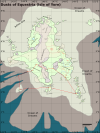
The Murinal Empire is named for the rat (Murinali ''murinat''). The keeping of fancy rats as pets in Murinia has a storied history. According to mythic history, when the Bhexidu conqueror Aghoor the Terrible conquered the city later known as Murinabaq, a particularly beautiful domestic rat was presented as a gift to him by the Matupaphu princess Matia, who begged him not to carry through with his plans to sack the city and carry its spoils to the mountains. As he was unfamiliar with the proper handling of the animal, the rat bit him, resulting in a fatal infection. In the ensuing power struggle among the invaders, Aghoor's nephew Tubarang came to power instead. Tubarang, evidently more sympathetic to the achievements of the lowland peoples than his uncle, did not sack the city. The city (and the Empire) were not named until much later, when a campaign of new construction under the Nasēsru saw the capital renamed in an allusion to the dynasty's claimed descent from the Matupaphu via Princess Matia. == History == === Prehistory === The Murinal civilization arose in the river valleys of the western lowlands of Murinia, at least 5000 years ''ante descensum''. Writing was developed independently by this Proto-Murinal civilization, diffusing outward from the Musatabhin river valley settlements, but the indigenous pictographic writing system was supplanted by one adapted from the Belite system completely. In fact, the old Murinal writing system is now a largely undeciphered script. === Classical Antiquity === The Murinal civilization came into its own around 900 AD, when the Musatabhin river valley civilization expanded by conquest and colonization to control the area known as Great Murinia. Its founding dynasty, the Matupaphu, were overthrown by Bhexidu mountain people in 740. However, the Bhexidu dynasty assimilated lowland cultural and political norms. In 517, the Padrāmu dynasty came to power, and oversaw the conquest of the Ithenian and Eghenhadine kingdoms of the south in 511 and 502 respectively. A devastating plague, which spread from seafarers, caused the collapse of the first empire in 318 AD. The Second (and current, by their reckoning) Murinal Empire arose in 210 AD. Its center was again the Musatabhin river cities. Its founding dynasty, the Nasēsru, subdued the southern dominions and many tributaries who had broken away as part of the collapse of the first empire. They rebuilt the capital, renaming it Murinabaq in an allusion to the mythic history of the region, and attempted to create a distinct Murinal (''Murinu'') cultural identity for the Empire. Nasēsru conquests added the Northern Dominion to their Empire, and came into conflict with the Belite civilization that had taken root in South Bel. The war went poorly for the new empire, and its expansion was checked, for the time being, by the Belites at the Belande river. A peace was concluded in 172 AD and a productive period of cultural interchange began despite the rocky start. The new empire had only a weak scribal tradition, Murinal literacy having much diminished during the 318-210 dark age, and the much simpler Belite system of writing was adapted for the Murinali language. === Late Antiquity === Twofold Way (312 PD) Second Belite war === Imperial Age === Maritime Power Conquest of Khamanians Great Tsunami Wars with the Empire of Atsef Dynastic change === The Division, and Maturity of the Empire === Conquest of Eastern provices Inconclusive War with the Eastern Throne Religious strife Dynastic change Tributary states === Modern Times === Foreign trade ports Dynastic change == Geography == [[attachment:murinia.png|{{attachment:murinia.png| Map of the Murinal Empire | width=400px }}]] === Climate === === Terrain === === Ecology === == Politics == === Political Subdivisions === The Empire is divided into five Dominions (''srebaqu'') and the ancestral homeland of the Murini, Great Murinia. Great Murinia is ruled (notionally) by the Emperor directly, whereas each dominion is ruled by an imperial vassal lord, whose title ''srebāt'' is [[PM/Translation Convention|translated]] 'Dominator.' The Dominions are the Northern Dominion (''Srebaq Abha''), Ithenian Dominion (''Srebaq Ithena''), Eghenhadine Dominion (''Srebaq Eghenāda''), Eastern Dominion (''Srebaqi Rūna''), Belvestine Dominion (''Srebaqi Belbhesa'') and Khamanian Dominion (''Srebaqi Khamana''). Some Dominions contain Imperial Cities (''Azraru Masrephā'') which are ruled by the Empire directly, rather than by the Dominator. === State Institutions === === Military === === Legal System === === Foreign Relations === == Economy == === Agriculture === === Trade === === Technology === The Murinal Empire has global preeminance in metallurgy, siege warfare, and pyrotechnics. Although its seafairing technology was once the envy of the world, it has been eclipsed in the Middlesea by the Kingdom of Heghom and the Maritimes. The Murinal fleet is still known, and feared, throughout the Southern Ocean, from the Pagan Kensus to the many tributary cities of the southern coast of the Great Desert. The Empire maintains an active policy of technological assimilation, rewarding skilled immigrants lavishly for technical secrets. The Empire has a vibrant tradition of plant and animal breeding. === Finance and Currency === The Murinal Empire's economy was originally based on silver, measured by weight, in common with most of the region. Presently, the main unit of currency is the "head" (Murinali: ''gāph''), named not for the image of the reigning Emperor on it, but for its weight equivalence to an idealized head of Murinal barley, 3.63 grams. The one-head coin is of a rounded square shape, about 14-15mm on a side. It is made of an alloy of about 90-95% silver, with the precise composition depending on the time it was minted and the source of the metal. Most of the balance is copper, which is the only alloying element added deliberately to Murinal coin silver. Murinal coins are rectangular in shape and made by casting. Larger coins have a hole at one end to facilitate putting them on a string for storage, and "string" (Murinali: ''sratat'') is a term meaning forty heads, i.e. 134 grams of coin silver. Prototypically, a string would be five 8-head coins, and historically, it corresponded to 10 days of wages (the working days in the [[PM/Calendar|twelve-day week]].) The Empire has a robust system of public banks. Lending money at interest has been a lucrative Imperial monopoly for centuries, and the Murinal banking system extends almost throughout the Southern Continent, and even north to Heghom and the Maritimes. === Magic === == Demographics == === Population === === Language === === Ethnic Composition === == Culture == === Religion === The predominant religion of the Murinal Empire is the [[PM/Twofold Way|Twofold Way]]. The orthodox Twofold Way is the state religion, but the Empire has long pursued a policy of religious toleration. There are substantial minorities of [[PM/Belvestianism|Belvestian]] polytheists and [[PM/Solar Temple|Solar Templars]], most of whom are members of Old Temple denominations. In the jungle and high mountain regions, indigenous animistic beliefs are widely practiced. In the Belvestine Dominion, taken from South Bel by conquest, Belvestianism is actually the majority religion. Though the Empire does not sponsor the practice of the Belvestian faith, it did not interfere with the pre-conquest system of temple endowments that supported it under the Belite state. === Arts === The Murinal Empire contains many of the artistic centers of Selt. The Empire produces the best fine-art metal casting in the world. === Cuisine === === Animal Fancy === [[WikiPedia:Fancy_rat|Rat fancy]] is an ancient cultural fixation of the Murinal Empire. For centuries, aristocrats and commoners alike have engaged in the keeping of domestic rats. The Murinali people do not consider their domestic rats to be the same animal as common verminous rats, a viewpoint supported by the considerable phenotypic divergence between the populations. However, common and fancy rats can (and, to the consternation of rat fanciers, sometimes do) interbreed. Murinal fancy rats are very large, weighing about a kilogram. They come in a staggering variety of coat colors and breeds, though yellow rats are a perennial favorite. |
(Under construction)
The Murinal Empire (Murinali: Masrephi Murinat [ma'ʂe.pʰi mu'ri.nat]) is the state controlling most of Murina, a tropical region of the Southern Continent. Its head of state is the Murinal Emperor, though in political matters the Emperor is largely a figurehead for his Grand Vizier; the Emperor's real cultural significance is as a spiritual leader. The Empire is made up of many constituent nations with their own laws and customs; many tributary states on the Southern coast of the continent acknowledge the suzerainty of the Empire.
The capital is Murinabaq, on the Western coast of Murina, in the heart of monsoon country.
The Murinal Empire is named for the rat (Murinali murinat). The keeping of fancy rats as pets in Murinia has a storied history. According to mythic history, when the Bhexidu conqueror Aghoor the Terrible conquered the city later known as Murinabaq, a particularly beautiful domestic rat was presented as a gift to him by the Matupaphu princess Matia, who begged him not to carry through with his plans to sack the city and carry its spoils to the mountains. As he was unfamiliar with the proper handling of the animal, the rat bit him, resulting in a fatal infection. In the ensuing power struggle among the invaders, Aghoor's nephew Tubarang came to power instead. Tubarang, evidently more sympathetic to the achievements of the lowland peoples than his uncle, did not sack the city. The city (and the Empire) were not named until much later, when a campaign of new construction under the Nasēsru saw the capital renamed in an allusion to the dynasty's claimed descent from the Matupaphu via Princess Matia.
History
Prehistory
The Murinal civilization arose in the river valleys of the western lowlands of Murinia, at least 5000 years ante descensum. Writing was developed independently by this Proto-Murinal civilization, diffusing outward from the Musatabhin river valley settlements, but the indigenous pictographic writing system was supplanted by one adapted from the Belite system completely. In fact, the old Murinal writing system is now a largely undeciphered script.
Classical Antiquity
The Murinal civilization came into its own around 900 AD, when the Musatabhin river valley civilization expanded by conquest and colonization to control the area known as Great Murinia. Its founding dynasty, the Matupaphu, were overthrown by Bhexidu mountain people in 740. However, the Bhexidu dynasty assimilated lowland cultural and political norms. In 517, the Padrāmu dynasty came to power, and oversaw the conquest of the Ithenian and Eghenhadine kingdoms of the south in 511 and 502 respectively. A devastating plague, which spread from seafarers, caused the collapse of the first empire in 318 AD.
The Second (and current, by their reckoning) Murinal Empire arose in 210 AD. Its center was again the Musatabhin river cities. Its founding dynasty, the Nasēsru, subdued the southern dominions and many tributaries who had broken away as part of the collapse of the first empire. They rebuilt the capital, renaming it Murinabaq in an allusion to the mythic history of the region, and attempted to create a distinct Murinal (Murinu) cultural identity for the Empire. Nasēsru conquests added the Northern Dominion to their Empire, and came into conflict with the Belite civilization that had taken root in South Bel. The war went poorly for the new empire, and its expansion was checked, for the time being, by the Belites at the Belande river. A peace was concluded in 172 AD and a productive period of cultural interchange began despite the rocky start. The new empire had only a weak scribal tradition, Murinal literacy having much diminished during the 318-210 dark age, and the much simpler Belite system of writing was adapted for the Murinali language.
Late Antiquity
- Twofold Way (312 PD) Second Belite war
Imperial Age
Maritime Power Conquest of Khamanians Great Tsunami Wars with the Empire of Atsef Dynastic change
The Division, and Maturity of the Empire
Conquest of Eastern provices Inconclusive War with the Eastern Throne Religious strife Dynastic change Tributary states
Modern Times
Foreign trade ports Dynastic change
Geography

Climate
Terrain
Ecology
Politics
Political Subdivisions
The Empire is divided into five Dominions (srebaqu) and the ancestral homeland of the Murini, Great Murinia. Great Murinia is ruled (notionally) by the Emperor directly, whereas each dominion is ruled by an imperial vassal lord, whose title srebāt is translated 'Dominator.' The Dominions are the Northern Dominion (Srebaq Abha), Ithenian Dominion (Srebaq Ithena), Eghenhadine Dominion (Srebaq Eghenāda), Eastern Dominion (Srebaqi Rūna), Belvestine Dominion (Srebaqi Belbhesa) and Khamanian Dominion (Srebaqi Khamana). Some Dominions contain Imperial Cities (Azraru Masrephā) which are ruled by the Empire directly, rather than by the Dominator.
State Institutions
Military
Legal System
Foreign Relations
Economy
Agriculture
Trade
Technology
The Murinal Empire has global preeminance in metallurgy, siege warfare, and pyrotechnics. Although its seafairing technology was once the envy of the world, it has been eclipsed in the Middlesea by the Kingdom of Heghom and the Maritimes. The Murinal fleet is still known, and feared, throughout the Southern Ocean, from the Pagan Kensus to the many tributary cities of the southern coast of the Great Desert. The Empire maintains an active policy of technological assimilation, rewarding skilled immigrants lavishly for technical secrets. The Empire has a vibrant tradition of plant and animal breeding.
Finance and Currency
The Murinal Empire's economy was originally based on silver, measured by weight, in common with most of the region. Presently, the main unit of currency is the "head" (Murinali: gāph), named not for the image of the reigning Emperor on it, but for its weight equivalence to an idealized head of Murinal barley, 3.63 grams. The one-head coin is of a rounded square shape, about 14-15mm on a side. It is made of an alloy of about 90-95% silver, with the precise composition depending on the time it was minted and the source of the metal. Most of the balance is copper, which is the only alloying element added deliberately to Murinal coin silver. Murinal coins are rectangular in shape and made by casting. Larger coins have a hole at one end to facilitate putting them on a string for storage, and "string" (Murinali: sratat) is a term meaning forty heads, i.e. 134 grams of coin silver. Prototypically, a string would be five 8-head coins, and historically, it corresponded to 10 days of wages (the working days in the twelve-day week.)
The Empire has a robust system of public banks. Lending money at interest has been a lucrative Imperial monopoly for centuries, and the Murinal banking system extends almost throughout the Southern Continent, and even north to Heghom and the Maritimes.
Magic
Demographics
Population
Language
Ethnic Composition
Culture
Religion
The predominant religion of the Murinal Empire is the Twofold Way. The orthodox Twofold Way is the state religion, but the Empire has long pursued a policy of religious toleration. There are substantial minorities of Belvestian polytheists and Solar Templars, most of whom are members of Old Temple denominations. In the jungle and high mountain regions, indigenous animistic beliefs are widely practiced. In the Belvestine Dominion, taken from South Bel by conquest, Belvestianism is actually the majority religion. Though the Empire does not sponsor the practice of the Belvestian faith, it did not interfere with the pre-conquest system of temple endowments that supported it under the Belite state.
Arts
The Murinal Empire contains many of the artistic centers of Selt. The Empire produces the best fine-art metal casting in the world.
Cuisine
Animal Fancy
Rat fancy is an ancient cultural fixation of the Murinal Empire. For centuries, aristocrats and commoners alike have engaged in the keeping of domestic rats. The Murinali people do not consider their domestic rats to be the same animal as common verminous rats, a viewpoint supported by the considerable phenotypic divergence between the populations. However, common and fancy rats can (and, to the consternation of rat fanciers, sometimes do) interbreed. Murinal fancy rats are very large, weighing about a kilogram. They come in a staggering variety of coat colors and breeds, though yellow rats are a perennial favorite.