|
Size: 7892
Comment:
|
Size: 7654
Comment:
|
| Deletions are marked like this. | Additions are marked like this. |
| Line 16: | Line 16: |
| In general, the range of physical sizes of the characters is somewhat condensed compared to their real-world equivalents, so architectural and design accommodations for rodents are more like those designed for little people in real life. All of the species are considered to be somewhat anthropomorphic (bipedal and with at least somewhat dexterous hands.) | All of the species are considered to be somewhat anthropomorphic (bipedal and with at least somewhat dexterous hands.) |
RIS is set in a broadly earthlike world in which all mammals have human-like intelligence (similar to the original hicu-rpg setting) though, unlike that setting, there are no actual humans. The technology level is similar to the 1920s-1930s, but the history and geography only vaguely correspond to those of our world, sharing a similar optimistic Zeitgeist following a major international war, compare to the Interwar period of human history. It is not my intention to extensively document the setting on the wiki before using it, but a brief outline is given on this page as a framework for further development and to allow players to have a sense of the setting without getting too far into the details.
Geography and Planetography
The game takes place on an earth-like planet, which is about 80% covered by water, has polar ice caps, has a single large barren moon, etc. The primary continents are arranged in a roughly ring-like shape around the Central Ocean spanning both sides of the equator. There is another continent on the opposite side of the planet, across the Outer Ocean, which was late to be discovered on account of its extreme remoteness from the origins of placental mammal civilization. It is called the New World for obvious reasons.
Species and Cultures
A similar variety of animal species exist as on earth, with many creatures in common. All mammals have human-like intelligence; non-mammals have similar intelligence to their real-world counterparts. Marsupial mammals were extinct on the Old World since before history was recorded, but continued to exist in the New World, where no placental mammals were found. Since contact between the continents was established, though, there has been significant exchange of species.
There are many cultures and civilizations. Most civilizations are multi-species, currently and throughout history. Mono-species civilizations are not unknown but tend to be small and compete poorly with multi-species civilizations when their interests came into conflict.
Rodents tend to have a relatively lowly position in civilization. However, their civil rights have improved in recent times, and in many places they enjoy equality before the law - at least theoretically.
All of the species are considered to be somewhat anthropomorphic (bipedal and with at least somewhat dexterous hands.)
Technology, Transit and Economy
The technology level is roughly similar to the late 1920s. Aviation and electronic technology is somewhat more advanced, with computers based on vacuum tubes starting to appear, but they are hobbled by primitive memory technologies.
Transit is by train (mostly diesel and electric), automobile, steamship, or aircraft. Both lighter-than-air and heavier-than-air craft exist; the former are culturally favored for luxury long-haul transport, though flying boats are making inroads. The jet engine and the liquid-fuel rocket are known in principle but not used yet in practice.
The global economy is currently doing well, riding an economic boom after the recovery from the Great War. It is diversified and industrialized. Resources continue to flow from the New World to the Old, though under less violent circumstances than before.
Prior to contact with Old World civilization, the New World had attained literate agricultural civilization, but was pre-industrial and unable to resist the economic and military dominance of Old World colonizers.
History
Recent history is notable for the Great War, which ended 15 years ago. This was a general war among the great powers surrounding the Central Ocean. The Southern Alliance fought the National Combine for six years, ending with an expensive victory for the Alliance. The nominal cause of the war was conflicting interests in the colonization of the New World. The Alliance secured the support of the colonized New World nations by promising independence, a promise which was honored, if perhaps not entirely according to the spirit of the agreement. The socialist nations of the Transmontane Pact, who only entered the war after several years and saw little fighting on their own territory, have been strengthened geopolitically.
Since the end of the war, more marsupials have come to live in the Old World, and a fair number of placental mammals born in the New World have decided to return to their metropoles rather than face the transition to majority rule in the New World.
The New World was discovered about 200 years prior to the Great War, and colonization began in force within about fifty years.
Simha City and the Obsidian Peninsula
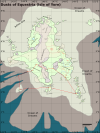
Simha City is a metropolitan city state in a temperate, coastal region on the Central Ocean, the Obsidian Peninsula. A major shipping hub, it was heavily targeted during the war, but quickly rebuilt thereafter; much of the city is of new construction. It has a liberal democratic government, which was part of the Southern Alliance during the Great War. However, it is not part of the embargo that some capitalist nations are maintaining against the Transmontane Pact, and so it is a major hub of external trade for them as well.
Historically, Simha city was the capital of a thalassocracy ruled by the Red Lion Clan, its erstwhile royal family. They remain powerful in business and politics, though the head of state is now an elected President.
Although Simha City is undoubtedly very prosperous, that wealth has not been at all equally distributed, and there is sometimes labor unrest in the city.
The RIS
Your private investigator firm, the Rodent Investigative Service, is a chartered private detective agency, which has limited police powers under Simhalan law when hired to investigate crimes. Of note, the criminal justice system of Simha operates under a model in which private prosecution before a magistrate predominates and the activities of public prosecutors are largely limited to matters of state security, high profile crimes, and the investigation of organized crime.
The RIS is often hired by insurance companies, mutual aid societies, and prosecution associations on behalf of their members who have been the victims of crimes. However, its services are also hired for security, civil, and family law cases, encompassing activities from industrial counter-espionage to divorce proceedings.
The RIS has both core employees and a variety of part-time contractors who are brought in for cases on an as-needed basis.
The chief of the RIS is Mick Belka, a rat. A bookish aficionado of true crime literature (and the All-Peninsular Chess Champion), he claims to have spent most of the war working as a quality control inspector in a radio factory. He undeniably has a significant knowledge of practical investigative work, although it is unclear how he came by it as he appears to rarely leave the main office on business.
The RIS has a motor pool, an in-house forensic laboratory, a couple of satellite offices on the peninsula, and access to the Investigator's Subscription Library for research needs. It is headquartered in the Camberline Building in the Fruitmarket District.