The Great War was the defining event of modern history in the world of the RIS campaign, and in the young adulthood or childhood of most RIS characters, depending on their age. It ended 15 years before the start of the campaign (in Winter 4793 AM), by implication in 4778 AM. The war was fought mainly between two sides, called the (National) Combine and the capitalist and liberal-democratic (Southern) Alliance, with the socialist Transmontane Pact joining the war late on the side of the Alliance.
Major Parties Involved
The origins of the National Combine lie in the 4710s as the two great rival Empires of the the old world, the Mesogorian Empire and the Green Empire, underwent significant social upheaval as a result of indigenous unrest in their overextended, directly-administrated colonies in the New World. Their economies had grown heavily dependent on mercantilism, and when violent independence movements in the new world degraded the prosperity of the population at home, it added fuel to nationalist movements. Many local aristocracies and devolved feudal leaders seized the opportunity to co-opt nationalist sentiment and break away from the Empires. On the other hand, some provinces of the empires attempted to become republics, casting off feudalism altogether. Much of the old world became a patchwork of tiny sovereign polities as the old empires collapsed, leading to a decade of economic contraction and the contraction of old world control over the new world in the former Mesogorian and Green colonies. Into this chaos emerged a powerful and charismatic general, duke Jaron Einhorn of Lorria, who began a war of conquest and unification to build a new Empire. He was very successful, though some former constituent polities of the old empires were never reincorporated. Tempering his conservative, monarchist world-view with an understanding of the needs and aspirations of the common people, Einhorn swept through his opponents and created a supranational union of mostly-small monarchies, styled the New Empire, with himself as a constitutional Emperor. Under the leadership of Emperor Jaron, the rebellions in the new world colonies were subdued in the 4730s-4740s and mercantile revenues and goods returned, distributed through the New Empire and under his direct control.
The New Empire, however, did not long outlast Emperor Jeron; his son, Jeron II, abdicated in 4756 after a few years on the throne after being unable to reverse a downturn in the colonial revenue, and the imperial monarchy was dissolved in favor of an elected chancellor of a new supranational union, the National Combine. Note that this chancellor was not democratically elected, but selected by the royal heads of state of the constituent polities. The National Combine tightened the screws on its colonies in the New World in an attempt to extract more wealth for itself, and enacted more oppressive mercantilist policies there through the 4760s, intensifying its economic rivalry with outside trading powers and its subjugation of indigenous populations.
States known to have been part of the Combine include Calenz and the as-yet unnamed state from which hailed General Hegenvol, the great protagonist of long-range dirigible bombing.
The Southern Alliance came into being in the 4750s-4760s, as major old-world countries outside the National Combine sought to protect their own trading interests in the New World; another factor pushing these mostly liberal-democratic and capitalist countries together was concern for Communist revolution. They generally supported policies of Free Trade, and often did little to prevent their merchants from attempting to defy the restrictive policies of the National Combine and directly trade with the Combine's New World colonies. Indeed, before the formation of the Alliance, many of these sea trade powers had done a tidy business supplying weapons and other materiel to the indigenous rebels in directly-governed imperial colonies in the new world, and resented the Combine's reassertion of control. Many of the population in the Alliance countries were also sympathetic to the democratic and nationalistic aspirations of the rebels, and regarded feudalism as backward; these noble sentiments were ripe for exploitation by politicians by the late sixties. The Southern Alliance countries, of course, had colonies of their own in the New World, but their directly-administered territories were tiny enclaves, island forts, port cities, and trading factories - for the most part, the Southern Alliance countries worked closely with native partners in their colonialist enterprises, propping up favorable indigenous elites with good terms on weapons and modern infrastructure, and occasionally sending in the marines to depose a particularly reluctant native ruler. Overall, though still clearly exploitative, the Alliance's colonial enterprise was less expensive to maintain and provoked much less violent resistance from the natives.
States known to be part of the Alliance include Simha City, Calidoria, Haldar, and the Coiné Union. The Vaghan Empire was neutral in the war until it nominally joined the alliance after the outcome was not in question.
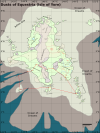
Under the pressures of urbanization and the concentration of wealth in the hands of the post-industrial-revolution elite, socialist and communist thought took hold in many countries, both democratic and otherwise, in the early-to-mid 48th century. During the collapse of the Mesogorian Empire, some of its far-flung Northern territories became the world's first states to be governed by parties holding to these ideologies. Attempting to spread their revolutions internationally, they came into sometimes-violent conflict with other powers in the region, but ultimately most countries in the far north joined their Transmontane Pact, which was divided from the Coiné Union by the Northern Barrier Mountains in the west, and from the New Empire by the Pohja Mountains in the east. Although most of the leaders of the Transmontane pact accepted the idea that the socialist world revolution need not be forced by their intervention and attempted to establish peaceful coexistence with their neighbors, ideological tensions were still strong. The countries making up the Pact had no substantial colonial enterprises of their own, and an ideology hostile to colonial exploitation in general. The Pact fought a border war with the National Combine and the independent Republic of Pojoimaa before the outbreak of the Great War, but had peace treaties with both by 4765. It was, however, economically isolated from most of the Southern Alliance, where capitalist parties attempted to bring down the Pact through an embargo.
States known to be part of the Pact include the titular Transmontanian People's Republic, but no others have been named so far. They are known to have various varieties of left-wing governments, ranging from democratic socialism to more "hard" leftism espousing dictatorship of the proletariat through a very strong central state.
Overall Outcome
The Southern Alliance and Transmontane Pact were victorious, achieving their stated war aims, and many of the countries of the National Combine were occupied. The Combine itself was dissolved after its executive council ratified the Instruments of Conditional Surrender. An international organization, the Comity of Nations, was established to organize international diplomacy and to manage the chief international work to be done - the decolonization of the new world and the construction of governments in the former Combine nations. Of course, both of these have been marked by intense squabbling between the Alliance and Pact as to the form of government which should be encouraged to develop there.