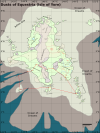
Agriculture in the Dusts is almost completely dependent on irrigation either by intensive cloud herding or by other means; only about 20% of the agricultural land receives enough precipitation to support even drylands farming, and most of that is north of the Hoofmount. Most irrigation is dependent on wells to the fossil aquifer under the uplands. The settlement of Springvale has a natural artesian well, but in most locations, deep wells must be dug and various sorts of mechanical contrivances used to lift water from them for crops. Water is too precious to transport by open canals, where it would be vulnerable to dust contamination and especially to evaporation; it is usually transported from the wells to farms in covered channels made of kaolin clay and roughly-hewn stone. In some areas, the ground is sufficiently hard and impervious to permit tunnels to be excavated as an alternative to the construction of surface channels.
The development of this extensive irrigation system took hundreds of years and began in earnest around the 28th century, as the Isle of Yore entered a period of relative peace.
The irrigation system is nominally controlled by the Water Lords of the hills, who own the oldest wells and extract an obligation of off-season corvee work on the maintenance of the system in exchange for its use. The water transport systems are typically maintained yearly. In the past, the Water Lords were a political force rivaling cities, but their power and independence has been curtailed significantly in the recent centuries, starting in the 3120s, by improvements in well technology. These improvements allowed deeper wells to be drilled, capable of reaching the aquifer in areas other than the foothills under the Water Lords' control.
Although the widespread building and adoption of these irrigation systems did much to alleviate the hardships of living in the Dusts, depletion of the fossil aquifer is a serious concern in the long term; some previously productive land has already been abandoned because of this problem, and the amount of water being removed from the aquifer has increased dramatically since the 32rd century. There is a serious concern that the great increase in agricultural productivity seen as a result of the development of widespread irrigation is not sustainable and that the attendant increase in the urban population will be dramatically reversed when the aquifer is depleted.