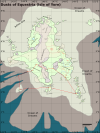
Angxue, the Soaring-Snow State (昂雪國) is a constituent polity of the Earth Kingdom. (Whether or not it should be considered an Earth Nation is debatable.) It previously contained a majority of ethnic Air Nationals, prior to the Air Nomad Genocide, and is the site of the Northern Air Temple, one of the four great cardinal Air Temples.
Geography
Angxue is located on the northern coast of the Earth Kingdom. As the name implies, it is rather cold, with a very short growing season. Coastal lowlands are dominated by peat bogs, including the unusual boreal saline peat bog typical of the neighboring Nitan State. A central valley of boreal forest (the Rong valley) is the only large area where agriculture is readily possible, chiefly using the Northern Lentil, giant parsnips and turnips, and short-season grain landraces. Milkvetch is used as a fodder crop for Sky Bison and other animals. The rest of the state is dominated by mountains; some mountain valleys with an Alpine climate afford a brief growing season and are the main source of grazing lands.
The Great Qin Road passes through Angxue, connecting it with a much wider segment of the Earth Kingdom than its highly isolating terrain would suggest. The civil earthbending works of the Great Qin Road as it passes through the extremely difficult terrain of Northeastern Chenbao to the State of Angxue are considered extremely impressive even today; it is said that Qin the Great's soldiers marched eighty abreast through Angxue during their Northern Campaign.
History
The first inhabitants of Angxue were ethnic water nationals who colonized the coast along the Northern Sea, but they did not move inland. By 4500 BG, Air Nomads migrating from the South had established themselves in the high Alpine valleys, though as they had not yet developed the technologies and practices necessary for year-round habitation, they would overwinter in the vicinity of the Western Sea. Eventually, a permanent monastic settlement appeared in the mountains, which grew into the Northern Air Temple as the Air Nomad's spiritual and monastic traditions developed; the monks were instrumental in developing crop cultivars that could survive in Angxue. By the time of the late Di dynasty, there was an extensive population of Air Nomads, as well as Beituzhu tribes and the original water tribes on the seacoast.
Eventually, the State of Angxue was annexed by the Earth Kingdom; in exchange for peaceful annexation, the abbots of the Northern Air Temple extracted various concessions from the Earth Kingdom. Notably, the temple itself and its immediate surroundings remained the sovereign possession of the monastic order, whereas the grazing lands that supported it with tithes and rents, and the temple's agricultural lands of the central valley, became sovereign territory of the Earth Kingdom, held in fee simple by the Air Temple. Tribute of sky bison products and religious art was sent to Ba Sing Se.
During the Ri Dynasty, some of the terms of the terms of the accession were renegotiated under the supervision of the Shenxing Emperor. Broadly, these terms appear to have been favorable to the Air Temple, and motivated by the Emperor's piety and interest in the Air Nomad religion. They eliminated all but a symbolic tribute obligation, and increased the subsidy of silver and grains sent from Ba Sing Se in return, but also secularized the administration of temple lands, which would thereafter be managed by Earth Kingdom officials on behalf of the Temple rather than by monk-officials.
Almost a hundred years ago, with Firebending greatly enhanced by the appearance of a comet, the Fire Nation invaded Angxue and committed genocide against the inhabitants. A sneak attack on the Northern Air Temple decapitated the Air Nomad leadership and resulted in the deaths of the vast majority of the monastics, with only a handful of its monks escaping (or being away from the temple at the time.) The Fire Nation proceeded to kill as many Air Nomads as it could find, and when this proved difficult due to their mobility, they poisoned the alpine valleys that supported the sky bison herds.
This was, of course, an act of war against the Earth Kingdom, but having enjoyed a long peace, the regional Earth Armies were unprepared to effectively resist the Fire Nation attack, and mostly did not try due to poor morale. Many non-air-national inhabitants of Angxue were also slain by the invaders, either out of confusion, because they were ethnically mixed, or because their presence was obstructing the operation; not a few died due to starvation as organized agriculture and trade broke down and arable land was poisoned.
The Fire Nation withdrew from Angxue as Chenbao and Ba Sing Se managed to muster armies and counter-attack, not wishing to have another front in the war on such unfavorable and profitless terrain. The Chenbao Army still occupies Angxue today, and the state remits its taxes to Maoshi rather than Ba Sing Se as a concession for this protection.
Nowadays, the valleys have recovered from the poisoning by the Fire Nation, and are capable of supporting life again. They remain sparsely populated, but some refugees have settled there recently, raising mainly ibex-goats. A relatively small part of Angxue was ceded to the Yonggan State, in a treaty largely negotiated by Chenbao. The benefits of the Treaty for Angxue were small and mostly related to free access to the Great Qin Road (which it already should have had), but the Yonggan State obligated itself to supply war badgermoles for the Chenbao Army. The circumstances were widely seen as establishing Chenbao as the suzerain of Angxue, or as an attempt by Chenbao to secure its more important colonies in Angxue against Yonggan expansionism.
Anthropology
Formerly, ethnic Air Nationals were the main group, though they never made up much more than half of the population, as the carrying capacity of the grazing lands was limited. Most of the Air National population were Air Nomads, but there were also settled ethnic air nationals in the valleys.
Jinggong Suizu (tributary water tribes) submitting to Earth Kingdom suzerainty inhabit the northern coast. There are also Beituzhu people inland, who mixed more or less freely with settled Air Nationals and formed a contact culture with them.
Since the Air Nomad genocide, a significant number of Chenbaozu have moved to the region and effectively colonized it. Originally, many of these people were camp followers of the Chenbao Army, but as the occupation became permanent, additional settlers moved there for economic reasons. One group of settlers has taken up residence in the Northern Air Temple itself, making significant modifications to the structure and experimenting with advanced technology.
Economy
Angxue is relatively poor since the loss of the sky bison herds that accounted for most of its exports. There is a limited mining industry, which has grown since the arrival of the Chenbaozu colonization. The water tribes on the northern coast export limited amounts of marine mammal products since the establishment of a tryworks a few decades ago, something that the Air Nomads had managed to prevent diplomatically prior to the genocide. Overall, the economy was previously autarkic and is now somewhat distorted by the wages of the Chenbao Army's soldiers, which are tending to subsidize its development.