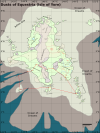
Beigang(北港, "Northern Port")is a port city in Xinbei Province (新北省) Northern Region of the Earth Kingdom. The largest city in the Northern Region outside of the State of Chenbao, It is an important route for goods to be brought from the Northern coast of the Earth Kingdom, and from international trade with the Northern Water Tribes, to Ba Sing Se via the Great Canal system. Beigang is located near the outlet of the Third Sister River (三姐江) into its associated bay, which is a natural shelter for ships from the sometimes rough climate of the North Sea.

History
Though the area had been inhabited for millennia by various Shuizu and Northern Aborigines (i.e. Beituzhu), and was the site of a prosperous Hwasalbujok settler village for centuries prior, Beigang was officially founded during the reign of the 6th Earth King (1099 - 1064 BG), one of the Former Ting dynasty. This was part of the king's ambitious program of canal building and infrastructure improvement, linking Ba Sing Se to the North Sea via an improved and expanded Grand Canal system (initially built in the late Di dynasty.)
The city has flourished almost since its founding. During Qin's rebellion, Beigang was heavily damaged in fighting between a general of Qin the Great and a warlord supporting the 46th Earth King. It was rebuilt during the Hao Ting renaissance, with significant improvements to its urban planning.
Lately, with the decline of the Hao Ting, the appointed officials of the city have been focused more on the extraction of tariffs on the Northern trade with the Central Earth Kingdom than with municipal administration. Criminal gangs, and even daofei, have been operating in the city, and citizens have banded together to form vigilante groups to protect themselves. Since the expansion of the Fire Nation invasion of the Earth Kingdom, refugees have come to the North, and many of them have settled in Beigang as it is more culturally familiar than the countryside. There has been a surge of refugees from the Central Continent recently, associated with the campaign of the Fire Nation's crown prince, General Iroh, to capture Ba Sing Se. This has added to the tensions within the city, as well as creating a homelessness problem and creating opportunities for criminals and rogues to exploit.
Geography and Climate
Beigang is situated on the West bank of the mouth of the Third Sister River. It is in a low-lying area, and much of the city is vulnerable to floods. Prior to the extensive flood control measures built by the earthbenders of the 6th Earth King, settlement had been confined to the relatively higher southwest part of the city's current territory.
A few minor tributary creeks of the Third Sister River flow through Beigang.
The winter climate is cold, with average temperatures below freezing for much of the winter. Spring and Autumn are mild and pleasant. Summers are moderately humid and warm, but not hot, with highs in the mid to upper 20s C. The climate is on the drier side, but there is some precipitation throughout the year, and it generally snows several times a year.
Demographics
All major ethnic groups of the North are represented in Beigang. A plurality are Zhongzu, with the recent expansion of their population with refugees; there is tension not only between the refugees and the other ethnic groups, but between the refugees and "Old" Zhongzu who had been living there before the Fire Nation invasion. There is a large and very old Ganjinese ethnic enclave in the city, home to about half of Xinbei province's Ganjinese population. A Shuizu village on an island just north of the city proper, is also legally part of its jurisdiction, but is not directly administered by the mayor of Beigang.
The government offices are located on the eponymous Yamen Hill in the Southwest of the town.
Transport and Infrastructure
The navigability of the mouth of the Third Sister River has been extensively improved by dredging and the construction of artificial riverbanks. There is also extensive development and improvement of the harbor, to such an extent that the original natural harbor at the site of Beigang is difficult to distinguish from its expansions. There are stone piers on the mouth of the river. A chain blocks the Third Sister River except for a designated channel, where officials may ensure that goods-laden shipping is diverted to the customshouses and properly taxed. There are also piers on the river itself.
Since its reconstruction after Qin's Rebellion, the city has enjoyed good streets in the city center, and well-built bridges and public facilities. However, in the past few centuries, the infrastructure has fallen into relative disrepair under a series of administrators who have been neglectful of such municipal matters.
A tunnel from inlet works on the Third Sister River upstream of the city provides drinking water to public fountains and baths, and some wealthy private estates. These waterworks were built in the reconstruction of the city after Qin's Rebellion, and greatly reduced the incidence of cholera. The water is delivered under pressure (about 20 meters of head) through tunnels earthbent through the bedrock, and is also used for hydraulic power in some areas.
Beigang has a high-quality underground sewer system, mostly built around the same time, though some underground sewers in the city center were carved out by badgermole tunneling during the Great Ri and remain in use. Waste is held in underground ponds before being pumped into the Third Sister Bay to be carried out with the tides. Initially, the sewer system was expanded with the city, but the areas of the city that have been built in the past century or so are not consistently connected and many of them have waste removed by night-soil collectors or in crude open sewers. Some industrial areas have greywater drains that run as open trenches, carrying water to natural stream courses or to the sea or river, which carry the used water from the hydraulic power system (so as not to impose an excessive burden on the blackwater sewers.) They also carry storm runoff.
Formerly, the city had a small civil waterbending corps of municipal waterbenders hired from the Northern Water Tribe or from assimilated or ethnically-mixed Suizu water tribespersons indigenous to the Northern Coast of the Earth Kingdom. The infamous Earth King Jialun put an end to this, as he and his advisors felt that it was inappropriate for the Earth Kingdom to rely on waterbenders in any essential capacity. This has made maintaining the infrastructure progressively more difficult, and there have been more interruptions as parts of the system must be blocked off and drained by earthbenders and manual laborers for maintenance.
Defenses

A cross section of the inner wall dividing the Royal Dockyards complex from the rest of the city. The outer wall is about three times as high.
Beigang has several walls protecting parts of the city, as well as an overall city wall with limited extensions to protect satellite settlements and an incomplete extension of the walls inland past the royal fort. The city walls are of stone raised from the bedrock and are of fairly typical construction for the northern earth kingdom, where timber remains abundant. Between the stone outer walls is rammed earth reenforced with massive timber (to prevent hostile earthbenders, or, especially, war badgermoles, from quickly breaking through.) Under the walls, in the cavity left from the elevation of the bedrock, an inspection catwalk runs to allow patrols to watch for hostile mining activity during times of war. In low-lying areas of the city, this cavity is partially filled with water as it extends well below the water table.
Economy
The economy of Beigang is focused on trade and maritime support industries. There are also some industrial facilities in the area, using hydraulic power from the water system to power grain mills, but mostly the hydraulic power is used to operate cranes and other ship- and cargo-handling equipment for the docks.
There are large tryworks in Beigang, but as local marine mammal populations have decreased, they have been surpassed in production by those of Mukai Town (much of the finished oil still passes through Beigang, but only as cargo.)
There is a substantial shipbuilding industry in Beigang, and the Royal Hao-Ting Dockyards. It provides labor to many different people, though many of the skilled trade apprenticeship-lineages were founded by the Hwasalbujok community, who brought with them their traditions of carpentry (a relatively underdeveloped field in most of the Earth Kingdom, on account of the availability of earthbending for stone building construction.)
A substantial fishing industry is based in Beigang, though it has declined since its peak. Many fishing boats, often run by multi-ethnic crews, have Beigang as their home port. The tidal flats of Third Sister Bay have economically important shellfish beds, the harvesting of which is regulated. Originally, Shuizu did most of the harvesting for their own use or to sell to inland people, but a series of corrupt actions about two hundred years ago put the rights to the shellfish beds almost entirely in the hands of a couple of wealthy settler families and their companies. Shuizu still do most of the actual work of harvesting, but for wages. An exception is on Ts'ikwa island, where the shellfish beds and rights to them remain firmly in indigenous hands.
Workhouses have lately been established to house and feed poor refugees; some of these have been established as self-sustaining charities, but others were founded as money-making enterprises and tend to be very exploitative. They make a variety of labor-intensive products, and many are employed in splitting firewood for the city.
A locally-famous product is the "Dragon Stove," a whale-oil fired cooking appliance favored by elite chiefs throughout the region, and increasingly popular in Ba Sing Se. It is expensive, but lightweight, making it useful for shipboard use. The Dragon Stove was invented about 90 years ago by DAMURA Akari, a Fire Nation expatriate who decided to stay in the Earth Kingdom rather than heed the Fire Lord's orders for all Fire Nationals in the Earth Kingdom to return home. The Damura Dragon Stove Company has remained in the hands of the family ever since. However, there is no firebender in the rising generation of the family, calling the future of the company into question as their manufacturing process requires firebending. The company was recently renamed simply to the "Dragon Stove Company" to avoid rising anti-Fire-Nation sentiment in the wake of General Iroh's campaign.
Culture
The city has a well-known indigenous shrine downtown, the Old Kutkh Shrine, which predates the construction of the city. It is named for a raven spirit important in Beituzhu mythic history as a trickster god who fooled the moon into providing light at night instead of exclusively shining with the sun during the day. The monthly New Moon Ceremony is celebrated by Northern Aborigines there.
The Wood-changing-to-Stone Temple (木變石觀) is the main place where the traditional popular religion of the Earth Kingdom is practiced; several numinous spirits are venerated there including the city's guardian spirit Shilinshen (石林神). The altar of Shilinshen is carved from a single large piece of petrified wood, brought from the South under the patronage of the 19th Earth Monarch. The temple is attended by a priest and a dozen shrine maidens. Most of the Zhongzu and other settler population is not particularly religious, but visit the temple during festal times, such as the Autumn Harvest Festival and New Year.
There is a small community, about 150 persons, of settled practitioners of the Air Nomad Religion (Angjiao), who are (supposedly) all ethnic Earth Nationals who converted to the religion hundreds of years ago. They support a shrine with an attached urban monastery housing about ten monks and nuns, including a cleric who is the religious leader of the Angjiao community of Beigang. (Prior to the Air Nomad genocide, they were attached to the Northern Air Temple and had only monks; now, the monastery is no longer sex-segregated, though the religious living there are still celibate.)
The immigrant community, particularly recent waves of refugees, has fueled a growing demand for Central Earth Kingdom popular culture, and there are several theaters catering to their entertainment desires. The existing Zhongzu community has acted as a bridge to the integration of their newly-arrived counterparts, but has been sometimes overwhelmed by the pressures of integrating them and there is tension. Wealthy patrons have tried to help refugees get resettled, as the government has done little to keep them fed or housed.
Several scribal schools train students in reading, writing, and the Classics, as preliminary preparation for the Civil Service Exam. Some hopefuls from the Central Region come North to study and establish local residency, so that they can then sit for the Civil Service Exam in Xinbei, where they hope the competition will be less stiff. These students often supplement their income by selling scribal services. There is also a Royal Learning Hall in Beigang, where the civil service exam is administered and earthbending is taught to students willing to agree to government service. The incumbent Grand Lector there is Hae-Won, a fourth-rank official who hails from the Eastern Region. Recruiters make grand promises of prestigious service guarding the Earth King or manning the walls of the inner city, but in truth, all but the most talented provincial earthbenders it trains are funneled into grueling and repetitious work on the towpaths of the grand canal system. A few bright students are sent to the capital, but most of them end up manning the outer wall defenses for the Royal Earth Army. Up-and-coming earthbenders in the know, at least those with a tolerance for risk, are more likely to join up with General Yi.
Prostitution, including entertainment-prostitution, is technically illegal, but the law is only selectively enforced and there is a significant red-light district.
The Old Omashu Opera House downtown is a local cultural attraction, over 400 years old. It originally (as the name implies) featured an opera company from Omashu, and a highly-assimilated form of the Omashu opera is still performed there. However, other acts also use the venue.
Occupying a choice piece of real estate at the city center is the Old Kutkh Shrine, an Beituzhu aboriginal shrine and its surrounding gardens. It predates the founding of the city, and indeed any settlement by non-indigenous people. Several attempts to put the land to other, more economically productive, uses have failed as the result of mysterious disasters. Many Non-Beituzhu generally avoid the shrine for superstitious reasons. Crowds of aboriginal pilgrims from the outlying areas visit it for the New Moon Ceremony every month, and sometimes become disorderly. Mayor Lai's predecessor attempted to limit the number of visitors in an attempt to control these rowdy crowds, but in the wake of his death, the policy has gone unenforced, and most settlers just try to stay out of the way of the pilgrims when the new moon emerges.
Politics and Crime
The Mayor of Beigang is an official appointed by the Ba Sing Se government directly, often without much consideration being given to the opinions of the governor of Xinbei, much less that of the local people. The current mayor is LAI Yuangen, a native of the middle ring of Ba Sing Se who has worked his way up through the bureaucratic ranks. Mayor Lai is less corrupt than some of his recent predecessors, and is known for shunning bribes, but it is undeniable that he has focused on making sure the flow of goods to Ba Sing Se continues uninterrupted over any other issue. In particular, he has been very reluctant to divert any municipal revenue to address the refugee situation, which has acutely worsened in the past few years, and has cut spending on infrastructure not related to the harbor and downtown areas.
Some of the Peoples' Self-Defense Organizations, formed to combat crime given the inadequacy of the official constabulary, are politically active, agitating in favor of one official or another. Although there are no elections and all officials are appointed, the officials doing the appointing do listen to the input of prominent citizens, who are in turn influenced by these various vigilante societies. (Some are also influenced, bribed, or threatened by criminal gangs.)
The most prominent Self-Defense Organizations are the Hongtang (紅堂, "Red Hall") Society and Baitang (白堂, "White Hall") Society, who are rivals. The Red Hall excludes New Zhongzu (i.e. people from the Central Earth Kingdom who moved to the North after the outbreak of the War with the Fire Nation) and unassimilated indigenous people. The Baitang split off from the Hongtang over this issue, and is more inclusive ethnically, but requires stringent character references for prospective members.
Organized criminal groups are dominated by the underworld suzerainty of the Dajianghui, (大江會 "Big River Association") which is an umbrella group controlling various smaller organizations in a quasi-feudal fashion. The Dajianghui, or at least some of its more violent constituent groups, are sometimes considered to be daofei (盜匪, i.e. violent bandits), especially by the authorities and the People's Self-Defense Organizations.