|
Size: 1648
Comment:
|
Size: 3350
Comment:
|
| Deletions are marked like this. | Additions are marked like this. |
| Line 5: | Line 5: |
| The Great Qin Road, on the other hand, is much more recent, dating the Earth Kingdom Civil War, where it was built to deliver Qin's army from their landing sites in Chenbao to the Central Earth Kingdom. It may be considered alongside the walls of Ba Sing Se as among the greatest works of civil earthbending extant in the world. Its construction through Yonggan State was desired and encouraged by the Aisin-Nara prince of Jin who was ruling as khagan at that time, and who threw his lot in with Qin the Great. | The Great Qin Road, on the other hand, is much more recent, dating to the Earth Kingdom Civil War, where it was built to deliver Qin's army from their landing sites in Chenbao to the Central Earth Kingdom. It may be considered alongside the walls of Ba Sing Se as among the greatest works of civil earthbending extant in the world. Its construction through Yonggan State was desired and encouraged by the Aisin-Nara Prince of Jin who was ruling as khagan at that time, and who threw his lot in with Qin the Great. |
| Line 7: | Line 7: |
| At the intersection of the Sun Road and Great Qin road was constructed a monument to the alliance between Qin and the Yonggan, with inscriptions and gigantic statues. Following Qin's death and the Hao Ting reconquest, the statues were defaced by the Royal Earth Army, and the monument fell into disrepair. Indeed, the official policy during the period of direct rule, was one of deliberate neglect. Nonetheless, the ruins have remained the subject of popular veneration, and lately, the Yonggan Nationalist regime has been engaged in archaeological and restoration work at the site. | At the intersection of the Sun Road and Great Qin road was constructed a monument to the alliance between Qin and the Yonggan, with inscriptions and gigantic statues. Following Qin's death and the Hao Ting reconquest, the statues were defaced by the Royal Earth Army, and the monument fell into disrepair. Indeed, the official policy during the period of direct rule, was one of deliberate neglect. Nonetheless, the ruins have remained the subject of popular veneration, and lately, the Yonggan Nationalist regime has been engaged in archaeological and restoration work at the site. As described by sources who saw it after it was first completed, the monument consisted of four monumental statues and many large relief carvings of historical and mythological scenes. Two of the monumental statues were of Qin the Great and the Nara Khagan, Aisin-Nara Jierhalang; these were the leaders whose alliance was commemorated. The other two were of the Yonggan mythological-historical figures Lord Nara, legendary founder of the then-ruling clan, and his father Barutu, a legendary Yonggan culture hero. The Royal Earth army defaced all four statues; they had been ordered to spare the statue of Barutu, but confused it with the statue of Lord Nara. Realizing the mistake, the officer in charge defaced the statue of Lord Nara as well. Some decades after the civil war, during the Hao Ting renaissance presided over by Avatar Kyoshi and the Earth Sages, the Barutu statue was permitted to be restored by volunteers, but state support of the site was not reinstated. Some of the subsidiary relief engravings were also vandalized by the Royal Earth Army, but not in a systematic way. Additional relief carvings have been unofficially added over the centuries, and sometimes defaced or removed with equal irregularity. The Qin statue was 42 meters tall, somewhat taller than Jierhalang and Lord Nara, and only a hair shorter than Barutu when his headgear is considered. In reality, of course, Qin was not known for his height, and was shorter than Jierhalang. Pilgrims continue to visit the site today, and there is a small modern shrine and a hermitage for folk Earth Sages in the mountains nearby. Some Yonggan priests also consider the site numinous and conduct rituals there. |
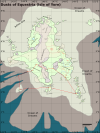
Holboni Dabagan is a place in the Celestial Mountains of Yongganguo, where the Great Qin Road intersects with the Sun Road.
The Sun Road was built in the 800s BG by civil earthbenders of the Nara Clan, to connect their capital at Gainan with the Nemu and Walrus Rivers. These rivers, which communicate to the Western Lake and North Sea, respectively, were important trade connections; the completion of the Sun Road laid the economic foundations for the Nara clan's successful challenge of the Jala clan's khaganate.
The Great Qin Road, on the other hand, is much more recent, dating to the Earth Kingdom Civil War, where it was built to deliver Qin's army from their landing sites in Chenbao to the Central Earth Kingdom. It may be considered alongside the walls of Ba Sing Se as among the greatest works of civil earthbending extant in the world. Its construction through Yonggan State was desired and encouraged by the Aisin-Nara Prince of Jin who was ruling as khagan at that time, and who threw his lot in with Qin the Great.
At the intersection of the Sun Road and Great Qin road was constructed a monument to the alliance between Qin and the Yonggan, with inscriptions and gigantic statues. Following Qin's death and the Hao Ting reconquest, the statues were defaced by the Royal Earth Army, and the monument fell into disrepair. Indeed, the official policy during the period of direct rule, was one of deliberate neglect. Nonetheless, the ruins have remained the subject of popular veneration, and lately, the Yonggan Nationalist regime has been engaged in archaeological and restoration work at the site.
As described by sources who saw it after it was first completed, the monument consisted of four monumental statues and many large relief carvings of historical and mythological scenes. Two of the monumental statues were of Qin the Great and the Nara Khagan, Aisin-Nara Jierhalang; these were the leaders whose alliance was commemorated. The other two were of the Yonggan mythological-historical figures Lord Nara, legendary founder of the then-ruling clan, and his father Barutu, a legendary Yonggan culture hero.
The Royal Earth army defaced all four statues; they had been ordered to spare the statue of Barutu, but confused it with the statue of Lord Nara. Realizing the mistake, the officer in charge defaced the statue of Lord Nara as well. Some decades after the civil war, during the Hao Ting renaissance presided over by Avatar Kyoshi and the Earth Sages, the Barutu statue was permitted to be restored by volunteers, but state support of the site was not reinstated. Some of the subsidiary relief engravings were also vandalized by the Royal Earth Army, but not in a systematic way. Additional relief carvings have been unofficially added over the centuries, and sometimes defaced or removed with equal irregularity.
The Qin statue was 42 meters tall, somewhat taller than Jierhalang and Lord Nara, and only a hair shorter than Barutu when his headgear is considered. In reality, of course, Qin was not known for his height, and was shorter than Jierhalang.
Pilgrims continue to visit the site today, and there is a small modern shrine and a hermitage for folk Earth Sages in the mountains nearby. Some Yonggan priests also consider the site numinous and conduct rituals there.