<<Card: execution failed [local variable 'page' referenced before assignment] (see also the log)>> 
Overview
The Yonggan State (Yongganguo) is a constituent polity of the Earth Kingdom, located in the northwesternmost part of the Western Region of the Central Continent. It is the national homeland of the Yonggan people. It is currently a mostly-independent khanate controlled by a Yonggan enthno-nationalist movement, which has been encroaching on neighboring polities along irredentist and ethnic lines.
History
Antiquity
Originally an independent khanate, sometimes a tributary of the Abka khagan, its borders have shifted over time with the political fortunes of the Yonggan and the relative strength of the state centered in Ba Sing Se. The Alarame People, one of several predecessors of the Yonggan, Nogai, and Abka, intermittently recognized the Earth King as their overlord since the late Di dynasty, though their territory was not an organic part of the Earth Kingdom until the Tu. The Yonggan State, by that name, was formally created in the Di dynasty. Although still designated as a guo (國), it has been (legally in the eyes of the Ba Sing Se government) a directly-governed province since the Earth Kingdom Civil War.
Before the War

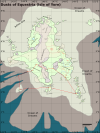
Territories of some principal Yonggan clans at the time of NARA Boosi, ca 800 BG. (The two Eastern clans are not shown.)
After being reduced in size by the Hao Ting after the Yonggan support of Qin the Conqueror, the de facto boundaries of the state have expanded again in the past few decades, as ambitious local leaders have gained effective control over Yonggan-majority areas from neighboring jurisdictions. The central government, preoccupied with the Fire Nation invasion, has not taken any effective action to reverse this, and the scholar-official appointed as Governor by the Earth King appears to be subordinate to a Yonggan nationalist warlord, Gioro Emoto Dabciku. No taxes have been remitted to Ba Sing Se since 72 AG.
Since the War
Geography
 Map of the modern Yonggan State.
Yongganguo is located in the Western region of the Earth Kingdom, bordering the Central Region. With its modern de facto borders, it borders the states of Angxue (i.e. the Soaring-Snow State), Yi, Abka, and Nitan, and the Shanbei and Xiping provinces. Although it lacks a coastline, Yongganguo has access to the sea via the Gulf of Harmony, which is navigable by ocean-going ships well within the borders of the state.
Yongganguo is a mountainous territory, and part of its customary border, separating it from Nitan, is the so-called Northern Divide. This is a long series of cliffs and ridges, which separate its highlands from the swampy lowlands of Nitan. The Northern Divide is a locus of seismic and low-grade volcanic activity.
The Gulf of Rong (Gulf of Harmony) extends over 400 km south into Yongganguo, being over 10km wide for much of its length. In the south, receiving several rivers, most notably the Rong River, it is a brackish-water body with a unique ecosystem. Foothills ascend on either side of the Gulf gently; it does not have the steep-sided character of a fjord. Most of the Beituzhu people (Northern Earth Aboriginals) in Yongganguo live between the Rong River and the Carki-Khan mountains, though many centuries of genetic, cultural and linguistic contact have blurred the distinction between these people and the general Yonggan population of the North. Before the Air Nomad genocide, many Air Nomads would graze their sky bison in Northern Yongganguo, and especially the vicinity of the Gulf of Rong, as sky bison and badgermoles have little dietary overlap and can share pasturage with little competition.
Also in the north of the country are the Carki-Khan Mountains, and the Celestial Mountains, separated by the Crow River valley. The Celestial Mountains are part of a larger range extending as far East as West Shuizu State. Both mountain complexes have extensive semi-nomadic Yonggan populations living traditional lifestyles, as well as mining-oriented fortified towns. Seasonal transhumance patterns sometimes bring seminomadic mountain Yonggan from higher elevations down into not only the alpine valleys, but even into the foothills and Crow Valley, where they may come into conflict with settled populations over grazing activities.
West of the Carki-Khan mountains, but east of the Gulf of Rong, are largely forested lands. This axis of forested land sweeps down to the southeast of the country, though, there, much of the forest has been cleared for agriculture by Zhongzu settlers in the aftermath of the Earth Kingdom Civil War. The land is rather rocky glacial till and generally fertile for agriculture. This land has many small rivers and lakes and extensive alluvial deposits of gold and gemstones, which have been harvested for thousands of years by artisanal placer mining.
The Southeastern border of the country is mostly made up of the Elephant-Bird and Ostrich Horse rivers. Two large lakes, the Elephant Lake (formerly, Nara Lake) and the Ostrich-Horse lake, are of geographic and cultural significance.
In the Southwest, the East Yi mountains are home to many montane Yonggan practicing traditional lifestyles. This extensive mountain range separates Yongganguo from the Hanwang Desert, contained in the Abka State, and from the Yi and Angxue states.
The term "Nemuland" is applied to a portion of the central forested hill country and the better part of the Celestial Mountains, which was the domain of the Nara Clan. After the Nara supported Qin in the Earth Kingdom civil war, they were dispossessed and exiled to the Hanwang Desert. The Nemuland was disestablished as a political subdivision, with its territory divided up between neighboring Yonggan clans and mostly Zhongzu settlers sent by the Hao Ting to occupy the former Nemuland.
Another semi-distinct region is Mountain Yonggan Country, in the far south, abutting the Hanwang Desert. Formerly, although inhabited by Yonggan-speaking people, this land was controlled by the Abka State. Since the rise of irridentist Yonggan nationalism, this area was mostly-peacefully annexed into Yongganguo as a semi-autonomous governorate. This action has not been recognized by the Ba Sing Se government, as with the Yonggan State's other territorial expansions, but neither has the Royal Earth Army mounted any forcible opposition.
Climate
Yongganguo is a large country with a varied, but mostly cold, climate. (It is a little smaller than Ukraine and at about the same range of latitudes, extending a bit farther north.)
In the north, the country is mostly cold and wet, with moisture-laden air coming in from the North Sea through the Rong Valley in the brief summer. The country is somewhat warmer and drier in the south, with a small area of temperate semi-arid lands in the south near the border with the Abka State. The East Yi mountains are wet on the northern side, but cast a long rain shadow helping to form the upland Hanwang Desert, and are themselves rather arid on the south side.
The less mountainous northern parts of Yongganguo have a boreal forest biome. It gives way to temperate, mostly coniferous, forest in the Central Valley. There is a small area of semiarid steppe near the Ostrich Horse Lake, that biome extending over vast regions of the Western Plains province and Abka State to the East and South, respectively.
City or Landmark |
Represented Region |
Average Summer Temperature (High-Low) |
Average Winter Temperature (High-Low) |
Average Annual Rainfall |
Gainan |
Celestial Mountains - alpine valley |
25 - 17 ℃ |
-5 - -28 |
1180 mm |
Funghuwang |
Gulf of Rong - coastal |
22 - 20 ℃ |
-3 - -12 ℃ |
1650 mm |
Emotofuke |
Central Valley - foothills |
27 - 20 ℃ |
-2 - -8 ℃ |
970 mm |
Barututaku |
Yi Mountains - high desert valley |
35 - 20 ℃ |
-10 - -30 ℃ |
290 mm |
Laibao |
Riparian - transitional boreal forest |
25 - 19 ℃ |
-6 - -10 ℃ |
1390 mm |
Biology
Yongganguo is noted for both wild and domesticated badgermoles; badgermoles' native range stretches from Chenbao to Weizhuang Province and several species of badgermole are indigenous to the Mountain West. An example of charismatic macrofauna more localized to Yongganguo is the Pikatiger, an unusually large-sized, striped, and ill-tempered rodent that is occasionally deadly to the unwary. The much smaller Tigerpika is a creature which is not very dangerous by comparison. Badgergoats, surface-dwelling relatives of badgermoles who use their natural earthbending for mobility, live in the high mountains, along with Ice Hyraxes. Armadillo-Dogs are found in the area of semiarid steppe in the Southeast of the country. Feral riverpigs are found in the Elephant-Bird and Ostrich-Horse river systems, but they are escaped livestock, not native to the area. The Alarame Macaquatoo is an a mammalian primate-like creature with a beak and fleshy crest on its head. It resists the stings of termite wasps and raids their nests, and is also known for enjoying hot springs. It is capable of gliding using a patagium.
Flying animals include the Carki Crowhawk, a bird of prey especially favored for falconry by the Abka minority, the Lesser Sparrowkeet, which is a popular pet, and the Yi Viperbat, a pest to miners.
Insects include the Jala Scorpion Bee, a stinging insect which produces a spicy honey beloved by many Southern Yonggan. It is naturally found only in the southernmost parts of the country, but has been semi-domesticated and transported through much of the central valley, where it survives the winter only with human intervention. The termite wasp, native to the boreal forests of Northern Yongganguo and the mountains below the tree line, manages with hibernation and elaborately-insulated paper nests. They digest cellulose and do not produce honey. The giant wood-borer is another wood-eating insect, and its larvae are a favorite food of badgermoles in the wild.
The Nitan pine is found extensively in the boreal forests in the north, giving way to the Yonggan redwood in the West and the Northern pine in the South and east. There are also some deciduous trees, more in the southeast. Yonggan forests are productive of berries and herbs. Ginseng grows wild in the highlands, and in cultivated gardens through much of the country.
Geology
The Central Valley is largely glacial moraine. The Carki-Khan mountains are an igneous province of mainly granite and gabbro, the Celestial mountains were formed by both tectonic uplift along the faultline of the Northern Divide, and associated volcanic activity. Here, the North Sea tectonic plate is colliding with the Centeral-Western Plate.
The Yi mountains in the south are due to uplift and have minimal geothermal activity, mostly associated with spiritual loci.
A notable large waterfall, the Cataract of Huwaliyasun, occurs where the Rong River emerges from the Yi mountains. The locks allowing boats to navigate the waterfall are considered a wonder of civil earthbending.
There are extensive deposits of alluvial gold in Yongganguo, as well as gold and silver in the mountains. Lead, iron and copper are found. There is a little coal in the north, though most of the deposits are located in Nitan state. Zinc and tin are found in the Yi mountains. Many kinds of useful structural stone are available in prolific abundance in the mountains. Good quality clay is found in the Central Valley and along the Rong river. In the volcanic areas in the North, cinnabar, orpiment, realgar, sulfur, and stibnite are mined.
The Orpiment Mountain is a volcanic hotspot in an otherwise "cold" area, thought to have originated because of spiritual activity, though theories vary.
Economy
The economy of the vast mountains and forests of the Yonggan State is focused on the primary industries and subsistence farming, but it has secondary and tertiary economic activities focused in the cities and towns.
Agriculture
As most Yonggan are nowadays settled agriculturalists, agriculture is a major sector of the economy. In the south, wheat is the main crop, followed by moderately cold-tolerant northern millet, whereas short-season cultivars of barley and sorghum are the main crop in the north. Rice cultivation is minor, for several reasons: first, most of the country is either too dry or too cold for it to be competitive with other crops; second, the largely hilly terrain would require terraces for flooded rice cultivation, an expensive measure which the low population density and relatively short growing season do not justify even in a country with abundant earthbending talent.
The badgermole, though it is of great cultural and military importance, is only a minor source of food: its dairy products are consumed as a delicacy, but its meat is taboo to the Yonggan, and badgermole slaughter is illegal; the slaughter and consumption of war badgermoles by the victorious Hao Ting troops after the surrender of Gainan is still widely remembered. In spite of the present political difficulties between the dynasty in Ba Sing Se and the local rulers of Yongganguo, trained badgermoles are still sold to the Royal Earth Army under the auspices of the khaganate. They are also sold to warlord armies the khagan considers friendly.
The main animals grown for food and textiles are the assgoat, pigdog, and wooly riverpig. Sometimes the latter animal is kept in earthbent ponds fed by small mountain streams, greatly extending the area in which it can be maintained; the ponds must be provided with winter shelters in which the animals can hibernate out of the ice. The assgoat is favored for dairy and fiber, but its meat is also eaten. It is sometimes used as a pack animal, especially suited to mountains, though the mulegoat is preferred. In lowland areas, the ostrich horse, usually hardy Abka breeds, are better pack and riding animals.
Industry
Metalworking is well developed, including mining, smelting, refining, casting, forging, smithy in a variety of metals, and fine artistic metalwork in iron and bronze. There is a nascent chemical industry, and a small but diversified selection of other industries such as tanning, charcoal-making, ceramics, and woodworking. The industrial heartland of Yongganguo is concentrated along the Horse-Bird and Ostrich-Horse rivers, depending on water power, but mills and factories are scattered about the central valley where hydraulic conditions permit and a settled population surplus sufficient to sustain them permits.
The Ceramics of the Rong River Valley are regionally appreciated and owe something to Beituzhu ceramics.
Although the steels of Yongganguo lag behind the quality of those of the Fire Nation, they are among the finest in the Earth Kingdom, comparable to those of Chenbao or the South. More work is done in precious metals, alloys, bronze, brass, and pewter notable among them.
The vegetable textile industry is concentrated around the Ostrich-Horse lake and dominated by ethnic Zhongzu. Most Yonggan prefer woolen garments, some also wearing furs, especially for winter clothing, which are obtained mostly as a byproduct of subsistence and market hunting. Silks are imported, mostly from Ganjingguo via the Ostrich-Horse river in exchange for metals and chemicals.
Medicines and religious products are produced in Gainan, still the largest city despite its decline since the Earth Kingdom civil war.
Trade
Salt is imported from the Hanwang Desert salt flats to the south, along with Nara badgermoles and some other cultural objects, mainly in exchange for food and textiles. Food and trained badgermoles are exported to the Yi State. Fish and sea products, such as train oil, are imported from Nitan and, formerly, Angxue. Yongganguo lacks maritime import controls, with the Earth Kingdom officials who were in charge of this at the Funghuwang customs house having fled; their replacement has been thusfar successfully obstructed by the Tatara clan whose base of power is in the region. As a result, Northern Water Tribe ships trade directly at many ports on the Gulf of Rong, sometimes dealing directly with even modest fishing villages by means of boats, and thereby avoiding paying any fees at all.
As far as internal trade, crude metals, obtained by smelters in mountain villages, are exported to craft workers and factories mostly located in urban areas, sometimes mills located in valleys to benefit from hydraulic power. Mountain ginseng and badgermole dairy products are produced in the highlands, as are some gathered or gardened forest products such as medicinal herbs. In the alpine meadows, various livestock are sometimes seasonally grazed by transhumant pastoralists. The lowlands mainly export grain to the highlands. Fish, mainly smoked or in the form of fermented sauces, is exported from villages on the Gulf of Harmony, whence products imported via the North Sea trade are also mostly received. Ceramics are mostly produced along the rivers of the central valley.
Forest products, including lumber, charcoal, and tar, and derivatives such as inkstones and turpentine, are both used locally and exported, mostly to the South via the Ostrich Horse river, as the Northern Earth Kingdom is generally well provisioned with forests. Some forest products do go to Nitan state, though, where much of the land is boggy with few trees. Some peat is imported from Nitan, in the far North.
Transportation
The Yonggan state has a comparatively dense network of roads compared to most of the Northern Earth Kingdom, and is less dependent on rivers. Roads range from narrow paths through the forest to the Great Qin Road, over which the armies of Qin the Conqueror marched eighty abreast. These are maintained by Yonggan earthbenders and, especially, the trained badgermoles of the civil earthbending corps. Rivers are still important and well used, and often developed with earthbending dredging or provided with locks and canals to facilitate transport. The Yonggan not having much talent with sailing and having a small waterbending Shuizu population in comparison to the more eastern states of the North, it is common for boats to be towed by pack animals on developed paths alongside a river or canal.
As a generalization, the mountain areas are more dependent on roads and the valleys on rivers, and the East of the country has a better developed network of both than the West. The steppes of the far south are generally traversed with ostrich-horses, and these do well on the roads as well. The assgoat or goatmule are preferred to the ostrich-horse to haul carts and carriages, though both are commonly seen doing this. The Rong River and the Great Qin Road are important in the export of metals to the North Sea Trade.
The Yonggan State has a stage coach system on the Imperial Highway, Sun Road, and the parts of the Great Qin Road controlled by the Yonggan State.
Culture and Anthropology
The Yonggan State is, as its name implies, predominantly populated by the Yonggan People, who are the indigenous inhabitants of the country excepting the Proto-Shuizu settlement areas along the Gulf of Harmony and some Beituzhu settlement in the far North. However, Yongganguo is not ethnically homogeneous, and many other groups now live there.
The most dramatic change to Yongganguo's demographics came after the Earth Kingdom Civil War, in which the Nara khagan supported Qin the Great in his attempt to overthrow the Hao Ting. After Qin's defeat, Yongganguo became part of a rump regime (the Northern Khaganate), which was eventually defeated militarily by the Hao Ting. Yongganguo was settled with mostly ethnic Zhongzu and Nanzu veterans of the Royal Earth Army in an attempt to pacify it. Most of them settled in the central Nemuland region, particularly in the Lake Country and Elephant River Valley, where land was more suitable for their agricultural methods than the more mountainous parts of the country. The descendants of these colonists from the Central Earth Kingdom make up a plurality of the population in parts of the Southeast. Over time, the distinction between Nanzu (i.e. persons from the South and Greater Omashu) was lost and almost all of the descendants of the settlers identify as Zhongzu; people identifying as Nanzu are mostly recent immigrants.
Ethnic Composition
Gulf of Harmony |
|
Group |
Percent of Population |
Abka |
5% |
Beituzhu |
7% |
Chenbaozu |
3% |
Ganjinese |
6% |
Shuizu |
12% |
Yonggan |
49% |
Zhongzu |
6% |
Mixed & All others |
12% |
Rong Valley except the Gulf of Harmony |
|
Group |
Percent of Population |
Abka |
26% |
Beituzhu |
11% |
Shuizu |
3% |
Yonggan |
51% |
Zhongzu |
2% |
Mixed & All others |
7% |
Central Valley |
|
Group |
Percent of Population |
Abka |
3% |
Ganjinese |
2% |
Yonggan |
79% |
Zhongzu |
12% |
Mixed & All others |
4% |
Carki-Khan Mountains |
|
Group |
Percent of Population |
Abka |
4% |
Yonggan |
91% |
Zhongzu |
3% |
Mixed & All others |
2% |
Western Yi Mountains |
|
Group |
Percent of Population |
Beituzhu |
4% |
Chenbaozu |
18% |
Ganjinese |
2% |
Yonggan |
39% |
Zhang |
3% |
Zhongzu |
21% |
Mixed & All others |
12% |
Southern Yi Mountains |
|
Group |
Percent of Population |
Abka |
7% |
Chenbaozu |
5% |
Yonggan |
71% |
Zhongzu |
12% |
Mixed & All others |
6% |
Lowlands South of Mt. Orpiment |
|
Group |
Percent of Population |
Abka |
37% |
Ganjinese |
3% |
Yonggan |
31% |
Zhang |
2% |
Zhongzu |
21% |
Mixed & All others |
6% |
Lake Country / Southeast |
|
Group |
Percent of Population |
Abka |
9% |
Beituzhu |
% |
Chenbaozu |
2% |
Ganjinese |
6% |
Heke |
4% |
Yonggan |
36% |
Zhang |
2% |
Zhongzu |
41% |
Mixed & All others |
10% |
Elephant River Valley |
|
Group |
Percent of Population |
Abka |
4% |
Ganjinese |
3% |
Heke |
6% |
Shuizu |
2% |
Yonggan |
36% |
Zhang |
3% |
Zhongzu |
34% |
Mixed & All others |
12% |
Celestial Mountains |
|
Group |
Percent of Population |
Ganjinese |
2% |
Yonggan |
81% |
Zhongzu |
13% |
Mixed & All others |
4% |
Far North |
|
Group |
Percent of Population |
Beituzhu |
15% |
Shuizu |
12% |
Yonggan |
55% |
Zhongzu |
7% |
Mixed & All others |
11% |
Crow-Dai River Valley |
|
Group |
Percent of Population |
Abka |
4% |
Beituzhu |
16% |
Ganjinese |
2% |
Shuizu |
5% |
Yonggan |
61% |
Zhongzu |
5% |
Mixed & All others |
6% |
The Ganjinese minority is almost entirely urban, and most of those who are not keep roadside inns, bathhouses, winehouses, and the like to serve travelers. The Shuizu are, naturally, concentrated in fishing villages on the Gulf of Harmony, though there are also some villages on rivers further inland. The Beituzhu are mostly found in the North in settled villages, practicing traditional lifestyles and usually paying tribute to one Yonggan clan or another for protection. The Abka minority sometimes live among Yonggan and intermarry with them, and these dispersed Abka are not genetically distinct from Yonggan; clan membership is matrilineal and family membership is patrilineal, as with the Yonggan, so some people with very small percentages of Abka blood are nontheless identified socially and on Yonggan censuses as Abka for this reason, even though they more likely speak Yonggan and maintain Yonggan customs. However, the Gorlos clan of Abka, who received protection from the Yonggan khagan in 994 BG, are settled west of the Carki-Khan mountains and remain mostly distinct and endogamous, speaking a dialect of the Abka language.
The Zhang minority is mostly urban and associated with the Ganjinese, having accompanied the Ganjinese as mercenaries during their years of regional ascendancy in the Western Tu and Elder Gong dynasties. Some Zhang settlements have long outlasted the Ganjinese factories and forts with which they were once associated, however, and a number of Zhang native to the Yonggan state have pursued the mineral wealth of the Yi mountains since their annexation.
Languages Used
Almost universally, the Yonggan speak the Yonggan language in various dialects. Many Yonggan also speak and read Common, which is the language of administration. Official proclamations are generally bilingual, though the Yonggan nationalists espouse the idea that only Yonggan should be used officially in Yongganguo. This is unlikely as centuries of records and documents are recorded in Common. What is more, though Yonggan has been increasingly written with its own phonetic alphabet since the Ri Dynasty, many old documents written in the Yonggan language use Common characters to represent the Yonggan language, making knowledge of the characters important for even the most Yonggan-Chauvinisti literati. On the whole, about half of Yonggan can speak common sufficiently for daily use, but these are disproportionately found in the valleys and towns, with mountain Yonggan practicing traditional badgermole pastoralism often not speaking any Common.
Non-Yonggan, and especially the assimilated Abka dispersed throughout Yongganguo, also may speak Yonggan. In the cities, many people who are not Yonggan or Zhongzu, are trilingual and understand both languages in addition to a home language such as Ganjinese. The Zhongzu in the Southeast, in the area that was most heavily colonized by Central Earth Kingdom settlers after the civil war, often do not speak Yonggan and are resistant to the idea that they ought to do so. Most Yonggan in just this area do speak, and often read and write, Common. Yonggan nationalists have expended much energy trying to persuade Yonggan to speak Yonggan by default in their public dealings.
A distinctive dialect of the Abka language is spoken by the Gorlos clan west of the Carki-Khan mountains. It is not mutually intelligible with modern Yonggan and has preserved many archaic features in comparison to the modern Abka languages.
The Beituzhu are linguistically diverse, but many of them understand some Yonggan or Common for trade.
Yongganguo's Shuizu minority usually speak Common in addition to their home language, but some in the interior speak Yonggan in addition to, or instead of, Common.
Cultural and Religious Institutions
Yonggan shamanism is mostly practiced out of doors or at shrines built around numinous sites, often caves with a spiritual presence. Since at least the days of the Great Ri, Yongganguo has been provided with various temples and monasteries of the Earth Sages. These were either shuttered or replaced with Royal Learning Halls after the suppression of the Earth Sages, but as central control has weakened, folk earth sages have reclaimed some of the abandoned facilities. Some of these folk orders blend pan-Earth-Nation wisdom and religious traditions with Yonggan shamanism, reminiscent of the religious syncretism of the Vast Sky Orthodox Religion, and they may compete in the market for divination and exorcism. The Royal Learning Hall in Garunggu is still in operation, with a Lector who is an official of the Hao Ting; it can safely be said that Garrungu is still largely under the control of Ba Sing Se despite the situation elsewhere and increasing nationalist activity. Earthbending and scribal arts are taught there.
There is a temple of the Spire-God Villagers in Funghuwang, which is the Easternmost such structure outside of Ganjin Country far to the South. It was founded by missionaries expelled from the State of Yi.
Education is mostly by apprenticeship, though there are common schools in many towns that teach reading and writing, of both Yonggan and Common. These are supported by tuition for their daily expenses, and are often endowed by wealthy patrons who wish for a good supply of clerks and scribes. Nationalists have taken to considering schools as a vehicle for the advancement of the people and promotion of a national identity, and have funded some urban schools which emphasize nationalist historiography. Some of them do not teach Common, but of those that do not, the characters are usually still taught so that the students can read old Yonggan-language works written in Common characters.
There are no universities in Yongganguo at this time, though the idea of building one in Emotofuke has been discussed at court. A teacher's college is associated with the scholarly nationalist community in Gainan, where a major school of the Great Northern Way earthbending tradition is also located.
The Yonggan have a tradition of communal bathing, which is an important social feature of both traditional seminomadic and urbanized Yonggan society. It has been influenced by Ganjinese ideas about hygene and the indigenous Yonggan and Beituzhu customs of sweat lodges and hot-spring bathing. Accordingly, these practices and traditions are more broadly associated with Yongganguo than the Yonggan in particular, though it is noteworthy that the Yonggan in diaspora mostly continue to carry them out. (Even the Nara clan, exiled to the Hanwang desert, continues to practice them among the elite, with the requisite water usage becoming conspicuous there.)
If not associated with a hot spring, Yonggan bath houses usually have a Ganjinese style of water and floor-heating system, fired by wood, or more rarely coal or peat, with a tall chimney. Usually, four or five extended families in a village, will share a single bathhouse owned in common, using it on different nights in rotation; only rich people have baths in their own homes, and those would still usually be shared with their extended family living in attached subsidiary dwellings. In towns, a greater number of families share a single baththouse, and it may be fired continuously rather than only in the evening. In Yongganguo, mixed bathing is the usual custom, though the most authentic Ganjinese bathhouses insist on segregation by gender except for small children. However, strangers do not bathe together except in some rural hot springs and remote mining camps. In villages, extended families bathe together, and indeed the sense of what constitutes one's extended familiy is essentially identical to the set of people a villager would bathe with. In the towns, family-based bathing groups are still the most common, but groups of individual friends or small families will also bathe together, especially if they are new arrivals from the countryside who do not have many family members in town. Private baths are unusual and mostly associated with shrines, for ritual purification of participants.
Sexual activity is taboo in the bath and believed to offend the spirits of the bathhouse. Although bathing is usually mixed-gender, men and women customarily sit on opposite sides of the bath and may have separate changing and washing areas, especially in towns and in Ganjinese-influenced baths. Village baths are more likely to have a common changing and washing area. It is usually fairly dark in the baths, which are often partially underground, and the air may be perfumed with incense. Staring and loud talking are considered impolite, customs inculcated in Yonggan children from an early age, but quiet conversation is frequent.
There is a Yonggan sweat lodge tradition, which may derive from a common cultural stratum with the Beituzhu. It is more of a spiritual activity, whereas bathing is more social and hygenic. However, the Ganjinese sauna tradition has long ago disseminated to Yongan Country, and it is widely offered at Ganjinese bathhouses, even ones that are more Yonggan in style. It can generally be assumed that an urban bathhouse advertising itself as Ganjinese will also offer a sauna.
Arts
Fine metalwork is undoubtedly the art for which the Yonggan State is best known. Ceramics and woolen goods are also carried on in a high state of technical sophistication, and sometimes reach the level of fine art. Silk and brocade are less developed. Painting is largely urban, and more associated with the Ganjinese and Zhongzu than the Yonggan. The Yonggan tradition of professional storytellers is alive and well, with stories from the Barutugisun popular alongside local legends, Air Nomad tales, and the moralizing ghost stories common throughout the Earth Kingdom. Poetry, music, and songwriting are also well-developed in addition to prose and spoken word; song and story are often blended. Some songs also emerge from Yonggan shamanism and contact with the spirit world, and in the Rong Valley, a distinct Shuizu influence is perceptible.

 Group including Yonggan people in the Northern Earth Kingdom, demonstrating the storytelling tradition.
Architecture
Most buildings are made of stone, as usual for the Earth Kingdom, though roofs are often wooden with ceramic tile. Arched stone roofs are also seen in some public buildings, but wood is actually considered grander. The tall redwood trees of the central valley are especially prized and sometimes exported, as such trees are not to be found in the central Earth Kingdom anymore. Green ceramic tiles are a common roofing material, though slate is cheaper. Earthbenders sometimes make claystone from clay and use it as a structural material in the lowland river valleys.
The pre-civil-war buildings of Gainan, and the historical Gainan Palace City, are considered the highpoint of architecture in Yonganguo. Besides some of the older buildings in Gainan, notable structures from the Ri Dynasty are the Imperial Hunting Lodge and Ri Ancestral Tombs. The Royal Learning Hall in Garunggu is a fine piece of Hao-Ting Rennasaince architecture, and it has some ornamental features bearing local influence. Emotofuke contains a number of recently-built grand public buildings. Under construction there is the Winter Palace of the Khagan, on which no expense is being spared.
Fashion
Fashion in Yongganguo has three poles - traditional Yonggan clothing, with peculiarities associated with each clan, is but the most obvious. High fashion in Yongganguo, preferred by the native elite, is heavily influenced by the Ganjinese. Lastly, that influenced by Central Earth Kingdom is important especially in areas of Zhongzu colonization. Blends between all these styles are seen, but the adoption of an explicitly-nationalist Yonggan fashion is emerging, which attempts to merge various clan-based clothing styles into a framework that can enter an artistic conversation with the Ganjinese and cosmopolitan Earth Kingdom styles. Some nationalist fashion designers have taken cues from the fashion of the Ri Dynasty, as this was a period of increased cultural contact that was on Yonggan terms, rather than from the Earth Kingdom fashions associated with Zhongzu settler colonialism in the aftermath of the civil war.
Traditional Yonggan clothing is warm and uses wool and fur extensively. Oiled leather outerwear is seen. Round hats with a dome emerging from a truncated cone, are traditional; ornaments such as tassels and gems attached to the hat are indicators of rank. Underwear is woolen or linen, rarely cotton, which is exclusively imported. Formal attire and official garments, under the influence of cosmopolitan earth kingdom fashions, use silks and brocade, but such clothes are too dear for most traditional Yonggan.
Colors are mostly grey or beige to light browns with trim in greens, yellows, or brownish-red. Some of the northernmost inhabitants wear blue-grays as well, similar to the Shuizu. More green is used in Ganjinese-influenced and official garments.
Yonggan men often wear a queue-like braid, though some wear a topknot; women wear two similar thin braids and often include elaborate hairstyles supported by jewelry on formal occasions. Ear piercing, often multiple, is seen, but other body piercing is rare among them.
To a varying extent, most non-Yonggan ethnic groups also follow these fashion trends, with the exception of the Gorlos Abka, who strictly adhere to their own traditional attire, and isolated Beituzhu villages. Shuizu clothing is more influenced by water tribe styles, though some accomodation of materials and colors is seen.
Cuisine
The cuisine of Yongganguo is heavily influenced by that of the Yonggan people. In broad strokes, it relies more on bread than rice (frybread, dumplings, and savory rolls and cakes, are favorites), as the great majority of Yongganguo is either too cold or too dry for efficient rice cultivation. Pickled and fermented foods are common. Hot pot, imported by the Ganjinese during the increased period of cultural contact associated with the early Western Tu dynasty, is a perennial favorite enjoyed by most citizens of the country. Seafood is eaten in the Gulf of Harmony region, and much of the country knows smoked fish and fermented sauces based on fish, though it is less popular in the mountains than the lowlands.
The cuisine of the southeast is a blend of Yonggan, Ganjinese, and Northwestern Earth Kingdom traditions, and is often considered the best by outsiders. This blending began before the Zhongzu settlement after the civil war; its origins rather date back to Yonggan bannermen of the Great Ri returning from their duties in the Central Earth Kingdom.
Food is mostly sweetened with honey, though some sugar is imported via the ostrich-horse river from the South.
The meat of the assgoat, riverpig, and pigdog are common red meats. Wild game is also popular, and market hunting, rather than farming, supplies around a quarter of the meat eaten in Yonggan country, disproportionately during festival times. Meat not consumed shortly after butchering is usually preserved by smoking. Marine mammal meat, a byproduct of train oil production, is eaten on the Gulf of Harmony, mostly by the Shuizu minority, but the general population of the country has little taste for it. Riverpig production is the main industry of the Heke, and various forms of riverpig meat are a major part of their cuisine.
Vegetables such as squash, potherbs, and beans are popular with most inhabitants. Mushrooms, often in complex symbiotic relationships with the forests, are gathered seasonally and much-loved; dried fungus is reconstituted year-round. The Yonggan Stone-Ear mushroom is prized. Yonggan sauce, a malted sauce made from mushrooms and sprouted short-season barley, is appreciated outside the region. Lichen beer is more of an acquired taste. In addition to conventional leaf tea, a savory brewed beverage is made from buckwheat and widely consumed in Yongganguo.
In general, the food in Yongganguo is less spicy than that of the Central Earth Kingdom, though the degree to which this is true is often exaggerated. Many imported spices have been popular with the Yonggan since major external trade began nearly 2000 years ago, and if less are used, it may be mainly out of a desire to economize on an expensive ingredient rather than being due to an intrinsic difference in tastes. Some local plants do provide seeds useful as spices, though indigenous flavorings are more commonly dried or fresh herbs than spices.
Dairy products, mostly of the assgoat, see wider use in Yongganguo than elsewhere, possibly because the Yonggan have about a 60% rate of persistent lactose tolerance in adulthood, versus only about 10% of Zhongzu. However, it is still mostly consumed in small quantities and as fermented foods such as yoghurt or cheese. Badgermole dairy is a delicacy, as though badgermoles produce a fairly large amount of milk, most badgermoles are not overmuch fond of being milked, and so it is usually consumed as small portions of highly flavorful cheese. Artisanal badgermole milkers identify lactating females with fewer than the usual number of cubs, and disguise themselves with padded costumes of fur while adopting a gait that carefully imitates the juvenile animal. It is a lucrative, but dangerous, vocation, which contributes to the cost. Fermented badgermole milk is consumed in shamanistic rituals.
Subdivisions and Politics
Yongganguo is, in the eyes of the Earth Kingdom government in Ba Sing Se, divided into various counties with appointed officials administrating civil matters. In practice, however, these jurisdictions are relevant only in towns; the countryside is administered almost entirely under Yonggan customary law. Even in the towns, Yonggan people rarely bring disputes with other Yonggan before the Earth Kingdom yamen, preferring to resolve their differences within the framework of traditional clan and family power structures. Each khan holds a court in concert with his head shaman and elders, to which any clan member might appeal if local dispute resolution fails. Lately, the yamens and officials working at them have come under increasing pressure to formally change their allegiance to the Khagan or his officers, and some have been forced out and replaced by native officials after failing to do so. In general, this process is most complete in the territory of the Emoto clan and in Yongganguo's territorial expansions, and least advanced in the East of the country, where Earth Kingdom law prevails to a greater extent.
Each clan has traditional territories, but their borders are subject to gradual evolution as families prosper, decline, and intermarry; the borders are associated with individual family grazing, hunting, mining, and agricultural rights.
The khagan of the Yonggan is Sakda-Emoto Dorgon khan, who also leads the Emoto clan. In theory, the khaganate is a ceremonial and spiritual office since the imposition of direct rule by Ba Sing Se after the Earth Kingdom civil war. During the Hao Ting renaissance following that war, the khagan rubber-stamped decisions of the appointed governor in temporal matters. This has no longer been the case for some time, however, and under Dorgon khan the civil official has been largely sidelined. The khagan has returned to a position of active political involvement, and has been cooperating with his son-in-law, the Yonggan nationalist warlord Gioro-Emoto Dabciku.
Dabciku expanded the territory of the Emoto clan by occupying lands belonging to the Abka state, but which were majority Yonggan. The clan armies, operating under the direction of the khagan, also occupied Yonggan-majority parts of Angxue and the State of Yi, and parts of the West Shuizu state that were historically Yonggan lands before the civil war. The warlord Dabciku has also expressed designs on portions of the Western Plains Province and North Mountain province which were formerly part of Yongganguo, even though those areas are no longer Yonggan-majority.
The country is not currently remitting taxes to Ba Sing Se, and has not since Dabciku married Dorgon khan's eldest daughter and was appointed the khagan's grand marshal. Since that time, the already-minimal tax payment that had been collected (chiefly from urban areas of mixed ethnic composition) has gone to Dabciku's Yonggan nationalist army.
Lately, the khagan has been moving further away from Ba Sing Se, and attempting to assert Yongganguo's status as an independent state. The Earth Army has been too preoccupied with the Fire Nation invasion to enforce its legal status as a directly-governed territory. Local powers aligned with Ba Sing Se, such as General Yi, are more concerned with courting Yongganguo as a regional power to jointly oppose the Fire Nation.
Capital
The legal capital of the Yonggan State is Garunggu, on the Elephant Lake near Qin's Bridge, in the East of the country. Historically, from the Nara ascendancy to the Earth Kingdom civil war, the capital was in the mountain city of Gainan. After the war, the native elite were banished from Gainan, and mostly-Zhongzu veterans settled there. The administrative capital was moved to Garunggu, and the appointed governor's yamen remains there to this day. Formerly, the Yonggan Khagan was obliged to reside in Garunggu for much of the year, but in 80 AG, the khagan has moved his court to Emotofuke, a new capital built in territory formerly held by the Nara clan, at the foot of the Orpiment Mountain. Emotofuke can be considered the de facto capital. The nationalist warlord Dabciku makes the city of Funghuwang his base of operations; it is located in the newly-annexed lands of the Rong river valley, Southeast of the Hailun mountain. Many Yonggan have returned to Gainan in the centuries since the war, and it remains the largest city, followed by Funghuwang, and Garunggu.
Governance
Yongganguo is mostly governed under Yonggan customary law, as noted above. In the cities, Earth Kingdom royal law has some influence, especially between non-Yonggan, and officials continue to be sporadically appointed by the Board of Appointments in Ba Sing Se. However, taxes are not being regularly remitted and there is extensive nationalist activity. What is more, the local leadership is actively occupying and annexing parts of neighboring polities on ethnic lines; in times of stronger central governance, the state would surely be considered to be in rebellion. However, the central government is, as yet, too occupied with the Fire Nation invasion and other problems to reassert itself in Yongganguo.
The de facto head of state is the khagan Dorgon. The Grand Marshal Dabciku is president of the khagan's council, and appears to be highly influential with the khagan, particularly with regard to foreign policy. The council consists of delegates from each khan and certain other regional and urban leaders, and leaders of the religious and scholarly communities. The council is dominated by Nationalists who wish to pursue a course of independent neutrality as part of a community of allied Earth Nations, and vary in the level to which they reject the authority of the Ba Sing Se government. The most pro-Hao-Ting members of the council advocate a return to the pre-Civil-War status of Yongan Country as a vassal feudal state to the Earth King; the most extreme nationalists favor full independence and advocate for cooperating with the Fire Nation or Northern Water Tribes to secure freedom from the Earth Kingdom, should it become necessary.
Each of the Yonggan clans and the Gorlos Abka have khans, and each of these khans is a vassal of the khagan. They have significant powers in their own territories, most of which are coterminous with the county boundaries of Yongganguo as revised by the Nationalists. Each county has a magistrate (a scholar-official) appointed by the Nationalist government. Each town or village has a chief or headman/headwoman; major cities have "urban prefects" who report directly to the central (Yonggan Country) government and not to the county magistrate of the surrounding land.
Khans of Yonggan State or of Yonggan clans |
|||
Family and Clan |
Given Name |
Title |
Note |
Sakda Emoto |
Dorgon |
khan of strategems (lit. schemer khan) |
Also khagan of the Yonggan and Gorlos Abka |
Arbu Aora |
Cuyen |
incisive khan |
|
Aiyin Nara |
Elden |
luminous khan |
In exile in the Hangwang desert. Dubious acession. |
Emit Jala |
Enduhen |
discrete khan |
Almost all of the khan's territory is in Shanbei and Pingyuanxi |
Nulu Ikulu |
Barutu |
striving khan |
|
Yoca Mengnat |
Duwara |
mountain khan |
|
Uya Tatara |
Hasar |
elegant khan |
|
Umu Urhan |
Jerjer |
reverent khan |
Only current female khan, rules east of Yonggan Country |
Aisin Sartuk |
Bahai |
khan of golden diagrams |
Territory east of Yonggan Country |