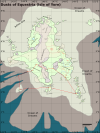
The Holy Antu Shrine is a small mountain shrine and hermitage located atop the Chief Peak. It is considered by traditional Eastern Yonggan shamanism to be a numinous site, where the Mountain Spirit Antu ("Sunny [i.e. Southern] side of a mountain") came to Earth and fathered the ancestor of the Yonggan people, Barutu. Western Yonggan instead believe that this took place at Mt. Sun, but still regard the shrine and peak as sacred. During the Ri dynasty, the Shenxing Emperor restored and expanded the shrine and facilities, but it has been in a state of rather poor repair for the better part of a century. It no longer receives state support, and is supported only by donations from its relatively infrequent visitors.
At the time of its restoration during the Shenxing reign, the shrine complex consisted of a central sanctuary, a small monastery with a meditation hall, kitchen, bath, and rooms for visitors. As part of the restoration, the monastery was completely rebuilt according to the design of the famed Eastern Peninsular architect and civil earthbender Kan the Incisive (間尖銳), commissioned by the earth monarch to take charge of the project. It is heated with a hypocaust system, very welcome given the climate. The shrine is above the tree line, so part of its (now discontinued) state support was in the form of fuel. Unfortunately, Kan died in an avalanche while descending the Chief Peak after a visit to supervise construction; he was entombed in the complex by the monks.
The central shrine building is an earthbent masonry dome of about 20 meters diameter, richly carved with scenes of Yonggan mythology. There is a solid jadeite altar stone directly under a central oculus.