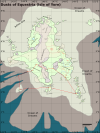
The Naraejebun ("Nara Chronicle") is a historical chronicle written, nominally, by the Prince of Lang, Niohuru-Nara Eidu, the younger brother of the seventeenth earth monarch Niohuru-Nara Arjin. It covers the history of the Nara clan, from the earliest times of myth and legend ca. 2100 BG, down to the great grandfather of the author, whose death in 801 BG concludes the work. It is based on the oral traditions of the Yonggan in the Nemuland, and of the Nara clan in particular, but also contains the results of extensive historical research in Yonggan and Common written sources. The Prince was assisted by a group of scholars, primarily Yonggan, some of whom traveled the Northern Earth Kingdom gathering material from storytellers and local records. Some ethnic Zhongzu scholars also participated, contributing to the literary and historical research, especially by searching the veritable records of previous dynasties for relevant material. However, they omitted anything which they thought might offend the Prince (a member of the Nara clan, who had only recently established a conquest dynasty in the Earth Kingdom), and so the Naraejebun paints an unrealistically positive picture of relations between the Central Earth Kingdom and the Yonggan.
The Naraejebun covers the descent of the Nara clan from the mythical culture-hero Barutu through his son, the Sun-Lord (i.e. Lord Nara). The establishment of the Nara clan's house of mantic shamanism, through Lord Nara's eldest daughter Nara Biyu, is also included. In all, the Naraejebun describes forty generations of the Nara clan, from Lord Nara to the undoubtedly-historical Nara Boosi, the first Yonggan Khan-of-Khans, inclusive.
In the parts of the chronicle more remote from reliable sources, its contents are likely legendary rather than historically accurate, but it exhibits a clear rationalizing impulse. This contrasts with the unashamedly mythological Barutugisun which preceded it as a great work of early Yonggan literature. That being said, it does bear the linguistic and stylistic influence of the Barutugisun, which was emerging as a national epic of the Yonggan.
The Naraejebun was written from the beginning in the Yonggan phonetic script. It was presented to the Renxian court in 730 BG and enjoyed the approbation of the seventeenth earth monarch, who ordered woodblocks cut. The work on this illustrated, bilingual edition was completed in 726, with the translation into Common being the work of the Shilin College of scholars in Ba Sing Se. The Renxian edition, as this version is called, differs slightly from the manuscript, by omitting material unflattering to the Earth Kingdom dynasties prior to the late Hao.
The Naraejebun, especially the Renxian edition, was undoubtedly intended to serve as unifying propaganda, glorifying the imperial clan to an audience of not only the other Yonggan clans and the literati of the Earth Kingdom, but to the members of the imperial clan itself. Nonetheless, it had real scholarship behind it, and where its historical content can be checked against other sources, it seems the authors were above outright falsehood, preferring rather to omit facts which did not support a positive view of the Nara ascendancy. That being said, part of its overarching narrative is to portray the gradual moral development of the clan to a position of just rulership, so it does not shy away from portraying some of the more remote historical figures as flawed.
Descent of the Nara
The following genealogy of the Nara is recorded in the Naraejebun. The dates in the chronicle are given using traditional Earth Kingdom dates, representing the efforts of the scholars to reconcile the history and traditions of the clan with recorded Earth Kingdom history. They did this even in the case of legendary figures, so the dates must be understood to be less than reliable the farther back they go. In the following table, figures are marked as H for "historical" if their existence and approximate chronology is confirmed by outside sources; H+ if some of the basic facts are also confirmed, H- for figures for whom only a similar name is corroborated or if the identification is uncertain. L is for legendary figures widely attested in Yonggan oral history and prior records of their stories, L+ for those common throughout the greater Yonggan cultural sphere and L- for those known only from the Naraejebun itself.
Of interest, the chronology set out by the Naraejebun is not the first attempt to reconcile Yonggan legend with the historical records of the Earth Kingdom. However, prior attempts by Yonggan scholars had denied the relative antiquity of the Earth Kingdom, making the Yonggan culture-hero Barutu a contemporary of Wen the Great (himself a legendary figure known only from the much older mytho-historical work Official History of the Wen and Gong, but whose years are conventionally 4912-4312 BG.) This resulted in many very long-lived monarchs in these prior chronologies of the Yonggan. In the Naraejebun, however, Lord Nara (Barutu's son) flourishes in the years of the late Di dynasty, and the raids of Barutu's brother Gaihasu are aligned with the proto-Abka raids on the Central Earth Kingdom which led to the Di dynasty fortifying their capital ca. 2400. The only exceptionally long-lived figures are those with substantial demispiritual ancestry. Thus, the Naraejebun candidly admits the relative youth of the Yonggan culture in comparison to those of Ba Sing Se or Omashu. This may have helped it to be accepted as historical by the Common literate culture emerging from those urban poles.
Number |
Name |
Dates |
Historicity |
Notes |
0. |
Barutu |
2481-2081 BG |
L+ |
|
1. |
Lord Nara |
2477-1877 BG |
L+ |
|
2. |
|
2450-1813 BG |
L |
|
3. |
|
|
L- |
|
4. |
|
|
L- |
|
5. |
|
|
|
|
6. |
|
|
|
|
7. |
|
|
|
|
8. |
|
|
|
|
9. |
|
|
|
|
10. |
|
|
|
|
11. |
|
|
|
|
12. |
|
|
|
|
13. |
|
|
|
|
14. |
|
|
|
|
15. |
|
|
|
|
16. |
|
|
|
|