|
Size: 70
Comment:
|
Size: 10638
Comment:
|
| Deletions are marked like this. | Additions are marked like this. |
| Line 1: | Line 1: |
| [[attachment:farnorth.png||{{attachment:farnorth.png||width=1000}}]] | [[attachment:farnorth.png|{{attachment:farnorth.png||width=1000}}]] The Northern Region is one of the subdivisions of the [[Avatar/Earth Kingdom|Earth Kingdom]] == Geography == === Northern Coast === === Peatbogs === === Northern Divide === === Northern Mountains === === Forests === === Three Sister Bays === === Otterbear Bay === === Walrus and Seal Bays === === Western Plains === === Western Coast === === Western Highlands === == Climate == == Anthropology == === Northern Aborigines === The Beituzhu (北土著), or Northern Aborigines (an exonym; endonym: ''Khemchik'') are the original inhabitants of the Northeast. They traditionally inhabited the wetlands and forests of the North, living in small villages with partially-underground longhouses. They are an earthbending people, i.e. ethnic earth nationals, though due to occasional genetic contact with the Water Tribes, they sometimes have waterbenders. Their language is unrelated to the Yonggan language but has many loanwords from it, as well as Ganjinese loanwords transmitted via the Yonggan. Before contact with the Central Earth Kingdom civilization, they were organized into small tribes. They traded with the Water Tribes and Yonggan, but also sometimes fought the latter for territory. They are mostly Fitzpatrick II-III in color. They have mostly green eyes. Most of them practice Kemchick shamanism, under syncretic influence with Moon Spirit Worship of the Water Tribes (the Ocean Spirit is considered less important to them) and Earth Kingdom Folk Religion. In the modern day, many continue to practice traditional hunting and gathering lifestyles; others practice short-season sorghum cultivation, peat cutting, trap fishing, and fur trapping. Earthbending is more common among them than among the descendents of Zhongzu settlers, and they are sometimes employed for their bending, e.g. in construction. Some live as an urban underclass in settler cities; they have some towns of their own but none larger than a few thousand inhabitants. === Water Tribe People === Since prehistory, ethnic Water Nationals have lived in the Far North of the Central Continent. Coming into contact with the Central civilization, they became Jinggong Shuizu (進貢水族), i.e. the Tributary Water Tribes, accepting the Earth Kingdom as their suzerain and sending tribute missions to Ba Sing Se. The tribes were organized into Eastern and Western groupings. As ethnic water nationals, and members may develop waterbending. They are in cultural continuity with the Northern Water Tribe, with which they have frequent trade contact and sometimes intermarriage, and most follow its religion, with some syncretism and local variations. Their Waterbending style is similar to other Northern peoples, but they lack the prestigious schools and traditions of the Northern Water Tribe, who look upon their waterbending as unrefined in style. Some live in settled fishing villages, others in towns; they have some of their own large towns and some cities, in which an economically important minority of the descendants ethnic Zhongzu settlers live. They are somewhat creolized with the Zhongzu, especially in more urban areas. They mostly have blue eyes and are mostly Fitzpatrick IV in skin color. === Central Earth Kingdom Settlers === The Zhongzu (中族) are ethnic Earth nationals who moved north as settlers, mostly in response to economic population pressures in the densely populated central plains. Most of the Zhongzu come from Five-Grains Province north of Ba Sing Se (some came from Ba Sing Se's agricultural zone itself, and are properly classified as Gucheng, but that distinction is not observed in the North.) The Tu Dynasty encouraged colonization in an attempt to make the North more stable and culturally connected to the central government. Many Zhongzu live as short-season grain farmers in the uplands, particularly in the Shizu states. The population is also large in the port cities. Obviously, these people speak Common or closely related dialects. === Yonggan === Settled and seminomadic [[Avatar/Yonggan|Yonggan]] people are a minority through the North, especially in the inland foothill regions. In antiquity, the Avatar (records are uncertain as to which) brought peace to the Yonggan and Khemchick by establishing the cliffs of the Northern Divide to divide settlement and hunting by the two peoples, but once both came under the suzerainty of the Earth Kingdom, that arrangement broke down somewhat. That being said, few Yonggan want to live on the northern coast, much less among the bogs, so they are seen mainly it towns and as journeyman earthbenders or traders. The Yonggan in the North have their own language, but many speak Common (including almost all of those living outside Yongganguo). See also [[Avatar/Yonggan People|the article on Yonggan People]]. === Air Nomads === Formerly, many [[Avatar/Air Nomad|Air Nomads]] lived in the Northern Air Temple and its surroundings. The Soaring Snow State recognized the Earth Kingdom as its suzerain but was entirely independent in internal matters until the Ri Dynasty, during which it became more closely integrated. Some of the Air Nomads lived in the Northern Air Temple, whereas the rest were proper nomads, traveling with their sky bison herds and only occasionally visiting the Temple. The bison were grazed mostly in the Soaring Snow State, but also ranged throughout the sparsely inhabited northern regions from Chenbao to the uplands of the Tributary Water Tribes; as settlers from the Central Earth Kingdom began putting more of the uplands to cultivation, the bison herds were shifted to mountain valley meadows, sometimes grazing alongside Yonggan badgermole herds. The Air Nomad population of the North had an influence on the culture and religious thought of the people living there, and were generally well-liked and peaceful, sometimes even being relied upon to mediate disputes between different groups. The Air Nomads were substantially wiped out by a Fire Nation invasion. The Earth Kingdom repelled the Fire Nation from the Soaring Snow State before they could completely burn and destroy the grazing lands, but they were not able to prevent elite Fire Nation units from moving through the countryside and slaughtering surviving Air Nomads and their Bison. Any survivors appear to have gone into hiding, and the Air Nomads are considered extinct in the North. === Eastern Settlers === Some of the "Arrow People" of the Eastern Peninsula, the Hwasalbujok (箭部族, also called 箭族 Jianzu, a loan-translation of endonym), migrated North in Antiquity, settling offshore and on the coasts Xinlin Province. As their population grew, they became the main settled population of the future Xibei province. There are few of them living West of the Third Sister River. They are mostly farmers and foresters in Xibei and Xinlin. A second wave of settlers from the South, mainly Zhongzu, joined them in these regions later; there remains a complex ethnic tension between "New Families" and "Old Families." They mostly have come to speak Common, rather than the Eastern Peninsular Language, but maintain some distinctive cultural practices. Many Hwasalbujok families are prosperous landholders, but there is a substantial class of yeoman farmers and market hunters in the extensive forests. They are ethnic Earth nationals and mostly practice their own Rustic School of Earthbending, but earthbending talent is relatively rare among them and they use more wood in their houses than most people of the Earth Kingdom. === Ganjinese === The [[Avatar/Gan Jin|Ganjinese]] are an important urban minority of the North. In this region, an overland mercantile network connects seaports in Ganjingguo with the ports of the Northwest, passing through Yonggan lands. Use of the network allows commerce between the Central and Western Earth Kingdom and the Northern Water Tribe, as well as bypassing unfavorable tariffs and duties in the larger Three Sisters ports that are more closely controlled by the government in Ba Sing Se. This trade network is dominated in its overland portion by Ganjinese merchants, though they often subcontract the actual caravan-driving to hirelings. In the urban North (including the Three Sisters ports), many Ganjinese serve as administrators and craftspeople. They tend to be endogamous, and maintain their distinct practices, but there are exceptions. There are some Ganjinese ethnic enclaves in towns, as well as a few trading posts established centuries ago, in which they remain the majority. Proficiency with the Common tongue, including the writing system, is almost universal among their working-age adults. === Zang Diaspora === [[Avatar/Zang|Zang people]] (dialectical, "Zheing") from the coast of the West Lake, are distributed throughout the North, mostly along the overland trade routes. Zang mercenaries were sometimes hired by the Yonggan and Ganjinese to prosecute wars in the past, and they also were hired to protect caravans. Thus, a minority of people in the North have come to have Zang heritage, though full-blooded Zang people are fairly rare here. Of those extended families who mainly identify as Zang, most are hunters in the forested hills and swamps, and they generally speak Common almost exclusively. == Economy == === Agriculture === === Fishing === === Forest Products === === Mining === === Trade === === Industry === === Tribute System === == History == === Prehistory === === Antiquity === === Late Antiquity === === Ting Dynasty === === Ri Dynasty === === Early Hao-Ting to Qin's Rebellion === === Qin's Rebellion and the Hao-Ting Renaissance === === Death of Kyoshi to the Present War === == Transport == === Coastal === === Bluewater === === Rivers === === Canals === === Roads === == Politics == === Subdivisions === ==== State of Nitan ==== ==== State of East Shui ==== ==== State of West Shui ==== ==== State of Chenbao ==== ==== State of Angxue (Soaring-Snow State) ==== ==== Yonggan State ==== Part of the [[Avatar/Yonggan State|Yonggan State]] is considered to be included in the Northern Region, though the Yonggan State is a whole is generally associated with the Western Region. In the past, the Yonggan State was divided into several polities, including the now-dissolved [[Avatar/Nemuland|Principality of the Nemuland]]; during the reforms of the Hao-Ting Renaissance, they were consolidated into one state. ==== Xibei Province ==== ==== Shanbei Province ==== |

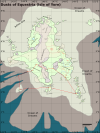
The Northern Region is one of the subdivisions of the Earth Kingdom
Geography
Northern Coast
Peatbogs
Northern Divide
Northern Mountains
Forests
Three Sister Bays
Otterbear Bay
Walrus and Seal Bays
Western Plains
Western Coast
Western Highlands
Climate
Anthropology
Northern Aborigines
The Beituzhu (北土著), or Northern Aborigines (an exonym; endonym: Khemchik) are the original inhabitants of the Northeast. They traditionally inhabited the wetlands and forests of the North, living in small villages with partially-underground longhouses. They are an earthbending people, i.e. ethnic earth nationals, though due to occasional genetic contact with the Water Tribes, they sometimes have waterbenders. Their language is unrelated to the Yonggan language but has many loanwords from it, as well as Ganjinese loanwords transmitted via the Yonggan. Before contact with the Central Earth Kingdom civilization, they were organized into small tribes. They traded with the Water Tribes and Yonggan, but also sometimes fought the latter for territory.
They are mostly Fitzpatrick II-III in color. They have mostly green eyes. Most of them practice Kemchick shamanism, under syncretic influence with Moon Spirit Worship of the Water Tribes (the Ocean Spirit is considered less important to them) and Earth Kingdom Folk Religion. In the modern day, many continue to practice traditional hunting and gathering lifestyles; others practice short-season sorghum cultivation, peat cutting, trap fishing, and fur trapping. Earthbending is more common among them than among the descendents of Zhongzu settlers, and they are sometimes employed for their bending, e.g. in construction. Some live as an urban underclass in settler cities; they have some towns of their own but none larger than a few thousand inhabitants.
Water Tribe People
Since prehistory, ethnic Water Nationals have lived in the Far North of the Central Continent. Coming into contact with the Central civilization, they became Jinggong Shuizu (進貢水族), i.e. the Tributary Water Tribes, accepting the Earth Kingdom as their suzerain and sending tribute missions to Ba Sing Se. The tribes were organized into Eastern and Western groupings. As ethnic water nationals, and members may develop waterbending. They are in cultural continuity with the Northern Water Tribe, with which they have frequent trade contact and sometimes intermarriage, and most follow its religion, with some syncretism and local variations. Their Waterbending style is similar to other Northern peoples, but they lack the prestigious schools and traditions of the Northern Water Tribe, who look upon their waterbending as unrefined in style.
Some live in settled fishing villages, others in towns; they have some of their own large towns and some cities, in which an economically important minority of the descendants ethnic Zhongzu settlers live. They are somewhat creolized with the Zhongzu, especially in more urban areas.
They mostly have blue eyes and are mostly Fitzpatrick IV in skin color.
Central Earth Kingdom Settlers
The Zhongzu (中族) are ethnic Earth nationals who moved north as settlers, mostly in response to economic population pressures in the densely populated central plains. Most of the Zhongzu come from Five-Grains Province north of Ba Sing Se (some came from Ba Sing Se's agricultural zone itself, and are properly classified as Gucheng, but that distinction is not observed in the North.) The Tu Dynasty encouraged colonization in an attempt to make the North more stable and culturally connected to the central government.
Many Zhongzu live as short-season grain farmers in the uplands, particularly in the Shizu states. The population is also large in the port cities.
Obviously, these people speak Common or closely related dialects.
Yonggan
Settled and seminomadic Yonggan people are a minority through the North, especially in the inland foothill regions. In antiquity, the Avatar (records are uncertain as to which) brought peace to the Yonggan and Khemchick by establishing the cliffs of the Northern Divide to divide settlement and hunting by the two peoples, but once both came under the suzerainty of the Earth Kingdom, that arrangement broke down somewhat. That being said, few Yonggan want to live on the northern coast, much less among the bogs, so they are seen mainly it towns and as journeyman earthbenders or traders.
The Yonggan in the North have their own language, but many speak Common (including almost all of those living outside Yongganguo).
See also the article on Yonggan People.
Air Nomads
Formerly, many Air Nomads lived in the Northern Air Temple and its surroundings. The Soaring Snow State recognized the Earth Kingdom as its suzerain but was entirely independent in internal matters until the Ri Dynasty, during which it became more closely integrated. Some of the Air Nomads lived in the Northern Air Temple, whereas the rest were proper nomads, traveling with their sky bison herds and only occasionally visiting the Temple. The bison were grazed mostly in the Soaring Snow State, but also ranged throughout the sparsely inhabited northern regions from Chenbao to the uplands of the Tributary Water Tribes; as settlers from the Central Earth Kingdom began putting more of the uplands to cultivation, the bison herds were shifted to mountain valley meadows, sometimes grazing alongside Yonggan badgermole herds.
The Air Nomad population of the North had an influence on the culture and religious thought of the people living there, and were generally well-liked and peaceful, sometimes even being relied upon to mediate disputes between different groups.
The Air Nomads were substantially wiped out by a Fire Nation invasion. The Earth Kingdom repelled the Fire Nation from the Soaring Snow State before they could completely burn and destroy the grazing lands, but they were not able to prevent elite Fire Nation units from moving through the countryside and slaughtering surviving Air Nomads and their Bison. Any survivors appear to have gone into hiding, and the Air Nomads are considered extinct in the North.
Eastern Settlers
Some of the "Arrow People" of the Eastern Peninsula, the Hwasalbujok (箭部族, also called 箭族 Jianzu, a loan-translation of endonym), migrated North in Antiquity, settling offshore and on the coasts Xinlin Province. As their population grew, they became the main settled population of the future Xibei province. There are few of them living West of the Third Sister River. They are mostly farmers and foresters in Xibei and Xinlin. A second wave of settlers from the South, mainly Zhongzu, joined them in these regions later; there remains a complex ethnic tension between "New Families" and "Old Families." They mostly have come to speak Common, rather than the Eastern Peninsular Language, but maintain some distinctive cultural practices.
Many Hwasalbujok families are prosperous landholders, but there is a substantial class of yeoman farmers and market hunters in the extensive forests. They are ethnic Earth nationals and mostly practice their own Rustic School of Earthbending, but earthbending talent is relatively rare among them and they use more wood in their houses than most people of the Earth Kingdom.
Ganjinese
The Ganjinese are an important urban minority of the North. In this region, an overland mercantile network connects seaports in Ganjingguo with the ports of the Northwest, passing through Yonggan lands. Use of the network allows commerce between the Central and Western Earth Kingdom and the Northern Water Tribe, as well as bypassing unfavorable tariffs and duties in the larger Three Sisters ports that are more closely controlled by the government in Ba Sing Se. This trade network is dominated in its overland portion by Ganjinese merchants, though they often subcontract the actual caravan-driving to hirelings. In the urban North (including the Three Sisters ports), many Ganjinese serve as administrators and craftspeople. They tend to be endogamous, and maintain their distinct practices, but there are exceptions.
There are some Ganjinese ethnic enclaves in towns, as well as a few trading posts established centuries ago, in which they remain the majority. Proficiency with the Common tongue, including the writing system, is almost universal among their working-age adults.
Zang Diaspora
Zang people (dialectical, "Zheing") from the coast of the West Lake, are distributed throughout the North, mostly along the overland trade routes. Zang mercenaries were sometimes hired by the Yonggan and Ganjinese to prosecute wars in the past, and they also were hired to protect caravans. Thus, a minority of people in the North have come to have Zang heritage, though full-blooded Zang people are fairly rare here. Of those extended families who mainly identify as Zang, most are hunters in the forested hills and swamps, and they generally speak Common almost exclusively.
Economy
Agriculture
Fishing
Forest Products
Mining
Trade
Industry
Tribute System
History
Prehistory
Antiquity
Late Antiquity
Ting Dynasty
Ri Dynasty
Early Hao-Ting to Qin's Rebellion
Qin's Rebellion and the Hao-Ting Renaissance
Death of Kyoshi to the Present War
Transport
Coastal
Bluewater
Rivers
Canals
Roads
Politics
Subdivisions
State of Nitan
State of East Shui
State of West Shui
State of Chenbao
State of Angxue (Soaring-Snow State)
Yonggan State
Part of the Yonggan State is considered to be included in the Northern Region, though the Yonggan State is a whole is generally associated with the Western Region. In the past, the Yonggan State was divided into several polities, including the now-dissolved Principality of the Nemuland; during the reforms of the Hao-Ting Renaissance, they were consolidated into one state.
Xibei Province