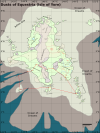

The Northern Region is one of the subdivisions of the Earth Kingdom
Geography
Northern Coast
Peatbogs
Northern Divide
Northern Mountains
Forests
Three Sister Bays
Otterbear Bay
Walrus and Seal Bays
Western Plains
Western Coast
Western Highlands
Climate
Anthropology
Northern Aborigines
The Beituzhu (北土著), or Northern Aborigines (an exonym; endonym: Khemchik) are the original inhabitants of the Northeast. They traditionally inhabited the wetlands and forests of the North, living in small villages with partially-underground longhouses. They are an earthbending people, i.e. ethnic earth nationals, though due to occasional genetic contact with the Water Tribes, they sometimes have waterbenders. Their language is unrelated to the Yonggan language but has many loanwords from it, as well as Ganjinese loanwords transmitted via the Yonggan. Before contact with the Central Earth Kingdom civilization, they were organized into small tribes. They traded with the Water Tribes and Yonggan, but also sometimes fought the latter for territory.
They are mostly Fitzpatrick II-III in color. They have mostly green eyes. Most of them practice Kemchick shamanism, under syncretic influence with Moon Spirit Worship of the Water Tribes (the Ocean Spirit is considered less important to them) and Earth Kingdom Folk Religion. In the modern day, many continue to practice traditional hunting and gathering lifestyles; others practice short-season sorghum cultivation, peat cutting, trap fishing, and fur trapping. Earthbending is more common among them than among the descendents of Zhongzu settlers, and they are sometimes employed for their bending, e.g. in construction. Some live as an urban underclass in settler cities; they have some towns of their own but none larger than a few thousand inhabitants.
In cities and towns, the Beituzhu usually know Common to some extent. Those living in remote villages often speak their own language and have limited Common proficiency.
Water Tribe People
Since prehistory, ethnic Water Nationals have lived in the Far North of the Central Continent. Coming into contact with the Central civilization, they became Jinggong Shuizu (進貢水族), i.e. the Tributary Water Tribes, accepting the Earth Kingdom as their suzerain and sending tribute missions to Ba Sing Se. The tribes were organized into Eastern and Western groupings, some of whom later left to become respectively the Siqupsiqqat and Uuyurat of the Northern Water Tribe. As ethnic water nationals, and members may develop waterbending. They are in cultural continuity with the Northern Water Tribe, with which they have frequent trade contact and sometimes intermarriage, and most follow its religion, with some syncretism and local variations. Their Waterbending style is similar to other Northern peoples, but they lack the prestigious schools and traditions of the Northern Water Tribe, who look upon their waterbending as unrefined in style.
Some live in settled fishing villages, others in towns; they have some of their own large towns and some cities, in which an economically important minority of the descendants ethnic Zhongzu settlers live. They are somewhat creolized with the Zhongzu, especially in more urban areas.
They mostly have blue eyes and are mostly Fitzpatrick IV in skin color. They are mostly speak some Common but prefer to speak their dialect of the Water Tribe language.
Central Earth Kingdom Settlers
The Zhongzu (中族) are ethnic Earth nationals who moved north as settlers, mostly in response to economic population pressures in the densely populated central plains. Most of the Zhongzu come from Five-Grains Province north of Ba Sing Se (some came from Ba Sing Se's agricultural zone itself, and are properly classified as Gucheng, but that distinction is not observed in the North.) The Tu Dynasty encouraged colonization in an attempt to make the North more stable and culturally connected to the central government.
Many Zhongzu live as short-season grain farmers in the uplands, particularly in the Shizu states. The population is also large in the port cities.
Obviously, these people speak Common or closely related dialects.
Yonggan
Settled and seminomadic Yonggan people are a minority through the North, especially in the inland foothill regions. In antiquity, the Avatar (records are uncertain as to which) brought peace to the Yonggan and Khemchick by establishing the cliffs of the Northern Divide to divide settlement and hunting by the two peoples, but once both came under the suzerainty of the Earth Kingdom, that arrangement broke down somewhat. That being said, few Yonggan want to live on the northern coast, much less among the bogs, so they are seen mainly it towns and as journeyman earthbenders or traders.
The Yonggan in the North have their own language, but many speak Common (including almost all of those living outside Yongganguo).
See also the article on Yonggan People.
Air Nomads
Formerly, many Air Nomads lived in the Northern Air Temple and its surroundings. The Soaring Snow State recognized the Earth Kingdom as its suzerain but was entirely independent in internal matters until the Ri Dynasty, during which it became more closely integrated. Some of the Air Nomads lived in the Northern Air Temple, whereas the rest were proper nomads, traveling with their sky bison herds and only occasionally visiting the Temple. The bison were grazed mostly in the Soaring Snow State, but also ranged throughout the sparsely inhabited northern regions from Chenbao to the uplands of the Tributary Water Tribes; as settlers from the Central Earth Kingdom began putting more of the uplands to cultivation, the bison herds were shifted to mountain valley meadows, sometimes grazing alongside Yonggan badgermole herds.
The Air Nomad population of the North had an influence on the culture and religious thought of the people living there, and were generally well-liked and peaceful, sometimes even being relied upon to mediate disputes between different groups.
The Air Nomads were substantially wiped out by a Fire Nation invasion. The Earth Kingdom repelled the Fire Nation from the Soaring Snow State before they could completely burn and destroy the grazing lands, but they were not able to prevent elite Fire Nation units from moving through the countryside and slaughtering surviving Air Nomads and their Bison. Any remaining survivors appear to have successfully gone into hiding, and the Air Nomads are considered extinct in the North.
Eastern Settlers
Some of the "Arrow People" of the Eastern Peninsula, the Hwasalbujok (箭部族, also called 箭族 Jianzu, a loan-translation of endonym), migrated North in Antiquity, settling offshore and on the coasts Xinlin Province. As their population grew, they became the main settled population of the future Xibei province. There are few of them living West of the Third Sister River. They are mostly farmers and foresters in Xibei and Xinlin. A second wave of settlers from the South, mainly Zhongzu, joined them in these regions later; there remains a complex ethnic tension between "New Families" and "Old Families." They mostly have come to speak Common, rather than the Eastern Peninsular Language, but maintain some distinctive cultural practices.
Many Hwasalbujok families are prosperous landholders, but there is a substantial class of yeoman farmers and market hunters in the extensive forests. They are ethnic Earth nationals and mostly practice their own Rustic School of Earthbending, but earthbending talent is relatively rare among them and they use more wood in their houses than most people of the Earth Kingdom.
Ganjinese
The Ganjinese are an important urban minority of the North. In this region, an overland mercantile network connects seaports in Ganjingguo with the ports of the Northwest, passing through Yonggan lands. Use of the network allows commerce between the Central and Western Earth Kingdom and the Northern Water Tribe, as well as bypassing unfavorable tariffs and duties in the larger Three Sisters ports that are more closely controlled by the government in Ba Sing Se. This trade network is dominated in its overland portion by Ganjinese merchants, though they often subcontract the actual caravan-driving to hirelings. In the urban North (including the Three Sisters ports), many Ganjinese serve as administrators and craftspeople. They tend to be endogamous, and maintain their distinct practices, but there are exceptions.
There are some Ganjinese ethnic enclaves in towns, as well as a few trading posts established centuries ago, in which they remain the majority. Proficiency with the Common tongue, including the writing system, is almost universal among their working-age adults.
Zang Diaspora
Zang people (dialectical, "Zheing") from the coast of the West Lake, are distributed throughout the North, mostly along the overland trade routes. Zang mercenaries were sometimes hired by the Yonggan and Ganjinese to prosecute wars in the past, and they also were hired to protect caravans. Thus, a minority of people in the North have come to have Zang heritage, though full-blooded Zang people are fairly rare here. Of those extended families who mainly identify as Zang, most are hunters in the forested hills and swamps, and they speak Common almost exclusively.
Economy
Agriculture
Short-season sorghum is the most common staple grain throughout the North. Important vegetables include leeks, rhubarb, giant radish, and frost greens. Milkvetch is a fodder crop that is important in crop rotations as it fixes nitrogen. The growing season is too short, and the population density too low, to support rice-based agriculture, though some wheat and barley are grown in the Xibei Province and southern Yongganguo.
A landrace of hardy Otterpig is raised in well-fenced wallow-ponds adjacent streams by the Beituzhu; Otterpig husbandry has been adopted by many others as well. Ostrich Horses are raised for transportation and eggs. The dwarf badgermole is raised in Yonggan country as an earthbending working animal. Formerly, sky bison herds were an economic pillar of the Soaring-Snow State, but the herds were decimated by the Fire Nation and those that remain are small groups of wary, feral animals that sometimes descend upon the crops of farmers and devour them.
Ocean and River Products
The North Sea is quite rich with marine life, and much of it is harvested commercially. Ocean fishing with nets is commonly practiced, and hunters pursue the whale, whale-walrus, walrus-yak, and various seals. Cold-water kelps are harvested from kelp forests near the shore, especially in the east, where they grow abundantly as far as Xinlin province. The Giant Octopus-Worm is a dangerous, but also delicious, species.
Train oil obtained from blubber-bearing mammals is produced in the tryworks of Northern cities, and widely used for lighting; it is also exported for that purpose.
The rivers of the North abound in anadromous fish, which are collected with trap fishing and spearfishing. Freshwater shellfish such as urchincrabs and clams are collected by the local people. Fermented urchin roe sauce is a delicacy exported to gourmands throughout the Central Earth Kingdom.
Forest Products
Coniferous forests are abundant in the North. The architecture of the Earth Kingdom is based mainly on stone, but timber is still needed for roofing, furniture, shipbuilding, and fuel. The Central Plains are relatively deforested, mainly as a result of land clearing for grain cultivation and fuel use, and so wood is mostly imported from the North and the Eastern Peninsula. Accordingly, a significant export from the North to the Central Earth Kingdom is timber. Timber is also exported to the Northern Water Tribe for similar purposes, as the small amount of boreal forest in the Northern Water Tribe's lands is slow-growing and must be used very lightly.
Pine nuts and ginseng are harvested in the North for export. Mushrooms and edible ferns are also harvested, mostly for local use.
Many cultures of the North find hunted forest animals an important part of their diet.
Mining
The mountains of the North have significant mineral resources, including both copper and tin, convenient for bronze production. Much of the copper is found as outstanding deposits of malachite. There is some silver, but the North is relatively poorer in silver resources and most mines have been exhausted since the time of the Great Ri who financed the later Nara-Ting Campaigns mostly with Northern silver.
There are significant resources of bituminous coal in Chenbao and smaller ones in Yongganguo, but no intensive mining; coal is only exploited from open mines at this time. Smaller deposits of lignite exist in the Soaring-Sky State and Nitan State.
There are many good deposits of jadeite in Yongganguo and the mountains of upland West Shizu. There are also significant resources of aragonite, serpentine and quartz.
There are significant placer deposits of gold in the North, particularly in the Walrus and Seal river watersheds, but the technology to exploit them effectively is not widely deployed.
Trade
The North has major trade with both the Northern Water Tribe and the rest of the Earth Kingdom, mostly bringing the products of its agriculture and extractive industries away in exchange for money and finished goods. It also serves to connect trade from the Northern Water Tribe with the Central Earth Kingdom, the Three Sisters ports being important for supplying Ba Sing Se.
Industry
Industry in the North is relatively undeveloped. Refugees from the Fire Nation invasion of the Central Earth Kingdom have brought an influx of craftworkers to the cities of the North, but the means of production necessary to fully employ them are not yet developed.
Blubber processing (mainly into train oil and soap) and charcoal-making are practiced; there is a metalworking industry in Yongganguo, though most fine metalworking is done in Ganjingguo. There is a significant wooden shipbuilding industry, and a royal Dockyard in Northport.
Yonggan stonework is a significant luxury good export. Ivory and scrimshaw carving is done by Shuizu people primarily, and some of it is made with the tastes of Central Earth Kingdom elites in mind - often in imitation of Northern Water Tribe styles. Lately, a minor controversy has arisen between the Northern Water Tribe and urban workshops in Mukai Town, who are mass-producing items in Northern Water Tribe styles for export south.
Peat-roasted Sorghum beer is an export of Nitan State, but it is consumed mostly locally and in the West, as Central folk have little taste for it.
Tribute System
In the past, the various states (as distinct from provinces) of the North were ruled by local rulers that accepted the overlordship of the Earth King and sent tribute missions to Ba Sing Se. Nowadays they are controlled by appointed governors who extract taxes and send them to the City. (Some States of the Earth Kingdom, such as Great Omashu and Ganjingguo, are still administered under the more feudal arrangement, and some "appointments" of governors represent an official rubber-stamp blessing on a de facto local dynasty; this is the case with Chenbao State.)
History
Prehistory
Antiquity
Late Antiquity
Ting Dynasty
Ri Dynasty
Early Hao-Ting to Qin's Rebellion
Qin's Rebellion and the Hao-Ting Renaissance
Death of Kyoshi to the Present War
Transport
Coastal and Oceanic
Extensive littoral trade along the coastal villages exists, often by small boats that may also participate in fishing.
Trade between the Northern Water Tribes and the Earth Kingdom is extensive; the biggest ports are in Chenbao, in the Northwest, but the Three Sisters ports are also very important for trade to Ba Sing Se as the Three Sisters rivers are navigable and can be used to transport goods to the city. Of note, Water Tribe vessels are not allowed to sail to Ba Sing Se directly, but rather the goods must be transferred to Earth Kingdom ships and customs duties carefully accounted for. The situation is looser in the minor ports of the North, and overland trade connections (mostly operated by Ganjinese trading companies) connect the ports of the North with the Ostrich Horse River and caravan routes to Ba Sing Se and the South.
The ports of the north are usually ice-free year-round; waterbending icebreakers are employed in Temene town when port access is threatened by sea ice.
Rivers
Rivers are very important for transport in the North. Some of them freeze during the Winter, isolating large numbers of villages for the season. Hired riverboats are a common means of passenger transportation.
Canals
There are few canals of consequence in the North. Some canals for irrigation and transport exist in the Nemuland, built during the Ri Dynasty, and a river improvement project has enhanced the navigability of the Second Sister River.
Roads
Roads are spotty in the North, and often poorly maintained, as the infrastructure of the region has been neglected by the Hao Ting. A Northern Highway was begun after Kyoshi's reforms, beginning and Temene Town. It connects it with Mukai town and a few river villages; it was supposed to extend to Ele Town and connect with the Great Qin Road, but a bridge being constructed on the Muyan river was destroyed by an angry river spirit and the project was abandoned.
The Great Qin Road was built by the earthbenders of Qin the Great's army during his Northern Campaign, allowing his army to bypass the Abka Line and the dense forests of the Southern Nemuland to attack Ba Sing Se. Its route was also influenced by his need to please his Yonggan allies. The Great Qin Road includes three important mountain passes and tunnels constructed with earthbending, which are considered among the greatest works of military engineering in the Earth Kingdom. Footsoldiers can march through the Great Qin Pass eighty abreast. The road is still extensively used today, though as no one has been marching large numbers of soldiers through it, the full width is not well maintained, and is in places been subject to infiltration by vegetation or frost damage.
The Ostrich Horse road is a toll road controlled by a patchwork of mostly Ganjinese and Yonggan petty lords. It is well-maintained for the most part (unsurprisingly, the quality of maintenance varies with ownership.)
The Ba Sing Se highway, built during the Hao Ting Renaissance, connects Ami Town to the settlements of the Valley of Perpetual Peace and the agricultural heartland of Wugu (Five Grains) Province.
The North River Road is a private venture attempting to bypass river transport fees and customs in Northport, sponsored by a very rich Hwasalbujok family, the Ri, who made their fortune in Xibei. (No relation to the assimilated name of the Nara clan of the Yonggan or its eponymous dynasty.) It is unclear if the Ba Sing Se government is unconcerned by this blatant attempt at tax avoidance, or if the relevant officials have simply been bribed.
Politics
Subdivisions
State of Nitan
State of East Shui
State of West Shui
State of Chenbao
A large and relatively populous state, Chenbao was once an independent principality that became a tributary of the Earth King. It has extensive settled agriculture and trade links with the Northern Water Tribe (and, formerly, Air Nomads and Fire Nation.) A large wall on the southern border was constructed to keep out nomadic raiders; it is believed to be the prototype of the walls of Ba Sing Se. However, the Chenbao Southern Wall is smaller and in a state of disrepair.
Chenbao has several important port cities. It formerly had a substantial Air Nomad population, especially in the mountain valleys of its Northeast (where it adjoins the Soaring Snow State), but they were expelled following the attack on the Northern Air temple as the government did not want them to "attract" a Fire Nation invasion.
The governor of Chenbao is nominally appointed by the Hao Ting, but in practice, the governorate has grown powerful and independent, and functions more like a feudal prince. (Which, indeed, was originally the situation prevailing as late as the Ting dynasty; Chenbao was not subjected to an appointed governor until the Ri Dynasty.) The current governor, Lu Bu, is the great-grandson of the last governor truly selected by the Ba Sing Se government, and his eldest son is being groomed to succeed him. It is expected that the Ba Sing Se government will rubber-stamp this succession by appointing the son as governor with Bu is ready to retire; the elder Lu has already been granted an unconstitutional life term in office and is no longer subject to periodic reappointments.
Governor Lu also has close relationships with some Northern and Western warlords. Relations with the Northern Water Tribe, once strained after a natural disaster and taxation dispute, have been repaired. He commands the Chenbao Army, one of the strongest regional forces.
State of Angxue (Soaring-Snow State)
Yonggan State
Part of the Yonggan State is considered to be included in the Northern Region, though the Yonggan State is a whole is generally associated with the Western Region. In the past, the Yonggan State was divided into several polities, including the now-dissolved Principality of the Nemuland; during the reforms of the Hao-Ting Renaissance, they were consolidated into one state and placed under the control of an appointed governor rather than their native beile lords.
Xibei Province