|
Size: 1354
Comment:
|
← Revision 4 as of 2026-07-31 06:50:29 ⇥
Size: 4864
Comment:
|
| Deletions are marked like this. | Additions are marked like this. |
| Line 5: | Line 5: |
| During the course of the formation of the Ri Dynasty, the victorious Yonggan khagan created large fiefs for his sons and various grandees, including the khans of the other Yonggan clans and other notables, collectively called the conquest elite. These fiefs were comprised of lands from feudal rulers who had opposed Jaikan's activities, and included extensive prime agricultural lands in the heartland of the Central Earth Kingdom. Among these fiefs was the Principality of Jin, created for Nara Aisin, Jaikan's second-eldest son. The Principality of Jin was immediately outside of the outer wall of Ba Sing Se, to the northwest, and also contained some mountains. Besides the lands he held as Prince of Jin, Nara Aisin also held some grazing lands in the Yonggan state, but these were much smaller and eventually were subsumed into the inheritance. |
|
| Line 7: | Line 9: |
| When the Hao Ting replaced the Ri, most of the Principality's land in the Central Earth Kingdom was expropriated by the new dynasty to reward its own supporters, as would be expected. However, as the incumbent Prince of Jin, Aisin Nara Bugan, was a shrewd diplomat, the new Earth King allowed a small portion to remain in the hands of the Aisin Nara. The title of Prince was also confirmed for the family under the Hao Ting. In the Central Earth Kingdom, the remaining lands of the Principality consisted of the Prince's palace and its demesne, and certain similar lands used by his relatives and major vassals and retainers, amounting to only about 1400 hectares. Thus, the Principality's lands in the [[Avatar/Nemuland|Nemuland]] became the dominant source of its much-diminished revenues. Although the Principality had lucrative investments in urban real estate in Gainan and business interests in the Ostrich Horse River trade, the revenues were greatly decreased by this loss. Whereas formerly the annual revenue of the Principality had exceeded 750,000 taels, they were now reduced to about 45,000. With the fall of the Niohuru Nara, the erstwhile imperial family of the Great Ri, the Aisin Nara managed to achieve dominance within the Nara clan, and maintain control of the Yonggan khaganate, becoming the vassal rulers of the Yonggan State as a whole. The profits of this position were partly invested in the Principality, and in time, the revenues recovered to around 560,000 taels per annum at the time of the last Nara khagan. |
|
| Line 8: | Line 16: |
Frustrated by an increasingly extractive and corrupt government in Ba Sing Se, the Prince of Jin, Aisin Nara Jierhalang, supported [[Avatar/Qin's Rebellion|Qin the Great]] in his attempt to replace the Hao Ting. As he was also khagan of the Yonggan, he was able to command considerable support for Qin. After the hegemon's death and subsequent collapse of his conquests into infighting among various claimants to his succession (including one promoted by Jierhalang), the resurgent Hao Ting conquered and subdued the Yonggan State. Ultimately, the Prince of Jin was executed by the Earth Kingdom. The principality was dissolved, and its assets distributed to Hao Ting supporters or the new direct-rule government of the occupied Yonggan State. The corresponding title was also disestablished at this time, in the eyes of the Hao Ting. |
|
| Line 13: | Line 24: |
| The Nara [[Avatar/Nara Pale of Banishment|in exile]] continue to use the title of Prince of Jin as a hereditary title. The ''de jure'' heir is [[Avatar/Mukushen|Aisin Nara Mukushen]], but it has been many generations since any of the claimants has even seen the lands of the former principality. | The Nara [[Avatar/Nara Pale of Banishment|in exile]] continue to use the title of Prince of Jin as a hereditary title. The ''de jure'' heir is [[Avatar/Mukushen|Aisin Nara Mukushen]], but it has been many generations since any of the claimants has even seen the lands of the former principality. She appears to be recognized as the heir by the Yonggan khagan, but it remains to be seen if this reflects an official policy of the Yonggan nationalist regime or if it was merely courtesy extended to the granddaughter of the last widely-recognized Nara khan, Wailan. |
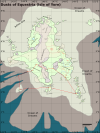
The Principality of Jin is a defunct polity of the Earth Kingdom, which was established in the Yonggan Conquest and was formally disestablished after the Earth Kingdom Civil War of Kyoshi's era, though it had been much reduced in size after the Yonggan conquest dynasty was replaced by the Hao Ting Dynasty. It was mostly located in the modern-day Five Grains Province.
Establishment under the Nara Ascendency
During the course of the formation of the Ri Dynasty, the victorious Yonggan khagan created large fiefs for his sons and various grandees, including the khans of the other Yonggan clans and other notables, collectively called the conquest elite. These fiefs were comprised of lands from feudal rulers who had opposed Jaikan's activities, and included extensive prime agricultural lands in the heartland of the Central Earth Kingdom. Among these fiefs was the Principality of Jin, created for Nara Aisin, Jaikan's second-eldest son. The Principality of Jin was immediately outside of the outer wall of Ba Sing Se, to the northwest, and also contained some mountains. Besides the lands he held as Prince of Jin, Nara Aisin also held some grazing lands in the Yonggan state, but these were much smaller and eventually were subsumed into the inheritance.
After the Fall of the Ri Dynasty
When the Hao Ting replaced the Ri, most of the Principality's land in the Central Earth Kingdom was expropriated by the new dynasty to reward its own supporters, as would be expected. However, as the incumbent Prince of Jin, Aisin Nara Bugan, was a shrewd diplomat, the new Earth King allowed a small portion to remain in the hands of the Aisin Nara. The title of Prince was also confirmed for the family under the Hao Ting.
In the Central Earth Kingdom, the remaining lands of the Principality consisted of the Prince's palace and its demesne, and certain similar lands used by his relatives and major vassals and retainers, amounting to only about 1400 hectares. Thus, the Principality's lands in the Nemuland became the dominant source of its much-diminished revenues. Although the Principality had lucrative investments in urban real estate in Gainan and business interests in the Ostrich Horse River trade, the revenues were greatly decreased by this loss. Whereas formerly the annual revenue of the Principality had exceeded 750,000 taels, they were now reduced to about 45,000.
With the fall of the Niohuru Nara, the erstwhile imperial family of the Great Ri, the Aisin Nara managed to achieve dominance within the Nara clan, and maintain control of the Yonggan khaganate, becoming the vassal rulers of the Yonggan State as a whole. The profits of this position were partly invested in the Principality, and in time, the revenues recovered to around 560,000 taels per annum at the time of the last Nara khagan.
Earth Kingdom Civil War
Frustrated by an increasingly extractive and corrupt government in Ba Sing Se, the Prince of Jin, Aisin Nara Jierhalang, supported Qin the Great in his attempt to replace the Hao Ting. As he was also khagan of the Yonggan, he was able to command considerable support for Qin. After the hegemon's death and subsequent collapse of his conquests into infighting among various claimants to his succession (including one promoted by Jierhalang), the resurgent Hao Ting conquered and subdued the Yonggan State. Ultimately, the Prince of Jin was executed by the Earth Kingdom. The principality was dissolved, and its assets distributed to Hao Ting supporters or the new direct-rule government of the occupied Yonggan State. The corresponding title was also disestablished at this time, in the eyes of the Hao Ting.
Modern Day
The principality was disestablished as an administrative entity early in the Hao Ting renaissance, under the reforms supported by the Avatar Kyoshi. Although the incumbent Earth King bore particular animus toward the Nara Yonggan (who held the title of Prince of Jin), this action was not primarily targeted at them and was part of a larger reform of the feudal system in which many rump fiefs and titles were formally disestablished or consolidated with others.
The Nara in exile continue to use the title of Prince of Jin as a hereditary title. The de jure heir is Aisin Nara Mukushen, but it has been many generations since any of the claimants has even seen the lands of the former principality. She appears to be recognized as the heir by the Yonggan khagan, but it remains to be seen if this reflects an official policy of the Yonggan nationalist regime or if it was merely courtesy extended to the granddaughter of the last widely-recognized Nara khan, Wailan.