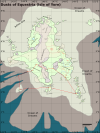
Qin Ji (秦籍), lived 325-270 BG, and was also known as Qin the Great, Qin the Conqueror (秦霸王) or even Emperor Qin (秦帝). He was an earthbender and local official under the Hao Ting, who attempted to violently overthrow the incumbent dynasty.
Qin descended from Central Earth Kingdom colonists, the Qin Clan, who had come to the West during the Younger Gong dynasty to seek their fortunes. Coming of age in the Northwestern Earth Kingdom after the death of Avatar Kuruk and before Avatar Kyoshi was active, he was frustrated by the weakness of the Ba Sing Se government and its inability to protect the Earth Kingdom from the depredations of bandits. From a family of local repute but little wealth, Qin sat for the civil service examinations but did not pass, probably because his family could not afford tutoring. Nonetheless, by this point in the Hao Ting success in the examinations was not absolutely requisite for the lowest levels of officialdom, and after defeating a bandit attack with his powerful earthbending, he came to the attention of local leaders. He was eventually appointed village headman (村長) of his hometown of Shiling Village (石陵村) and amassed considerable soft power in the local community. He was noted to be harsh toward criminals and anyone who threatened his community, and vindictive toward those who did not support his efforts to defend and improve Shiling. However, he also had a reputation for personal incorruptibility, and did not tolerate corruption among his subordinates. In 297 BG, he used his earthbending to execute a corrupt yamen runner who had been shaking down local fishermen. Word of this incident spread, and he was reprimanded for it; his bureaucratic superior reportedly wanted to remove him but he was so feared in Shiling that no one would dare to take his place as headman. Later the same year, Qin discovered that a bandit gang was being protected by the headman of the neighboring village of Jianghu (江胡村), and went there in arms to demand the bandits be surrendered. Details of the incident vary, but either the corrupt headman refused to surrender the bandits despite the fact that Qin was there with several dozen armed supporters, or Qin was so enraged by the headman's obviously false denials that he slew him on the spot. Either way, the corrupt headman was dead and his official residence was burned (possibly accidentally); Qin installed himself as "acting" official in charge of that village as well. When he ignored a Hao-Ting edict deposing him, his rebellion officially began in 295.
Qin was a charismatic propagandist and quickly drew many local leaders to his side despite his status as an underdog outlaw, with the slogan "Support Qin, destroy the bandits" (助秦滅匪) being written on the banners under which his growing army marched. Indeed, Qin did subdue many large bandit gangs and bring order, if not peace, to the Western Continent. The hitherto undefeated Earth Kingdom general "Paragon" Ji (無敵紀) and his sons, led a royal army from the regional capital Xijing to confront Qin, but his army was bogged down by poorly maintained infrastructure and weather conditions. Hearing of this, Qin sailed down the Great Weak-Water River, which was previously considered not to be navigable, and encircled Ji's army. General Ji fought gallantly against Qin's army, but Qin's cavalry captured the royal army's baggage train and in so doing also captured the favorite concubine of the Hao-Ting prince of Xijing who accompanied General Ji to advise him. The prince demanded Ji negotiate with Qin for the return of the concubine and baggage, which he did, calling a truce to parley. Qin stalled, knowing that the royal army could not live off the land pinned down in the swamps, and made unreasonable demands as the food supply dwindled. General Ji recognized the tactic, and told the prince that with morale low, food and fodder dwindling, they had no choice but to continue fighting and attempt to break out; the enraged prince ordered General Ji's execution for suggesting the "abandonment" of a royal concubine. When Ji's sons and other officers heard of General Ji's death, they mutinied and killed the Prince. During the parley of the mutineers with Qin to negotiate, Qin made an inspiring speech, loudly enough that the common soldiers of the royal army could hear. Pointing out that the mutineers and anyone associated with them would surely be killed by the Hao-Ting, and the order he had brought to the west, he won over his erstwhile enemies and was hailed as Qin the Great. United, they marched on Xijing, where Qin's expanded forces secured the surrender of the regional government; after only two days of siege, the Hao-Ting representatives were overthrown by an internal coup and the new leadership negotiated the city's submission to Qin. Qin brutally purged the former regime, holding them particularly responsible for the unrest in the Northwest, and purportedly made a cup out of the skull of the Prince of Xijing. However, he also had a monument to General "Paragon" Ji built in Xijing, and was said to have never spoken ill of the man he considered his most worthy opponent. One of Ji's sons, JI Hongren, went on to serve as Qin's second-in-command, later being entrusted with the conquest of the Southern Continent. As de facto ruler of the West, Qin enthusiastically supported land reforms, redistributing the holdings of wealthy landlords - often absentees living in Xijing or even Ba Sing Se - to their tenant farmers. Perhaps not coincidentally, many of the deposed landlords had opposed him in the early days of his movement. In any case, it won him considerable popular support.
In 290, the entirety of the Western Continent had submitted to Qin, including the Ganjinese colonies on the Southern coast, who had enthusiastically supported his suppression of banditry and piracy, long thorns in the side of their vast mercantile operations. Qin sent envoys to the Ganjinese homeland on the Western Sea, and found a warm but cautious welcome with the Princess of Ganjin, whose personal name was Chundu (純度). Chundu was, however, a royal sister-in-law, being married to a Hao-Ting prince. When the prince-consort found out about his wife giving an official reception to Qin's representatives, he sent a letter to Ba Sing Se informing the central government of this fact. Meanwhile, on the pretense of incursions by Nogai raiders and the invitation of the King of Chenbao, Qin launched an invasion of the Western Plains through Chenbao, crossing the Straits of Chenbao on Ganjinese ships. Qin's earthbending corps created the Great Qin Roads from Chenbao to the North of the Central Continent, and the Southern Qin Road to connect with Ganjingguo. Qin's army met with little resistance and quickly secured the submission of the Nogai Khagan, who was promised the restoration of traditional pasturage privileges encroached upon by Nanzu colonists. With his growing army overwintering at the Rabaroo river, Qin sent emissaries to the Abka, Yonggan and Zang, the major local powers with cultures distinct from the Hao Ting. Dissatisfied by the inefficient and often extractive administrations of Hao Ting governors, all three gave some degree of support. The Aisin Nara Prince of Jin, who was also the Yonggan khagan, conducted secret negotiations with Qin, promising the support of the Yonggan if Qin would make replacing the Hao Ting an explicit goal of his movement, to which he agreed.
After the new year, an edict from the Earth King deposing the Princess of Ganjin was received. Denouncing the edict as illegal, she burnt it and declared the restoration of the independent Ganjinese Empire, which had been unified with the Earth Kingdom through a political marriage arranged by the Jiongyu Avatar during the Ting dynasty. Her husband went along with this, quietly hoping that his role would not be discovered. Qin's army moved largely unopposed across the Western Plains, receiving the support of the various Western states for his movement. By 288, his forces had reached the old "Abka line" of fortifications dividing the Central Earth Kingdom from the West. Qin himself remained temporarily in the Ganjinese capital, Gansanjiao (乾三角), where he was formally enthroned as Gengshidi (更始帝) "Regeneration Emperor." After the death of Princess Chundu's husband in an "unfortunate boulder accident," Qin took her as his paramount wife, deposing the woman from his home village who had supported him loyally for many decades. In 288, Qin's third child, and the first by Princess Chundu, was born, a daughter he named Fu (秦芙). Qin sent General Ji (the younger) to conquer the South. As Qin consolidated his power in the West, Ji enjoyed considerable success in the South. The Hao-Ting had desperately withdrawn most of their forces from the South to fortify the Abka Line, and Ji was able to make swift progress. Qin used "Potemkin Village" tactics to make it seem that most of his Army was camped near the Abka line, but secretly withdrew North and joined his general Tong, who was fighting a bloody war in the North against tribes loyal to the Hao Ting, with the assistance of the Chenbao Army and allied Yonggan. The war in the north was a distraction that stalled his conquest of the Central Continent, but in combination with the construction of the Great Qin Road, opened up a route for an invasion of the Central Plains that bypassed the Abka Line and secured his supply lines for a siege of Ba Sing Se.
Having seized control of the southern irrigation system in the early stages of his Southern Campaign, General Ji defeated the Hao-Ting garrison of Omashu with the help of an indigenous rebellion, and "liberated" the Second City of the Earth Kingdom with relatively minimal violence. He was not so fortunate in Gaoling, which only succumbed after a long siege and was looted by poorly disciplined local rebels who had aligned themselves with Qin's movement. General Ji had many of the looters executed, but knowing that Qin would not tolerate the breakdown in discipline, and wrote a letter to the warlord offering his life to protect the common soldiers of his army from any further punishment for the sack of Gaoling. Qin was furious about the damage the looting might do to his reputation, but was ultimately persuaded by his advisors to retain General Ji.
In the Summer of 287, Qin made an attack from the North on the Central plains, intending to bring down the walls of Ba Sing Se with his feared earthbending corps, now bolstered by many Great Northern Way practitioners. Thinking an invasion from the Northern route unlikely as the overland routes existing before the Great Qin Road were all but impassable for an army, the Hao Ting had left it almost undefended. Qin's army steamrolled what little resistance they faced, often (though not always) being greeted as liberators. Meanwhile, Ji pushed from the South, and achieved similar success. Qin sent emissaries to the East, and, believing he saw the writing on the wall for his extended family, the Royal Prince of Dongjing negotiated with them. In return for his support in the war to capture Ba Sing Se, his lineage would be recognized by Qin's regime as the legitimate branch of the Hao-Ting, and be enthroned as Earth King when Ba Sing Se was captured. However, it was with the understanding that he would exercise real power only in the East and Ba Sing Se, with Qin as the Restoring Emperor being the sovereign of the Earth Kingdom as a whole.
Despite continued efforts of Qin and his allies, Ba Sing Se resisted the ensuing siege. By 280, it was generally accepted by his court, though not by Qin himself, that his conquests had reached their apex; General Ji fell out of favor after a failed attempt to take the Great Treasure Donation (formerly the Westernmost extremity of the Earth Kingdom) back from the Air Nomads, and he retired to a monastery. In 276, Qin had to buy the continued support of the Yonggan (who were wary of his deal-making with the Prince of Dongjing), and in particular to secure his supply of war badgermoles, by betrothing his 12-year-old daughter Princess QIN Fu to the grandson of the Prince of Jin, AISIN-NARA Taiku (愛新納喇·太杵, 285-264). Now with more badgermoles and earthbenders, Qin made another push to take Ba Sing Se in 274, but it too was turned back, with great loss of life. In 271 a rebellion broke out in the far southern subcontinent, fomented by Hao-Ting loyalists. While leading his army on campaign in the South, Qin discovered that the Yokoya peninsula, home to the Avatar Kyoshi with which he had had a difficult relationship, had never formally submitted to him. Investigating, he discovered that General Ji had made an agreement with the inhabitants, vouchsafed by the Avatar, for its continued independence provided that the Hao-Ting forces were also excluded; this fact had never been reported to him. Enraged, he issued an edict for the execution of the retired General Ji (now living at a monastery in Xijing) and took some of his army to the peninsula to demand its submission while the rest of his army mopped up the rebellion as originally planned. General Ji was spirited away by air nomads, and lived out the rest of his days among them in peace, repentant for his earlier actions.
This did not go well for Qin. Confronting Avatar Kyoshi, he was killed, and his soldiers fled. Meanwhile, the larger part of his expeditionary force was tied up in difficult jungle fighting, and defeated by the "Hao Ting Restoration Movement" based in Gaoling. When news of Qin's death spread, a large number of rival claimants attempted to fill the power vacuum: the Eastern Hao-Ting prince who had been promised the title of Earth King, several of Qin's more prominent generals, Lord QIN She (his eldest son by his first wife), and the teenage boy to whom Qin's daughter by Chundu was betrothed, prince Taiku of the Aisin Nara.
In 269, the situation had coalesced around the most powerful claimants to Qin's succession. The Far South had completely overthrown the Qin regime and returned to the Hao Ting. In the East, the Prince of Dongjing had enthroned himself as Earth King and enjoyed the support of several provinces in the Central Plains. In the Southern Continent, the King of Omashu had proclaimed independence from both the Hao Ting and Qin's former regime. Another claimant, Qin's general Tai, was defeated in attempting to subjugate Omashu; he was then assassinated by Zang mercenaries employed by a rival general Lo. General Lo in turn provoked a popular uprising by excessive taxation and conscription; he was defeated and the rebels peacefully submitted to the reformed Hao Ting under the mediation of Avatar Kyoshi. Meanwhile, the North threw off Qin's regime and realigned with the Hao Ting. In the near West, Prince Taiku was hastily married to Princess Fu, and enthroned in Gansanjiao as "Earth Emperor," with the era name Rimu (日穆). However, the boy was a puppet for his grandfather, Jierhalang (the Prince of Jin), who ruled from his palace in the Nemuland. Farther West, Qin the Great's son, She Qin, was also enthroned by his supporters, as "Great Successor Emperor." His armies, dominated by the descendants of Yonger Gong era, ethnic-Central colonists and Nogai nomads, fought the mostly Ganjinese and Yonggan supporters of the Rimu emperor.
With the support of the Avatar, who was instituting bracing reforms of the Hao Ting government with the support of the Earth Sages, the Central Plains were entirely returned to the control of Ba Sing Se by 267. The Avatar also negotiated a peaceful settlement between the Earth Kingdom and the Prince of Dongjing, who abdicated in favor of his son and retired to a monastery. With the exception of Omashu and its dependencies, the South was also brought back under administrative control of the Earth King. Soon, the Hao Ting's armies were marching West. They were fiercely resisted by the Abka, but the ongoing war between Taiku and She Qin prevented effective preparations for the Hao Ting invasion from being made. Hao Ting diplomats subverted several Yonggan and Abka tribes, who rose in rebellion against the Nara khaganate and the Gansanjiao regime; the Hao Ting also bribed the Great Chief of the Zang Country to attack the Gan Jin, perennial rivals as they were. Gansanjiao was besieged, and Taiku barely escaped back to the Nemuland with the dowager Chundu, his wife GAN Fu, and his infant son, Hurhan. The Prince of Jin, Jierhalang, and his remaining allies subdued their rivals in the mountains, but Gansanjiao capitulated, and Gan Jin Country submitted to the arriving Hao Ting army after a brief internal conflict between supporters of QIN She and the deceased Hao-Ting Prince Consort's former supporters in the local administration.
In 265, after a brutal campaign, the Hao Ting conquered the Nemuland. The Prince of Jin, Jierhalang, had already been deposed and replaced as the Yonggan khagan, and had lived to see Qin's dream of a new dynasty unravel. Unable to bear the shame of surrendering to the Hao Ting, he killed himself. His heir, Mengtemu, surrendered to the Hao Ting. He, along with Chundu, Taiku and Fu, were taken to Ba Sing Se and executed in 264 for treason (contrary to the terms of surrender); the Principality of Jin was officially dissolved, and the Nemuland was divided up among nearby peoples who had supported the Hao Ting conquest. Some of its forest land was cleared for agriculture and settled with Hao-Ting veterans. The whole Nara clan was sent into exile in the Hanwang Desert.
The Hao Ting campaign in the further West was initially a grueling slog, as this was Qin's homeland and deepest base of support. The royal army suffered mightily from Qin loyalist guerillas and partisans of Qin's land reforms. With the mediation of the Avatar, a peace was finally achieved in 263, with many of Qin's reforms remaining in place and considerable regional autonomy. Omashu was also returned to the Earth Kingdom fold later the same year, but with so much local control that the Ba Sing Se government was little more than a suzerain to Omashu and its dependencies. Thus, the Earth Kingdom was - ostensibly - reunited.
Great and continuing efforts by the Avatar and Earth Sages were necessary to maintain the reforms to the Hao Ting and its bureaucracy, and civil unrest continued intermittently for some time. A constitution was imposed on the Earth King, marking an end to absolute monarchy in the Kingdom. Some historians speak of a Hao Ting renaissance, and certainly, the Kingdom enjoyed increased prosperity and stability under the watchful supervision of Avatar Kyoshi. However, in the end, Qin's Rebellion accelerated a trend of decentralization - ironic given that his aim was to centralize power under himself. By the death of Kyoshi in 82 BG, the Kingdom was again in marked decline.