|
⇤ ← Revision 1 as of 2023-11-21 05:42:34
Size: 580
Comment:
|
Size: 6860
Comment:
|
| Deletions are marked like this. | Additions are marked like this. |
| Line 4: | Line 4: |
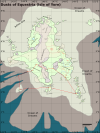
The State of Yi (also Yiguo, Yi State, or simply Yi) is a political subdivision of the [[Avatar/Earth Kingdom|Earth Kingdom]] in the West. Large and mostly mountainous, it is situated in the continental interior, but has access to the sea via ports on the navigable Rabaroo River (which terminates in the [[Avatar/Eastern Lake|Eastern Lake]] and thence communicates with the ocean via the Straits of Chenbao and Straits of Huxin.) |
|
| Line 6: | Line 10: |
Yi was inhabited by various tribal earth nations since time immemorial. When explorers from the Central Earth Kingdom arrived in the area, they were informed by the neighboring Alarame that it was home to "Yi," (夷), i.e. barbarians. The name stuck despite its lack of exactitude. In the early days of its contact with the Earth Kingdom, Yi was conquered by an ambitious warlord from the Six Animals Province. He established himself as King of Yi during the collapse of the Tu dynasty around 1730 BG, and married the daughter of a native Yi leader. He introduced many features of Earth Kingdom civil administration, but also had to accommodate native power structures. His dynasty persisted long enough to see the Earth Kingdom reassert itself under the Younger Gong, and his descendants became vassal kings, some favored by marrying Ganjinese princesses of the royal blood. Being closely aligned with the Ganjinese empire, this dynasty did not successfully navigate the transition to the Ting or the Fire Nation-Ganjinese wars, but the structures of state power endured with the help of the Jiongyu Avatar (a notorious meddler in Earth Kingdom politics). The Avatar installed a member of a cadet branch of the Ting royal family on the throne to promote regional stability. This second dynasty of Kings of Yi proved quite enduring, lasting until well into the Hao dynasty in Ba Sing Se. The exploitative actions of the late Hao brought poverty and famine, but the central government was able to defeat the King of Yi when the state rebelled against the authority of the badgermole throne. It was thereafter administered as a directly-governed province, though the designation of ''guo'' was retained for historical reasons. |
|
| Line 7: | Line 18: |
Yi became relatively impoverished under the extractive regime of direct rule, despite its extensive natural resources. There are state monopolies on the mining of various minerals, and heavy taxes on independent miners. Reforms have been attempted repeatedly, sometimes achieving a measure of success, but the state mine system is vulnerable to embezzlement by corrupt officials. The state is relatively easy to control, because it produces little food of its own, and until the Earth Kingdom Civil War, most grain was imported through the capital, where it could be controlled and denied to any area in rebellion. The situation changed with the construction of the Great Qin Road, and most of Northern Yi's population defected to Qin's regime, helping to conquer the state for the hegemon. In the aftermath of [[Avatar/Qin's Rebellion|the Earth Kingdom civil war]], portions of the Yonggan State and Chenbao were transferred to Yi, as it was felt that they were more economically relevant to the State of Yi, or would be better-administered from Yaishi than distant Garunggu or Maoshi. Of course, this action was seen as primarily punitive in Chenbao and Yongganguo, and indeed large parts of Northeastern Yi have been annexed by the Yonggan Nationalist regime on irredentist grounds. |
|
| Line 8: | Line 24: |
The northeast of Yi was subjected to some raids by the Fire Nation to pursue fleeing Air Nomads, unsurprising given its proximity to the Northern Air Temple and its history as a location where Air Nomads would graze their sky bison herds. However, the damage to the state was minimal. Ba Sing Se continues to administrate Yi under a highly extractive regime. Large amounts of gold and silver are still remitted to the capital from the State of Yai, but recent advances in Prince-General Iroh's campaign have diverted these flows to elsewhere in the Earth Kingdom, though still under the nominal control of the Throne. |
|
| Line 9: | Line 30: |
Almost the entire state of Yi is mountainous, with small region in the Southwest containing part of the Rabaroo river flood plain. |
|
| Line 11: | Line 35: |
There is little arable land. The land around the Rabaroo river, in the far Southwest, is very productive and fertile, but it is not extensive. Wheat and sorghum are grown there. Some terraced rice is cultivated on the hills near Yai and along the upper Rabaroo, but most of the country is either far too dry for rice cultivation, or else too cold. Assgoats and badgermoles are raised, both useful to miners. Overall, Yi is not remotely self-sufficient on food, and must import grain. The North obtains most of its grain from the Yonggan State or Chenbao, the South and Central regions obtain some from Chenbao and some from the Eastern Lake trade, especially depending upon Ganjinese rice exports. With increased Fire Nation activity in the Eastern Lake, evidently in support of the crown prince's Ba Sing Se campaign, the security of Yi's food supply has come into question. Were Chenbao to cut off the food supplied via the Rabaroo river, a famine could result - and seriously disrupt the Earth Kingdom's revenues. Since Chenbao is widely suspected of having made a secret treaty with the Fire Nation, this is considered to be a real possibility. |
|
| Line 12: | Line 41: |
The economy is dominated by primary industry, specifically mining. Hard rock mines produce a variety of metals and ores, and they are often smelted locally using coke produced from bituminous coal deposits. This has lead to significant environmental damage, and sometimes outbreaks of poisoning. |
|
| Line 21: | Line 53: |
The capital of Yiguo is Yaishi (崕市). It is located in the southwestern part of the state. It is not actually on the Rabaroo river, but is connected to the port via a short stone road of five ''li''. The reason is that the Rabaroo river is prone to flooding, and its floodplain is covered in deep silt. By contrast, Yaishi is situated on higher ground, with relatively shallow bedrock available for quarrying. |
|
| Line 22: | Line 57: |
Though designated as a ''guo'', Yi was incorporated as a directly-governed province after an unsuccessful rebellion against the Hao dynasty under the 13th earth king. |
<<Card: execution failed [local variable 'page' referenced before assignment] (see also the log)>>
Overview
The State of Yi (also Yiguo, Yi State, or simply Yi) is a political subdivision of the Earth Kingdom in the West. Large and mostly mountainous, it is situated in the continental interior, but has access to the sea via ports on the navigable Rabaroo River (which terminates in the Eastern Lake and thence communicates with the ocean via the Straits of Chenbao and Straits of Huxin.)
History
Antiquity
Yi was inhabited by various tribal earth nations since time immemorial. When explorers from the Central Earth Kingdom arrived in the area, they were informed by the neighboring Alarame that it was home to "Yi," (夷), i.e. barbarians. The name stuck despite its lack of exactitude.
In the early days of its contact with the Earth Kingdom, Yi was conquered by an ambitious warlord from the Six Animals Province. He established himself as King of Yi during the collapse of the Tu dynasty around 1730 BG, and married the daughter of a native Yi leader. He introduced many features of Earth Kingdom civil administration, but also had to accommodate native power structures. His dynasty persisted long enough to see the Earth Kingdom reassert itself under the Younger Gong, and his descendants became vassal kings, some favored by marrying Ganjinese princesses of the royal blood.
Being closely aligned with the Ganjinese empire, this dynasty did not successfully navigate the transition to the Ting or the Fire Nation-Ganjinese wars, but the structures of state power endured with the help of the Jiongyu Avatar (a notorious meddler in Earth Kingdom politics). The Avatar installed a member of a cadet branch of the Ting royal family on the throne to promote regional stability. This second dynasty of Kings of Yi proved quite enduring, lasting until well into the Hao dynasty in Ba Sing Se. The exploitative actions of the late Hao brought poverty and famine, but the central government was able to defeat the King of Yi when the state rebelled against the authority of the badgermole throne. It was thereafter administered as a directly-governed province, though the designation of guo was retained for historical reasons.
Before the War
Yi became relatively impoverished under the extractive regime of direct rule, despite its extensive natural resources. There are state monopolies on the mining of various minerals, and heavy taxes on independent miners. Reforms have been attempted repeatedly, sometimes achieving a measure of success, but the state mine system is vulnerable to embezzlement by corrupt officials. The state is relatively easy to control, because it produces little food of its own, and until the Earth Kingdom Civil War, most grain was imported through the capital, where it could be controlled and denied to any area in rebellion. The situation changed with the construction of the Great Qin Road, and most of Northern Yi's population defected to Qin's regime, helping to conquer the state for the hegemon.
In the aftermath of the Earth Kingdom civil war, portions of the Yonggan State and Chenbao were transferred to Yi, as it was felt that they were more economically relevant to the State of Yi, or would be better-administered from Yaishi than distant Garunggu or Maoshi. Of course, this action was seen as primarily punitive in Chenbao and Yongganguo, and indeed large parts of Northeastern Yi have been annexed by the Yonggan Nationalist regime on irredentist grounds.
Since the War
The northeast of Yi was subjected to some raids by the Fire Nation to pursue fleeing Air Nomads, unsurprising given its proximity to the Northern Air Temple and its history as a location where Air Nomads would graze their sky bison herds. However, the damage to the state was minimal.
Ba Sing Se continues to administrate Yi under a highly extractive regime. Large amounts of gold and silver are still remitted to the capital from the State of Yai, but recent advances in Prince-General Iroh's campaign have diverted these flows to elsewhere in the Earth Kingdom, though still under the nominal control of the Throne.
Climate, Geography and Biology
Almost the entire state of Yi is mountainous, with small region in the Southwest containing part of the Rabaroo river flood plain.
Economy
Agriculture
There is little arable land. The land around the Rabaroo river, in the far Southwest, is very productive and fertile, but it is not extensive. Wheat and sorghum are grown there. Some terraced rice is cultivated on the hills near Yai and along the upper Rabaroo, but most of the country is either far too dry for rice cultivation, or else too cold. Assgoats and badgermoles are raised, both useful to miners.
Overall, Yi is not remotely self-sufficient on food, and must import grain. The North obtains most of its grain from the Yonggan State or Chenbao, the South and Central regions obtain some from Chenbao and some from the Eastern Lake trade, especially depending upon Ganjinese rice exports. With increased Fire Nation activity in the Eastern Lake, evidently in support of the crown prince's Ba Sing Se campaign, the security of Yi's food supply has come into question. Were Chenbao to cut off the food supplied via the Rabaroo river, a famine could result - and seriously disrupt the Earth Kingdom's revenues. Since Chenbao is widely suspected of having made a secret treaty with the Fire Nation, this is considered to be a real possibility.
Industry
The economy is dominated by primary industry, specifically mining. Hard rock mines produce a variety of metals and ores, and they are often smelted locally using coke produced from bituminous coal deposits. This has lead to significant environmental damage, and sometimes outbreaks of poisoning.
Trade
Transportation
Culture and Anthropology
Ethnic Composition
Languages Spoken
Cultural and Religious Institutions
Arts, Fashion and Cuisine
Subdivisions and Politics
Capital
The capital of Yiguo is Yaishi (崕市). It is located in the southwestern part of the state. It is not actually on the Rabaroo river, but is connected to the port via a short stone road of five li. The reason is that the Rabaroo river is prone to flooding, and its floodplain is covered in deep silt. By contrast, Yaishi is situated on higher ground, with relatively shallow bedrock available for quarrying.
Governance
Though designated as a guo, Yi was incorporated as a directly-governed province after an unsuccessful rebellion against the Hao dynasty under the 13th earth king.