The Heidelberg Aerospace Association AS37 (Atmospheric Shuttle, type 37) is a single-stage-to-orbit spaceplane with a compact thermal fusion propulsion system. A high-performance, medium-capacity vehicle, its performance envelope includes most terrestrial planets with atmospheres, even if the atmosphere does not contain sufficient oxygen to support combustion.
The payload the AS37 can deliver to orbit varies significantly depending on where propellant choice (water, liquid ammonia, etc) and planetary parameters (atmosphere thickness and composition, gravity, etc) place the craft within its performance envelope. From an earthlike world in its stock configuration, it can transport 15 tonnes of cargo and passengers to a stable orbit. Seats for 4 passengers and 2 crew are provided in the cockpit. (Passenger body and baggage mass count against the 15 tonne figure quoted previously.)
A variety of modules can be placed in the cargo bay. The Zheng He has a HAA AS37-PM24 passenger module available, which masses 10 tonnes. It provides space and life support for 24 passengers and their baggage. (8 seats can be removed to accommodate the portable Biran habitat.) The cargo bay itself can be pressurized for the transportation of non-living cargo incompatible with vacuum.
The shuttle on the Zhenge He has been upgraded with a vertical takeoff-and-landing system. This system requires use of the engines, and is not suitable for landing or taking off from populated areas.
The AS37 is capable of unpowered water landings. Water takeoffs are possible, but because of the position of the engines, it requires the installation of expendable engine fairings (jettisoned after takeoff.) Water takeoff should not be attempted from populated areas or from bodies of water that supply drinking water (because of the neutron activation of metal ions in natural water, particularly ingested water spray.)
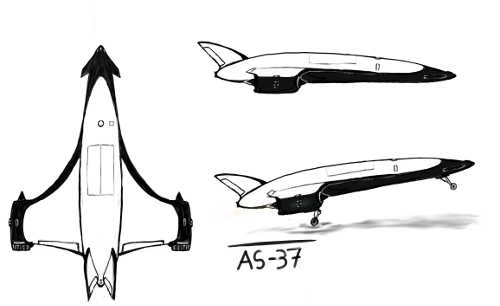 Stock shuttle in non-VTOL configuration pictured.
Propulsion
The AS37 uses a pair of Morris-Huang TF-11 thermal fusion hybrid engines. These engines are capable of using either stored propellant or a sufficiently dense planetary atmosphere as reaction mass. The heat of the fusion plasma is used to heat reaction mass (either the planet's atmosphere, or, when that becomes too rarefied, propellant stored in tanks) and expel it from the engine nozzles, imparting a reaction force to the craft. The thrust-to-weight ratio of these engines is much better than those of interstellar spacecraft, but their efficiency is greatly compromised to achieve this. (In the atmosphere, of course, the engine does not need to expend propellant.)
The TF-11 engines use Deuterium-Tritium fusion, which is much easier to achieve than the Deuterium-Deuterium reaction preferred for spaceships that do not have to land or make abrupt manoeuvres, or the Deuterium-Helium3 reaction used on the highest-performance spacecraft. Tritium is radioactive, and while it poses no great shielding challenge, it is still not suitable for long-term storage, with a half-life of only about twelve years. Since the AS37's mission profile is for repeated trips to and from a planet's surface (i.e. as a shuttle) rather than for long-duration trips, this is not a serious problem for the design in its typical use. On the Zheng He, a lithium-based tritium breeder blanket has been installed on the main propulsion system, to use otherwise-wasted neutrons to produce fusion fuel for the shuttle, but it is not thought that the half-life of tritium will pose serious problems for the mission in the absence of excessive shuttle activity, since the half life is still considerably longer than the expected mission duration.
In an oxygen atmosphere, tritium remaining in the spent fusion fuel could react with the oxygen in the air to produce radioactive water. Although the radioactive decay of tritium is very low energy and not harmful externally, in the form of water it could be ingested and become an undesirable health risk to nearby planetary inhabitants. The TF-11 engines are accordingly designed to store spent fusion fuel to facilitate safe takeoff (and, if necessary, powered landing) from inhabited areas.
Fusion fuel is stored as compressed gas. The craft is designed to use liquid propellant, possibly cryogenic, and engine parts have a very wide range of chemical compatibility even at elevated temperatures.
Radiation Shielding and Environmental Impact
D/T fusion makes a lot of neutrons. For some combinations of gravity and atmosphere which may require more power to be delivered from the fusion reaction, the payload may be reduced to make room for supplementary radiation shielding for the crew compartment.
It is dangerous to closely overfly inhabited areas during powered flight. Minimum altitudes (which depend complexly on atmospheric composition and density, and on the required thrust to sustain flight) must be respected to protect unshielded people on the ground - at least, if their presence cannot be excluded.
Ship components are designed for low neutron activation, but unnecessary proximity to shut down engine components should still be avoided out of abundance of caution.
Propellant may be activated by the intense neutron radiation with in the engine. Mission planners should give attention to the possible susceptibility of unusual atmospheric components to neutron activation at the energy levels expected during the ascent profile.