Rosmerta is one of the Good Moons. It is part of the Arthurian League, a constituent state of the Free Confederation of Allied Worlds.
Physical Planetography
Rosmerta is tidally locked to the gas giant Carlisle, New Europa VII, of which it is the third moon. It is in an orbital resonance system with fellow inner moons Peitho and Sirona. Rosmerta's diameter is 6161 km at the equator. Its gravity is 21% of Earth gravity. Rosmerta is characterized as a 'warm Titan', with a heavily reducing chemistry rich in hydrocarbons. Rosmerta has a modest magnetic field. The atmospheric pressure at sea level is 1.62 bar. The atmosphere is mainly nitrogen with hydrocarbons and organics. The average temperature is -20C; temperatures range from -35 - +5C throughout the moon's surface. Rosmerta is modestly volcanically active. The oceans are mainly liquid butane and pentane and isomers. Butane rain is sometimes observed and drives erosion. The atmosphere is poisonous due to naturally-occurring cyanogen and hydrogen cyanide.
Lighting is about as bright as twilight on earth during the Rosmertine day of 98.3 hours. The sky is a hazy brown, with clouds of butane and other organics. New Europa is visible as a bright spot in the haze. The extensively-ringed gas planet Carlisle is visible from the surface only under certain lighting conditions, under which it appears as a diffuse bright region in the sky. (i.e. New Europa is shining on Carlisle and it is star-night at the observer's location on Rosmerta, in which case the reflected light from Carlisle is the primary light source.) No stars besides New Europa are visible from the surface.
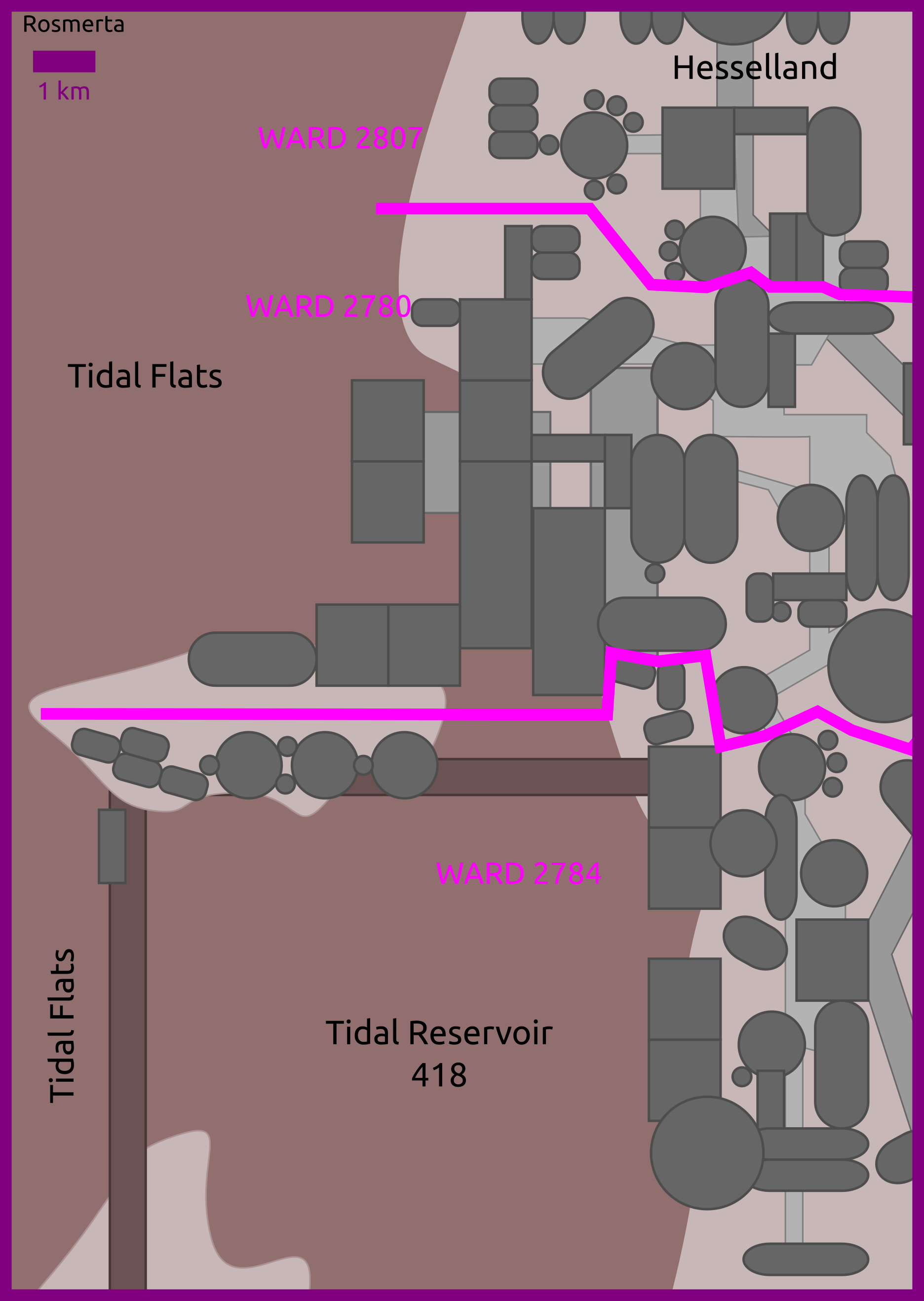
About 95% of Rosmerta's surface is covered by hydrocarbon seas, the other 6 million square kilometers being land above the high tide limit. Rosmerta has significant tides, and millions of square kilometers of tidal flats and lowlands. The largest landmass is called Hesselland (~4 million square kilometers), and is dominated by a mountainous north-south ridge extending about forty degrees above and below the equator. West of equatorial Hesselland are unusually large and smooth tidal flats which rise gently to the east; these are inundated by the tides driven by the other moons (especially the large rocky moon Peitho, but the other moons also contribute to a complex system of tides). North of Hesselland is Brenel, of ~1 million square kilometers, sparsely inhabited.
Culture and History
Rosmerta was settled before the fall of the Empire, along with Sirona and Heidelberg. Whereas Sirona was abandoned during the Dark Age, humans continued to live on Rosmerta continuously, never entirely losing the capacity for spaceflight and keeping in tenuous cultural, if not economic, contact with Heidelberg throughout. The moon endured a substantial population contraction late in the dark age due to accumulated failures of Imperial-era infrastructure, with some survivors managing to relocate to Heidelberg and contribute to its renaissance in the next century. Ramses Stallone, revered today as the founding father of the Rosmertine world government, led the construction of tidal power projects to sustain the colony. Colonists from Heidelberg and Rosmerta resettled Sirona and colonized Damara around the time of the formation of the Allied Worlds, and its population is today the largest of the Good Moons.
The Empire colonized Rosmerta with a "worldhouse," an earth-sheltered tensile greenhouse complex supported by modest positive pressure (1 KPa, 4 inches of water column) and containing a breathable atmosphere. The worldhouse covers 123,800 square km in Western Hesselland. Though radiation levels on Rosmerta are moderate, sleeping spaces are customarily underground, in keeping with Imperial colonial practice. Farming is indoors, mostly of algae, with some higher plants and aquatic invertebrates. Throwing or tossing objects is culturally taboo on Rosmerta. The population is moderately low-gravity-adapted.
The government of Rosmerta, the Rosmertine State, controls the worldhouse and its surroundings; the rest of the moon has no effective governance, and is rarely patrolled by RS forces or agents. The Rosmertine State is a representative democracy with a unitary legislature, and divides its territory into 318 administrative districts. No party holds a majority in the legislature; the ruling coalition is headed by the plurality, the center-left Redevelopment Party.
The primary social issue facing Rosmerta is overpopulation of the Worldhouse and increased food and energy prices.
Economy
Rosmerta's economy is dominated by organic chemistry, polymers and carbon structural materials, including composites. It is tidally locked and therefore unsuitable for a space elevator, but because of its modest gravity and thick atmosphere, thermal-fusion space planes provide ready and inexpensive access to space. Energy is obtained from deuterium-deuterium fusion (60%), wind turbines (12%), and tidal reservoir hydroelectricity (28%), the latter having been, essentially, the salvation of the Rosmertine population in the Dark Age as the attrition of Imperial fusion reactors took its toll.
Expansion of the worldhouse to accommodate the growing population has been stymied somewhat by a mild recession following the conclusion of the Dirac civil war and a reduction of Allied military spending, but it is believed that in the long term, the reduced polymer and construction costs will actually be beneficial for expansion. More locally, the industrial heart of Hesselland near the equator has suffered from substantial unemployment resulting from the recent bankruptcy of Rosmerta's largest shipbuilding concern (Rosmertine Fleet Yards) and its supporting industries. The government is supporting the construction of additional tidal power reservoirs, building huge earthen dams in Western Hesselland with the hope of lowering food prices, particularly on desirable multicellular foods.