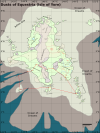
Rosmerta is one of the Good Moons. It is part of the Arthurian League, a constituent state of the Free Confederation of Allied Worlds.
Culture and History
Rosmerta was settled before the fall of the Empire, along with Sirona and Heidelberg. Whereas Sirona was abandoned during the Dark Age, humans continued to live on Rosmerta continuously, never entirely losing the capacity for spaceflight and keeping in tenuous cultural, if not economic, contact with Heidelberg throughout. Rosmerta endured a population contraction late in the dark age due to accumulated failures of Imperial-era infrastructure, with some survivors managing to relocate to Heidelberg and contribute to its renaissance in the next century. Colonists from Heidelberg and Rosmerta resettled Sirona and colonized Damara around the time of the formation of the Allied Worlds, and its population is today the largest of the Good Moons.
Physical Planetography
Rosmerta is tidally locked to the gas giant Carlisle, New Europa VII, of which it is the third moon. It is in an orbital resonance system with fellow inner moons Peitho and Sirona. Rosmerta's diameter is 6161 km at the equator. Its gravity is 21% of Earth gravity. Rosmerta is characterized as a 'warm Titan', with a heavily reducing chemistry rich in hydrocarbons. Rosmerta has a modest magnetic field. The atmospheric pressure at sea level is 1.62 bar. The atmosphere is mainly nitrogen with hydrocarbons and organics and is characterized as dominantly reducing. The average temperature is -20C; temperatures range from -35 - +5C throughout the moon's surface. Rosmerta is modestly volcanically active. The oceans are mainly liquid butane and pentane and isomers. Butane rain is sometimes observed and drives erosion. The atmosphere is poisonous due to naturally-occurring cyanogen and hydrogen cyanide.
Lighting is about as bright as twilight on earth during the Rosmertine day of 98.3 hours. The sky is a hazy brown, with clouds of butane and other organics. New Europa is visible as a bright spot in the haze. The extensively-ringed gas planet Carlisle is visible from the surface only under certain lighting conditions, under which it appears as a diffuse bright region in the sky. (i.e. New Europa is shining on Carlisle and it is star-night at the observer's location on Rosmerta, in which case the reflected light from Carlisle is the primary light source.) No stars besides New Europa are visible from the surface.
About 80% of Rosmerta's surface is covered by hydrocarbon seas. The largest landmass is called Hesselland, and is dominated by a mountainous north-south ridge extending about forty degrees above and below the equator. West of equatorial Hesselland are unusually large and smooth tidal flats which rise gently to the east; these are inundated by the tides driven by the other moons (especially the large rocky moon Peitho, but the other moons also contribute to a complex system of tides).