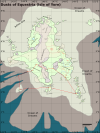
The Twelve Worlds are a collection of inhabited bodies which retained or redeveloped technologically advanced civilizations after the fall of the Empire, in which their part of the galaxy was cut off from the rest of connected space by the deliberate destruction of a wormhole gate. Today, the Twelve Worlds and their colonies form the Free Confederation of Allied Worlds. They were originally colonized relatively late in Imperial History, and mainly by humans, with no Mu Araen and few Biran having settled there at the time they became isolated.
History
The three Elder Species, an alliance including humans and two other intelligent species, spread their civilizations far and wide over the galaxy. In time, their ambition grew, and they raised the banner of the Great Empire of Biran, Sol and Mu Arae, which held the the known galaxy in its strong but even-tempered grip for many centuries.
However much their technology and political efficiency improved, though, they knew that others had gone before them: then, as now, the only way to travel between stars in a reasonable amount of time was by a system of artificial wormholes within gates. These were the work of an ancient race of incomprehensible power, whose awesome handiwork had shaped and transformed the mass-energy of entire gas giants into a network of tunnels in spacetime, linking the galaxy together.
It was inevitable that some should worship the makers of the wormhole gates as gods. Most of these regarded those gods with respect and gratitude for their precious gift, much as their ancestors revered the creator gods that gave them life. But others thought that traversing the wormholes was taking a shortcut through Heaven, and that the blasphemy of interstellar travel must end. It was the distinct misfortune of the Empire that it was the latter who came to possess the secrets of efficient Antimatter production. With the promise of free energy and incomparable destructive power joined to their call to penitence, their message began to catch the ears of the Empire's disaffected trillions.
Thus began the Antimatter Wars, and the collapse of the Empire. The collapse was necessarily slow, for the vastness of the Empire and its decentralized administration gave it a tremendous amount of inertia. Antimatter technology was captured and employed by both sides. In the ultimate act of desperation, some Imperial viceroys adopted the methods of the enemy and used antimatter bombs to destroy the wormhole mouths linking their dominions with the rest of the galaxy. No one may ever know what became of them, or likewise of the hundreds of rebel worlds who likewise destroyed their wormhole mouths in pious repentance for a thousand years of sacrilegious traversal.
The collapse in the longest-inhabited regions of the galaxy was especially violent, doing irreparable damage to the wormhole network. In the less-well-traveled regions, it was less dramatic. In many parts of the galaxy, the call to the destruction of the wormholes found no purchase, or took a less extreme form which regarded the destruction of wormholes as perhaps the one thing more reprehensible than traversing them.
But there were exceptions. The nomadic worldship Renard's Free Station had acquired a substantial amount of antimatter under unclear circumstances, and used it to extort tribute from a string of outlying systems. Doggedly pursued by a remnant Imperial squadron, the bandits traversed the Susan Wormhole and used their antimatter to destroy it behind them. This act bought them only a few years: the bandits had exhausted their antimatter destroying the wormhole. The inhabitants of the Dirac system called the bandits' bluffs and destroyed them.
Widespread political turmoil and economic disruption marked the destruction of the Susan wormhole. Although the economics of interstellar travel, even at the apex of the Imperial age, dictated that all but the newest colonies were sufficient in bulk agricultural and industrial goods, planetary economies and production were intertwined to a great extent at the time, and the technological advancement of the Twelve Worlds declined considerably in isolation from the rest of the Galaxy. Humans even went extinct from some of them due to incomplete terraforming and infrastructural failures.
It was hoped that trade would be reestablished by another route, but civilization in the space beyond Dirac collapsed far and hard, with sentient life becoming extinct or losing the infrastructure necessary to support economic interstellar trade. The Twelve Worlds became insular, slowly redeveloping and reconnecting each other over two centuries, growing unconcerned with the fate of the wider galaxy. Many began to doubt that there was anything of immediate interest beyond Dirac: perhaps the anti-wormhole extremists had isolated that region too, leaving only a few burned-out planets behind.
There were quarrels enough among the Twelve Worlds themselves to contend with. Planets that had redeveloped the capacity for interstellar travel sooner than others tried to dominate the latecomers, and factions competed to colonize or recolonize the uninhabited planets in their systems. Powerful nations fought each other in struggles to form unified planetary governments. After years of destructive turmoil, a confederation was formed, binding the civilized world together on the high-minded principle that all planetary civilizations would be treated as equals and mostly left to determine their own internal affairs - provided that some essential rights of citizens and interstellar travellers were respected, those being established in the early crucible of the Toll Wars, the Alliance's last existential crisis.
Since then, the Alliance has been largely successful at preventing the ruinously costly and destructive tragedy that is interplanetary war. However, its reluctance to intervene in member planets' internal conflicts proved a weakness when, fifty years ago, a civil war broke out on Dirac IV. The AW backed the recently-formed Dirac planetary government, but it collapsed, and despite the fact that no effective military aid had been provided by the AW to the failed government, the new rulers of the planet decided they had had enough of the alliance and its favouritism toward their opponents. They blockaded their wormhole to the rest of the Twelve Worlds' space. Extremists on Dirac talked of attempting to collapse the wormhole if the Alliance challenged the blockade. It was uncertain if they had the capacity or actual inclination to do so. The Alliance played it safe and waited them out.
Recently, a second planetary war took place on Dirac, in which the wormhole blockade was ended by one side, who subsequently revealed the fact that an automated space probe had passed through the system's other gate, the Cohen 138-Guo's Star wormhole - the first sign of technologically advanced life beyond Guo's Star since Imperial times. This faction also invited Allied intervention in the war, and in light of the unusual circumstances, this was done. The victorious Reformists made overtures to the AW to mediate the establishment of a supranational union on Dirac and the resumption of interstellar trade. Allied diplomats were able to achieve an agreement, and though it remains to be seen if this agreement will be enduring, the Dirac system is again part of the Allied Worlds, open to commerce and intellectual exchange.
The Twelve Worlds are Iridia, New Iridia, Dirac, Thane, The Water Planet, Heidelberg, Mars, Susa, Larsa, The Good Moons (actually several worlds), Nguyen's Planet, and Shamash.
The configuration of the starsystems with respect to the wormhole network is:
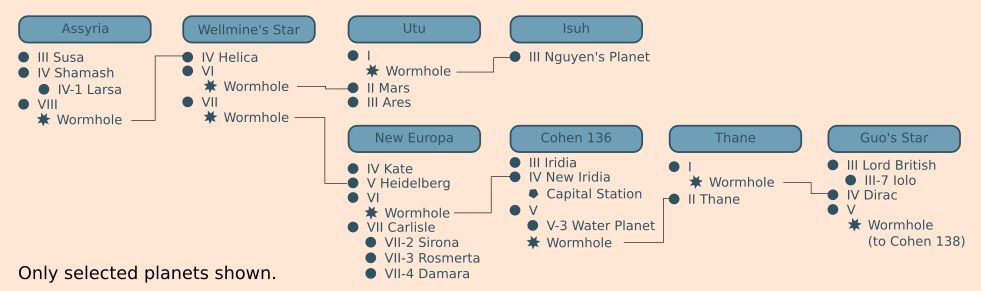
Guo's Star Links: Thane I -> Dirac (Guo's Star IV); Guo's Star V -> Cohen 138 III
Thane Links: Cohen 136 V* -> Thane (Thane II); Thane I -> Dirac (Guo's Star IV)
Cohen (136) Links: New Europa VI -> New Iridia (Cohen 136 III); Cohen 136 V -> Thane (Thane I)
Utu Links: Wellmine's Star VII -> Mars (Utu II); Utu I -> Isuh IV
Isuh Links: Utu I -> Isuh IV
New Europa Wellmine's Star VI -> Heidelberg (New Europa V); New Europa VI -> New Iridia (Cohen 136 III)
Wellmine's Star Links: Assyria VIII -> Helica (Wellmine's Star IV); Wellmine's Star VII -> Mars (Utu II); Wellmine's Star VI -> Heidelberg (New Europa V)
Assyria Links: Guller VII -> Susa (Assyria III) [collapsed]; Assyria VIII -> Helica (Wellmine's Star IV)