Cultures
- The following is divided by major cultures and their appropriate descriptors. These are often including multiple countries or other governments within them for the sake of convenience.
Bun Cultures:
Almiraj Empire, Tsarcrov
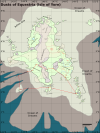
- Tsarcrov refers to the massive Almiraj empire that covers the continent of krolit. It's capital is Ashkod. Empire is being used to refer to the culture due to the extensive effect the Tsarcrov empire (lasting 450 generations, ended 65 years ago) had on their culture.
General Elements
- The bulk of the region is part of the old empire, a vast and lush area surrounded by an immense and dangerous range of mountains that are themselves surrounded by barren wasteland. This, until recent years when sea travel was opened, enabled the empire to create an isolated culture. In fact until 75 years ago most buns in the empire space believed they occupied the only habitable region on the planet and the rest of the world was lifeless and dead. Though this belief is no longer widespread it still lingers in places and the myth of the Tviticzem (The deadlands) still features prominently in folklore and fiction. The rest of the region consists of a series of towns and cities outside of the wasteland (and in one case in the desert region) that were founded by those buns banished from the empire (at the time this was believed to be worst than death). These outside towns possess a variety of political structures while the central country of Tsarlika, the remainder of the empire, has transitioned to a republic of several territories governed by elected officials.
- Much as with other bun cultures the Tsarcrov place an emphasis on the duty and authority of does over bucks. Though recent years have seen bucks vying for more rights and have been taking on far less traditional jobs/roles there are still many places that do not allow bucks to be land owners or side in favor of does in any matter of ownership. Crowned buns are left to decide their roles as desired but are always treated in legal matters as does.
- Initially the empire consisted of several large farming and mining regions with their goods transported to cities that functioned as centers of trade and craft with little of their own natural resources, the largest of these becoming the capital of Ashkod. The outcast cities, by necessity, all tend to have their own direct sources for natural resources in the local region. Ashkod and most of the other trading centers remain functioning economically be becoming outward centers for trade and have since integrated several of the island communities near the region.
- Fashion among empire individuals are heavily focused on coloration. They mainly use flowing full-body garments with loose pants underneath and accessorize with sashes or veils. Bright colors are the most common and in situations where one cannot afford cloth in bright colors they often supplement it with embroidery of cheaper threads or flowers worn in accessories. The main exceptions are in professions associated with death, medicine, or prostitution. In those cases the traditional indication of those occupations are dark blue, dark red, or black clothing, often with ashes or dye used to artificially darken the fur. Most cloth is made from a local plant whose fiber can be turned into either coarse or fine fabrics depending on the method of treatment. Because the coarse fabric is cheaper, thicker, and more durable it is far more often worn by buns of lower financial status.
- While the Tsarcrov embraces fairly typical gender roles they are also fairly accepting of varying sexuality. A strong preference for doe/doe over buck/buck relationships exists due to the fairly heavy legal limitations that bucks experience. In relationship terms Tsarcrov culture consider buns to be an adult at 17 years of age. Physical attractiveness in does is heavily skewed towards short upright ears, a firm jawline, and physical strength. In bucks the preference tends to focus on long ears, full hips, bright fur color, and long claws on the feet. These preferences have produced a number of trends resulting in it being not uncommon for does to clip their ears and bucks to bleach (or brightly dye) their fur, add extensions/paint to the claws on their feet, and to wear cloth sleeves over their ears. Socially does are often evaluated based on their capacity to protect and provide for a family while bucks are often evaluated based on their child rearing and tenderness.
- As with most bun cultures children are referred to as kits and tend to be born singly. Child rearing in rural areas and the outcast region is generally handled by the family but most of the large cities in Tsarcrov have created the concept of public education for the early part of childhood (4-8 years) after which a kit is expected to either be apprenticed or otherwise set to learn a trade. They are generally considered adults in a terms of professional and legal matters at the age of 20.
- Tsarcrov produced a wide range of art, but by far the most famous products are their tapestries and pottery. Tapestries often have a large artistic depiction, either of historical or mythological elements. The largest of these often double as historical records, sometimes covering spans as large as 100 years. Pottery initially began as large and elegant vases or pots but has long since shifted to statues and figurines with an emphasis on the delicacy and elegant painting. Pottery is mostly depictions of buns and usually of either current models or of historical figures. The most infamous and most famous aspect of this was a collection called the 71 domos (71 hutches) a series of 71 exquisitely detailed erotic figurines of buns. It prompted a large amount of both imitators and derivative art in the same field. This prompted a somewhat unfair reputation of the field of Tsarcrov ceramics as being perverted.
- Tsarcrov believe that crowned almiraj buns are touched by the divine, but specifically by the same divine blood that once anointed the bloodline of their empresses. As a result there is both an underlying belief that all crowned buns are related and a law that bans relationships between crowned buns. A free training system exists for crowned buns within the former empire but requires travel to one of the major academies specialized in such. In the outcast lands this is replaced by apprenticeship to whomever happens to be the most experienced crowned bun in the area.
Food
- Tsarcrov has a pretty diverse range of food sources. The bulk of grain comes from the svet plant, a climbing plant that needs to be grown on a trellis similar to grapes. It's grains are usually either boiled or ground into a very fine flour that produces a springy and slightly sweet dough. That dough can be rolled into flexible flatbreads that form a major constituent of all hand/street food. Buns of this region raise floghs, maes, and scriggs as their primary livestock and the meat of maes and scriggs form the bulk of their proteins. Cooking is heavily mixed between a form of pit based slow cooking, smoking, and frying for the meat, with the bulk of vegetation being either boiled or fryed. While svet makes up a lot of farming a regional verdig, kapust (green flowers) a leafy green, bihts a leafy vegatable with deep blue coloration to the stalk and root both of which are eaten, and perets a vine growing and very large berry with a mostly savory taste make up the majority of other crops.
- Tsarcrov cooking is has some very strong sweet flavors with subtle undertones and buns from other cultures often find overwhelming. Especially when treated with either bekyu (black sauce) or prany (pink sauce). Both of these sauces are based on heavily reduced and thickened fruit juices with other spices added at various stages of cooking and fermenting. This is countered by the accompanyment of tsarcrov alcohol, most of which is either based off the root of biht and the fruit (otherwise inedible) of the yad bush. The alcohol, especially the trupsat (death water, usually 90 or higher proof), has a taste that is a mix of sour and bitter that often at least distracts from the very sweet food. Though most tsarcrov food critics feel that they compliment each other.
Architecture
- Buildings built in the Tsarcrov region is very heavy in block shaped buildings made with an adobe-like substance. They also employ an immense amount of integrated gardening. On most buildings this is done by placing a layer of turf on top of the blocky-flat-topped buildings. An external drainage system is then employed to prevent the accumulation of excess water. In wealthier buildings this is mostly decorative and usually includes ornate hedges, climbing vines, and bright flowers. In the less wealthy areas the top is usually used for a small amount of house crops to shave a bit off the family budget. Internally the buildings rely much more soft rush or other similar floor coatings to retain heat than on hangings or rugs. The buildings are also noted for maintaining mostly open layouts with buildings only having separate rooms when needed for professional reasons.
- Of notable exception are the monestaries, temples, and the imperial palace. While these structures still tend towards blocky shapes they tend to be made out of carved stone or marble bricks. With complex and spiraling metal working added to corners and towers as a decorative element. The buildings also tend to be much larger and more complex than other buildings in the culture. With many separate rooms for specific functions. In religious buildings there's a major decorative element referred to as "The Shep" (The Spine) consisting of a long pointed shape with downward angled spurs jutting off every 1/5 of the length. These are are often implemented as paintings, tilework, or sculptures.
- Tsarcrov is also often noted for the paved roads that connect every town and city in the region of the empire and the efficient sewage systems in it's larger cities. Large irrigation projects have been established for centuries and not only serve to water the crops but to also motivate the plumbing systems of the city, and provide water for the large public bathing fascilities.
Religion
- Tsarcrov buns believe in a hierarchy of spirits, beginning with Otet the father of all spirits and leading downward all the way to minor spirits believed to emmbody the food, water, and warmth of individual homes. The second rank of spirits are the 4 spirits of earth, wind, water, and fire with each having a major monestary devoted to them. A central temple in the capital of the empire is devoted to Otet and many smaller monestaries, temples, and shrines are devoted to the other lesser spirits.
- Worship is primarily through meditation and chanting with monks and priestesses acting more as advisors and guides than as preachers. Interestingly the Tsarcrov religion is unique among buns for being headed by a buck. While many other bun religions have religious orders and positions filled by bucks only they have a high priest. Most Tsarcrov clergy have at least one vow of abstinence from a specific behavior, the individual vow is determined by monastic order with the Otet taking a vow of celibacy. The most common vow is that taken by the monks of the household spirits (who have a collective order rather than an order for each individual household) have a vow against living in one place for more than 3 days and as a result spend most of their time traveling the empire and performing minor religious functions for those they encounter.
Almiraj Queendom, Azmalakah
- In this case this refers to the three large Almiraj countries along the continent Arnab. Only one of which is still a part of the queendom in question, the other two having seceded, one due to the rise of the merchant class and the other due to dissidence of a group of nobles over changes to the order of inheritance for one of the queens. The queendom was renamed to Narsarab after the ruling queen who stabilized it after the most recent of the secessions. The merchant secession went on to form Cinderfel while the seceding nobles formed a new country named Ashire.
General Elements
- Being a former feudal region most of Azmalakah is structured of cities and towns grown around manors or castles with the surrounding region dominated by farms or by fishing communities. These stretch the full length of the old queendom which extended from the North-East tip of the continent all the way around the southern edge to the North-West tip. The boundaries to this being the two great mountain ranges which prevented expansion not only because of the physical boundary but because they were settled already by the skvader. Those same skvader now are major allies of the almiraj buns in the region, providing the patrols and watches that keep the roads safe in the area. At this time this region has become one of the largest centers of trade in the world and all 3 countries boast an immense trading network and a large amount of colonies on the other continents and islands.
- As a result of the open trade and overall welcoming nature of the communities the cities in this region often include many other cultures intermingling with the original culture of the region, though they often gather in specific quarters (similar to places like chinatown). This has also resulted in a strong focus on trade as both the economic and cultural focus of the area.
- Azmalakah buns still retain a lot of traditional views regarding the roles of bucks and does though these are getting challenged at an increasing rate and many bucks are beginning to hold occupations in areas long considered the domain of does. They do still hold some of their oldest views on crowned buns and still cede them a great deal of respect while accepting any identity they choose to maintain. Despite this all three countries do, at least in law, recognize bucks and does as equals with cultural inertia currently proving the greatest barrier. The views on orientation are fairly generous though doe/doe relationships are considered slightly more acceptable than buck/buck relationships. Azmalakah society is also comfortable with the concept of polyamory and still consider large immediate families (3-4 generations from 2-3 separate branches) to be a normal family structure. Physically does attractiveness is heavily around physical strength, a firm jawline, and dark fur coloration while buck attractiveness is focused around small and slender body types with soft fur and big eyes. Trends around this are mainly dark dyes of fur on does and elements of eye make-up such as mascara and shadow. Socially standards of attraction change a lot between rural and urban regions. In rural areas most bucks are evaluated on their ability to support the tasks of running farms and large households as well as their ability to cook while does are evaluated socially more on the prospects of their family. In more urban areas the bucks are often evaluated on their skills at artistic pursuits (such as music, dance, or painting) and their cooking.
- Children in this culture are still called kits. No public educational system exists and child care is exclusively the domain of the parents or immediate family. In larger cities there are private schools and a few guilds have public policies of taking in any foundlings (though many of them present the kit with a bill on reaching adulthood). More commonly any education outside of training towards a family profession comes from religious sources who also provide the most common care for orphans outside of large cities. Adulthood for buns is considered to begin at 19 in this culture.
- Art in the kingdom is very heavily influenced by religion and especially by The Sisters of The Sun. Aside from personal commissions most major artwork are of saints or of Lyx himself. The most common art forms in the rural region are weaving (especially tapestries and clothing) and woodcarving. In urban regions the art forms have shifted heavily towards painting and marble sculptures. The current focus on the painting is towards a form of oil painting and is focused on realistic anatomy and proportions. In professional terms the art community of the kingdom is in the state where most of the artists are scouted individuals who become personally matronized by a wealthy individual.
- The more religious buns in the region are still of the view that crowned buns are a divine touch upon the world but elsewhere more pragmatic views are developing and many now view them with the same attitude one does a person with other exceptional traits (such as high dexterity or a sharp memory). This is proportional to a similar view that places a not insignificant pressure on crowned buns to present and live by a more feminine standard and many of the stricter religious buns consider it profoundly disappointing when a crowned bun acts or considers himself a buck. This is also being pushed back because of the growing religion worshiping the deeds of Golden Wheat who was very clear about considering himself a buck.
Food
- Azmalakah food comes most famously from talax (a plant that grows similar in shape to moss but produces internal pod structures that acts a lot as a kind of wheat), scriggs (both meat and eggs), verdig (a fruiting carnivorous tree), flifil (a spicy root vegetable), and ablata (a savory vine whose every part is edible but especially the vines, leaves, and ghourd-like fruit). Talax is pretty much always baked into breads (it can also make pastry and other varieties of dough but that's a little regional) though the bread is often studded with fruits or nuts. Meat is most frequently roasted or boiled depending on availability. A lot of the fruits get made into preserves either as jams or drying.
- The food itself is often criticized by other cultures for having a much less intense range of flavors as it includes a lot of savory foods that get heavily boiled to remove the saltiness. This relates a lot more to the fact that most of these foods are being cooked by travelers who needed to preserve the food to travel. When working with fresh foods and their full range of spices they have a strong amount of sour and spicy flavors processed into thick stews used to coat or fill breads.
Architecture
- At the bottom end of the social orders much of the buildings are squat structures made of wooden logs with scrigg or grass thatching. But as it goes upward it leans heavily into either stone or lime bricks built into rounded structures and a preference towards adding new levels to a structure than to expanding the grounds. As building techniques have become more refined it has also taken on a tendency towards overhanging structures that can give some buildings a decidedly mushroom like appearance. In the most common home layout there are usually three distinct rooms; a living room, a sleeping room, and a kitchen. As with many other societies they follow fairly traditional doors structures and separations between these rooms.
- Decorative architecture is largely unused on normal buildings and is almost exclusively used for the homes of the rich, important civic structures, and religious buildings. Most of the decorative elements are carved statuary or stained glass. An exception to this is the usiqasa (beat-stone) a single brick or stone with a carved depiction of Lyx that is found on the lower right of the front door on nearly every Azmalakah building (even carved into the wood on houses that do not use stone or brick). This is originated as a religious appeal for divine protection over a newly built hours but has become more of a general tradition in some areas (though many buns believe it to be bad luck for a building to either be missing this or for it to have been defaced) and in some of the more secular cities these are replaced with a carving of a family crest.
- Running plumbing is still a fancy concept in Azmalakah and most buns either rely on a combination of buckets and city gutter systems or on the tried and tested outhouse. In part because of this public bathing as a concept is still not especially common and baths are more often done in the home using a hip bath and buckets of water.
Religion
- The most dominant religion in the queendom by far is The Sisters of The Sun. This was the religion of the first queen and was heavily enforced on new areas during early expansion. When the skvader were brought in as allies rather than being absorbed they also brought in their religious order The Flame Holders. As a result for a long time those were the two largest religions in the areas until roughly 900 years ago when the order of The Hero's Walk was founded (10 years after the death of Golden Wheat). Currently the sisters are in a steady decline as not only a shift towards secularism has developed but also as the newer and less oppressive religion has gained popularity.
- Worship is primarily performed in chapels or cathedrals and tend to lean heavily towards formalized structures of worship and instruction. Much of the social position of religion in the queendom is currently maintained by the wealthy making large donations for their own benefit (in at least one case the sisters were given a large plot of land by the crown to ignore the slaughter of the previous contender for said crown). Despite the decline in popularity the sisters are still a major cultural force and their influence can be seen easily by the frequent theme of religious artwork specifically based around events of their church.
Skvader Stratocracy, Myndighet
- The Myndighet, the collection of the Skvader territories across Arnab, consists of no less than 18 separate countries. Though they do have a representative council used to help handle diplomatic and territorial matters. Officially each skvader fort represents its own sovereign territory consisting of several towns, villages, and outposts as well as the region that fort is responsible for patroling. Each of these forts is lead by a bun referred to as the commander, though the position may be designated by military promotion, prowess in a relevant skill, or democratic election depending on the preferences of the population of the fort. In addition to the commander each fort has a Minister Councilor who acts as the representative of the fort's interests in the council. These Councilors serve for life and are appointed by the current commander of the fort when their predecessor passes away (though it is not unheard of for commanders to arrange said passage in order to place their own representative in that position).
General Elements
- Skvader culture has heavily spartan origins and as a result most of their cities, towns, and villages as well as their personal interaction, aesthetics, food, etc are all flavored with a degree of military nature. This origin came about as a result of the nomadic skvader hunter-gather tribes establishing a trade relationship with the early agriculture tribes of the almiraj buns. In exchange for supplies the skvader became the protective element of these almiraj tribes, a role that necessitated strict discipline and fighting prowess and forever left traces of military throughout their society. This faded to it's current level as the almiraj tribes and their protectors inter-married and inter-bred until their cultures fused into the more modern Myndighet. When the Azmalakah Queendom spread to these same regions the risk posed in battle against the well trained and disciplined warrior buns was determined to far outweigh the benefits of conquest and so the autonomy of these regions was allowed to continue on the condition that the protection be extended out to the new regions. As this also included the ceding of more territory to the Myndighet it was readily accepted.
- While no less welcoming of other cultures than the buns of Azmalakah the skvader culture remains more homogeneous because the majority of the culture is in the large mountain and plateau forts/cities which are less geographically welcoming. That said most of them include a pulley elevator system to bring up their ground-bound visitors and friends and have surrounded the area near the elevator with housing, shops, and other business specifically derived from and run by a more diverse set of buns. These areas are referred to as jordhol (Dirt Dens).
- Skvader views on gender dynamics are at once both more and less progressive than those of other buns. While bucks are freely and happily accepted as warriors and most other professions they are still considered lesser in these roles than does. In fact bucks are limited to only the first three ranks of the enlisted and commissioned ranks. As well it is considered standard that does do all ownership in a relationship. However there is also a standard law in all of the forts that a formal challenge can be made to duel over issues of ownership, meaning that more than a few bucks have achieved social parity with does by dueling and defeating the matriarch of their family unit (In many cases the doe was in fact on the side of their partner and intentionally chose a duel they would lose or otherwise threw the fight). At the same time their society has a very reasoned view of crowned buns and never really developed any major religious views about them and only consider them to have an exceptional gift that must be developed and honed the same as any other. The stratocracy is completely accepting of all orientations and in fact considers it extremely inappropriate to press or harass others on this issue believing that "what any soldiers do in the barracks is between them and the bedrolls." However polyamory is only normalized in favor of does having multiple partners and tend to treat any doe in such a relationship as the matriarch and dominant position. Central elements of physical attractiveness for does is split between a large and powerful physique and wingspan, though oddly enough there is no strong position held on height for skvader does. For skvader bucks physical attractiveness is centered around small, slender physiques and the coloration of their wings (buck skvader tend to have a wide range of bright colors to their wings). Social attractiveness for all genders is almost exclusively based around military/combat prowess, though bucks are also evaluated heavily on their ability to tend to a home. Accommodating the heavy interest in martial prowess most of the decorative aspects of individual skvader are centered around making themselves look powerful and intimidating, they frequently wear (even if it's only decorative or leather) armor and weapons. It is also not unusual for skvader to give themselves decorative scarring.
- Kits in the stratocracy are considered the responsibility firstly of their family but they always make sure some resource exists to provide communal care for the children of buns unable to tend to the kits either from military obligation or death. This resource is typically a communal child care center run by an experienced buck and is referred to as faoir armr (phrase referring to an all-accepting father). Aside from this all kits are given a free education in both general studies and in military matters. As a result all buns born in a skvader town are given at least a minimal amount of combat training. Buns graduate from this at an average age of 16 at which point they are required to serve 2 years in a martial force, either the rangers, the home guard, or the paladins of the flame. Skvader kits are considered legal adults at 16 for the purpose of property ownership and gaining military rank. However they are not considered adults for purposes of relationships until 22 years old.
- Being heavily influenced by their military past almost all of the skvader arts are centered around martial themes. Musically skvader have a heavy focus on skaldic chants and drums, often these are accompanied by a variety of fire-dances using either torches or burning censers. In terms of visual art skvader firstly focus on the creation of fine art as weapons or armor. This often includes armor with complex pictures of legends and stories engraved or gilded onto them and weapons with similar subjects written onto their blades are also very common. A secondary focus though is on murals. Most skvader cities have a central library stocked not with books but with series of walls each containing murals depicting informative subjects. Outside of these libraries most skvader buildings feature stylized murals that depict the history of the family who owns the building in question.
Food
- Instead of their food being undeveloped and limited to practical military food skvader cooking is known for a staggering level of diversity especially in the area of meat and spices. Skvader in fact have a reputation (admittedly a joking one) as being willing to eat just about anything set before them. In actuality the buns have such a strong history of hunting that their traditional foods are filled with just about every variety of meat around and whatever combination of spices are needed to make them palatable. Most of the meat is slow cooked (which is especially needed for tough and gamey bush meat) and usually all of the food is cooked and served in a single unit. For smaller foods the meal is usually cooked slowly in a single large pot while larger foods are usually slowly spit-roasted and a low temperature while wrapped in exceptionally large gerda leaves (plant with leaves more than 1 m in length). Food prepared for long term storage is more often than not pickled. Skvader cooking involves very little sweets outside of raw fruit. Instead the flavor is mostly savory, spicy, or sour.
Architecture
- Skvader architecture is heavily functional in nature and derives its materials from whatever is most practical for the region. Because of the common cliffside or plateau dwellings much of their buildings are carved out of natural rock. Most major buildings are built specifically for military function so that in an emergency they can act as shelters and centers of resistance. Thus most of them have narrow windows, heavy doors, and external walkways that provide defensive positions. Smaller domestic or business structures are instead build in square shapes for efficiency and have no more rooms or development than needed for family functions (usually a central room, and bedrooms).
- Given skvader fondness for murals it's natural that it becomes a common element of decorative architecture. All homes are traditionally decorated with depictions of the most noble deeds of the family ancestors done in stylized forms consisting of simple shapes of primary colors. Decorative sculptures are unknown as they are considered only appropriate to use in burial sites owing to a skvader superstition that a sculpture of a thing is imbued with a bit of the will/soul of the thing. Thus sculptures of the living steal away a soul and sculptures of non-existent things are inviting the will of the strange damned servants of Xyl (Specifically they believe it invites a ristada, a malicious spirit in the form of a bun with an upside-down face that lurks in a building causing it to fall apart in fashions that harm the occupants).
- Being that most skvader live on top of plateaus and cliffs most of them find it more efficient not to develop plumbing and instead still use hip-baths and a localized dumping location for waste.
Religion
- The Flame Holders are the main skvader religion. It's reflected in that every skvader settlement, village, or city has a "home-fire" a large fire pit in their central building that is maintained throughout the life of the settlement. In addition there is a similar fire pit in all religious buildings and most skvader homes have a fire that is kept burning for the whole of the home's usage. While this is the primary religion in skvader regions they do not actively oppose the spread or teaching of other religions and so the jordhol usually contains a small chapel or other religious building devoted to another religion.
- Flame Holder worship is mostly conducted on a weekly basis by community gatherings around the fire pit in the local temple/chapel for religious readings. While that is the main face of worship the main place of religious practice is in the home by both the maintenance of the fire and by a nightly prayer around the same.
Dwarf Tribune, Shenze
- This refers to the bulk of Dwarf bun culture, though moderate changes exist in those not a direct part of the tribunal due to the extremely spread out nature of their tribes. Initially each tribe and each island housed a distinct culture and governing body (typically the eldest or greatest warrior as chief). The tribune developed when several prominent seers foresaw the arrival of Almiraj colonists from Azmalakah and concluded that they needed to present a unified front. The seers suggested to their chieftains that a representative go out to all of the tribes they knew of and request those tribes do the same with the final goal that all of them meet together to form a governing body prepared to meet this new challenge. The Tribune is the resulting governing body.
- Shenze (Big meeting) is a council composed of the leaders of the 22 known dwarf tribes. It is often referred to as a Tribune as the representatives of the 3 largest tribes hold special positions managing the affairs of the council itself. While these leaders are not in control of the council as a whole they do have the position of confirming new actions, bills, and subjects to be introduced to the council as well as ensuring that protocol for the body is followed. The current largest tribes (by a very significant margin) are Fledeiliet (Redstone), Hariver (Big Beans), and Fauc Guer (Mighty Axe) tribes.
General Elements
- Dwarf culture, by dint of having developed on many small islands, is heavily focused around the sea as a major source of resources. This results in a fishing as the most traditional form of employment and sailing as the most traditional skillset. These traditions began making major changes as the dwarf buns prepared to respond to the dangers of the colonizing almiraj they focused on the second most traditional part of their cultural that of the seers. As the crowned buns were able to use their magic to glimpse the future they were able to reverse engineer devices and chemical concepts from their visions. In this case the seers levied the knowledge of firearms to convince colonizing forces that they were better off cooperating with the Tribune in exchange for guns than trying to wipe out the creators of these weapons and having to work to figure out their nature themselves. By the time Almiraj tinkerers had figured it out for themselves the Tribune had established such extensive political connections that they would have to fight the whole of the world to complete a colonization of the dwarf buns. Both these oldest elements and the newer ones combine to form the whole culture of the modern dwarf bun. They are thoroughly split between the nautical traditions and the fast developing mechanical and alchemical studies.
- Dwarf buns are somewhat open to other cultures but it always strikes outsiders as something very guarded. This is because while there are no blatant laws or prejudices against outsiders themselves the cultural secrets (major alchemy and mechanical discoveries) are regulated and secured on a governmental level. This means that all alchemist and mechanist shops are under government protection and required to keep a lot of their methods secret from potential outsiders, including their own clients. This also extends to a ban on non-dwarfs working in either of those shops. The ban is purely pragmatic in nature and doesn't reflect anything other than a desire to maintain these secrets as a bargaining chip against groups with larger military presences.
- Dwarf buns have the most progressive of gender views among buns. In the earliest days they held views similar to that of other cultures, with does in charge of fishing and sailing while bucks handled the cleaning and other domestic issues. In contrast the modern dwarf culture has accepted equality in both legal and professional areas for bucks and does, due in no small part to the seers foresight showing them that such a state was the natural order of cultural progress. As well the seers ability to sense spirits and similar forces led to an early and easy adaptation of transgender buns as they tended to say that such abilities backed up the need of the bun to live as a given gender. Crowned buns are heavily revered but, especially by their own explanation, do not have a religious association. The Tribune likewise doesn't fret over matters of orientation so long as both participants are consenting adults. The physical attractiveness of dwarf does is primarily focused around a prominent dewlap, broad shoulders and short upright ears. For the bucks the physical elements of attractiveness are dominantly short height, curvy hips and long lop ears (some individual of exceptional attractiveness have had ears that physically touched the ground while standing). Social elements of attractiveness are mainly around either kindness or ambitious dreams with caring individuals and passionate workers both being considered very appealing. In acknowledgement of those traits considered most appealing many dwarf does wear shoulder pads, scarves, or stoles to make their shoulder and neck region appear larger. While most of their culture doesn't highly regard large or ornate clothing there is a noted fashion among bucks to wear either bustles or large hip pouches to accentuate curves in that region. Both genders heavily decorate their ears, does with rings at the base to hold them upright and bucks with heavy earring to drag them down.
- In most of the dwarf tribes kits are considered less a family issue and more of a communal resource or responsibility. Most provide communal education and childcare with an emphasis on finding areas children excel at so that those areas may be most heavily pursued. The educational and childcare are usually run from combined centers (especially for smaller tribes) referred to as guarderi (Small Farm of Children). Typically the formal education begins at 6-7 years of age and lasts 8-9 years with additional years at either the Mechanics or Alchemical colleges or a relevant apprenticeship. Kits are considered legal adults at the age of 17.
- As noted most of dwarf bun art is themed around the ocean. This art is, in largest part, consists of woodcarving, tattoos (permanent or dyed), and metal worked jewelry. Also of note is the developing trend of the addition of artwork to any mechanical work to the extent that several of the mechanics guild-houses no longer recognize devices without the addition of at least some artwork (most commonly the Spring Seal, a stylized rabbit head superimposed over flowing water). Artwork is heavily skewed to depictions of ocean life, island plants, and other aspects of the natural world. While depictions of religious subjects are not uncommon they are vastly outnumbered by other subjects.
Food
- Predictably dwarf bun food is heavily controlled by the tropical island climate from which it originated. The diet consists of heavy amounts of fish, sea plants, and tropical fruits. Aside from a few melons most all of the fruit they consume is cooked or otherwise heavily processed before consumption. Sea-life is mostly cooked by boiling into soups and stews, salt drying, or in a range of dishes referred to as namasa that consists of raw fish seasoned with vinegar or peppers and served on top of herbs and grilled koso (a slightly spice fruit). Aside from namasa and a few other fish dishes most of the dwarf buns have a heavier occupation on the fields of sweet or spicy flavors than sour or bitter.
Architecture
- The earliest of dwarf bun architecture was mainly grass huts, over time this has progressed to dominantly wood structures with grass thatching. An exception developed as alchemy became a major cultural element for them as the potential risk of fire and explosives necessitated the use of more sturdy materials. As such the workshops, stores, and guild-houses associated with alchemy or mechanics are readily identified as the only frequently stone or brick buildings.
- Most of their buildings, being made of wood, are decorated by carvings made directly into the building at key points such as door or window frames. These carvings are split between decorative depictions of artistic themes and labels that identify the owner or function of the building. Buildings are rarely painted though sometimes they are stained or treated to prevent damage to the wood and for aesthetic reasons.
Religion
- Religion is a very visible part of dwarf bun life, especially in smaller towns or villages where the growing focus on their technical capacities has yet to displace that aspect. In larger cities there are still recognized priestesses and their apprentices but the traditional one-per-population has been adjusted for population density in these locations to something closer to one-per-hundred. For the tribal capital cities these groups of priestesses are often organized through a central "guild house" that takes responsibility for assignments and organizing large events. For the areas more focused on the religion the local priestess holds a position of authority slightly higher than any handful of members of the local governing council of elders but slightly lower than the council as a whole. They tend to be consulted frequently on even minor life choices, due in part to the tradition that many of the priestesses are also seers and can use clairvoyance for such tasks.
- In both cases the priestesses officiate most major life, political, and cultural events in their culture. Even the largely secular guild events and gatherings usually invite a priestess to bless or open the event if just to ensure a civil relationship to the religious powers that be. This presence is usually polite and understated out of a similar desire. Both groups understand that a division or conflict between the two would represent a weakening of the unified efforts that have protected their culture and communities from exploitation by outside groups.
- While officially the Tribune places no restriction on buns of other religions preaching their views on the matter they do have a law that limits the number of buildings in any town that can be devoted to religious functions with that number being largely under control of the local authority for their own religion. As a result any buns intending missionary efforts to their cities and towns must either convince the True Spring priestesses to get permission for a new building or rely on the hospitality of local members of their flock to host their activities in their homes. While the dwarf preistesses are usually happy to have a new building be allowed they almost always do so on the condition that the building be jointly controlled by themselves and the newcomer to enable a priestess stationed there to keep their evangilical efforts in check.
The Seekers of the Spring
- In addition there are a number of traveling True Spring worshippers that belong to an order called "The Seekers of the Spring." Though the seekers are not a part of the same group that organizes and recognizes the priestesses the organization does recognize them and usually extends authority as Priest or Priestess to senior seekers. This combined with the Tribune extending a mild amount of civil authority to all of the seekers means that they have achieved a definitive level of reverence in dwarf bun culture. Seekers are often viewed as traveling law enforcement or arbitrators on difficult judicial problems, even by local civil and religious authority.
The Seekers of the Spring were founded over 1000 years ago by MesocarpGrey, a seer who claimed to have seen the True Spring being discovered and who devoted their life to hunting down information about the spring by traveling to all of the known tribes and gathering their stories and histories. In the process they learned to appreciate their own culture and began lending whatever help they could to protect and care for the tribes they visited. Eventually Mesocarp picked up an apprentice, then three more, and eventually they had to trade in their canoe for a larger sailing vessel to accomodate their followers. This would be the point where it transformed in function. At this point Mesocarp believed the seekers to have the most complete records of any dwarf bun and so concluded that the main function of their group would no longer be gathering information. Instead the purpose became one of traveling to seek out the location of the spring, exploring the oceans, and providing aid to the local powers-that-be.
- Eventually Mesocarp named an apprentice as their successor and as the first Lead Seeker. The Lead Seeker is ostensibly the leader but is also considered a first among equals and mainly serve to regulate the actual power of the organization which is a popular vote by all present Master Seekers. This is one of the only two hierarchical divisions in the group the other being between Master and Apprentice Seekers.
- Currently the headquarters of the seekers is "The Mighty Truth," the single largest sailing vessel on the planet and captained by the Lead Seeker. Traditionally this ship is accompanied by anywhere between 19-30 other ships and boats. This fleet regularly cycles between the capitol cities of the 5 largest tribes and each of them have reached the point of treating the arrival of the fleet as its own holiday as a result of the massive influx of trade and business.
- When a bun joins the seekers they are considered tochd fuh hall (Dead to the World). Their name is stricken from any tribunal record and they conduct a little mock funeral for their previous life (including carving their old name on a rock and casting it into the sea). The apprentice is then set to meditate on a small raft for 3 days and nights to decide their new identity. This isn't limited to a name change and more than a few seekers took this opportunity to come out as a different gender or orientation, something that the seekers have accepted since their inception. After this the bun is initiated to the seekers and spends the next four years being trained on survival/sailing techniques, history, and law. Once this training is completed the bun is apprenticed to a Master Seeker and leaves the fleet to travel the sea with them. After 10 years, or pending evaluation by committee at the fleet on recommendation by their master, the apprentice is given an examination before being elevated to Master Seeker. Once a bun has achieved mastery they are expected to spend most of their life traveling away from the fleet, only returning 1 year in 10 for a brief period of service and guidance.
- The only unifying strict belief of the seekers is in the existence of The True Spring. As a result there are actually several seekers who are not dwarf buns and do not actually belong to The True Spring religion. These members tend to view the spring as simply a great magical site and are generally not pressured to change any preexisting religious views. In addition to not requiring a change of religion the seekers do not require buns to actually sever all ties with their previous life and in fact encourage them to remain connected to loved ones from same. The actual laws and rules of the organization are largely about proper and legal behavior, including prohibitions on standard issues such as murder or theft as well as more strict requirements such as a complete ban on any form of lying and a requirement to always provide assistance when asked. While most of the rules are an extension of already existing social taboos they are strictly enforced and any violation can result in serious penalties. These penalties include things like; being kept at the fleet for 10 years work under a vow of silence for telling a small lie, reduction to apprentice for refusing aid to the needy, expulsion from the seekers for striking an innocent, or even death for some of the most extreme violations.
- Seekers are identified by the sky-blue skirts, clay armbands with a blue spring painted on them, and a small brand on the tips of their ears for the masters. Apprentice Seekers wear simple white skirts. In both cases the skirt can be worn over other clothing if the situation calls for such. Most seekers wield a growstock (big stick), a pole arm developed from the double-ended oars dwarf buns traditionally used for their boats with one end being an oar and the other being a curved blade.
Rex Queendom, Reyflor
- Reyflor includes 14 Rex countries on the southern half of krolit with the royal family of the Queendom of Hadaflor acting as less of a unified ruler and more as a neutral arbiter between the others. Even this level of unity is relatively recent and is owing more to the development of business interest and attempted colonization by the Azmalakah Queendom. While not possessed of the supernatural foresight of the dwarf buns the rex buns were able to employ their prowess in combat to rebuff the overt violent attempts and their prowess in social graces (a natural result of a culture with gease magic as a primary resource) to rebuff the more subtle attempts. In both case the numbers possessed by the colonizing forces meant that the individual countries were forced to unify behind the Princess of Hadaflor in order to make these methods successful.
- Currently the individual countries all have their own system of leadership, with the bulk being either ruling nobles or royalty but with a growing handful developing more democratic leanings. However the whole extended a few unique powers to the ruler of the largest country Hadaflor. These powers are mainly organizational unless they're threatened by a major disaster or invasion by a foreign power. In peace time the Princess (Hadaflor does not recognize any other royal position and bucks who attain leadership are officially declared does) does little more than arbitrate between trade/border disputes and calling the Rheal Rescor (Grand Blossom), a gathering of the leadership or empowered buns from all of the countries for the purpose of making any laws that address all of the countries.
General Elements
- Rex culture is largely focused around artistic and social areas, such as theology, philosophy, and the beginnings of science. As a result Rex buns have some of the largest colleges and organizations of study of all bun cultures with every major city having at least one major institute of learning. This is largely a result of the impressive physique and size of the buns making most of the more violent tasks easy enough to not require huge social focus. While this is where their culture tended to begin the current stat is seeing a steady shift to place a focus on the martial prowess of the rex buns as many of the other cultures are seeing them as valuable mercenary assets. This change is being opposed not only because many rex buns see it as a degradation of their society but also because it's frequently a predatory financial tactic employed to get these buns placed into indentured servitude.
- Most of their largest cities cite marsh or swamp areas as their founding locations and their agriculture is heavily focused on the plants and animals found naturally in these water rich environments. Whereas most of their highest vaunted educational centers originated out from mountain monasteries. This resulted in a view of swamps and wetlands as the natural location of civilization, mountains as the natural location of religious institutions, and the plains or deserts as the natural location of the uncultured and uncivilized.
- Rex buns have a fairly guarded view of other cultures. Given that of the first two major contacts the established with other cultures were with the xenophobic and isolationist Tsarcrov Empire and the colonizing and imperialist Azmalakah Queendom this is not the most unreasonable of position. However their leadership is not naive and in general understand that demonizing/banning things tends to glamorize them. The solution to this was to allow the immigration and trade with other cultures on the basis of remaining in highly specific locations of cities under licensing and taxation systems designed to prevent exploitation. Ironically the theological and philosophical sectors are the most welcoming of outside cultures as the former view an understanding of other religions as a key to properly understand their own and the latter view the accumulation of more knowledge and views as a primary objective.
- Rex buns are not exceptionally progressive or regressive in gender views. They largely accept bucks taking up any intellectual, religious, or craftsbun roles but are still hesitant to allow them into roles involving heavy physical labor or violence. Meanwhile their legal positions are a little more lenient with no restrictions on property or legislative rights based on gender. The religious significance of crowned buns is actually a subject of major debate among rex buns at this point as many theologians, philosophers, and rudimentary scientists are in constant conflict over the issue. Due to this conflict the majority of rex buns have concluded that it's best to leave the issue to the debate and as a result have excised it from most political and legal matters. Rex buns have no objections to orientations and actually have the highest incidence of gay relationships among buns (especially between does). Polyamory is accepted by rex buns but is really quite infrequent and seen mainly as either an indication of extreme success (a rich bun supporting multiple lovers) or an indication of low success (working buns providing mutual support). Physical attractiveness in does is focused around height and dark fur colors. For buck physical attractiveness is around shapely curves and long ears. Socially both focus on intellectualism and artistic abilities. The result is a large focus on a fashion scene with emphasis on making bucks appear to have large hips and does look taller.
- Rex children are largely the responsibility of their family but nearly all of their cities and towns have some form of communal education in the intellectual areas. Despite this educational asset most buns still recieve their professional training working alongside their parents or from an apprenticeship system. The public education typically lasts between the ages of 5-12 years, at which point the bun either leaves formal education to pursue a career or moves on to more formal education at a college or similar center of learning. Rex buns are considered adults at 22 years old. Unlike most buns rex children are referred to as mura (Saplings).
- In addition to their studious and intellectual efforts rex buns have a heavy focus on artistic pursuits with exceptional focus on song, poetry, and literature. Rex buns were the first to develop a written language and while not the first to invent a printing press are the only ones currently making large scale use of them. Rex cities often include theaters and public libraries as centers for these artistic pursuits. Their music is heavily focused on both stringed and woodwind instruments. In all cases the dominant subject for artwork are modern buns and mythological events. The former is growing in reputation especially well for the romantic and tragic productions.
Food
- As most of the agriculture originated in the wetlands and swamps the rex diet is especially rich in freshwater creatures, like fish and swamp scrigg, and water bound plant life, like the surface version of nuitble and balata (an aquatic tuber). Most of these dishes are cooked for long periods of time, either in large stew-like dishes or by roasting wrapped in fluid-rich leaves. Notably traditional rex quisine is very lacking in any form of red meats and the inclusion of them is often viewed as an indication of desperation or low status.
- On the street most foods are either served in hollowed and roasted balata or in carved deepset bowls called covos (Pits). In the case of the latter most large cities and festivals in smaller towns have a bun employed to run and collect the used bowls for cleaning and resale. In the case of the former the naturally water proof, but flavorful, balata skin means that tubers easily work for stews and similar foods.
Architecture
Religion
Vulps
Surface Vulps, Cults
General Elements
- Several millennia ago a religious movement developed in the underground vulp cities. This movement, referred to by outsiders as The Church of The Cold Den and by members as the Cult of Blood/Bone/Fangs (these divisions are regional in nature), emphasized a message of racial supremacy coupled with a belief that the developing technology of the forge and smelting were an affront to nature and with it to their goddess. While those beliefs formed initial wedges between the cult members and their neighbors they developed additional reasons as the divide increased. Eventually the cult members began to view all outsiders as weak, corrupting, and hedonistic. Feeling that a direct conflict would be too devastating to their movement the leaders of the cult instead chose to separate from the existing cities, forming a major exodus that lead them out of the cities and onto the surface.
- Once on the surface the fractious nature of this sort of belief caused the large groups to divide and splinter into their modern form, small populations of a few families that are generally referred to as sects. Each sect usually has a few minor beliefs that differentiate them from the others and that acted as a wedge issue with their original group. These were sometimes major concepts, such as whether or not fish counted as an animal and was allowed as food, but more often were minor elements, such as whether the cold den at the dawn of their species was cold as ice or cold as winter. Each sect is usually named for the regional division with attached words the sect picked to describe itself (Cult of Flowing blood, Cult of Cracking Bone, etc). Occasionally warfare between sects or other external pressures will further divide a sect or cause some of them to reunite.
- Due to their religious ban on farming a vulp sect is almost always a hunter-gatherer structure, though due to their oppposition to eating plants the gathering is limited to foods like shellfish or eggs and plants/substances with a non-food application. Division of this labor is wholly unconcerned with gender roles (gender being a concept completely unknown to vulps). Those assigned to hunting often range several days out from their home to build up a larger catch before returning. Vulps hunt whatever is most available in their region but also adjust hunting habits so as to not eliminate prey populations. The catches from these hunts will be either eaten immediately or dried for long term storage. Despite the opposition to smelting the vulp sects seem perfectly willing to retain items of smelted material from any buns caught on a hunt and seem to regard them as a part of the natural spoils of the hunted creature.
- Vulp clothing is primarily leathers and furs. While they are perfectly capable of weaving that pursuit seems largely limited to decorative and religious purposes. The clothing worn tends to be more functional than anything else and is usually consists only of protective elements around the trunk and extremities. Decoration is largely reserved for jewelry and religious decorations. Vulps wear a large amount of these and they can be made of most any material but almost always include elements of a prize from a hunt (bones, teeth, scales, or even shiny objects taken off of a bun). As noted vulps do not recognize gender and as a result there is no strong difference in clothing along those lines.
- Vulp culture places no heavy emphasis on any specific sexuality and are equally accepting of any relationship so long as it doesn't harm the cohesiveness of the sect as a whole. Vulps reach adulthood in the cult at 22 years, at which point they are allowed to begin seeking out adult relationships. Vulps also have no objection to polyamory and it is not unusual for an exceptionally skilled vulp to have multiple partners. The primary physical elements of attraction in vulps are tail fullness/length, ear height, coat coloration (with a preference towards darker colors), and long fangs. The primary social elements of attraction in vulps are exclusively around the vulps ability to support the sect, whether it be in hunting, gathering, the processing of supplies or in the rearing of children.
- Children in the vulp sects are referred to as cubs and are typically born in groups of 2-3 cubs at a time. Once born cubs are considered at once both a shared resource of the sect and a responsibility of their parents. While cubs learn from and are often given chores by all members of the sect their behavior and discipline is primarily left to their parents. For cubs too young to engage in work the sect typically assigns 1-3 adults who show an aptitude for childcare to tend to the cubs and keep watch over them so that their parents can continue to contribute their labor to the sect. Cubs are usually able to graduate from the duveflack (literally puddle of fluffs) at around 7 years of age when they are old enough to take up simple chores without supervision.
- Conflicts between sect members are usually resolved through arbitration under the appropriate leader. If the leader finds that both sides have an equal claim in the issue they may be issued a requirement to engage in a form of duel to resolve the conflict. Punishments can include death but that is very rare and vulps are far more likely to banish a problematic member than they are to kill them.
- Vulp sects produce a large amount of what could be considered art, though most of it also serves a practical or religious purpose. Most common are large (.8-.9 m) painted clay vessels used to store substances for fermentation in caves. Vulps typically decorate with depictions of natural objects or depictions of religious legends and important figures.
- Voxen are viewed as a divine gift by any sect lucky enough to have one and almost all voxen, whether of their own intent or out of pressure, will become religious leaders of their sect. Their magic is somewhat warped by the cultural interpretation which holds that the magic of the body is to strengthen and heal the faithful, the magic of poisons is the amplify their hunting skills, and that the illusions are the ability to see mystical visions that are shared with all but can only be interpreted by the voxen (A belief that many have taken advantage of).
Food
- Cult vulp food is almost devoid of plant matter altogether, this includes any form of baking. The sole exception being vianbil (gut meats), semi digested plant matter found inside herbivorous animals and herbs/spices (usually used in sausages). Meats that are eaten immediately are usually roasted (though cultist vulps do not have objections to eating raw meat if forced) with a minimal amount of seasoning. Meats that are preserved have a range of options and can be dried, smoked, made into sausages, or even used in one of several sauces made from fermented meat products. Flavor and sauces tend to come across as extremely pungent and vulps seem to have a slight preference for tart over sweet or spicy flavors.
Architecture
- Cultist vulps do not build a large number of permanent structures but tend to make them from either rough hewn logs or by stretching skins over wooden frames. The leather structures tend to be painted or have decorative fetishes hung on them. Buildings are commonly built for either housing, smoking, or religious functions. Seating within the structures is usually upon the ground or on folded piles of hide.
Religion
- Cultist vulps are raised under a strong religious guidance that claims the abundance of material recources in nature (minerals/metals growing from biological life, very edible creatures, and the magic to reshape parts of the body into natural weapons) indicates that their god (Xyl) intended for them to use the natural resources to their fullest without the need to destroy them in the process and therefore smelting was a horrible sin. This si the basis of their religious ban on the use of smelted metal. Accompanying beliefs of a vulpocentric nature mean that they also believe the purpose of all life on the planet is to enable vulps to thrive and as a result they tend to consider all other species to be food.
- These religious views are maintained by either a voxen or an elder who acts as a leader in religious rites and rituals. If separate from the tribes secular leadership then the religious leader acts as a co-leader, taking priority of sect dictum in all things spiritual but ceding control over matters of day-to-day management.
- Rites often include the following elements; sacrifice of a living creature (Value of a sacrifice is by size, so a large cattle would be considered a better sacrifice than a bun), painting the bodies with dyes, the burning of a wide variety of herbal concoctions, and the construction of fetishes.
Language
- Cult vulps use a variety of languages due to minor deviations but they all deviated from vancais (prounounced van-cay-es), the common language of the underground vulps.
Underground Vulps
General Elements
- The vulpi living underground do so in large cities in caverns. These cities are often placed near underground lakes or streams for obvious reasons. The outskirts of the city often become large fields of crops (typically fungal but with a few exceptions). The absence of large military forces underground means that very few of the cities have any form of major wall or gate. In addition to the etoilebre (large magical plants that emit light) most of these cities sport large towers with a convex polished metal disk to reflect an internal light source. These are typically absent in the fields as many of their crops are bio-luminescent.
- Most of these cities are run as a form of plutocratic-aristocratic-republic where a council containing members of the most influential or powerful families are responsible for the ruling of the city. This results in both an noticeable class divide and in a large amount of political intrigue. Because of this divide and governmental structure most of the lower class find themselves ignored by the official laws of the city and their regions instead become ruled by either the local noble family or, in the case of the poorest areas, by a local gang. The official law enforcement comes about from an ostensibly neutral group of guards funded jointly by all members of the council. These guards however are only concerned with the laws relating to interactions with noble houses and are only seen by common vulps when making an arrest on accusation by a noble. Unofficial law enforcement comes from the muscle employed by individual houses and the gangs.
- Fashion in these cities as an overall guideline focuses a lot on vertical flowing cloth, vertical striping, and heavy ornamentation. The relative absence of seasonal factors means that most cities are founded in areas where the temperature is comfortable all year round. Due to this most vulp fashion finds little need to focus on any form of protection from the elements and aside from professional clothing designed for occupational protection tends to leave limbs and torsos uncovered.
- Since vulp magic includes many bio-magic elements and in the cities has advanced to the point where it can cause extensive modifications to the body leading to modifications as a large facet of vulp fashions. While many of these modifications include elements as minor as fur color, glowing markings, or changes of eye color they also include a lot of more severe mods, especially in high fashion circles.
- Like their tribal kin, city vulps do not have a heavy emphasis on sexuality and no real social concept of gender. Because of this there's no notable discrimination against sexualities in their society. A vulp is considered an adult and able to seek out adult relationships at 20 years of age. Unlike tribal vulps they do not consider polyamory normal, though it is tolerated it is very infrequent. Physical attractiveness for city vulps focuses heavily on height of all elements (ears, arms, legs, torso) and pale physical coloration. Social attractiveness among the higher class is completely around financial and social position while among the lower classes it is more heavily split between an ability to support their family, compassion, and kindness.
- Cubs are still born at a rate of 2-3 per birth. While city vulps do not have the same communal child-rearing methods as tribal vulps they do tend to live in extended family units (A typical vulp family includes at least 3 generations of a family) to enable effective child rearing. Vulp children are expected to help with household chores as early as 7 and to begin earning a full wage as early as 13 years. At 13 a cub is traditionally given a Vieufete (Age Celebration) which marks their entry into full responsibility and in high-society is the point where they can represent their family at official functions. Much of education is performed at home or by apprenticeships with a few cities having a civicole (Civil Academy) that provides education for a fee (or for a contract obligating the student to working as a civil servant for a while). The exception to this are voxen cubs who are offered a chance to pursue education at the Sorsedemie (Magic Academy) under similar clause to the civicole.
- Conflicts within the cities are usually resolved quickly either by summary judgement of a noble or crimelord. In the case of public accusations by a noble house of violation of the council laws a session will be established to pass judgement on the accused who will be allowed a brief chance to speak in their defense. Though lawyers are not unheard of they are not a right and only nobles tend to have them. Penalties in the private courts tend to be either fiscal or physically brutal ranging from fines, to physical mutilation, to death. Penalties in the official courts tend to be less physical but have large social consequences, they can include imprisonment, a removal of a houses title/assets, or most infamously exile. In the latter cases the vulp is given a Sanpo Ataunt (Sinmark), a biomagic marking carved into the forehead that magically conveys the nature of the crime committed. While the information is conveyed magically it is limited by cultural elements, so that the further one is removed from city vulp culture the less of the information they understand. At the close end this contains the names of the victims, the dates of the crime, and the vulps who sat in judgement. At the far end this simply conveys an emphatic sense of the nature of the crime as a part of the vulp's personality. Thus even among buns most exiles find it difficult to get a comfortable life anywhere.
- The cities do produce a lot of art, most of it is either magical (whether biomagic or illusions), painting, carving, or metal working. The most common themes are religious figures or scenes from local folklore. Art is either produced casually as among the lower class or for a private patron. A few lower class varieties of art are somewhat common and include both pottery and weaving.
- Voxen are not viewed in a religious manner in the cities but are highly respected for their unique capacities and skills. Most cities provide training for voxen dependent either upon payment or provision of service to the city. While voxen are not required to take this training the promise of guaranteed employment, an education, and the chance for a better life means that almost all of them do. Magic in the cities is regulated and requires varieties of licensing to practice due to the extreme damage the magics of poison and biomagic can produce when misused.
Food
- The region around the city is thick with farms and they contribute a wide range of foods to the vulp diet. While even city vulps have a noted preference for meat meals, the most common staple of the diet is a combination of vache ore (Fox ear, a variety of fungus) and nuitble (a grain that grows in a moss-like form) especially combined into briq, a thick crusted but nutritious bread that forms the base of many dishes.
- Other major crops include several fruiting vine like structures, a large blue-purple gourd, and at least 32 types of fungus. Domesticated food animals are primarily cave scriggs (smaller than their topside variety and far more pale) for eggs and meat, campags (cute fat one) for meat, and the lamantin (meat float) for meat (vulps aren't fond of their milk so it rarely enters their cuisine). Non domesticated animals are mainly aquatic, with the exception of a small sourry breed that lives in the region, and include a variety of cave fish, aquatic mammels, and arthropods.
- Cooking itself is most commonly frying, performed either in oil or crout (mushroom juice) a sauce made of fish and fungus. The next most common is roasting but that is more often reserved for either celebrations or for the rich. A non-cooking method of preparation called butie (spicy mushroom) that involves raw meat/fish served in spiced fungus either used as a wrap or served on a bed of shredded fungus is also fairly common. Butie and stuffed fried dough (as balls or oblongs) are the most common forms of street food. Unlike their tribal counterparts city vulp food has a heavy preference for spicy and sour flavorings though the few buns who tasted their cuisine have stated it is too bitter (a taste vulps are decidedly bad at noticing).
Architecture
- Buildings are divided between sebout (inside of) and debout (outside of) referring to whether the building is carved out of the cave walls/ground or freestanding with the latter usually being made of carved stone blocks worked into smooth shapes. Internally sebout tend to be curved and flowing to emulate the structure of natural cave walls, they employ heavy use of wall hangings and rugs, to keep the area comfortable, and tend to employ hanging cloth or beaded curtains instead of doors. Debout buildings tend to have largely angular slopes to their base (wider bottom) but employ more cylindrical towers when building something past the 3rd floor of a building (rarely seen outside of buildings belonging to the wealthy or the light beacons). As with sebout rugs are in frequent use but debout are slightly more likely to employ a primitive furnace to heat cold regions. Debout also make more frequent use of solid doors. In both cases windows are infrequent and lighting comes mainly from sconces and mirror structures that distribute various light sources.
- Of exceptional note are the invention of the lumicoin (plant nook), a small planter structure that grows a bright luminescent plant or fungus and uses strategic mirrors to disperse the light through multiple rooms. Well tended the lumicoin can live for upwards of 5 years with only routine watering. Though a few other organisms, primarily a few tubers, can be added to extend this lifespan it is still recommended to fully change out the soil between plantings.
Religion
- Most vulp cities still, at least in an official sense, worship Xyl. All of the cities have at least one temple to them and an order of priests dedicated to their worship. But at the same time most of these same cities find that the steady development of culture and philosophy has pushed their worship into a less central position. These temples remain well funded more from displays of wealth from nobles attempting to one-up each other than from regular worshipers. Also unlike their tribal cousins the city vulp's religion is now mostly devoid of any notion of physical sacrifice. Those rites have been replaced with sermons, prayers, songs, and similar religious functions.
Language
- City vulps use a language called vancais (prounounced van-cay-es).