|
Size: 21627
Comment:
|
Size: 33343
Comment:
|
| Deletions are marked like this. | Additions are marked like this. |
| Line 20: | Line 20: |
| . While the Tsarcrov embraces fairly typical gender roles they are also fairly accepting of varying sexuality. A strong preference for doe/doe over buck/buck relationships exists due to the fairly heavy legal limitations that bucks experience. In relationship terms Tsarcrov culture consider buns to be an adult at 17 years of age. Physical attractiveness in does is heavily skewed towards short upright ears, a firm jawline, and physical strength. In bucks the preference tends to focus on long ears, full hips, bright fur color, and long claws on the feet. These preferences have produced a number of trends resulting in it being not uncommon for does to clip their ears and does to bleach (or brightly dye) their fur, add extensions/paint to the claws on their feet, and to wear cloth sleeves over their ears. Socially does are often evaluated based on their capacity to protect and provide for a family while bucks are often evaluated based on their child rearing and tenderness. . As with most bun cultures children are referred to as kits and tend to be born singly. ==== Food ==== ==== Architecture ==== ==== Religion ==== |
. While the Tsarcrov embraces fairly typical gender roles they are also fairly accepting of varying sexuality. A strong preference for doe/doe over buck/buck relationships exists due to the fairly heavy legal limitations that bucks experience. In relationship terms Tsarcrov culture consider buns to be an adult at 17 years of age. Physical attractiveness in does is heavily skewed towards short upright ears, a firm jawline, and physical strength. In bucks the preference tends to focus on long ears, full hips, bright fur color, and long claws on the feet. These preferences have produced a number of trends resulting in it being not uncommon for does to clip their ears and bucks to bleach (or brightly dye) their fur, add extensions/paint to the claws on their feet, and to wear cloth sleeves over their ears. Socially does are often evaluated based on their capacity to protect and provide for a family while bucks are often evaluated based on their child rearing and tenderness. . As with most bun cultures children are referred to as kits and tend to be born singly. Child rearing in rural areas and the outcast region is generally handled by the family but most of the large cities in Tsarcrov have created the concept of public education for the early part of childhood (4-8 years) after which a kit is expected to either be apprenticed or otherwise set to learn a trade. They are generally considered adults in a terms of professional and legal matters at the age of 20. . Tsarcrov produced a wide range of art, but by far the most famous products are their tapestries and pottery. Tapestries often have a large artistic depiction, either of historical or mythological elements. The largest of these often double as historical records, sometimes covering spans as large as 100 years. Pottery initially began as large and elegant vases or pots but has long since shifted to statues and figurines with an emphasis on the delicacy and elegant painting. Pottery is mostly depictions of buns and usually of either current models or of historical figures. The most infamous and most famous aspect of this was a collection called the 71 domos (71 hutches) a series of 71 exquisitely detailed erotic figurines of buns. It prompted a large amount of both imitators and derivative art in the same field. This prompted a somewhat unfair reputation of the field of Tsarcrov ceramics as being perverted. . Tsarcrov believe that crowned almiraj buns are touched by the divine, but specifically by the same divine blood that once anointed the bloodline of their empresses. As a result there is both an underlying belief that all crowned buns are related and a law that bans relationships between crowned buns. A free training system exists for crowned buns within the former empire but requires travel to one of the major academies specialized in such. In the outcast lands this is replaced by apprenticeship to whomever happens to be the most experienced crowned bun in the area. ==== Food ==== . Tsarcrov has a pretty diverse range of food sources. The bulk of grain comes from the svet plant, a climbing plant that needs to be grown on a trellis similar to grapes. It's grains are usually either boiled or ground into a very fine flour that produces a springy and slightly sweet dough. That dough can be rolled into flexible flatbreads that form a major constituent of all hand/street food. Buns of this region raise floghs, maes, and scriggs as their primary livestock and the meat of maes and scriggs form the bulk of their proteins. Cooking is heavily mixed between a form of pit based slow cooking, smoking, and frying for the meat, with the bulk of vegetation being either boiled or fryed. While svet makes up a lot of farming a regional verdig, kapust (green flowers) a leafy green, bihts a leafy vegatable with deep blue coloration to the stalk and root both of which are eaten, and perets a vine growing and very large berry with a mostly savory taste make up the majority of other crops. . Tsarcrov cooking is has some very strong sweet flavors with subtle undertones and buns from other cultures often find overwhelming. Especially when treated with either bekyu (black sauce) or prany (pink sauce). Both of these sauces are based on heavily reduced and thickened fruit juices with other spices added at various stages of cooking and fermenting. This is countered by the accompanyment of tsarcrov alcohol, most of which is either based off the root of biht and the fruit (otherwise inedible) of the yad bush. The alcohol, especially the trupsat (death water, usually 90 or higher proof), has a taste that is a mix of sour and bitter that often at least distracts from the very sweet food. Though most tsarcrov food critics feel that they compliment each other. ==== Architecture ==== . Buildings built in the Tsarcrov region is very heavy in block shaped buildings made with an adobe-like substance. They also employ an immense amount of integrated gardening. On most buildings this is done by placing a layer of turf on top of the blocky-flat-topped buildings. An external drainage system is then employed to prevent the accumulation of excess water. In wealthier buildings this is mostly decorative and usually includes ornate hedges, climbing vines, and bright flowers. In the less wealthy areas the top is usually used for a small amount of house crops to shave a bit off the family budget. Internally the buildings rely much more soft rush or other similar floor coatings to retain heat than on hangings or rugs. The buildings are also noted for maintaining mostly open with buildings only having separate rooms when needed for professional reasons. . Of notable exception are the monestaries, temples, and the imperial palace. While these structures still tend towards blocky shapes they tend to be made out of carved stone or marble bricks. With complex and spiraling metal working added to corners and towers as a decorative element. The buildings also tend to be much larger and more complex than other buildings in the culture. With many separate rooms for specific functions. In religious buildings there's a major decorative element referred to as "The Shep" (The Spine) consisting of a long pointed shape with downward angled spurs jutting off every 1/5 of the length. These are are often implemented as paintings, tilework, or sculptures. . Tsarcrov is also often noted for the paved roads that connect every town and city in the region of the empire and the efficient sewage systems in it's larger cities. Large irrigation projects have been established for centuries and not only serve to water the crops but to also motivate the plumbing systems of the city, and provide water for the large public bathing fascilities. ==== Religion ==== . Tsarcrov buns believe in a hierarchy of spirits, beginning with Otet the father of all spirits and leading downward all the way to minor spirits believed to emmbody the food, water, and warmth of individual homes. The second rank of spirits are the 4 spirits of earth, wind, water, and fire with each having a major monestary devoted to them. A central temple in the capital of the empire is devoted to Otet and many smalle rmonestaries, temples, and shrines are devoted to the other lesser spirits. . Worship is primarily through meditation and chanting with monks and priestesses acting more as advisors and guides than as preachers. Interestingly the Tsarcrov religion is unique among buns for being headed by a buck. While many other bun religions have religious orders and positions filled by bucks only they have a high priest. Most Tsarcrov clergy have at least one vow of abstinence from a specific behavior, the individual vow is determined by monastic order with the Otet taking a vow of celibacy. The most common vow is that taken by the monks of the household spirits (who have a collective order rather than an order for each individual household) have a vow against living in one place for more than 3 days and as a result spend most of their time traveling the empire and performing minor religious functions for those they encounter. |
| Line 32: | Line 51: |
| . In this case this refers to the three large Almiraj countries along the continent Arnab. ==== General Elements ==== |
. In this case this refers to the three large Almiraj countries along the continent Arnab. Only one of which is still a part of the queendom in question, the other two having seceded, one due to the rise of the merchant class and the other due to dissidence of a group of nobles over changes to the order of inheritance for one of the queens. The queendom was renamed to Narsarab after the ruling queen who stabilized it after the most recent of the secesions. The merchant secession went on to form Cinderfel while the seceding nobles formed a new country named Ashire. ==== General Elements ==== . Being a former feudal region most of Azmalakah is structured of cities and towns grown around manors or castles with the surrounding region dominated by farms or by fishing communities. These stretch the full length of the old queendom which extended from the North-East tip of the continent all the way around the southern edge to the North-West tip. The boundaries to this being the two great mountain ranges which prevented expansion not only because of the physical boundary but because they were settled alread by the Skvander. Those same skvander now are major allies of the almiraj buns in the region, providing the patrols and watches that keep the roads safe in the area. At this time this region has become one of the largest centers of trade in the world and all 3 countries boast an immense trading network and a large amount of colonies on the other continents and islands. . As a result of the open trade and overall welcoming nature of the communities the cities in this region often include many other cultures intermingling with the original culture of the region, though they often gather in specific quarters (similar to places like chinatown). This has also resulted in a strong focus on trade as both the economic and cultural focus of the area. . Azmalakah buns still retain a lot of traditional views regarding the roles of bucks and does though these are getting challenged at an increasing rate and many bucks are beginning to hold occupations in areas long considered the domain of does. They do still hold some of their oldest views on crowned buns and still cede them a great deal of respect while accepting any identity they choose to maintain. Despite this all three countries do, at least in law, recognize bucks and does as equals with cultural inertia currently proving the greatest barrier. |
| Line 153: | Line 179: |
| . Conflicts within the cities are usually resolved quickly either by summary judgement of a noble or crimelord. In the case of public accusations by a noble house of violation of the council laws a session will be established to pass judgement on the accused who will be allowed a brief chance to speak in their defense. Though lawyers are not unheard of they are not a right and only nobles tend to have them. Penalties in the private courts tend to be either fiscal or physically brutal ranging from fines, to physical mutilation, to death. Penalties in the official courts tend to be less physical but have large social consequences, they can include imprisonment, a removal of a houses title/assets, or most infamously exile. In the latter cases the vulp is given a Sanpo Ataunt (Sinmark), a biomagic marking carved into the forehead that magically conveys the nature of the crime committed. While the information is conveyed magically it is limited by cultural elements, so that the further one is removed from city vulp culture the less of the information they understand. At the close end this contains the names of the victims, the dates of the crime, and the vulps who sat in judgement. At the far end this simply conveys an emphatic sense of the nature of the crime as a part of the vulp's personality. Thus even among buns most exiles find it difficult to get a comfortable life anywhere. . The cities do produce a lot of art, most of it is either magical (whether biomagic or illusions), painting, carving, or metal working. The most common themes are religious figures or scenes from local folklore. Art is either produced casually as among the lower class or for a private patron. A few lower class varieties of art are somewhat common and include both pottery and weaving. . Voxen are not viewed in a religious manner in the cities but are highly respected for their unique capacities and skills. Most cities provide training for voxen dependent either upon payment or provision of service to the city. While voxen are not required to take this training the promise of guaranteed employment, an education, and the chance for a better life means that almost all of them do. Magic in the cities is regulated and requires varieties of licensing to practice due to the extreme damage the magics of poison and biomagic can produce when misused. |
|
| Line 163: | Line 195: |
| . Buildings are divided between sebout (inside of) and debout (outside of) referring to whether the building is freestanding or carved out of the cave walls/ground with the latter usually being made of carved stone blocks carved into smooth shapes. Internally sebout tend to be curved and flowing to emulate the structure of natural cave walls, they employ heavy use of wall hangings and rugs, to keep the area comfortable, and tend to employ hanging cloth or beaded curtains instead of doors. Debout buildings tend to have largely angular slopes to their base (wider bottom) but employ more cylindrical towers when building something past the 3rd floor of a building (rarely seen outside of buildings belonging to the wealthy or the light beacons). As with sebout rugs are in frequent use but debout are slightly more likely to employ a primitive furnace to heat cold regions. Debout also make more frequent use of solid doors. In both cases windows are infrequent and lighting comes mainly from sconces and mirror structures that distribute various light sources. | . Buildings are divided between sebout (inside of) and debout (outside of) referring to whether the building is carved out of the cave walls/ground or freestanding with the latter usually being made of carved stone blocks worked into smooth shapes. Internally sebout tend to be curved and flowing to emulate the structure of natural cave walls, they employ heavy use of wall hangings and rugs, to keep the area comfortable, and tend to employ hanging cloth or beaded curtains instead of doors. Debout buildings tend to have largely angular slopes to their base (wider bottom) but employ more cylindrical towers when building something past the 3rd floor of a building (rarely seen outside of buildings belonging to the wealthy or the light beacons). As with sebout rugs are in frequent use but debout are slightly more likely to employ a primitive furnace to heat cold regions. Debout also make more frequent use of solid doors. In both cases windows are infrequent and lighting comes mainly from sconces and mirror structures that distribute various light sources. |
Cultures
- The following is divided by major cultures and their appropriate descriptors. These are often including multiple countries or other governments within them for the sake of convenience.
Bun Cultures:
Almiraj Empire, Tsarcrov
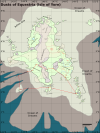
- Tsarcrov refers to the massive Almiraj empire that covers the continent of krolit. It's capital is Ashkod. Empire is being used to refer to the culture due to the extensive effect the Tsarcrov empire (lasting 450 generations, ended 65 years ago) had on their culture.
General Elements
- The bulk of the region is part of the old empire, a vast and lush area surrounded by an immense and dangerous range of mountains that are themselves surrounded by barren wasteland. This, until recent years when sea travel was opened, enabled the empire to create an isolated culture. In fact until 75 years ago most buns in the empire space believed they occupied the only habitable region on the planet and the rest of the world was lifeless and dead. Though this belief is no longer widespread it still lingers in places and the myth of the Tviticzem (The deadlands) still features prominently in folklore and fiction. The rest of the region consists of a series of towns and cities outside of the wasteland (and in one case in the desert region) that were founded by those buns banished from the empire (at the time this was believed to be worst than death). These outside towns possess a variety of political structures while the central country of Tsarlika, the remainder of the empire, has transitioned to a republic of several territories governed by elected officials.
- Much as with other bun cultures the Tsarcrov place an emphasis on the duty and authority of does over bucks. Though recent years have seen bucks vying for more rights and have been taking on far less traditional jobs/roles there are still many places that do not allow bucks to be land owners or side in favor of does in any matter of ownership. Crowned buns are left to decide their roles as desired but are always treated in legal matters as does.
- Initially the empire consisted of several large farming and mining regions with their goods transported to cities that functioned as centers of trade and craft with little of their own natural resources, the largest of these becoming the capital of Ashkod. The outcast cities, by necessity, all tend to have their own direct sources for natural resources in the local region. Ashkod and most of the other trading centers remain functioning economically be becoming outward centers for trade and have since integrated several of the island communities near the region.
- Fashion among empire individuals are heavily focused on coloration. They mainly use flowing full-body garments with loose pants underneath and accessorize with sashes or veils. Bright colors are the most common and in situations where one cannot afford cloth in bright colors they often supplement it with embroidery of cheaper threads or flowers worn in accessories. The main exceptions are in professions associated with death, medicine, or prostitution. In those cases the traditional indication of those occupations are dark blue, dark red, or black clothing, often with ashes or dye used to artificially darken the fur. Most cloth is made from a local plant whose fiber can be turned into either coarse or fine fabrics depending on the method of treatment. Because the coarse fabric is cheaper, thicker, and more durable it is far more often worn by buns of lower financial status.
- While the Tsarcrov embraces fairly typical gender roles they are also fairly accepting of varying sexuality. A strong preference for doe/doe over buck/buck relationships exists due to the fairly heavy legal limitations that bucks experience. In relationship terms Tsarcrov culture consider buns to be an adult at 17 years of age. Physical attractiveness in does is heavily skewed towards short upright ears, a firm jawline, and physical strength. In bucks the preference tends to focus on long ears, full hips, bright fur color, and long claws on the feet. These preferences have produced a number of trends resulting in it being not uncommon for does to clip their ears and bucks to bleach (or brightly dye) their fur, add extensions/paint to the claws on their feet, and to wear cloth sleeves over their ears. Socially does are often evaluated based on their capacity to protect and provide for a family while bucks are often evaluated based on their child rearing and tenderness.
- As with most bun cultures children are referred to as kits and tend to be born singly. Child rearing in rural areas and the outcast region is generally handled by the family but most of the large cities in Tsarcrov have created the concept of public education for the early part of childhood (4-8 years) after which a kit is expected to either be apprenticed or otherwise set to learn a trade. They are generally considered adults in a terms of professional and legal matters at the age of 20.
- Tsarcrov produced a wide range of art, but by far the most famous products are their tapestries and pottery. Tapestries often have a large artistic depiction, either of historical or mythological elements. The largest of these often double as historical records, sometimes covering spans as large as 100 years. Pottery initially began as large and elegant vases or pots but has long since shifted to statues and figurines with an emphasis on the delicacy and elegant painting. Pottery is mostly depictions of buns and usually of either current models or of historical figures. The most infamous and most famous aspect of this was a collection called the 71 domos (71 hutches) a series of 71 exquisitely detailed erotic figurines of buns. It prompted a large amount of both imitators and derivative art in the same field. This prompted a somewhat unfair reputation of the field of Tsarcrov ceramics as being perverted.
- Tsarcrov believe that crowned almiraj buns are touched by the divine, but specifically by the same divine blood that once anointed the bloodline of their empresses. As a result there is both an underlying belief that all crowned buns are related and a law that bans relationships between crowned buns. A free training system exists for crowned buns within the former empire but requires travel to one of the major academies specialized in such. In the outcast lands this is replaced by apprenticeship to whomever happens to be the most experienced crowned bun in the area.
Food
- Tsarcrov has a pretty diverse range of food sources. The bulk of grain comes from the svet plant, a climbing plant that needs to be grown on a trellis similar to grapes. It's grains are usually either boiled or ground into a very fine flour that produces a springy and slightly sweet dough. That dough can be rolled into flexible flatbreads that form a major constituent of all hand/street food. Buns of this region raise floghs, maes, and scriggs as their primary livestock and the meat of maes and scriggs form the bulk of their proteins. Cooking is heavily mixed between a form of pit based slow cooking, smoking, and frying for the meat, with the bulk of vegetation being either boiled or fryed. While svet makes up a lot of farming a regional verdig, kapust (green flowers) a leafy green, bihts a leafy vegatable with deep blue coloration to the stalk and root both of which are eaten, and perets a vine growing and very large berry with a mostly savory taste make up the majority of other crops.
- Tsarcrov cooking is has some very strong sweet flavors with subtle undertones and buns from other cultures often find overwhelming. Especially when treated with either bekyu (black sauce) or prany (pink sauce). Both of these sauces are based on heavily reduced and thickened fruit juices with other spices added at various stages of cooking and fermenting. This is countered by the accompanyment of tsarcrov alcohol, most of which is either based off the root of biht and the fruit (otherwise inedible) of the yad bush. The alcohol, especially the trupsat (death water, usually 90 or higher proof), has a taste that is a mix of sour and bitter that often at least distracts from the very sweet food. Though most tsarcrov food critics feel that they compliment each other.
Architecture
- Buildings built in the Tsarcrov region is very heavy in block shaped buildings made with an adobe-like substance. They also employ an immense amount of integrated gardening. On most buildings this is done by placing a layer of turf on top of the blocky-flat-topped buildings. An external drainage system is then employed to prevent the accumulation of excess water. In wealthier buildings this is mostly decorative and usually includes ornate hedges, climbing vines, and bright flowers. In the less wealthy areas the top is usually used for a small amount of house crops to shave a bit off the family budget. Internally the buildings rely much more soft rush or other similar floor coatings to retain heat than on hangings or rugs. The buildings are also noted for maintaining mostly open with buildings only having separate rooms when needed for professional reasons.
- Of notable exception are the monestaries, temples, and the imperial palace. While these structures still tend towards blocky shapes they tend to be made out of carved stone or marble bricks. With complex and spiraling metal working added to corners and towers as a decorative element. The buildings also tend to be much larger and more complex than other buildings in the culture. With many separate rooms for specific functions. In religious buildings there's a major decorative element referred to as "The Shep" (The Spine) consisting of a long pointed shape with downward angled spurs jutting off every 1/5 of the length. These are are often implemented as paintings, tilework, or sculptures.
- Tsarcrov is also often noted for the paved roads that connect every town and city in the region of the empire and the efficient sewage systems in it's larger cities. Large irrigation projects have been established for centuries and not only serve to water the crops but to also motivate the plumbing systems of the city, and provide water for the large public bathing fascilities.
Religion
- Tsarcrov buns believe in a hierarchy of spirits, beginning with Otet the father of all spirits and leading downward all the way to minor spirits believed to emmbody the food, water, and warmth of individual homes. The second rank of spirits are the 4 spirits of earth, wind, water, and fire with each having a major monestary devoted to them. A central temple in the capital of the empire is devoted to Otet and many smalle rmonestaries, temples, and shrines are devoted to the other lesser spirits.
- Worship is primarily through meditation and chanting with monks and priestesses acting more as advisors and guides than as preachers. Interestingly the Tsarcrov religion is unique among buns for being headed by a buck. While many other bun religions have religious orders and positions filled by bucks only they have a high priest. Most Tsarcrov clergy have at least one vow of abstinence from a specific behavior, the individual vow is determined by monastic order with the Otet taking a vow of celibacy. The most common vow is that taken by the monks of the household spirits (who have a collective order rather than an order for each individual household) have a vow against living in one place for more than 3 days and as a result spend most of their time traveling the empire and performing minor religious functions for those they encounter.
Almiraj Kingdom, Azmalakah
- In this case this refers to the three large Almiraj countries along the continent Arnab. Only one of which is still a part of the queendom in question, the other two having seceded, one due to the rise of the merchant class and the other due to dissidence of a group of nobles over changes to the order of inheritance for one of the queens. The queendom was renamed to Narsarab after the ruling queen who stabilized it after the most recent of the secesions. The merchant secession went on to form Cinderfel while the seceding nobles formed a new country named Ashire.
General Elements
- Being a former feudal region most of Azmalakah is structured of cities and towns grown around manors or castles with the surrounding region dominated by farms or by fishing communities. These stretch the full length of the old queendom which extended from the North-East tip of the continent all the way around the southern edge to the North-West tip. The boundaries to this being the two great mountain ranges which prevented expansion not only because of the physical boundary but because they were settled alread by the Skvander. Those same skvander now are major allies of the almiraj buns in the region, providing the patrols and watches that keep the roads safe in the area. At this time this region has become one of the largest centers of trade in the world and all 3 countries boast an immense trading network and a large amount of colonies on the other continents and islands.
- As a result of the open trade and overall welcoming nature of the communities the cities in this region often include many other cultures intermingling with the original culture of the region, though they often gather in specific quarters (similar to places like chinatown). This has also resulted in a strong focus on trade as both the economic and cultural focus of the area.
- Azmalakah buns still retain a lot of traditional views regarding the roles of bucks and does though these are getting challenged at an increasing rate and many bucks are beginning to hold occupations in areas long considered the domain of does. They do still hold some of their oldest views on crowned buns and still cede them a great deal of respect while accepting any identity they choose to maintain. Despite this all three countries do, at least in law, recognize bucks and does as equals with cultural inertia currently proving the greatest barrier.
Food
Architecture
Religion
Skvander Stratocracy, Myndighet
- The Myndighet, the collection of the Skvander territories across Arnab, consists of no less than 18 separate countries. Though they do have a representative council used to help handle diplomatic and territorial matters.
General Elements
Food
Architecture
Religion
Dwarf Tribune, Shenze
- This refers to the bulk of Dwarf bun culture, though moderate changes exist in those not a direct part of the tribunal due to the extremely spread out nature of their tribes.
General Elements
Food
Architecture
Religion
Rex Kingdom, Reyflor
- Reyflor includes 14 Rex countries on the southern half of krolit with the royal family of the kingdom of Hadaflor acting as less of a unified ruler and more as a neutral arbiter between the others.
General Elements
Food
Architecture
Religion
Vulps
Surface Vulps, Tribal
General Elements
- A vulp tribe is almost always a hunter-gatherer structure, though due to their oppposition to eating plants the gathering is limited to foods like shellfish or eggs and plants/substances with a non-food application. Division of this labor is wholly unconcerned with gender roles (gender being a concept completely unknown to vulps). Those assigned to hunting often range several days out from their home to build up a larger catch before returning. Vulps hunt whatever is most available in their region but also adjust hunting habits so as to not eliminate prey populations. The catches from these hunts will be either eaten immediately or dried for long term storage. Despite the opposition to smelting the vulp tribes seem perfectly willing to retain items of smelted material from any buns caught on a hunt and seem to regard them as a part of the natural spoils of the hunted creature.
- Vulp clothing is primarily leathers and furs. While they are perfectly capable of weaving that pursuit seems largely limited to decorative and religious purposes. The clothing worn tends to be more functional than anything else and is usually consists only of protective elements around the trunk and extremities. Decoration is largely reserved for jewelry and worn fetishes. Vulps wear a large amount of these and they can be made of most any material but almost always include elements of a prize from a hunt (bones, teeth, scales, or even shiny objects taken off of a bun). As noted vulps do not recognize gender and as a result there is no strong difference in clothing along those lines.
- Vulp culture places no heavy emphasis on any specific sexuality and are equally accepting of any relationship so long as it doesn't harm the cohesiveness of the tribe as a whole. Vulps reach adulthood in the tribe at 22 years, at which point they are allowed to begin seeking out adult relationships. Vulps also have no objection to polyamory and it is not unusual for an exceptionally skilled hunter, chieftain, or shaman to have multiple partners. The primary physical elements of attraction in vulps are tail fullness/length, ear height, coat coloration (with a preference towards darker colors), and long fangs. The primary social elements of attraction in vulps are exclusively around the vulps ability to support the tribe, whether it be in hunting, gathering, the processing of supplies or in the rearing of children.
- Children in the vulp tribes are referred to as cubs and are typically born in groups of 2-3 cubs at a time. Once born cubs are considered at once both a shared resource of the tribe and a responsibility of their parents. While cubs learn from and are often given chores by all members of the tribe their behavior and discipline is primarily left to their parents. For cubs too young to engage in work the tribe typically assigns 1-3 adults who show an aptitude for childcare to tend to the cubs and keep watch over them so that their parents can continue to contribute their labor to the tribe. Cubs are usually able to graduate from the duveflack (literally puddle of fluffs) at around 7 years of age when they are old enough to take up simple chores without supervision.
- Conflicts between tribal members are usually resolved through arbitration under the appropriate leader. If the leader finds that both sides have an equal claim in the issue they may be issued a requirement to engage in a form of duel to resolve the conflict. Punishments can include death but that is very rare and vulps are far more likely to banish a problematic member than they are to kill them.
- Vulp tribes produce a large amount of what could be considered art, though most of it also serves a practical or religious purpose. Most common are large (.8-.9 m) painted clay vessels used to store substances for fermentation in caves. Vulps typically decorate with depictions of natural objects or depictions of tribal legends and important figures.
- Voxen are viewed as a divine gift by any tribe lucky enough to have one and almost all voxen, whether of their own intent or out of pressure, will become shaman and leaders of their tribe. Their magic is somewhat warped by the cultural interpretation which holds that the magic of the body is to strengthen and heal the tribe, the magic of poisons is the amplify their hunting skills, and that the illusions are the ability to see mystical visions that are shared with all but can only be interpreted by the voxen (A belief that many have taken advantage of).
Food
- Tribal vulp food is almost devoid of plant matter altogether, this includes any form of baking. The sole exception being vianbil (gut meats), semi digested plant matter found inside herbivorous animals and herbs/spices (usually used in sausages). Meats that are eaten immediately are usually roasted (though tribal vulps do not have objections to eating raw meat if forced) with a minimal amount of seasoning. Meats that are preserved have a range of options and can be dried, smoked, made into sausages, or even used in one of several sauces made from fermented meat products. Flavor and sauces tend to come across as extremely pungent and vulps seem to have a slight preference for tart over sweet or spicy flavors.
Architecture
- Tribal vulps do not build a large number of permanent structures but tend to make them from either rough hewn logs or by stretching skins over wooden frames. The leather structures tend to be painted or have decorative fetishes hung on them. Buildings are commonly built for either housing, smoking, or religious functions. Seating within the structures is usually upon the ground or on folded piles of hide.
Religion
- Tribal vulps are raised under a strong religious guidance that claims the abundance of material recources in nature (minerals/metals growing from biological life, very edible creatures, and the magic to reshape parts of the body into natural weapons) indicates that their god (Xyl) intended for them to use the natural resources to their fullest without the need to destroy them in the process and therefore smelting was a horrible sin. As a result the tribal vulps ban the use of smelted metal. Accompanying beliefs of a vulpocentric nature mean that they also believe the purpose of all life on the planet is to enable vulps to thrive and as a result they tend to consider all other species to be food.
- These religious views are maintained by either a voxen shaman or a tribal elder who acts as a leader in religious rites and rituals. If separate from the tribes chieftain then the religious leader acts as a co-leader, taking priority of clan dictum in all things spiritual but ceding control over matters of day-to-day management.
- Rites often include the following elements; sacrifice of a living creature (Value of a sacrifice is by size, so a large cattle would be considered a better sacrifice than a bun), painting the bodies with dyes, the burning of a wide variety of herbal concoctions, and the construction of fetishes.
Underground Vulps
General Elements
- The vulpi living underground do so in large cities in caverns. These cities are often placed near underground lakes or streams for obvious reasons. The outskirts of the city often become large fields of crops (typically fungal but with a few exceptions). The absence of large military forces underground means that very few of the cities have any form of major wall or gate. In addition to the etoilebre (large magical plants that emit light) most of these cities sport large towers with a convex polished metal disk to reflect an internal light source. These are typically absent in the fields as many of their crops are bio-luminescent.
- Most of these cities are run as a form of plutocratic-aristocratic-republic where a council containing members of the most influential or powerful families are responsible for the ruling of the city. This results in both an noticeable class divide and in a large amount of political intrigue. Because of this divide and governmental structure most of the lower class find themselves ignored by the official laws of the city and their regions instead become ruled by either the local noble family or, in the case of the poorest areas, by a local gang. The official law enforcement comes about from an ostensibly neutral group of guards funded jointly by all members of the council. These guards however are only concerned with the laws relating to interactions with noble houses and are only seen by common vulps when making an arrest on accusation by a noble. Unofficial law enforcement comes from the muscle employed by individual houses and the gangs.
- Fashion in these cities as an overall guideline focuses a lot on vertical flowing cloth, vertical striping, and heavy ornamentation. The relative absence of seasonal factors means that most cities are founded in areas where the temperature is comfortable all year round. Due to this most vulp fashion finds little need to focus on any form of protection from the elements and aside from professional clothing designed for occupational protection tends to leave limbs and torsos uncovered.
- Since vulp magic includes many bio-magic elements and in the cities has advanced to the point where it can cause extensive modifications to the body leading to modifications as a large facet of vulp fashions. While many of these modifications include elements as minor as fur color, glowing markings, or changes of eye color they also include a lot of more severe mods, especially in high fashion circles.
- Like their tribal kin, city vulps do not have a heavy emphasis on sexuality and no real social concept of gender. Because of this there's no notable discrimination against sexualities in their society. A vulp is considered an adult and able to seek out adult relationships at 20 years of age. Unlike tribal vulps they do not consider polyamory normal, though it is tolerated it is very infrequent. Physical attractiveness for city vulps focuses heavily on height of all elements (ears, arms, legs, torso) and pale physical coloration. Social attractiveness among the higher class is completely around financial and social position while among the lower classes it is more heavily split between an ability to support their family, compassion, and kindness.
- Cubs are still born at a rate of 2-3 per birth. While city vulps do not have the same communal child-rearing methods as tribal vulps they do tend to live in extended family units (A typical vulp family includes at least 3 generations of a family) to enable effective child rearing. Vulp children are expected to help with household chores as early as 7 and to begin earning a full wage as early as 13 years. At 13 a cub is traditionally given a Vieufete (Age Celebration) which marks their entry into full responsibility and in high-society is the point where they can represent their family at official functions. Much of education is performed at home or by apprenticeships with a few cities having a civicole (Civil Academy) that provides education for a fee (or for a contract obligating the student to working as a civil servant for a while). The exception to this are voxen cubs who are offered a chance to pursue education at the Sorsedemie (Magic Academy) under similar clause to the civicole.
- Conflicts within the cities are usually resolved quickly either by summary judgement of a noble or crimelord. In the case of public accusations by a noble house of violation of the council laws a session will be established to pass judgement on the accused who will be allowed a brief chance to speak in their defense. Though lawyers are not unheard of they are not a right and only nobles tend to have them. Penalties in the private courts tend to be either fiscal or physically brutal ranging from fines, to physical mutilation, to death. Penalties in the official courts tend to be less physical but have large social consequences, they can include imprisonment, a removal of a houses title/assets, or most infamously exile. In the latter cases the vulp is given a Sanpo Ataunt (Sinmark), a biomagic marking carved into the forehead that magically conveys the nature of the crime committed. While the information is conveyed magically it is limited by cultural elements, so that the further one is removed from city vulp culture the less of the information they understand. At the close end this contains the names of the victims, the dates of the crime, and the vulps who sat in judgement. At the far end this simply conveys an emphatic sense of the nature of the crime as a part of the vulp's personality. Thus even among buns most exiles find it difficult to get a comfortable life anywhere.
- The cities do produce a lot of art, most of it is either magical (whether biomagic or illusions), painting, carving, or metal working. The most common themes are religious figures or scenes from local folklore. Art is either produced casually as among the lower class or for a private patron. A few lower class varieties of art are somewhat common and include both pottery and weaving.
- Voxen are not viewed in a religious manner in the cities but are highly respected for their unique capacities and skills. Most cities provide training for voxen dependent either upon payment or provision of service to the city. While voxen are not required to take this training the promise of guaranteed employment, an education, and the chance for a better life means that almost all of them do. Magic in the cities is regulated and requires varieties of licensing to practice due to the extreme damage the magics of poison and biomagic can produce when misused.
Food
- The region around the city is thick with farms and they contribute a wide range of foods to the vulp diet. While even city vulps have a noted preference for meat meals, the most common staple of the diet is a combination of vache ore (Fox ear, a variety of fungus) and nuitble (a grain that grows in a moss-like form) especially combined into briq, a thick crusted but nutritious bread that forms the base of many dishes.
- Other major crops include several fruiting vine like structures, a large blue-purple gourd, and at least 32 types of fungus. Domesticated food animals are primarily cave scriggs (smaller than their topside variety and far more pale) for eggs and meat, campags (cute fat one) for meat, and the lamantin (meat float) for meat (vulps aren't fond of their milk so it rarely enters their cuisine). Non domesticated animals are mainly aquatic, with the exception of a small sourry breed that lives in the region, and include a variety of cave fish, aquatic mammels, and arthropods.
- Cooking itself is most commonly frying, performed either in oil or crout (mushroom juice) a sauce made of fish and fungus. The next most common is roasting but that is more often reserved for either celebrations or for the rich. A non-cooking method of preparation called butie (spicy mushroom) that involves raw meat/fish served in spiced fungus either used as a wrap or served on a bed of shredded fungus is also fairly common. Butie and stuffed fried dough (as balls or oblongs) are the most common forms of street food. Unlike their tribal counterparts city vulp food has a heavy preference for spicy and sour flavorings though the few buns who tasted their cuisine have stated it is too bitter (a taste vulps are decidedly bad at noticing).
Architecture
- Buildings are divided between sebout (inside of) and debout (outside of) referring to whether the building is carved out of the cave walls/ground or freestanding with the latter usually being made of carved stone blocks worked into smooth shapes. Internally sebout tend to be curved and flowing to emulate the structure of natural cave walls, they employ heavy use of wall hangings and rugs, to keep the area comfortable, and tend to employ hanging cloth or beaded curtains instead of doors. Debout buildings tend to have largely angular slopes to their base (wider bottom) but employ more cylindrical towers when building something past the 3rd floor of a building (rarely seen outside of buildings belonging to the wealthy or the light beacons). As with sebout rugs are in frequent use but debout are slightly more likely to employ a primitive furnace to heat cold regions. Debout also make more frequent use of solid doors. In both cases windows are infrequent and lighting comes mainly from sconces and mirror structures that distribute various light sources.
- Of exceptional note are the invention of the lumicoin (plant nook), a small planter structure that grows a bright luminescent plant or fungus and uses strategic mirrors to disperse the light through multiple rooms. Well tended the lumicoin can live for upwards of 5 years with only routine watering. Though a few other organisms, primarily a few tubers, can be added to extend this lifespan it is still recommended to fully change out the soil between plantings.
Religion
- Most vulp cities still, at least in an official sense, worship Xyl. All of the cities have at least one temple to them and an order of priests dedicated to their worship. But at the same time most of these same cities find that the steady development of culture and philosophy has pushed their worship into a less central position. These temples remain well funded more from displays of wealth from nobles attempting to one-up each other than from regular worshipers. Also unlike their tribal cousins the city vulp's religion is now mostly devoid of any notion of physical sacrifice. Those rites have been replaced with sermons, prayers, songs, and similar religious functions.