Development and Growth
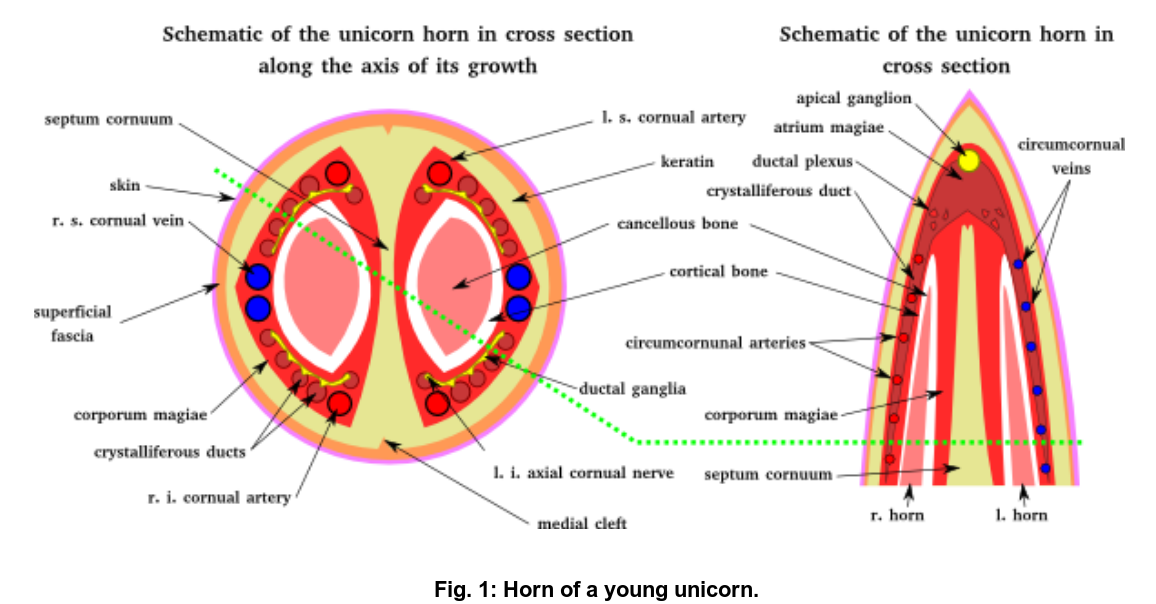
The horn of a unicorn (or, alicorn) develops from two horn buds over the temporal bone, in keeping with the bilateral symmetry of the organism, but they merge during development of the fetal unicorn. The apices of the primitive horns fuse before birth, but the true nature of the horn is readily apparent when it is sectioned proximal to the skull. The atrium magiae does not develop fully until the fourth or fifth year, and the keratinous and superficial structures of the horn continue to grow throughout life, although more slowly as age advances. The corporum magiae will also continue to grow beyond the apical ganglion. The keratinous layer of the horn becomes thicker as the organism ages, making it more resilient to damage. The bony structures of the horn, however, does tend to be partly reabsorbed over time and in some cases overtaken by hypertrophied structures of the corporum magiae, and differential growth favors the other structures of the horn, such that the bone of a mature unicorn horn terminates at only about one quarter of its length. The unicorn’s horn is quite different from that of the horns of familiar horned mammals, especially with regard to vasculature, reflecting its specialized function.
Innervation
The left and right horns are innervated by the left and right cornual nerves, a pair of cranial nerves arising in the corpora arcanorum of the telencephalon. Bisection of one cornual nerve does not result in complete loss of ipsilateral horn function because some axons reach the apical ganglion and innervate crystalliferous ducts on the contralateral horn.
Vasculature
The horn is heavily vascular. Horn vasculature serves both to supply oxygen and nutrients to the active cells of the corporum magiae and to carry away waste heat produced in the crystalliferous ducts. When the axial vessels are dilated during magical exertion, they deliver blood from the arterial to the venous circulation by passing through a network of vessels surrounding the crystalliferous ducts, thereby cooling them. It is heat dissipation, rather than delivery of oxygenated, glucose-rich blood, that generally limits sustained magical control. Extensive vessels in the apex of the horn also participate in cooling the whole contents of the ductal space, as hot aqueous substance rises naturally by convection toward the tip of the horn. The bone is also normally vascularized, receiving blood from the central branch of the cornual artery, itself a branch of the temporal artery, which is very well-developed in unicorns.
Functional Anatomy and Cell Biology
The horn is the unicorn’s primary organ of magical perception and control, and in particular this function is associated with the corpora magiae within it. The coporum magiae contains cells associated with keratin production, blood vessels, nerves, and other ancillary structures; the structures which are essential to magical control are the crystalliferous ducts.
The lumen of the crystalliferous ducts is filled with a strongly hypertonic, supersaturated solution of carboxylic acid salts produced and secreted by tiny glands scattered throughout the ducts, but most common on the walls of the atrium magiae. The peduncular cells, innervated by the axons of cornual nerves, each grow a single crystal of these salts attached to the cell body in the wall of the duct by a stalk-like process. The freshly sectioned ducts will thus glisten and diffract sunlight spectacularly, but quickly lose their sparkle with drying or embalming, as the crystals are destroyed. When stimulated by the nerve, the peduncular cell depolarizes and its peduncle contracts, changing its geometry with respect to its neighbors and possibly bringing it into the magical field.
When the crystal of a peduncular cell interacts nonlinearly to manipulate the magical field, it generally does so to establish a communication between the magical power of the unicorn and the ambient magic field, producing most prototypically force at a distance, although as is well known, a variety of effects can be produced. In so doing, the crystal dissipates a fraction of the power it effects as heat. The crystal is in general a poor conductor of heat, but its small volume relative to its surface area allows it to cool relatively quickly. The aqueous content of the crystalliferous ducts has considerable heat capacity, and is in turn cooled by the aforementioned circumcornual circulation.
A third type of cell found in the duct is the peripeduncular cell, which is responsible for the creation of a meshwork of glycoprotein structures that surround each peduncular cell and prevent its crystal from growing too large and merging with adjacent crystals. The chemical composition and geometry of the crystals changes along the length of the horn, such that a nearly continuous spectrum of psychomagical resonances are available. Specialization of unicorn magic does not generally occur via changes in duct structures, but in patterns of innervation and neuronal synapses in the brain.
The specialized peduncular cells of the proximal surface of the atrium magiae develop tight junctions with one another, creating a syncytium, at the same time the peripeduncular cells around them undergo apoptosis. This allows the development of the cristallus magna, a large crystal contained within the atrium magiae of the fully developed horn. The magical resonant frequency of the cristallus magna is far lower than that of the small crystals of the ordinary peduncular cells, and it serves to direct magical energy from the ambient field back into the aetherial pattern of the unicorn for later use, accounting for approximately a third of the replenishment, with the other two thirds accumulated in the crystalline canals of the unicorn spine. The syncytium from which the cristallus magna arises is amply nourished by capillaries arising from all four cornual arteries.
Sensory nerves synapse with the sensory bodies of the corporum magiae, which surround the ducts and are most abundant in the ductal plexus. They overlie the acid-secreting glands, and are derived from the same precursor cells during development. Rather than excreting their organic acids, however, the sensory body cells retain them in crystalline inclusions which are also magically resonant. The crystals are much smaller than those of the peduncular cells, and sensitive to higher frequency magical fields, generally the fifth and higher harmonics of the aetherial vibration frequencies created by the peduncular cells. Crystalline inclusion size of the sensory body cells increases distally, the opposite of the pattern seen in the crystals of the peduncular cells of the ducts. Cell bodies of the neurons synapsing with these cells lie in the apical ganglion.
Clinical Aspects
Magical Exhaustion
This term describes a simple lack of magical energy in the unicorn’s aetherial pattern. In such a condition, no magic can be performed which requires greater power than that provided by the actions of the cristallus magna and other magic-gathering structures of the unicorn’s body. Time until complete recovery depends on the individual and ambient magical conditions, but is generally around six to ten hours as magical reserves fully replenish in a roughly linear fashion.
Effector Magical Fatigue
This condition arises from fatigue of the effector (peduncular) cells of the horn, through prolonged use, generally irrespective of the quantity manipulated, and in proportion to the complexity of the magical effect (requiring more movements of the peduncular processes.) It is by nature self-limiting and temporary, and the cells can adapt to more complex use over time, subject to individual limits. Complete recovery is generally within tens of minutes.
Central Magical Fatigue
This condition results from prolonged complex magic use, and can also be provoked by noxious magical sensory stimulation, nutritional deficiency, or psychological problems. Its effect is more subtle than effector fatigue and usually manifests itself as uncharacteristic telekinetic clumsiness and a lack of success in correctly performing more complicated magic. Recovery of fatigue resulting simply from overuse is generally complete after restful sleep. It is attributed to neurotransmitter depletion.
Cornual Overexertion
This condition occurs when too much power is handled by the unicorn’s horn, and is primarily a concern of more magical unicorns who exert themselves, although all are theoretically vulnerable. The basic mechanism is overheating of the magical effector structures, which takes several forms with different prognoses.
Heat generated by the imperfect efficiency of the crystals of the peduncular cells when manipulating the magical field is the primary mechanism by which injury may occur. The axial blood vessels of the horn, while quite efficient at removing heat, have limits, and also do not respond instantaneously to changes in power dissipation, although the thermal mass of the aqueous contents of the crystalliferous ducts tends to ameliorate the consequences of not “warming up.”
Sudden, massive, exertion, not outside the capacity of most unicorns but not usually available without well-developed skills, can cause affected crystals of the peduncular cells to become so hot that the organic acid molecules comprising them decompose. As the crystals are in equilibrium with ions in the aqueous substance within the lumen of the crystalliferous ducts, they will eventually reform over a period of days, depending on the size of the crystal (i.e. on its resonant frequency and its position along the axis of the duct). Until the crystal is substantially reformed, it will not be available for use. As cracking a crystal in this manner is usually attended by considerable pain, the exertion rarely continues to crack all crystals of that resonant frequency. This condition therefore most typically causes an attenuation of available magical power, rather than making a particular effect totally unavailable. Repeated events of this type can lead to permanent crystal malformations, resulting in altered resonant frequency and changes in magical function.
Overexertion of longer duration, but of lesser power, may cause the temperature of the area immediately surrounding the crystal to become hot enough to denature proteins. The peduncle of the peduncular cell is usually affected, its motor proteins becoming denatured and unable to move the crystal correctly in response to nervous stimulation. Usually the crystal is “jammed off,” but this is not always the case and occasionally peduncular denaturation may lead to an isolated cracked crystal as seen in sudden exertion. The proteins in the peduncle are replaced sufficiently frequently that the effects of this kind of overexertion are manifest for only a few days. It is quite possible for a whole set of cells with similar crystals to become denatured in this way, leading to transient inability to perform magic dependant on them.
Outside the concern of most unicorns because of limited total magical reserves, is the possibility of the temperature of the crystalliferous ducts rising so high that the cell bodies of the peduncular cells are killed. As peduncular cells are postmitotic and no stem cells remain in the adult unicorn horn, this would cause permanent magical disability vis-a-vis the function of the affected cells. The increase in temperature would also be extremely painful, which would generally result in the cessation of magical exertion before much damage was done; it is primarily a concern of unusually magical unicorns during a prolonged episode of magical incontinence. Young unicorns have better prospects for functional recovery than older victims.
Paroxysmal Loss of Magical Control
Attacks of magical incontinence are most often seen in younger and more magical unicorns, although they can also be brought on by a wide range of neurological conditions (such as a focal or generalized epileptic seizure) and other circumstances throughout life. Attacks may be spontaneous or provoked by excessive exertion in a runaway process.
Such an attack can be directly dangerous to the sufferer, due to the various consequences of overexertion and fatigue described above, and indirectly dangerous to the self and bystanders due to the unpredictable and frequently unusually powerful magical effects produced. Attacks can not usually be terminated consciously, and end rather due to exhaustion of magical power, fatigue, or, particularly with more magical unicorns, overexertion effects. Recovery is dependent on the sort of damage done, if any.
Other Types of Magical Incontinence
The magical effectors are usually disabled during sleep (analogously to normal sleep paralysis of the skeletal muscles) but magic use during sleepwalking is not uncommon, particularly telekinesis. The magical analogue of the hypnic jerk is also known. Unicorns do not normally have magical “wet dreams” despite the use of their magic obviously figuring commonly in their dreams, but this can change in certain neurological conditions.
It is possible for damage to or disease of the corpora arcanorum to cause involuntary magic use, which is often simple and highly stereotypic, but may be hazardous and is apt to lead to various forms of fatigue and exhaustion. It can usually be controlled with medication.
Magic Addiction
Most unicorns enjoy using their magic, and non-excessive magical work gives pleasure similar to the “runner’s high” experienced during physical exercise. However, predisposed individuals may become addicted to intensive magic use, considered pathological when it interferes with activities of daily living or leads to significant overexertion effects.
Impact to the Horn
If struck with a sharp blow insufficient to damage it, any magical effects in progress are nonetheless very likely to be altered or disrupted by the transient misalignment of the crystals resulting from the blow. It also causes pain which may itself be sufficiently distracting as to have similar effects.
Severed Horn
A severed or fractured horn, if promptly surgically reattached, will often recover most of its original function over six to ten months as its axons regenerate. The particulars depend on where the horn is severed. Better outcomes depend on appropriate supportive magical therapy and management of complications of the healing process.
Floppy Horn
Various conditions are known to result in a flaccid horn, in which the keratin of the horn is to varying degrees imperfect and fails to support the structure of the horn. Since the horn is, under the influence of gravity, no longer straight, the crystals of the ducts are unable to come into proper alignment, severely impairing all magical effects dependent on the resonances of crystals distal to the terminus of the cornual bone, and in many cases producing generalized magical impotence.
Cristallus Magna Agenesis
In this congenital abnormality, no cristallus magna is found in the atrium magiae, and as a consequence the unicorn accumulates magical energy at a reduced rate. Expenditure of magical energy is at normal rates.
Cornual Bifida
In this congenital abnormality, the primitive horns fail to fuse at their apices, and each terminates with a rudimentary ductal plexus and usually no proper ganglion. Profound magic-deafness is the usual result, but most individuals can learn basic telekinesis with intensive therapy. The horn may or may not be visibly bifurcated, because the keratinous layer and fascia may merge in varying degrees of completeness.
Aside on Physiology
Metabolism
Magical substance is brought into a high-energy state in the aetherial pattern of the unicorn through the actions of the syncytium of the cristallus magna and the luminal cells of the crystalline canals of the spine, which are powered by glucose metabolism. The maximum amount of magical substance accumulated is regulated homeostatically, and individual unicorns differ in their maximum rate of accumulation (i.e. the rate as measured when completely exhausted.) Malnutrition and competing metabolic demands (sickness, pregnancy, physical exercise) may reduce the rate of accumulation but is not totally abolished even in the face of imminent starvation.
Physiological Model
Unicorn magic can be modeled parametrically: Magical energy (J) - how much is currently energy is available from the magic in the unicorn’s aetherial pattern, available for use.
Magical energy capacity (J) - the maximum capacity that can be held in the pattern.
Magical energy replenishment (W) - the rate at which magic is pumped from the ambient field into the individual’s pattern. Cornual power dissipation (W) - the maximum heat energy per time that the unicorn can reject. Power use beyond this will lead to an increase in cornual temperature (effect on physiologic temperature homeostasis is not modeled.)
Magical efficiency is not entirely invariant across unicorns, but is roughly 90% for telekinesis and lower for more complex magic.
The parameters above model the unicorn in terms of energy and power rather than in magic, this is sort of analogous to modeling the contents of a hydroelectric dam’s reservoir in joules instead of liters. The aetherial substances is brought to a high-energy, ordered state in the unicorn’s aetherial pattern, then released back to the ambient field to power various desired effects. (This scheme would also have a practical advantage in terms of experimentation, because energy and temperature changes can readily be measured with mundane instrumentation.)