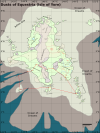
Simha City is served by several rail systems, most prominently the subway run by the Simhalan Rapid Transit Company. There are also long-distance and interurban passenger and freight links.
Long Distance Railroads
The Coiné-Peninsular Railroad
This railroad is owned by shareholders mostly in the Coiné Union, where it is headquartered. It runs overland from the Coiné Union to Simha City, with many intermediate stops and branches. It has both freight and passenger service. The railroad is not electrified. When it originally was built, it terminated in the harbor area of Simha City, which was convenient for freight operations, but less so for passengers. This remains its freight terminal, but as part of the construction of Union Station, new tracks were built diverging from the line to the harbor to go around south of the city and meet with the shared tracks going to Union Station. This is more convenient for most passengers.
The CPR offers coach and sleeper service. Three trains a day leave for the three-day journey to the Coiné Union. The most luxurious is the Humberside Thunderbolt.
Locomotives are mostly coal-fired steam locomotives, with some diesels. Electric locomotives are switched in at Banda Town Station in Simha City for the trip to Union Station, as much of that trip is in tunnels and the railroad appreciates that passengers prefer the small delay to the alternative of suffocation.
The Vagha & Simha City Railroad
The V&SCR is a freight and passenger railroad which originally connected to Banda Town, and then came to an agreement with the BTR to run trains on its tracks to the Banda Town Station in Simha City. It was one of the railroads which cooperated in the building of Union Station downtown, and so now it also has trains coming to Union Station in Simha City. It is jointly owned by Simhalan and Vaghan interests, and the Vaghan state owns a 40% stake in it.
Like the CPR, the V&SCR uses both steam and diesel locomotives, but has been less enthusiastic about diesels.
The Star of Haldar is a premium all-sleeper train operated by the V&SCR which travels weekly between Simha City and the capital of the Haldari Republic, a five-day journey. Service was suspended during the war, but it has been revived recently. The carriages are luxuriously fitted out in the art nouveau style, and are nostalgic symbols of pre-war luxury.
Various more ordinary and frequent passenger service to points mostly on the southern coast of the Obsidian peninsula is provided, and trains that run to various cities on the V&SCR's rather large rail network are also provided.
Interurbans
The Simha-Kottai-Banda Electric Railway (SKBER)
This interurban railroad is the newest addition to the region's rail transit situation. It runs along the end of the Obsidian Peninsula, with spectacular views of the Uyarntatu Straits, servicing various coastal communities - most notably Kottai City on the straits. It then proceeds south and west, following the coast, through sparsely populated country before arriving at Banda Town.
The SKBER runs on the street in Kottai City, well connected with Kottai's meter-gauge streetcar system, and runs in Simha City's subway tunnels as well. Thus, it is possible to take the SKBER directly from subway stations Downtown in Simha City. The SKBER has a couple stations in Banda Town, including one downtown, but it is not compatible with the standard gauge streetcars there and instead runs as an elevated line to its Banda Town Terminal.
SKBER service is reasonably frequent. The Kottai Cannonball, a premium service, runs between Simha City and wealthy suburban areas near Kottai City where many well-to-do citizens moved during the war to avoid bombings. The Cannonball was introduced at the end of Prohibition, and features a lounge car where alcoholic beverages are served.
The SKBER passenger trains are generally hauled by a pair of electric locomotives, one on each end of the train. They are capable of running on the third rail power of the subway system, but when running on their own right-of-way, the SKBER trains use 2800V DC catenary power. The locomotives have four DC electric motors, which are switched from a series to a parallel configuration when transitioning to the 700V third rail. This is accomplished automatically with small trackside bollards hitting levers on the locomotives; they also lower the pantographs by releasing air from the pneumatic cylinders that lift them. This prevents an inattentive driver from forgetting to lower it and having it be sheered off as the train enters the subway tunnels.
The livery is mostly white and blue.
The Banda Town Railroad
The oldest railroad servicing Simha City, it originated as a steam railroad connecting Simha City to Banda Town, on the southern shore of the Obsidian Peninsula. It allowed cargo and passengers to avoid a day or two of sailing around the peninsula and also connected various rural communities in the hill country to the city.
The railroad was electrified and the BTR now operates as an interurban railroad, with frequent service between Banda Town and Simha City. When it was built, it terminated in the 18th Ward, well south of downtown, but nowadays most of its passenger trains continue all the way to Union Station. Ticket prices are reasonable, though most of the trains are made up of older prewar rolling stock and not necessarily in pristine condition.
The railroad uses both electric multiple units and electric locomotives, and shares some of its tracks with the long distance railroads. It is electrified with a DC overhead catenary, and owns two hydroelectric plants in the hill country which provide for its power needs. The tracks are standard gauge.
The livery is black with a red stripe.
Mass Transit
Simha city has a subway, operated by the Simhalan Rapid Transit Company, a publicly-traded corporation. Most of the infrastructure is actually owned by the National Mass Transit Trust. It grew out of a smaller, privately built subway system that only covered some of the most lucrative areas; public financing through a bond issue and taxation funded a comprehensive system. The system was started about fifty years ago, but construction continues to this day.
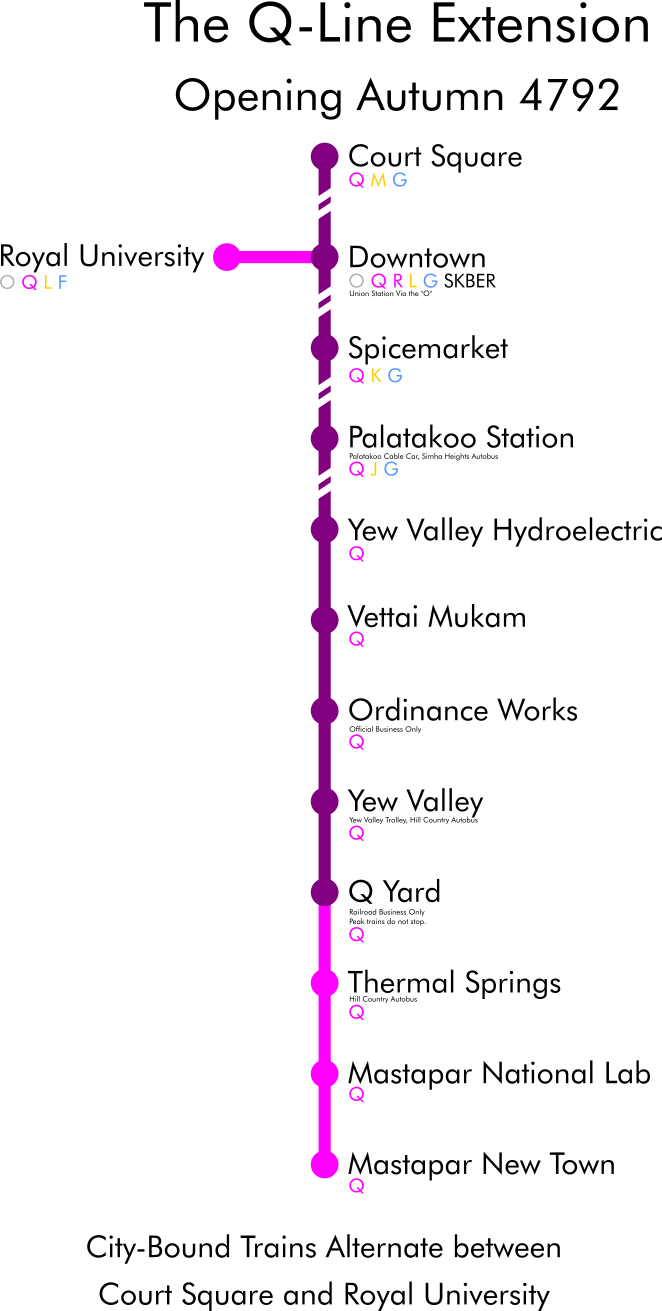
The subway system is large, with 311 stations and 18 lines. The lines are assigned letters: A, B, C, D, E, F, G, H, and I lines ("Blue") run roughly north-south from the coast to the hills. J, K, L, and M lines ("Gold") run around the harbor, each connecting with the A-I lines. The N O and P ("Silver") lines, owned by the SRTC directly, connect to existing major roads or transit infrastructure in a more ad-hoc route, though each makes connection with one or more Blue and Gold lines. The Q and R lines ("Purple") are to service suburbs that did not have existing transit to the city at the the time the subway was created, and are owned by their municipal governments and leased to the SRTC. Each line has local and express trains except on the Q and R, which run as local out of the city and express in the city. The train technically runs 24h / day but service after 2300 and before 0500 is much sparser. (~45 minutes headway instead of ~10 minutes.)
The subway, as its name implies, is mostly underground. However, it does run at grade in the outskirts of the city and the suburbs it services (where land was cheap enough when it was built to make this more economical than tunneling), and it also runs at grade in the low-lying harbor area where the water table is inconveniently high for a subway. Some of the stations are fairly deep, especially in the hilly parts of the city, and subways there were constructed with tunneling shields. Most of the system was constructed with cut-and-cover methods, however, and roughly follows existing streets as the city was already mature at the time the system was being constructed.
The subway is a meter-gauge electric multiple unit powered by a DC third rail at 700 volts.
The subway livery is red, cream, and black.
Miscellaneous
Some of the very hilly portions of Simha City in the southeast are served by cable cars running at street level. They are privately owned and operated. Some surburban wards and outlying areas may have streetcars that are not mentioned here. Various industrial and mining railways, estate railways and amusements using rails presumably exist but aren't discussed on this page.
Buildings and Facilities
Simha City Union Station, usually just called Union Station, is located on the border of the 9th and 10th wards downtown in Simha City, on the edge of the central business district. It was built by a consortium of railroad companies with the support of the state, so that passenger railroad service could come into the city center. Because Simha City was already relatively developed and mature when the railroad was introduced, it had been considered a prohibitively expensive proposition before the consortium was formed. The development of railway electrification was also very important in making the project practical, as this allowed trains to more realistically and safely run in tunnels.
Union Station is a terminal with bay platforms below street level. There is an underground railyard associated with it, which has buildings built overtop of it. The original building, built in beaux arts style with some indigenous Simhalan architectural flourishes, was heavily damaged during the war by airship bombing. It was rebuilt in a modern, art deco style, with construction having been completed about five years ago.
Standard gauge trains of the Banda Town Railway (an interurban), V&SCR, and CPR come to the station. An underground pedestrian corridor connects Union Station with a subway station on the O and K lines.
Tracks in underground tunnels connect Union Station and its railyard to a station originally built by the Banda Town Railroad on the outskirts of Simha City. There, steam and diesel locomotives from the long distance railroads are swapped for electric locomotives. Union Station and its tunnels have DC overhead line electrification, as with the rest of the Banda Town Railroad.