The Cloacavipera are venomous, live-bearing creatures of a serpentine habitus, native to Equestria. They are water-adapted and are very tolerant of polluted waters - indeed, they are attracted to any water rich in organic substances.
Cloacavipera have an extremely versatile and aggressive digestive system. It begins with their venom, which contains extremely powerful proteolytic enzymes and neurotoxic alkaloids. (C. percussura and C. insidiosa spit this venom at potential prey, but C. magna rarely does.) The venom is so potent that it can dissolve the unprotected hide of many animals within minutes and liquify their tissues. They are thus not limited to eating prey they can swallow whole; they rather consume the liquefied remains of their prey, a key advantage over other snakes. The Cloacavipera are essentially immune to enteric bacterial infection, and readily consume putrefied remains that would be inedible to most scavengers, as long as they remain sufficiently soft and moist. Of course, they prefer fresher food, as it yields more useful nutrition than tissues already partly consumed by bacteria. Extremely omnivorous, they can digest vegetable as well as animal matter, but prefer flesh. They will consume all parts of an animal corpse except the bones, consuming even the hair and hide.
All Cloacavipera are poisonous and no part of the animal makes good eating. The venom glands and sacs are extremely large, as its venom serves a digestive role, rather than serving only to kill prey. They are not completely immune to their own venom, and spit the venom through modified fangs.
A discovered parasitoid of the quarry eel discovered in the Golden Age may be related to the Cloacavipera. Further research on the subject was not conducted due to the deaths of six consecutive graduate students assigned to work on the project.
There has been some industrial use of the relatively even-tempered C. magna. (The “great toilet snake” or “plumber’s snake.”) Some have trained them to enter sewer systems and remove clogs, dissolving them with their venom and movements. Although they are very effective, the inherent hazards of training them purportedly led to the development of a “mechanical toilet snake” in the Golden Age, but knowledge of the machine has been lost.
All toilet snakes have were known to infest municipal sewer systems with a connection to natural bodies of water, most frequently in swampy areas, although sporadic infestations elsewhere were occasionally reported. As sewers are an almost-ideal habitat for these hardy, gastronomically undiscriminating creatures, they can be quite difficult to eliminate after establishing themselves. It is universally agreed that the best option is to prevent the infestation in the first place, but the most effective measures are expensive (especially to retrofit to existing sewage treatment plants) and thus restricted to vulnerable communities. Whatever the other effects of climate change following the Catastrophe, it must be admitted that it greatly reduced the amount of toilet snake habitat.
The pegasus theologian Airius, of the pre-classical period, was said to have been killed by a toilet snake (of uncertain species) lurking in a public privy. His religious opponents claimed that it was a divine judgement, whereas his supporters claimed that his opponents put the snake there. Toilet snakes continued to occasionally kill ponies through the Early Golden Age at least, although an alchemical antidote to their poison was available. This antidote only arrested further damage; it did not heal the effects of the venom that occurred prior to treatment.
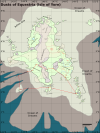
C. magna, and C. insidiosa were distributed throughout the temperate and warmer regions of Equestria during the Golden Age; they are presently much rarer and no one has described their current range. Their natural habitat is especially swamps and bogs, although they occasionally come into moving water and migrate considerable distances. They will go onto land, but C. insidiosa rarely travels more than a hundred meters from water.
C. magna is the largest of the Cloacavipera, and the least bound to water. It is predominantly a scavenger, and its venom has a much lower fraction of neurotoxic alkaloids than the others. It typically gives birth in a large carcass near water, so that its progeny will be amply nourished. Although mainly a scavenger, it will still attack animals if conditions are favorable.
C. insidiosa is known to lie in wait for prey, for which habit it is named; typically the creature hides in a hollow log near stagnant water, waiting for animals to pass by. It may also inhabit a burrow, similarly located. It spits venom.
C. percussura is the most ill-tempered and aggressive of all sewer snakes, and spits venom from up to two meters away. It is, fortunately, rarer than the other varieties, and found mainly in the southeast of Equestria.