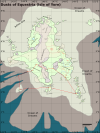
New Pegasopolis
New Pegasopolis was a cloud city in south-eastern Ponecia exclusively inhabited by pegasi. Harkening back to the classical age pegasi, the city was a mimicry of the pegasus city states of that era. It was highly militaristic and extremely racist, with an aggressive foreign policy to the other countries existing on the continent. It conquered several smaller nations around it, reducing them to tributary states in the Pegasoponessean War. Through skilled leadership and strong discipline it defeated a whole coalition formed against it, that included the nascent Ponecian superstate. The coalition watched impotently as its combined armies were defeated despite overwhelming odds and New Pegasopolis forced humiliating treaties on those it attacked and those who had allied against it. The city state was made magnificently wealthy as a result of the punitive tribute in money on top of the loot and captured slaves during the war, resulting in decades of unsurpassed growth for the small but blossoming empire. Its fortunes changed over a decade before the campaign's start. Ponecia, though having grown ever larger, incorporating nations to offer its protection, and modernizing its military through military contractors and armed mega corporations, was very reluctant to challenge New Pegasopolis despite the increasingly flagrant abuses committed against its non-pegasus population and client states. This changed when New Pegasopolis became bogged down in conflict with the Zebrian Empire to its south-east. Although it conquered their cities with ease and brought down its imperial family, its Jungle Commando fighters proved tenacious. Despite cruel tactics employed to suppress this guerrilla war, New Pegasopolis seemed increasingly impotent against these upstart partisans. Allying itself with the zebras, Ponecia made a second attempt to curtail New Pegasopolis' imperialistic ambitions. This time, they met with stunning success. The subjugated lands openly rebelled, agreeing to join Ponecia in exchange for its military protection. Starved of food and resources, New Pegasopolis' armies were paralyzed even as Ponecia launched a direct attack on its capitol city. Griffin mercenaries seized control of its government and much of the city. In the Sack of New Pegasopolis, the city was destroyed in its entirety, its population scattering across Ponecia. While some of its citizenry has been allowed the freedom and rights of Ponecian citizens, a large number were put on show trials and left at the mercy of Ponecia's factional interests. Former citizens remain highly resentful and foster a desire to rebuild their city, as well as humbling Ponecia as it did them.
Culture
Pegasopoli culture was notably militaristic, glorifying the pre-Equestrian pegasi culture for its focus on breeding strong armies. Foals who were deemed weak by midwives could be taken from their parents to be raised to fulfil professions not considered conductive to a militaristic society. Sports and physical education were a major part of a pegasus' upbringing, and rhetoric and wit the focus of social development. Military training took up the entirety of a pegasus' teenage years. As a result, adult pegasi were disciplined and at peak physical condition, with a great deal of civic pride.
All art from Pegasopolis was neo-classical and in the pegasus style of that age. Painted vases depicting pegasus myths or great battles were one form of art that could often be found traded to collectors beyond the city, and cloud sculpted statues another. Paintings on canvas were not very common until the after the sack of Pegasopolis, though there have been a number of Pegasopolitan painters who quickly adapted to it. Theatre plays, particularly tragedies and tales of hubris, have gained widespread fame beyond the city even before the exodus of its ponies. Chariot races were a favourite pastime of citizens, again a recreation of the classical age. Teams would be comprised of a driver and up to two horses. Competition between teams could often be fierce and lead to riots. Arena games were another known pastime and often bloody affairs. The gladiators who played in them could attain celebrity status, and even retire after a successful career. These games were taken serious by spectators and honour and excitement was of great importance. If a fight lacked these qualities, crowds could vote to have the loser killed, and the organizers and sponsors thus found themselves in the position of judge at the end of a match. Many of the fights symbolized historical battles or events.
The society was overall very liberal to its citizens, and personal freedom was something the Pegasopolitans prided themselves on. Genders were equal and sexual morality more concerned with dominance of a partner, even though males tended to be seen as naturally dominant. But for those holding second class status, there was no freedom. Slaves, non-pegasi and pegasi who had been deemed inferior, or 'clipped', were expected to serve in their assigned role under brutal exploitation and there were hardly any repercussions for pegasi who abused and killed them, except under damaged property laws.
Politics was a passionate affair, and closely interlinked with military success. Populism, demagoguery, satire and oratory skill where tools to bludgeon rivals into submission and make a name for oneself.