|
Size: 3703
Comment:
|
Size: 4245
Comment: Also, I'm guessing that that "Long long live" in the inscription is deliberate, but I'm mentioning it in this comment in case it isn't.
|
| Deletions are marked like this. | Additions are marked like this. |
| Line 5: | Line 5: |
| In antiquity, Ele Town was founded by Beituzhu from what is now Nitan Province, who made their way up the cliffs of the Northern Divide to settle near the confluence of the Crow River with a major tributary, the Dai River. The practiced settled agriculture and were frequently tributaries of the Alarame, and, later, the Yonggan. | In antiquity, Ele Town was founded by Beituzhu from what is now Nitan Province, who made their way up the cliffs of the Northern Divide to settle near the confluence of the Crow River with a major tributary, the Dai River. They practiced settled agriculture and were frequently tributaries of the Alarame, and, later, the Yonggan. |
| Line 15: | Line 15: |
| Ele Town's nearby countryside has mostly been cleared for agriculture, and grains, especially sorghum and millet, are grown there. Riverpigs, pigdogs, and assgoats are common livestock. | Ele Town's nearby countryside has mostly been cleared for agriculture, and grains, especially sorghum and millet, are grown there. Riverpigs, pigdogs, and assgoats are common livestock; the Huxin chickenpheasant is a local specialty in a country which otherwise eats comparatively little poultry. The gate inscription at Ele Town reads: {{{ Long long live Sakda-Emoto Dorgon, serene prince of the Yonggan State, khagan of all Yonggan people and of the Gorlos Abka, khan of the Emoto clan. Territory of the Mengnat Yonggan clan. Long live Yoca Mengnat Duwara, mountain khan. Aisin Mengnat Aiyongga, county magistrate. Io Kamak, town chief. Great Spirits of Earth and Heaven guide them all and prosper the Nation! }}} |
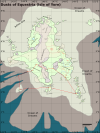
Ele Town is a settlement in northern Yongganguo. It is the largest settlement in the Crow River Valley between the Celestial Mountains to the East and the Carki-Khan Mountains to the West.
Under the Yonggan Nationalist system of administration, Ele Town is under the control of Yoca Mengnat Duwara khan and is considered part of the territory of the Mengnat clan, as with the rest of the Crow River Valley West of the Dai River; the small portion to the East of the Dai River is controlled by the Ikulu clan. However, it should be noted that Ele Town did not originate as a Yonggan settlement, and while many Yonggan have come to live there over the centuries, Ele Town has strong Beituzhu roots and a multiethnic identity. Today, Ele Town is about 40% Yonggan, 30% Beituzhu, 15% Zhongzu, and 10% Ganjinese, the balance being all other groups. Among the Yonggan, about 40% are of the Mengnat clan, 25% Ikulu clan, and the remainder all other clans (including minor clans.)
In antiquity, Ele Town was founded by Beituzhu from what is now Nitan Province, who made their way up the cliffs of the Northern Divide to settle near the confluence of the Crow River with a major tributary, the Dai River. They practiced settled agriculture and were frequently tributaries of the Alarame, and, later, the Yonggan.
There is an important temple to the Moon Spirit of Kemchick shamanism in Ele Town, identified with Tui of the water tribes. Many Beituzhu come to Ele Town on the new moon, for a pilgrimage. The shrine is headed by an earthbending matriarch elected by community leaders upon the death of the previous officeholder; the Matriarch also serves a political function in representing the Beituzhu community to the regional overlord, presently the Mengnat khan, previously the centrally-appointed Earth Kingdom magistrate (since deposed by the Yonggan Nationalist regime.)
Besides being a regional trade hub for the Crow Valley - unsurprising given its position on two important navigable rivers and the Great Qin Road - Ele Town is also a hub of industry, with metalwork, ceramics, food, and clothing being significant exports. Much of its metal goods trade is ultimately bound for the Northern Water Tribes, and has been affected by the increased Fire Nation activity in the North Sea since the fall of Beigang. This has, temporarily, led to something of a glut on the local market. Train oil and seafood from the North Sea trade are sold in Ele Town. Peat cut from the lowlands north of the Northern Divide, mostly from Nitan state, is also imported and sold as fuel - mostly it is burned in Ele Town itself, because of local deforestation; the Crow River Valley as a whole has more than enough forest land to supply heating and cooking fuel.
Ele Town is a walled city (like any decent city in the Earth Kingdom), with composite wood-stone walls. Its watch towers have commanding views of the lowlands of Nitan state below. Its most important work of civil earthbending, though, is its locks that allow boats to pass the Ele Cataract on the Northern Divide. In order to actually reach the Crow River in Nitan state, a second set of locks about 40 km north must also be passed. Both sets of locks are presently under the control of the Yonggan state, which is a source of resentment to some in Nitan.
The Great Qin road crosses the Crow River at Ele Town, on a very large bridge. The ruins of an older bridge are also visible.
Ele Town's nearby countryside has mostly been cleared for agriculture, and grains, especially sorghum and millet, are grown there. Riverpigs, pigdogs, and assgoats are common livestock; the Huxin chickenpheasant is a local specialty in a country which otherwise eats comparatively little poultry.
The gate inscription at Ele Town reads:
Long long live Sakda-Emoto Dorgon, serene prince of the Yonggan State, khagan of all Yonggan people and of the Gorlos Abka, khan of the Emoto clan.
Territory of the Mengnat Yonggan clan.
Long live Yoca Mengnat Duwara, mountain khan.
Aisin Mengnat Aiyongga, county magistrate.
Io Kamak, town chief.
Great Spirits of Earth and Heaven guide them all and prosper the Nation!