Geography
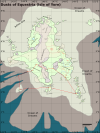
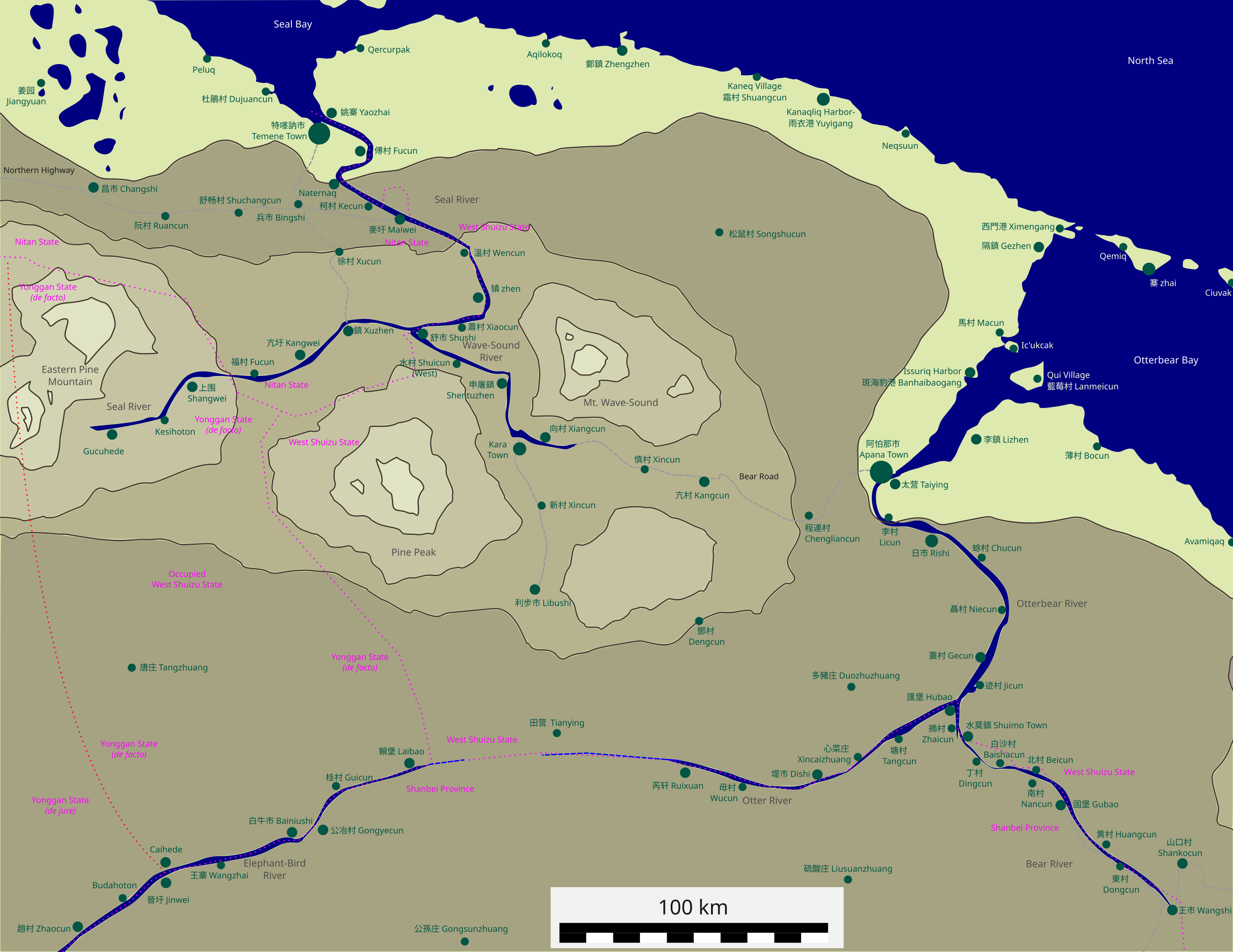
The Otterbear river and its principal tributaries, the Otter and Bear rivers, receive water from the eastern third of the Whitewood Valley, north of the Northern Barrier Mountains. The watershed includes parts of the West Shuizu State and the Shanbei Province, with the Otter and Bear rivers forming part of the historic borders of these regions. The river opens into the Otterbear Bay at Apana Town, the administrative center of the region and a major northern port.
Northwest of Apana Town rises the Northern Divide, a cliff that divides the highlands of Yongganguo from the cold peatbogs of Nitan State and the West Shuizu State.
The Perpetual Peace Mountains are actually the site of longstanding vulcanism and were given their Common language name in a spirit of optimism. They produce abundant sulfur, arsenical sulfides used for pest control, and cinnabar. The cinnabar is associated with its alkaline hot springs. There has been no eruption in historical memory, though oral tradition of the indigenous earthbending tribes tells of an eruption some centuries prior to contact with the literate civilizations of the South.
Transport and Economy
The Otterbear river is important to the economy of the region, both for trade, fishing, and various riparian products. The river system brings products to Apana town, where they are loaded onto oceangoing ships for the North Sea trade (including sometimes transport to Beigang, bound for the central heartland and Ba Sing Se via the Grand Canal.) The Otterbear river system is linked to overland transit by the Ba Sing Se Highway, which crosses the mountains to Manbao and the Astringent River system opening into the Third Sister Bay. At Wangshi, the Bear River Road connects the Otterbear river system with the Far West River system, providing a trade link to the north of the Five Grains Province and an additional connection to the Grand Canal to Ba Sing Se.
The Bear River Road, which runs alongside the Bear River, is nowadays somewhat redundant as the river is navigable from Wangshi year round thanks to the building of a dam at Wangshi. However, in the past, during dry years the river would not be navigable southeast of Gubao, or, in extraordinary dry seasons, of the confluence with the Perpetual Peace River, a tributary between Gubao and Nancun and originating in the mountains of the same name.
Economy of the region is predominantly agricultural. Crops are grown in the fertile river valley, and although it is too cold for rice, many typical crops of northern landraces thrive there. The woolly riverpig is raised for food, and the assgoat as a work and dairy animal. Tamed giant badgermoles, and domesticated members of the Shanbei Forest Badgermole breed, are used as work animals and for dairy products by the Yonggan minority. There is some mining activity, of coal and metal-bearing ore minerals, in the vicinity of Wangshi and the more mountainous parts of the area. Peat is commonly used in the north of the region, near Apana town, where it can be cut nearby. However, upriver, coal and wood are favored as they can be sent downriver. Mercury (quicksilver) and sulfur are also exported via the Otterbear river, as they are mined in the Perpetual Peace Mountains, though they are also exported via the Everstrong River system.
The watershed is heavily wooded and market hunting and trapping is economically significant. Both fur and meat are important. The otterbear is treasured for its warm and waterproof fur, but has become difficult to find since the introduction of foothold traps from Temene Town, which made them much easier to take than with the traditional methods of hunting with spears and bending.
Up the Bear and Otter rivers near the confluence, and in the Otterbear river, there are a number of boatmills which are used to process grain.
General Yi has a number of people engaged in building a canal from the Otter River to the Elephant Bird River. This would connect Apana Town to the Elephantbird River and ultimately to the Western Sea. Such a canal project was contemplated in the final years of the Ri Dynasty, but the project was abandoned after only about ten kilometers of canal were built due to political infighting between Yonggan princes. The Yonggan warlord Gioro Emoto Dabciku has agreed not to interfere with this canal project in exchange for eventual mercantile access and recognition of Yonganguo's annexation of parts of West Shuizu State.
A drying oil produced from the Shanbei Paint-Nut is a major forest product. Mixed with "green whale soap" (a copper fatty acid salt, i.e. a metallic soap, prepared from train oil) as a pigment and drying agent, it is used in great quantity as a green paint. Of course, many green paints are made and known in the Earth Kingdom, but the product of the paint mills of Apana town, "Apana Green Quick-Paint," is treasured as fast-drying, even in cold weather. The Paint-Nut, which grows on trees, is also edible, though somewhat of an acquired taste. The oil has a low smoke point, making it unsuited to frying.
Bleaching powder is a product of Wangshi, which has a nascent chemical industry of its own.
Politics
The region is part of the Earth Kingdom, however, central control is not strong here. The notorious warlord General Yi makes his headquarters in Apana town, and the population generally pays taxes to him rather than Ba Sing Se. Wangshi is a notable exception on the Bear River, and some Yonggan villages in the West are also resistive. That being said, some of the towns do have appointed earth kingdom officials, who have maintained their administrative positions (and stipends) by supporting General Yi's work.
Most of the population is not politically engaged. General Yi is resented for his conscription (particularly of earthbenders and military-age young men) but his military administrative structure has actually been, if not less financially demanding, more predictable and consistent in its demands than the prior structures of power. The elimination of these informally corrupt structures, and the inflow of spoils and tax money from General Yi's activities outside the region, has produced a modest increase in material prosperity.
Apana Town is under blockade by the Fire Nation, who seek to deny the North Sea trade to General Yi. The general's Northern Army has a small navy, manned partly with Shuizu waterbenders local to the region, but they are too small to break the blockade openly and have been mostly engaged in nighttime raids on the blockading vessels.
Settlements
Bear River
Wangshi. A larger settlement founded by an Earth King of the Ting dynasty to trade with frontier peoples. Not under the control of General Yi.
Dongcun. One of the four "Cardinal Direction Villages" founded, in legend, by four brothers exiled from their home in the mountains. It is a local agricultural community, and the site of a Zang community and a Ganjinese factory involved in the fur and clothes industries. After the Zang were expelled from Gubao by General Yi (following their refusal to cooperate with his younger brother), many of them resettled in Dongcun, putting pressure on the fur and game animal populations.
Huangcun (黃村). Huangcun is the location of the royal sulfur market, established during the early Hao Ting dynasty to regulate the trade in brimstone mined in the Perpetual Peace Mountains. It is said that in the past, the roads from the mountains to the market and the docks were yellow with spilled sulfur powder, as the regulations in force at the time forbid any registered sulfur miners to come to Huangcun themselves, and at the same time forbid anyone but a registered sulfur miner from collecting sulfur. Regulations were altered after many lives were lost to the poisonous fumes of an accidental fire.
Gubao (固堡). Named for its formidable walls, Gubao is second only to Apana town in size and population among the settlements on the Otterbear river system. It was an ancient capital of an indigenous earthbending civilization which was wiped out in high antiquity by proto-Beituzhu, before they were themselves subjugated by the Zhongzu settlers, who continued to dominate it after the lands north of the Bear river became part of the West Shuizu State. After centuries of decline - it had never fully recovered from its sack by the forces of Qin the Conqueror - it has been revived as a stronghold and shipbuilding center by General Yi, who has appointed his younger brother General Manseok Yi as its commander. A toll chain controls the Bear river at Gubao, and there are water-driven sawmills.
Nancun. A modest village known for its pottery, and the presence of a good marina which is connected to the Bear River and is the Western terminus of the Bear River road.
Beicun. A fishing village of Shuizu people, under indigenous governance. There is a Yonggan minority involved with mineral extraction and earthbending.
Baisha village. Known for its whitestone quarry and shrine to a spirit associated with the same, who is propitiated by offerings of water and said to threaten droughts when angered.
Ding village. Originating as a woodcutting camp. There are some Shuizu loggers and carpenters here; they use waterbent ice-blades to cut trees. The technique is a local secret.
Shuimo Town. A mixed-ethnicity village which includes a Ganjinese trading factory and bathhouse. It is best known for being the site of production of boat-watermills. It is administered by General Yi's military government directly, after a dispute between the general and the elected headman, who felt that too many of the village's young people had been drafted.
Zhai village. This village dates only to the Hao Ting, during Kyoshi's era. It was built by a group of refugees from Beigang, of mixed ethnic and linguistic stock, at the site of an old Shuizu fishing camp that had been abandoned due to a malevolent fish spirit. The spirit was subdued by Kyoshi and confined to the village well, from which water now springs spontaneously under pressure.
Otter River
Tangcun - A Zheing colony built by Wei Hao (f. 900 BG in the reign of the twelfth enumerated Earth King), a rare earthbending talent among the Zheing people. According to legend (the village historical records are scant), Wei was sold the low-lying land along the coast of the Otter River by a shiftless Ganjinese lord, Jin Xipei, who did not tell him that it was dangerously prone to flooding. Over many years, Wei built a system of levees to protect his land, and encouraged people to settle there. The Wei family ancestral temple is located there, and sometimes pregnant Zheing come there to pray for earthbending talent in their children. The economy is mainly agricultural, though it also produces forest products (such as paint-nuts), wild game as a product of its market hunters, and some ceramics - the local clay is of high quality.
Xincaizhuang - An agricultural village of mixed ethnicity. The village is located just East of a narrowing of the Otter river. Although still navigable, it requires skill to pass. The village is located in a stone cliff-face, mostly underground. Large stepped light-wells, some up to thirty meters deep, provide light and ventilation to its parts farther from the cliff face. The village's agricultural lands are located over the village. The village grows vegetables, notably the eponymous variety of Brassica, rosette pak choy, and some staple crops. Wooly riverpigs are raised for meat and fiber. There is a locally-famous pharmacy here.
Dishi - As its name implies, this town is the location of a big market. The population is about 3200. A road along the cliffs connects it with Xincaizhuang, and river pilots sometimes travel back and forth along the road if there is an imbalance of boat crossings through the Dishi narrows to the East. Many hamlets in the hinterland bring their goods for sale in Dishi. There is a Ganjinese factory here, the original nucleus of the town, and the Ganjinese diaspora remains well-represented here. Like Xincaizhuang, it includes buildings built into the cliffside, but this mode of development is less predominant. Furs, forest products including paint nuts, agricultural produce, and artisanal craft products are exported to the riparian trade.
Wucun - This village originates in a colony of "mean people," members of disfavored social castes. Although the category of "mean people" was disestablished during the Ri Dynasty, the village remained poor and freewheeling for a long time. Even today, it has a certain reputation for lawlessness. Occasionally, prominent inhabitants extort money from river traffic (mostly from Ruixuan) with a river-chain. They do this for a few days before removing and hiding the chain before an official response can be mounted. General Yi has threatened the village with collective punishment if it continues to happen under his administration of the region, but the inhabitants seem inclined to test him. Wucun exports agricultural products from the hinterland, and has services such as inns, wine houses, a noted brothel, and two gambling dens. It also has a market, smaller than Dishi, and servicing the hinterland south of the river.
Ruixuan - A town of about 4000 inhabitants, mostly Yonggan. It is named for the a small temple pavilion on a hill overlooking the river, also the site of a monastery of folk earth sages who went into hiding rather than submit to Earth King Jialun's dissolution of the order. They are now openly teaching earth sage doctrines again under the protection of General Yi. General Yi's forces have an outpost in Ruixuan, controlling access to the canal being built and monitoring the frontier for Fire Nation incursions. The "engineering office" of the canal project is also located here. A nephew of the general is the chief civil earthbender of the project.
Tianying - An army training camp of General Yi. It is rather removed from the river, at the location of a crossroads and hinterland market. Although the military administration used it for training for years, lately it has grown in size as it is where workers on the canal project are based. After a week of work on the canal, they rotate back to Tianying for rest and recuperation. It is connected by roads to a dock on the new canal.
Songtun (松屯) - A small hamlet next to the canal being built to link the Otter and Elephant-Bird rivers. It is on a hill. Its source of water is a creek at the foot of the hill, which formerly drained into a non-navigable tributary of the Otter River; this tributary has now been subsumed by the canal. Its main economic activities are subsistence farming, harvesting forest products, hunting and gathering. The population is mostly Zhongzu settlers with some Beituzhu and Yonggan admixture. The headman of the village, Hu Haowang, is related to many of the seventy or so long-term inhabitants. Some livestock is raised for export, and herds of assgoats and mulegoats are driven to market overland at Tianying. The population has swollen to about 200 on account of the nearby canal-building activities, and despite the protestations of some of the locals, a winehouse, brothel, gambling den, and two cheap inns have appeared there. These serve the large numbers of laborers working on the project. Headman Hu has launched a project of his own, funded by taxing these new businesses, to construct a yamen for Songtun in the hope of it being accorded official Village status. It incorporates a Songtun Museum, a sort of visitors' center glorifying the supposed history of Songtun and the Hu clan.
Otterbear River
Hubao (匯堡) A town at the confluence of the Bear and Otter rivers. It surrounds an old fort - some say built by the Di Dynasty - which is well-preserved and made from an inselberg with earthbending.
Jicun
Gecun
Niecun
Chucun
Rishi
Licun
Taiying
Apana Town