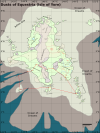
The Biran are sapient aquatic organisms native to the a moon of the planet Bira V (all human exonyms; the Birans do not have a spoken language of their own to provide usable loanwords.) Their psychology is, in the broadest terms, similar to humans; both species work to advance individual and societal goals, form social relations with each other dependent on robust theories of mind, are capable of altruism, and value their individual continuity of existence highly. They know the day night cycle and seasons only academically; they do not use them in reckoning time, which is reported colloquially in terms of typical Biran swimming distance. (E.g. imagine saying "See you in fifteen kilometers" to mean "see you in three hours;" compare the human habit of reporting distances in terms of the time taken on the journey.)
The native environment of the Biran is analogous to the coldwater reefs of Earth. They communicate with bioluminescence. The Biran are exceedingly prolific spawners but do not begin to develop sentience until passing through a pelagic larval form which allows wide dispersal. When young adult-form Birans are found by mature adults after arriving in the reef, they are taken into the shoal and nurtured from that point. This mechanism allows genetic diversity to be maintained without adult Birans leaving their native reef environment (at considerable risk of predation) since they are unlikely to be very closely related to their neighbors. Like most higher life on their homeworld, they are tetraploid (having four sets of chromosomes). Their genetic material is not DNA but is broadly similar, with a different phosphate ester backbone and different nucleic acids.
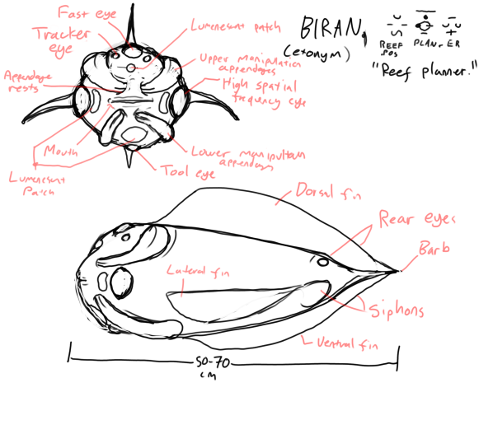
Biran who reach adulthood live a very long time, typically over five hundred Earth years in a safe, civilized context. Ordinarily, they will perish if brought from their deep reef habitat to the surface, the rapid change in hydrostatic pressure being deadly to them. However, if protected from pelagic predators (by the absence of such creatures or appropriate technology) they can survive a gradual ascent over the course of weeks. (This possibility was not discovered until after the surface had already been reached and found to be of practical significance.) Their preferred temperature range is -2 to 12C and they require salt water, though they are relatively hardy with respect to salinity and higher temperatures, beginning to perish from overheating only in the 40s C. Biran are approximately 50 cm long, 20cm wide and 30 cm high, and do not have sexes. (I.e. the species has only one kind of gamete, which needs to find another gamete from a different Biran to begin growing into the tetraploid organism.)
The Biran are tool-users but their manipulative appendages are cruder than those of humans. They regard the fingered hands of human mechanics and engineers with respect bordering on awe. The same, however, can be said of humans considering the Biran affinity for chemistry. They are masters of materials, organic and biochemistry. The have a great degree of conscious control over their biochemistry and specialized secretory glands, thought to have evolved to produce neurotoxins and antibiotics tailored to prey species, parasites or would-be predators in their ecological niche. The Biran are wide-ranging, often swimming many kilometres along the reef and having several preferred niches in which to rest.
An old species whose historical records speak to thirty thousand years of agricultural civilization and symbolic record-keeping, the Biran were relative latecomers to spaceflight who might have settled the galaxy before humans invented the blackpowder rocket had they not such faced such difficulty developing an accurate cosmology. Indeed, they did not reach the ocean surface of their world to glimpse its night sky until they had developed reliable pressure vessel technology and the ability to create bulk gases for buoyancy. But once they reached the surface, they realized the value of its abundant solar energy to their industries, then dependent on scarce geothermal resources. Combustion, a relatively little-known laboratory phenomenon to the Biran at the time, was also quickly appreciated in practice and investigated. In the end, not two centuries passed between the first Biran eyes beholding the starry night sky of its homeworld and their first visit to another world. Discovery of the wormhole network followed, and with their advanced chemical technology being readily applicable to environmental engineering, they had success at colonization.
As spacefairers, the Biran's need for a (heavy) aqueous environment is partially offset by their small size, tolerance of confined environments (a Biran feels very safe and content when snug in a nook barely larger than its body, as when resting in its home in a reef), long lifespan, and ability to survive extreme accelerations.
The Empire owed much to the Biran, who provided a variety of advanced materials, including incredible engineering plastics, self-healing materials and self-assembling nanostructures.
Only two of the BTW/Twelve Worlds (The Water Planet of Iridia and Heidelberg) have a large Biran population, but colonization of some other planets has begun in the last few centuries. Even on worlds that share large Biran and Human populations, the two species rarely interact directly, preferring to trade by cargo containers with appropriate buoyancy and written messages. Biran usually organize their societies around units called a "compact", a sort of voluntary association formed to organize and regulate a certain category of effort or behavior. Compacts have what might be described as "subject matter" jurisdiction, and the Biran seem to consider the primacy humans give to geography in questions of jurisdiction to be very odd. This, of course, is a generality, and like humans the Biran have experimented with many forms of government and society over their long history.
Naming Customs
Biran full personal names are often long and descriptive of behaviour or characteristics early in life. Additional name phrases may be awarded by consensus as a sort of decoration; it is considered very arrogant to change one's own name. Like all nonwritten language of the Biran, names are encoded as patterns of flashing light. They are rendered into human language usually by literal translation. Names invariably start with "The One who" or some other variation introducing a dependant clause; this may be omitted. In both Biran language and in translation, names (which can be quite long) are usually abridged to the initial and final noun. (Which may still be multiple words in translation.)
Biolumenescence
Biran produce light from four patches on their face. The intensity of the light can be very rapidly modulated, and, compared to biolumenescent organisms found on Earth, it can be very bright. The Biran typical reef habitat on their homeworld is dark, and most light is from biolumenescence.
Eyes
Biran have eight eyes, specialized for various tasks. They have a pair of High-Spatial-Frequency-Eyes, which have a wide field of view, great sensitivity to detail (as the name implies) and stereoscopic vision. However, their temporal resolution is low. The Fast Eye has moderate resolution and no depth perception, but has exceedingly high temporal resolution, and is the eye used for communication. (I.e. for "Listening" to the Biran language of flashing lights.) The Tool Eye has high resolution and a very narrow field of view. It has excellent coordination with the manipulation appendages and good temporal resolution. The Fast Eye and Tool Eye are sensitive to color, with two retinal pigments having peak sensitivities at 505 nm and 571 nm corresponding to the emission peaks of Biran photolumenescence. The High Spatial Frequency Eyes are not color-sensitive, but are sensitive to these wavelengths as well.
The Tracker Eyes move independently and unconsciously to provide situational information about the position and speed of nearby moving objects; the Biran is not consciously aware of what is actually seen by these eyes. The Rear eyes are similar to the Tracker Eyes, but they are larger and not as fast-moving, being more specialized to track distant objects. The conscious mind is provided with the positions and distances of moving objects seen by the rear eyes, but cannot actually "see" them. Tracker and Rear eyes are sensitive to the far infrared, able to pick out non-uniformities in the temperature of the sea, hazardous plumes of volcanically heated water, etc.
The specialization of the eyes is reflected in the neurological organization of the Biran brain.