|
Size: 4948
Comment:
|
Size: 20095
Comment:
|
| Deletions are marked like this. | Additions are marked like this. |
| Line 7: | Line 7: |
| Many of the political subdivisions of the Earth Kingdom have histories as independent countries that were tributaries of the Central Earth Kingdom government in Ba Sing Se, and which were later incorporated as organic parts of the kingdom. Four of these subdivisions, originating as vassal kingdoms, are termed states rather than provinces, with leaders who are "prince" or "king / sovereign" (王), the latter term also being used for the Earth Monarch in Ba Sing Se. For historical reasons, many of the provinces are still called countries (國) even though their leaders are not allowed to call themselves kings/princes (or queens/princesses.) The Earth Monarch is usually an Earth King (), though sometimes there have been Earth Queens regnant who use the same title as when the Earth Monarch is male, and under the [[Avatar/Ri Dynasty|Great Ri]] the Earth Monarch was titled Emperor of the Great Ri in most contexts, being called "Earth King" only in the context of his rule in Ba Sing Se. | Many of the political subdivisions of the Earth Kingdom have histories as independent countries that were tributaries of the Central Earth Kingdom government in Ba Sing Se, and which were later incorporated as organic parts of the kingdom. Four of these subdivisions, originating as vassal kingdoms, are termed states rather than provinces, with leaders who are "prince" or "king / sovereign" (王), the latter term also being used for the Earth Monarch in Ba Sing Se. For historical reasons, many of the provinces are still called countries (國) even though their leaders are not allowed to call themselves kings/princes (or queens/princesses.) The Earth Monarch is usually an Earth King (土王), though sometimes there have been Earth Queens regnant who use the same title as when the Earth Monarch is male, and under the [[Avatar/Ri Dynasty|Great Ri]] the Earth Monarch was titled Emperor of the Great Ri in most contexts, being called "Earth King" only in the context of his rule in Ba Sing Se. |
| Line 10: | Line 10: |
| The Earth Kingdom is enormous and contains essentially every biome from frozen glaciers to torrid jungles. [[Avatar/Northern Region of the Earth Kingdom|Northern Region]] |
|
| Line 12: | Line 15: |
The Earth Kingdom has forty-one widely-recognized Ethnic Groups, many of which contain subdivisions. The term "Earth Peoples" (土民) is collectively used for everyone who isn't descended from the natives of Ba Sing Se. Ba Sing Se natives (the ancestral stock of both the Hao and the Ting) are not considered "ethnic" by the Hao Ting, though the Ri and Later Gong used the term Guchengminzu (固城民族) "Solid walls ethnic group" for them. The Guchengminzu may be considered the "zeroth" group on the list below, although they are not on the official lists. ||'''Name'''||'''Note'''|| ||1 [[Avatar/Zhongzu|Central]] (中族) / Zhongzu || The majority population of the provinces surrounding Ba Sing Se. Genetically very similar to the Gucheng people, but considered a distinct group socially for the past few centuries.|| ||2 [[Avatar/Nanzu|Southerner]] (南族) || The majority population of the Southern continent, including Omashu. || ||3 [[Avatar/Gangzu|Gangzu]] (港族) "Harbor people" || Settled seafairing people from the Southeast coast of the central continent. Established the ancient Di dynasty. || ||4 [[Avatar/Gan Jin|Ganjinese]] (乾凈族) || Inhabitants of a coastal country on the Western Lake, once the center of a multiethnic empire. Noted for mercantilism.|| ||5 [[Avatar/Zang|Zangs]] (髒族, reclaimed exonym) || A settled arboreal hunting culture of the Western Plains, widely disseminated as fighters.|| ||6 [[Avatar/Abka|Abka]] (嗄佧民族, endonym), Maniaomin (馬鳥民)|| Ostrich-horse riding steppe nomadic sometime-raiders practicing mounted archery. || ||7 [[Avatar/Nogai|Nogai]] (諾蓋族, phonetic loan)|| A nomadic group in West. || ||8 [[Avatar/Yonggan|Yonggan]] (勇敢民族) "''Yonggan'' peoples" || Mountain dwelling earthbenders, founded [[Avatar/Ri Dynasty|a conquest dynasty]]|| ||9 [[Avatar/Swamp Villagers|Zhaozecunmin]] (沼澤村民) "Swamp Villagers" || Several related waterbending tribes living in marshes and swamps. One such tribe lives in the Foggy Swamp. || ||10 [[Avatar/Eastern Peninsular Peoples|Naksibujok]] 釣部族 / 釣族 ||"Fishhook people," Coastal / seafairing ethnic group indigenous to the East|| ||11 [[Avatar/Yokoya Islanders|Yougouya Daomin]] (游溝雅島民) "Yokoya Islanders" || I.e. the Kyoshi Islanders, a previously peninsular, now insular, settled people of the Southwest.|| ||12 || Far Western montane Indigenous People 1|| ||13 [[Avatar/Heke|Heke]] 河客|| Transient/nomadic riparian people of the West, Far West, and Western Lake. Sometimes thought to be distant kin of the Jiangke, they are actually independent of them and are mostly of waterbending stock. || ||14 [[Avatar/Northern Aborigines|Beituzhu]] (北土著), endonym Khemchik||Northern Aborigines inhabiting the northern coast of the Central Continent || ||15 [[Avatar/Chenbao|Chenbaozu]] (塵暴族) || Primary inhabitants of Chenbao || ||16||far south high mountain people practicing air nomad religion but they are earthbenders - attacked but not wiped out by fire nation|| ||17 [[Avatar/Mau Dai|Miaotai]] (苗薹族) || See [[Avatar/Mau Dai|Mau Dai people.]] || ||18|| Far Western boreal forest indigenous people|| ||19|| Far Western plains indigenous people 1 || ||20 [[Avatar/Eastern Peninsular Peoples|Hwasalbujok]] (箭部族) / 箭族 Jianzu ||Primary indigenous ethnic group of the Eastern Peninsula || ||21 沙瓤族 [[Avatar/Sharangzu|Sharangzu]] || Far western coastal indigenous people || ||22 [[Avatar/Sandbender Tribes|Nanfang Shazu]] 南方沙族 "Southern Sand Tribes" || i.e. [[https://avatar.fandom.com/wiki/Si_Wong_tribes|Siwang sandbenders tribes]] || ||23 [[Avatar/Sandbender Tribes|Beifang Shazu]] 北方沙族 "Northern Sand Tribes" || i.e. [[Avatar/Hanwang Desert|Hanwang]] sandbenders || ||24 [[Avatar/Caomumin|Caomumin]] (螬牧民) "Beetle herders" || Beetle-helmet people, nomadic traders who are widely dispersed and known for skills in desert crossings. || ||25|| indigenous jungle people of the south|| ||26|| indigenous jungle people 2 of the far south|| ||27|| indigenous jungle people 2 of the far south|| ||28 [[Avatar/Honghu|Honghu]] (紅鬍族)"Redbeard Tribe" || far western indigenous people || ||29|| far southern settled people 1 || ||30|| far southern settled people 2|| ||31|| outward lands jungle people || ||32|| outward lands coastal people || ||33|| outward lands people 1|| ||34|| outward lands people 2|| ||35|| beryl archipelago tributary people || ||36 [[Avatar/Jiangke|Jiangke]] (江客) "River guests." || Nomadic people living on the rivers and canals of the Southern Continent, and in semi-permanent riparian camps, sometimes coming into conflict with settled people. They are of mixed water and earth elemental ethnicity. || ||37 [[Avatar/Air Nomad|Angmumin]](昂牧民)"Air Nomads" || Associated with the Northern Air Temple but some also lived in the South; believed eradicated in the genocide by the Fire Nation || ||38 [[Avatar/Tributary Water Tribes|Jinggong Shuizu]] (進貢水族) Tributary Water Tribes || Ethnic water nation people living in the Far North, recognizing the Earth Kingdom as suzerain. The Maozu and Banzu split from these groups to join the Northern Water Tribes' confederation. || ||39 [[Avatar/Huoke|Huoke]] (火客) "Fire guests" || Ethnic Fire Nation People living in the far west (prior to the Invasion) - mostly in territories now occupied by the Fire Nation or expelled in ethnic violence.|| ||40 || Reserved ethnic group || ||41 || Reserved ethnic group || |
|
| Line 18: | Line 66: |
| ||1 Yonggucheng (永固城) || Ba Sing Se || | ||1 [[Avatar/Ba Sing Se|Yonggucheng]] (永固城) || Ba Sing Se || |
| Line 22: | Line 71: |
| ||3 || || | ||3 || 新林省 [[Avatar/Xinlin Province|Xinlin Province]] || |
| Line 24: | Line 73: |
| ||5 || || ||6 || || |
||5 || 五榖省 [[Avatar/Five Grains Province|Wugu Province]]|| ||6 || 平原西省 [[Avatar/West Plains Province|West Plains Province]]|| |
| Line 27: | Line 76: |
| ||54|| || | ||54|| Reserved Province || |
| Line 31: | Line 80: |
| ||8 || || | ||8 || Contains the regional capital, Dongjing || |
| Line 33: | Line 82: |
| ||10 || || | ||10 || Where Misun Pak was from, archery tradition || |
| Line 37: | Line 86: |
| ||11 || || ||12 || || |
||11 Great [[Avatar/Omashu|Omashu]] || Second City of the Earth Kingdom; Ruler is titled Mawang, (瑪王) literally "Agate King." || ||12 [[Avatar/East Lake Province|East Lake Province]] 東湖省|| On the southern shores of the Eastern Lake. Formerly a vassal buffer state of Omashu, now ruled by an appointed governor. || |
| Line 40: | Line 89: |
| ||14 || || ||15 || || ||16 || || |
||14 [[Avatar/Pohuai|Pohuai]] || (partially controlled by the Fire Nation) || ||15 || (controled by the Fire Nation) || ||16 [[Avatar/Gintong|Gintong]] |||| |
| Line 44: | Line 93: |
| ||52 || || ||53 || || |
||52 [[Avatar/South Hu Xin|South Hu Xin]] || || ||53 ||Reserved Province || |
| Line 49: | Line 98: |
| ||18 || || ||19 || || ||20 || || ||21 || || ||22 || || ||23 || || |
||18 [[Avatar/Abka State|Marenguo]] 馬人國 (Abka State)|| || ||19 [[Avatar/Ganjin Country|Ganjingguo]] || || ||20 [[Avatar/Zang Country|Zangguo]] || || ||21 [[Avatar/State of Yi|Yi]] || in the west || ||22 勇敢國 [[Avatar/Yonggan State|Yongganguo]] (Yonggan State)|| || ||23 [[Avatar/Nogai State|Nogaiguo]] || || ||55 Western Plains Province || Contains Xingjing, the regional capital || |
| Line 58: | Line 108: |
| ||24 || || ||25 || || ||26 || || ||27 || || ||55 || || |
||24 ||䀚雪國 [[Avatar/Angxue State|Soaring-Snow State]]|| ||25 ||泥炭國 [[Avatar/Nitan State|Nitan State]] || ||26 ||水族西國 [[Avatar/West Shuizu State|West Shuizu State]] || ||31 || 水族東國 [[Avatar/East Shuizu State|East Shuizu State]] || ||30 || 新北省 [[Avatar/Xinbei Province|Xinbei Province]] || ||41 || 山北省 [[Avatar/Shanbei Province|Shanbei Province]] || ||27 ||塵暴國 [[Avatar/State of Chenbao|Chenbao State]]|| |
| Line 65: | Line 118: |
| ||||Not to be confused with the previous Far West ceded to the Air Nation|| | ||||Not to be confused with the previous Far West ceded to the Air Nation|| |
| Line 67: | Line 120: |
| ||28 || || ||29 || || ||30 || || ||31 || || ||32 || || ||33 || || ||34 || || ||35 || || ||36 || || ||37 || || |
||28 弱水國 [[Avatar/Ruoshui State|Ruoshui State]] || In the Northeast, contains a hydrologically puzzling river. || ||29 || [[Avatar/North Hu Xin|North Hu Xin]]|| ||32 || Reserved for future use State || ||33 武隆省 [[Avatar/Wulong Province|Wulong Province]] || Partially controlled by the Fire Nation || ||34 || Partially controlled by the Fire Nation, Reserved for future use || ||35 || (Island, home of Yu Dao, Controlled by the Fire Nation) || ||36 || (Controlled by the Fire Nation) || ||37 || (Controlled by the Fire Nation) || |
| Line 80: | Line 131: |
| ||38 || || | ||38 [[Avatar/Gaoling|Gaoling]] || || |
| Line 83: | Line 134: |
| ||41 || || | |
| Line 85: | Line 135: |
| ||43 || || ||44 || || |
||43 || Reserved || ||44 ||[[Avatar/Zeizhou|Zeizhou]] || |
| Line 96: | Line 146: |
| ||50 || || ||51 || || |
||50 || Reserved || ||51 || Reserved || |
| Line 101: | Line 152: |
| The Earth Kingdom is ruled by the Earth King, who reigns from the Badgermole Throne in the Hall of Invincible Stability, part of the innermost palace complex in Ba Sing Se. Earth Monarchs assume rulership by "ascending the throne" and issuing an edict stating this fact and proclaiming an Era Name to be used on the new year. (Thus, an Earth King first rules during the last year of the era of his predecessor; interregnums are normally very short unless the former Earth King has died close to the new year, in which case the official ascension would be delayed lest confusion about the current era name be created in the far-flung corners of the Kingdom.) | The Earth Kingdom is ruled by the Earth Monarch (土王), who reigns from the Badgermole Throne (獾鼴寶座) in the Hall of Invincible Stability (永穩殿 lit. ''Ever-Stable [Palace] Hall''), part of the innermost palace complex in Ba Sing Se. Earth Monarchs assume rulership by "ascending the throne" and issuing an edict stating this fact and proclaiming an Era Name to be used in the new year. (Thus, an Earth King first rules during the last year of the era of his predecessor; if the former Earth King has died close to the new year, the official ascension would be separated from the Era Name proclamation lest confusion about the current era name be created in the far-flung corners of the Kingdom where the edict might not be disseminated before the New Year.) |
| Line 103: | Line 154: |
| Iconography of the monarchy varied by dynasty. The current Hao Ting favors a circular symbol with a central square hole, somewhat resembling a cash coin. The preceding Ri dynasty used a stylized badgermole and a quadripartite symbol similar to the yin-yang (࿌). The Hao dynasty immediately preceding the Ri also used badgermole symbolism; the austere Ting used a circular symbol more similar to the current emblem until the recovery of the ancient badgermole throne. | Iconography of the monarchy varied by dynasty. The current Hao Ting favors a circular symbol with a central square hole, somewhat resembling a cash coin. The preceding Ri dynasty used a stylized badgermole and a quadripartite symbol similar to the yin-yang (࿌) which signified the balance of the Four Elements. The Hao dynasty immediately preceding the Ri also used badgermole symbolism; the austere Ting used a circular symbol more similar to the current emblem until the recovery of the ancient badgermole throne. |
| Line 105: | Line 156: |
| Green is the national color of the Earth Kingdom. Traditionally, the color of the Earth Monarch's regalia was described as "celadon," though the current regalia no longer closely fit that color description. | Green is the national color of the Earth Kingdom. Traditionally, the color of the Earth Monarch's regalia was described as "celadon," though the current regalia no longer closely fit that color description precisely. The Royal regalia has been made in Gan Jin Country since the time of the Great Ri and the tradition continues to the present. === Military === The Royal Earth Army is the traditional army of the Earth Kingdom. It has a proud and storied history, but as of 95 AG the organization has fallen on hard times. Most of the best units have been decimated in battle with the Fire Nation; many of the remaining troops of the regular army are tied up in ensuring the flow of taxes to Ba Sing Se or protecting the outer wall. The defense of the West and South has largely been left to highly-autonomous provincial generals, warlords in all but name, who levy their own taxes and conscript local people on their own authority. They fight the Fire Nation invasion, bandits, rebels (such as those who refuse to give them money or soldiers), and occasionally, each other. These generals act in a poorly-coordinated fashion, often preferring to defend their local bases of support rather than pursue objectives in the interest of the Kingdom overall; they treat orders from Ba Sing Se as more of suggestions which they might implement or not. Lately, the Hao-Ting war council has come to accept that it has to bribe them to do anything against their self-interest. The warlord armies are usually controlled with brutal discipline, but that does not extend to their treatment of defeated enemies, as they often engage in war crimes. That being said, some of the warlord generals are comparatively chivalrous; the legendary scholar-general [[Avatar/General Yang|YANG Guofan]] and his Gaoling Army are both loyal to the state and well-disciplined. The Earth Navy uses mainly sailing ships. It was decimated by the Fire Nation early in the course of the war, as they were no match for the metal-hulled and steam-propelled Fire Navy. The Earth Navy in the far East and Outward Lands has experimented with a few steam-powered ships of their own, based on captured Fire Nation technology, but without firebending, both the operation and building of such ships is limited. (Notably, they are still wooden steamships, except for a couple of Fire Nation ships that ran around and were captured.) Most of the Earth Navy's large sailing ships are in the sea between the mainland and the outlying Southern territories of the Earth Kingdom; the experimental steamships and captured Fire Nation ships are kept in the Eastern Sea to defend Ba Sing Se from an attack from the East. (The strategic merits of this decision are questionable.) With the assistance of Southern Water Tribe members who joined the war, the Earth Kingdom does conduct some commerce raiding with smaller vessels against Fire Nation shipping between the Fire Islands and their colonies in the Earth Kingdom. However, as the Fire Nation has started modernizing their merchant navy and started to use convoy escorts, these raids have become less effective. === Bureaucracy === The Earth Kingdom is administrated through an extensive bureaucracy, the power of which in relation to other institutions (the Earth Sages, the Military, large commercial interests and feudal nobility) waxes and wanes with the passing of reigns and dynasties. Under the Hao Ting, the bureaucracy waxed strong before a long decline. Even it its dotage, suborned to warlords and power-hungry governors and administrators that have emerged from within it, the system of officials appointed and advanced on merit remains a substantial influence on the culture of the country. Would-be bureaucrats qualify to enter the system by passing the Civil Service Exam, held once a year in every state and province of the Earth Kingdom. If they pass, they can submit themselves for official service, agreeing to be sent wherever there is a need for them, generally not in their home province. Officials are divided into eight ranks; newly accepted officials are eighth rank and about 60% never rise above that rank; of those how do, most remain in rank seven or six. Of the total officials, less than 3% are rank five or above. There are less than 100 rank one officials in the entire Kingdom, most of them in Ba Sing Se or Omashu, and report directly to the Grand Secretary or the other Supernal Ministers of the Earth King; some are the Prime Ministers of the King of Omashu and other constituent states of the Earth Kingdom who have feudal vassal rulers instead of appointed governors. The Eight Supernal Ministers (ostensibly at least) report to the Earth King, and together with the Grand Secretary and the Grand Preceptor, help him rule the country. The ministries are: The Ministry of Armaments, The Foreign Ministry, Ministry of State Rituals, Ministry of Agriculture, Ministry of Works, Ministry of Cultural Preservation (i.e. the Dai Li), Ministry of Civil Appointments, and the Ministry of State Revenue. Official rank allows the holder to use various prestige symbols under sumptuary laws, which originally protected the prestige of feudal nobility from upwardly mobile merchant classes. An official of the sixth rank is entitled to keep one eunuch, and have a servant run in front of them banging a gong, for example: ||||''Official Sumptuary Privileges''|| ||Exam Passed, no appointment|| Not to rise and bow to a passing official; wear a tassel on their hats|| ||Rank 8|| Garments with state insignia. || ||Rank 7|| Runner with a bell and/or white lantern going before them. || ||Rank 6|| Runner with a gong or green lantern going before them. May keep a eunuch. || ||Rank 5|| One gong runner, two green lantern runners. Two eunuchs. State carriage. || ||Rank 4|| Four lantern runners, gong and a trumpeter. || ||Rank 3|| Six lantern runners, gong and two trumpeters, may keep up to ten eunuchs, up to 12 personal guards. || ||Rank 2|| Eight lantern runners, up to 24 personal guards. Semi-Precious stone hat ornaments. || ||Rank 1|| Ten lantern runners, precious stone hat ornaments, carriage drawn by ostrich horses of the royal flock, may keep any number of household eunuchs. || ||Supernal Ministers|| Very fancy hat, twelve lantern runners going before them. || Higher ranks have all the privileges of the ranks below them. Each rank has distinctive insignia for their official garments. Note that most members of the given official rank, except near the very top, are unlikely to actually be able to afford to exercise all of these privileges. In particular, since penal law reforms during the Renxian reign (745-712 BG) the supply of eunuchs has become greatly restricted in most areas; further, getting together twelve extra guys to go with your palanquin bearers or carriage servants is a bit inconvenient for heading to the office for a meeting, so this sort of thing is mainly seen during state occasions. There are also "unranked officials," who are subordinate to the 8th rank in precedence and have not passed the civil service exam, but a literacy test instead. They are appointed mostly in distant regions as village headmen and "frontier bailiffs" who must correspond with a relatively distant yamen in writing rather than being able to conveniently speak in person with their superior. They have a distinctive insignia but no tassel for their hats. |
The Earth Kingdom is the largest and most populous country in the known world, and encompasses the overwhelming majority of Earth Nation polities. Its inhabitants are primarily of Earth National elemental ethnicities and hence its culture and history have been heavily influenced by the development of Earthbending.
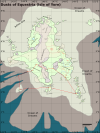
The Earth Kingdom is vast and diverse, with 51 provinces and four constituent states. It controlled substantially all of its claimed territory at the start of the Fire Nation invasion, but now some provinces are controlled by the Fire Nation colonial government and others have attained de facto independence after neglect or perceived abuse from the Ba Sing Se government.
The Earth Kingdom is divided into nine regions, eight of which have regional capitals and the other of which is coterminous with the outer barrier wall of the royal capital, Ba Sing Se.
Many of the political subdivisions of the Earth Kingdom have histories as independent countries that were tributaries of the Central Earth Kingdom government in Ba Sing Se, and which were later incorporated as organic parts of the kingdom. Four of these subdivisions, originating as vassal kingdoms, are termed states rather than provinces, with leaders who are "prince" or "king / sovereign" (王), the latter term also being used for the Earth Monarch in Ba Sing Se. For historical reasons, many of the provinces are still called countries (國) even though their leaders are not allowed to call themselves kings/princes (or queens/princesses.) The Earth Monarch is usually an Earth King (土王), though sometimes there have been Earth Queens regnant who use the same title as when the Earth Monarch is male, and under the Great Ri the Earth Monarch was titled Emperor of the Great Ri in most contexts, being called "Earth King" only in the context of his rule in Ba Sing Se.
Geography
The Earth Kingdom is enormous and contains essentially every biome from frozen glaciers to torrid jungles.
Ethnic Groups
The Earth Kingdom has forty-one widely-recognized Ethnic Groups, many of which contain subdivisions. The term "Earth Peoples" (土民) is collectively used for everyone who isn't descended from the natives of Ba Sing Se. Ba Sing Se natives (the ancestral stock of both the Hao and the Ting) are not considered "ethnic" by the Hao Ting, though the Ri and Later Gong used the term Guchengminzu (固城民族) "Solid walls ethnic group" for them. The Guchengminzu may be considered the "zeroth" group on the list below, although they are not on the official lists.
Name |
Note |
1 Central (中族) / Zhongzu |
The majority population of the provinces surrounding Ba Sing Se. Genetically very similar to the Gucheng people, but considered a distinct group socially for the past few centuries. |
2 Southerner (南族) |
The majority population of the Southern continent, including Omashu. |
3 Gangzu (港族) "Harbor people" |
Settled seafairing people from the Southeast coast of the central continent. Established the ancient Di dynasty. |
4 Ganjinese (乾凈族) |
Inhabitants of a coastal country on the Western Lake, once the center of a multiethnic empire. Noted for mercantilism. |
5 Zangs (髒族, reclaimed exonym) |
A settled arboreal hunting culture of the Western Plains, widely disseminated as fighters. |
6 Abka (嗄佧民族, endonym), Maniaomin (馬鳥民) |
Ostrich-horse riding steppe nomadic sometime-raiders practicing mounted archery. |
7 Nogai (諾蓋族, phonetic loan) |
A nomadic group in West. |
8 Yonggan (勇敢民族) "Yonggan peoples" |
Mountain dwelling earthbenders, founded a conquest dynasty |
9 Zhaozecunmin (沼澤村民) "Swamp Villagers" |
Several related waterbending tribes living in marshes and swamps. One such tribe lives in the Foggy Swamp. |
10 Naksibujok 釣部族 / 釣族 |
"Fishhook people," Coastal / seafairing ethnic group indigenous to the East |
11 Yougouya Daomin (游溝雅島民) "Yokoya Islanders" |
I.e. the Kyoshi Islanders, a previously peninsular, now insular, settled people of the Southwest. |
12 |
Far Western montane Indigenous People 1 |
13 Heke 河客 |
Transient/nomadic riparian people of the West, Far West, and Western Lake. Sometimes thought to be distant kin of the Jiangke, they are actually independent of them and are mostly of waterbending stock. |
14 Beituzhu (北土著), endonym Khemchik |
Northern Aborigines inhabiting the northern coast of the Central Continent |
15 Chenbaozu (塵暴族) |
Primary inhabitants of Chenbao |
16 |
far south high mountain people practicing air nomad religion but they are earthbenders - attacked but not wiped out by fire nation |
17 Miaotai (苗薹族) |
See Mau Dai people. |
18 |
Far Western boreal forest indigenous people |
19 |
Far Western plains indigenous people 1 |
20 Hwasalbujok (箭部族) / 箭族 Jianzu |
Primary indigenous ethnic group of the Eastern Peninsula |
21 沙瓤族 Sharangzu |
Far western coastal indigenous people |
22 Nanfang Shazu 南方沙族 "Southern Sand Tribes" |
|
23 Beifang Shazu 北方沙族 "Northern Sand Tribes" |
i.e. Hanwang sandbenders |
24 Caomumin (螬牧民) "Beetle herders" |
Beetle-helmet people, nomadic traders who are widely dispersed and known for skills in desert crossings. |
25 |
indigenous jungle people of the south |
26 |
indigenous jungle people 2 of the far south |
27 |
indigenous jungle people 2 of the far south |
28 Honghu (紅鬍族)"Redbeard Tribe" |
far western indigenous people |
29 |
far southern settled people 1 |
30 |
far southern settled people 2 |
31 |
outward lands jungle people |
32 |
outward lands coastal people |
33 |
outward lands people 1 |
34 |
outward lands people 2 |
35 |
beryl archipelago tributary people |
36 Jiangke (江客) "River guests." |
Nomadic people living on the rivers and canals of the Southern Continent, and in semi-permanent riparian camps, sometimes coming into conflict with settled people. They are of mixed water and earth elemental ethnicity. |
37 Angmumin(昂牧民)"Air Nomads" |
Associated with the Northern Air Temple but some also lived in the South; believed eradicated in the genocide by the Fire Nation |
38 Jinggong Shuizu (進貢水族) Tributary Water Tribes |
Ethnic water nation people living in the Far North, recognizing the Earth Kingdom as suzerain. The Maozu and Banzu split from these groups to join the Northern Water Tribes' confederation. |
39 Huoke (火客) "Fire guests" |
Ethnic Fire Nation People living in the far west (prior to the Invasion) - mostly in territories now occupied by the Fire Nation or expelled in ethnic violence. |
40 |
Reserved ethnic group |
41 |
Reserved ethnic group |
Political Subdivisions
Capital Region |
|
Coterminous with the region defined by the outer wall of Ba Sing Se |
|
Name |
Note |
1 Yonggucheng (永固城) |
Ba Sing Se |
Central Region |
|
Name |
Note |
2 |
|
3 |
新林省 Xinlin Province |
4 |
|
5 |
五榖省 Wugu Province |
6 |
平原西省 West Plains Province |
7 |
In the southeast, speaks a different dialect, trade contact with the south, provided the Di dynasty. |
54 |
Reserved Province |
Eastern Region |
|
Name |
Note |
8 |
Contains the regional capital, Dongjing |
9 |
|
10 |
Where Misun Pak was from, archery tradition |
Southern Region |
|
Name |
Note |
11 Great Omashu |
Second City of the Earth Kingdom; Ruler is titled Mawang, (瑪王) literally "Agate King." |
12 East Lake Province 東湖省 |
On the southern shores of the Eastern Lake. Formerly a vassal buffer state of Omashu, now ruled by an appointed governor. |
13 |
|
14 Pohuai |
(partially controlled by the Fire Nation) |
15 |
(controled by the Fire Nation) |
16 Gintong |
|
17 |
|
52 South Hu Xin |
|
53 |
Reserved Province |
Western Region |
|
Name |
Note |
18 Marenguo 馬人國 (Abka State) |
|
19 Ganjingguo |
|
20 Zangguo |
|
21 Yi |
in the west |
22 勇敢國 Yongganguo (Yonggan State) |
|
23 Nogaiguo |
|
55 Western Plains Province |
Contains Xingjing, the regional capital |
Northern Region |
|
Name |
Note |
24 |
|
25 |
泥炭國 Nitan State |
26 |
水族西國 West Shuizu State |
31 |
水族東國 East Shuizu State |
30 |
新北省 Xinbei Province |
41 |
山北省 Shanbei Province |
27 |
塵暴國 Chenbao State |
Far Western Region |
|
Not to be confused with the previous Far West ceded to the Air Nation |
|
Name |
Note |
28 弱水國 Ruoshui State |
In the Northeast, contains a hydrologically puzzling river. |
29 |
|
32 |
Reserved for future use State |
33 武隆省 Wulong Province |
Partially controlled by the Fire Nation |
34 |
Partially controlled by the Fire Nation, Reserved for future use |
35 |
(Island, home of Yu Dao, Controlled by the Fire Nation) |
36 |
(Controlled by the Fire Nation) |
37 |
(Controlled by the Fire Nation) |
Outward Region |
|
Name |
Note |
45 |
|
46 |
|
47 |
|
48 |
|
49 |
|
50 |
Reserved |
51 |
Reserved |
Monarchy and Symbolism
See Dynastic History of the Earth Kingdom for the historical development and key points of the history of the monarchy.
The Earth Kingdom is ruled by the Earth Monarch (土王), who reigns from the Badgermole Throne (獾鼴寶座) in the Hall of Invincible Stability (永穩殿 lit. Ever-Stable [Palace] Hall), part of the innermost palace complex in Ba Sing Se. Earth Monarchs assume rulership by "ascending the throne" and issuing an edict stating this fact and proclaiming an Era Name to be used in the new year. (Thus, an Earth King first rules during the last year of the era of his predecessor; if the former Earth King has died close to the new year, the official ascension would be separated from the Era Name proclamation lest confusion about the current era name be created in the far-flung corners of the Kingdom where the edict might not be disseminated before the New Year.)
Iconography of the monarchy varied by dynasty. The current Hao Ting favors a circular symbol with a central square hole, somewhat resembling a cash coin. The preceding Ri dynasty used a stylized badgermole and a quadripartite symbol similar to the yin-yang (࿌) which signified the balance of the Four Elements. The Hao dynasty immediately preceding the Ri also used badgermole symbolism; the austere Ting used a circular symbol more similar to the current emblem until the recovery of the ancient badgermole throne.
Green is the national color of the Earth Kingdom. Traditionally, the color of the Earth Monarch's regalia was described as "celadon," though the current regalia no longer closely fit that color description precisely. The Royal regalia has been made in Gan Jin Country since the time of the Great Ri and the tradition continues to the present.
Military
The Royal Earth Army is the traditional army of the Earth Kingdom. It has a proud and storied history, but as of 95 AG the organization has fallen on hard times. Most of the best units have been decimated in battle with the Fire Nation; many of the remaining troops of the regular army are tied up in ensuring the flow of taxes to Ba Sing Se or protecting the outer wall. The defense of the West and South has largely been left to highly-autonomous provincial generals, warlords in all but name, who levy their own taxes and conscript local people on their own authority. They fight the Fire Nation invasion, bandits, rebels (such as those who refuse to give them money or soldiers), and occasionally, each other. These generals act in a poorly-coordinated fashion, often preferring to defend their local bases of support rather than pursue objectives in the interest of the Kingdom overall; they treat orders from Ba Sing Se as more of suggestions which they might implement or not. Lately, the Hao-Ting war council has come to accept that it has to bribe them to do anything against their self-interest. The warlord armies are usually controlled with brutal discipline, but that does not extend to their treatment of defeated enemies, as they often engage in war crimes. That being said, some of the warlord generals are comparatively chivalrous; the legendary scholar-general YANG Guofan and his Gaoling Army are both loyal to the state and well-disciplined.
The Earth Navy uses mainly sailing ships. It was decimated by the Fire Nation early in the course of the war, as they were no match for the metal-hulled and steam-propelled Fire Navy. The Earth Navy in the far East and Outward Lands has experimented with a few steam-powered ships of their own, based on captured Fire Nation technology, but without firebending, both the operation and building of such ships is limited. (Notably, they are still wooden steamships, except for a couple of Fire Nation ships that ran around and were captured.) Most of the Earth Navy's large sailing ships are in the sea between the mainland and the outlying Southern territories of the Earth Kingdom; the experimental steamships and captured Fire Nation ships are kept in the Eastern Sea to defend Ba Sing Se from an attack from the East. (The strategic merits of this decision are questionable.) With the assistance of Southern Water Tribe members who joined the war, the Earth Kingdom does conduct some commerce raiding with smaller vessels against Fire Nation shipping between the Fire Islands and their colonies in the Earth Kingdom. However, as the Fire Nation has started modernizing their merchant navy and started to use convoy escorts, these raids have become less effective.
Bureaucracy
The Earth Kingdom is administrated through an extensive bureaucracy, the power of which in relation to other institutions (the Earth Sages, the Military, large commercial interests and feudal nobility) waxes and wanes with the passing of reigns and dynasties. Under the Hao Ting, the bureaucracy waxed strong before a long decline. Even it its dotage, suborned to warlords and power-hungry governors and administrators that have emerged from within it, the system of officials appointed and advanced on merit remains a substantial influence on the culture of the country.
Would-be bureaucrats qualify to enter the system by passing the Civil Service Exam, held once a year in every state and province of the Earth Kingdom. If they pass, they can submit themselves for official service, agreeing to be sent wherever there is a need for them, generally not in their home province. Officials are divided into eight ranks; newly accepted officials are eighth rank and about 60% never rise above that rank; of those how do, most remain in rank seven or six. Of the total officials, less than 3% are rank five or above. There are less than 100 rank one officials in the entire Kingdom, most of them in Ba Sing Se or Omashu, and report directly to the Grand Secretary or the other Supernal Ministers of the Earth King; some are the Prime Ministers of the King of Omashu and other constituent states of the Earth Kingdom who have feudal vassal rulers instead of appointed governors.
The Eight Supernal Ministers (ostensibly at least) report to the Earth King, and together with the Grand Secretary and the Grand Preceptor, help him rule the country. The ministries are: The Ministry of Armaments, The Foreign Ministry, Ministry of State Rituals, Ministry of Agriculture, Ministry of Works, Ministry of Cultural Preservation (i.e. the Dai Li), Ministry of Civil Appointments, and the Ministry of State Revenue.
Official rank allows the holder to use various prestige symbols under sumptuary laws, which originally protected the prestige of feudal nobility from upwardly mobile merchant classes. An official of the sixth rank is entitled to keep one eunuch, and have a servant run in front of them banging a gong, for example:
Official Sumptuary Privileges |
|
Exam Passed, no appointment |
Not to rise and bow to a passing official; wear a tassel on their hats |
Rank 8 |
Garments with state insignia. |
Rank 7 |
Runner with a bell and/or white lantern going before them. |
Rank 6 |
Runner with a gong or green lantern going before them. May keep a eunuch. |
Rank 5 |
One gong runner, two green lantern runners. Two eunuchs. State carriage. |
Rank 4 |
Four lantern runners, gong and a trumpeter. |
Rank 3 |
Six lantern runners, gong and two trumpeters, may keep up to ten eunuchs, up to 12 personal guards. |
Rank 2 |
Eight lantern runners, up to 24 personal guards. Semi-Precious stone hat ornaments. |
Rank 1 |
Ten lantern runners, precious stone hat ornaments, carriage drawn by ostrich horses of the royal flock, may keep any number of household eunuchs. |
Supernal Ministers |
Very fancy hat, twelve lantern runners going before them. |
Higher ranks have all the privileges of the ranks below them. Each rank has distinctive insignia for their official garments. Note that most members of the given official rank, except near the very top, are unlikely to actually be able to afford to exercise all of these privileges. In particular, since penal law reforms during the Renxian reign (745-712 BG) the supply of eunuchs has become greatly restricted in most areas; further, getting together twelve extra guys to go with your palanquin bearers or carriage servants is a bit inconvenient for heading to the office for a meeting, so this sort of thing is mainly seen during state occasions.
There are also "unranked officials," who are subordinate to the 8th rank in precedence and have not passed the civil service exam, but a literacy test instead. They are appointed mostly in distant regions as village headmen and "frontier bailiffs" who must correspond with a relatively distant yamen in writing rather than being able to conveniently speak in person with their superior. They have a distinctive insignia but no tassel for their hats.