Gainan (溉楠) is the former capital of the Nemuland and of the Yonggan State as a whole under the Nara khaganate. It is today no longer an administrative center, though it has been included on the Emoto Khagan's annual circuit since its resumption.
Although Gainan is an ancient city of great spiritual significance to the Yonggan, and the Nara and Ikulu clans in particular, it was a small mountain town for many centuries. During these years, it was noted mainly for an important shrine, where an exceptionally stately grove of Yonggan Redwood grew at the site of a mineral spring pool.
It was reconstructed as Gainan Palace City during the early years of the Ri Dynasty; the official refounding as Gainan Palace City was by the first Imperial Prince of Jin, Nara Aisin (納喇·愛新), toward the end of the Nara-Hao wars. It was substantially completed early in the reign of the Renxian Emperor (r. 745-712 BG). The city consists of a palace complex, inner fortified city, and an outer zone with secondary defenses - somewhat similar to Ba Sing Se, but on a far smaller scale and with nothing particularly equivalent to the agricultural zone. The Ri-era palace was built at a cost of 220,000 silver taels from the feudal revenues of the Imperial Prince of Jin.
The last major addition to the palace itself was the Hall of Solar Radiance (日光輝殿), built for the Muri emperor, (born Prince Taiku), whom the incumbent Yonggan khagan attempted to install as a successor to Qin the Great. When the Hao Ting conquered Gainan, they turned the Hall of Solar Radiance into a marketplace, carrying off its ornamentation as spoils of war. The other palace buildings were similarly stripped and auctioned off, as the Hao Ting felt that grand civic buildings and fortifications might tempt future vassal rulers or ambitious governors. Ultimately, they moved the administrative capital away from Gainan Palace City altogether, feeling that the city was too devastated to be suitable. Instead, the capital of the directly-ruled Yonggan state was moved to Garunggu, on the eastern border of the country.
Today, the city has recovered from its sack and is a significant settlement and commercial center for Yongganguo. However, its greatest significance, in the eyes of many Yonggan today, is spiritual. Since the Yonggan Nationalist regime came to power at the expense of the appointed governor from Ba Sing Se, the khagan has regularly visited Gainan on his circuit of major cities. His palace there remains comparatively modest, since the grand public buildings were long ago appropriated for other uses, but there is some talk of restoring the Hall of Solar Radiance for his use.
Environment and Climate
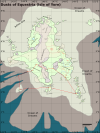
Gainan is located in the Celestial Mountains region of the Yonggan State, traditionally part of the so-called Mineral Lands. It has an mountain climate, with frigid, snowy winters and moderate summers. The elevation is 2100 meters above mean sea level. The climate is not too dry, as Gainan is on the windward side of the Celestial Mountains. It receives moist ocean air from winds blowing south through the Crow River Valley, bringing fairly frequent summer rains. In Winter, though, polar winds sometimes sweep down by the same route, and temperatures commonly reach the negative twenties. Autumn is the driest season, but Gainan has a number of year-round mountain springs.
Gainan is below the tree line, and the Yonggan Redwood once grew in unfathomable abundance in the area, though not on the rocky top of the Gainan batholith itself. The forests began to diminish with increased harvesting during the Ri dynasty, and reached a nadir early in the Direct Rule era, when many old-growth forests were logged for roof beams - in the aftermath of the Civil War, many large public buildings and wood-reinforced fortifications required rebuilding. The forests have made a partial recovery since then, but remain diminished.
Gainan is largely built into an intrusive granite batholith, though marble and quartzite occur nearby and are often incorporated into structures for decorative effect. The soil in the area is fairly thin, with bedrock being found generally less than 4 meters under the surface. Mountain springs are fed by reservoirs in the karstic marble surrounding the batholith, and centuries of earthbending have resulted in aquaducts securing a generous and siege-resistant year-round water supply. Unfortunately, none of the many small creeks and streams are practically navigable.
Agriculture and other Primary Economic Activities
Small-scale horticulture, foraging, and market hunting are important local sources of food. Foraging in forest commons yields native berries and edible lichens, and these berries are also targets of horticulture. Agriculture is limited, though short-season buckwheat is the most economically significant. Artisanal badgermole dairies are found in the area, though opinions differ on how it compares with that produced by the traditional husbandry of seasonally-transhumant herds. Some small numbers of pig-chickens, riverpigs, pigdogs, assgoats, goatmules, and other cosmopolitan edible or dairy livestock are kept with appropriate winter shelters. In general, Gainan is a net importer of food.
Logging and other forest product industries are significant, though the lack of river transport means that most of these products are used relatively nearby - an exception is when very large or long wooden beams are desired, as few grow so large or tall as the Yonggan redwoods nearby; these are worth the trouble to move overland when their like is needed.
Mining is the main activity of the primary economy. In the area are found gold, silver, chalcopyrite and iron pyrite, galena, cassiterite, uraninite, and sphalerite. Hard rock mining is employed. Local alluvial gold is practically exhausted. Hard rock gold, silver, and tin are scarcer than they once were but still significant.
Gainan Granite is sometimes exported for Yonggan prestige projects elsewhere in the state, most significantly for the construction of the Emoto Khagan's new Winter Palace in Emotofuke.
Transport
Gainan is situated on the Sun Road, which is its main trainsport artery. During the early Direct Rule area, construction was started on a system of locks and dams that would have connected the area to the Dai River, but it was abandoned due to violent opposition by mountain badgermole pastoralists. Their attacks and sabotage made it impossible to retain the necessary earthbenders. None of the natural waterways nearby are economically navigable. There are various minor roads connecting Gainan to mountain villages, mining towns, fortified redoubts, and so forth. The Yonggan National Post makes its headquarters in Gainan, and the city is naturally well-served by the postal carriage system.
Higher Industries
Metalsmithing, including utilitarian, martial, and artistic categories, is the largest industry. Metal smelters are banned from the immediate vicinity of the city, but are regionally common. Woodcarving is also a local industry, and owes much to the Zhongzu minority.
Culture, Religion, and Education
Gainan is considered the spiritual capital of Yongganguo, and there are many elite ritual specialists practicing there, representing nearly every tradition of Alarame spirituality, as the site is considered extremely numinous by most of the traditionally-nomadic cultures of the Northwest. There are various shrines, temples, and monastic sketes. The Sacred Grove Temple is generally considered the greatest, and has an attached order of folk earth sages, and another order in the Ikulu Yonggan tradition of mediumistic shamanism. Formerly, there was an order of Nara Yonggan mantic shamans there as well. Several Avatars have visited the site in recorded or mythic history.
The examples of pre-civil-war Yonggan public architecture in Gainan, which survived the fall and subsequent despoliation by the Hao Ting, are considered the finest available. Some of them are being actively restored after centuries of neglect. The Solar Essence Hall (日精輝殿), where the Mirror Throne of the Luminous Khan was formerly located, was left in ruins after the sack of the city; in this it differs from most of the other structures of the Gainan Palace, which were deliberately converted to mundane purposes to discourage nationalistic sentiment. The Sacred Grove Temple (聖林寺) was also damaged and pillaged during the sack, but restored during the Hao-Ting Renaissance, largely as it was before, leaving it perhaps the finest large public structure today. The khagan, when visiting Gainan, has lately occupied the Lustrous Hall (光彩殿), built by the Yulu Nara and located on one of the few Nara-held princely palace estates not broken up in the Direct Rule era. It was sold to the khagan for 17,000 taels by its former owners, the Ganjinese Chao family of merchants, who had obtained it under increasingly controversial circumstances. The price was considered to have been under the market value.
There are many bathhouses in Gainan, some of them based on mineral springs. However, as Gainan is not a geothermal area, these are cold springs and must be heated artificially. Baths are in Ganjinese, Yonggan, Yonggan-Ganjinese, and several more exotic styles, including the famous Nanzu Mud Baths. Lately, one operated by a Fire Nation expatriate has opened to offer a traditional bathing and exercise experience in that cultural milieu, which has been divisive.
 Topographical/geological map of the vicinity of Gainan.