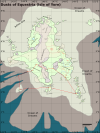
The Nara are a clan of the Yonggan People, a group of semi-nomadic people native to the Northern Earth Kingdom. According to the legends of the Nara, they descend from an ancient Yonggan warrior, the Sun Lord (日主), who was supposedly borne by Ikirihan, the mountain spirit of the Twin Mountains. The mythic origin of the Yonggan is set out in the Barutugisun, a collection of older oral traditions that entered written form circa 850 BG. Like other Yonggan, they are an originally steppe-dwelling semi-nomadic pastoralist people who eventually quit the steppe for the forested foothills and mountains under pressure from the Abka domestication of the ostrich horse and mastery of mounted archery; they found mountainous terrain more defensible and a better substrate for their earthbending. The Nara clan settled in the Nemu Land. Eventually, during the middle of the Hao dynasty, they consolidated power among the Yonggan and ultimately overthrew the Hao and established the Ri Dynasty which ruled the Earth Kingdom (as the Ri Empire) for almost two hundred years.
After their conquest dynasty fell into decline and was overthrown in turn by the Hao-Ting, many of the Nara in the Central Earth Kingdom returned to Yonggan lands or assimilated into broader Earth Kingdom culture. With the extermination of the former imperial family (the Niohuru Nara), power among the Nara (and Yonggan more generally) shifted to the Aisin Nara, a collateral branch of the Niohuru who were descendants of the Imperial Prince of Jin. They continued in this favorable position, ruling as princely sovereigns in the Nemuland, but as the feudal subjects of the Hao-Ting Earth King in Ba Sing Se, until they threw in their lot with Qin the Great during his attempt to overthrow the Hao-Ting and establish a new dynasty. The Aisin Nara even attempted to position one of their nobles as successor to Qin, but was not recognized as such outside of the Northwest and most of Qin's other allies and conquests quickly made submission to the resurgent Hao-Ting. The so-called Northern Khaganate regime, suffering military defeats and economic instability due to a blockade, collapsed as its component states defected.
In the aftermath of Qin's rebellion, the Hao Ting severely punished the Nara, exiling the entire clan to the desolate Hanwang desert. Many perished during the forced relocation, and to this day, the Nara generally regard the Hao Ting as bitter enemies of their people. The Yonggan khaganate passed to another clan, as the Nara could not effectively influence Yonggan politics from exile. Thanks in part to their powerful earthbenders and adaptability, however, the Nara in exile eventually achieved relative prosperity and maintained their distinctive traditions, albeit adapted to the desert. Some of the continued to use noble titles dating from the Great Ri, though these were all abolished (in the eyes of the Ba Sing Se government) at the time of the exile.
Some Nara successfully disguised their clan identity rather than go into exile, joining other Yonggan clans (who were often sympathetic to their plight and distrustful of the Hao Ting.) When the Fire Nation established its colonies, some of these crypto-Nara and recent escapees from the Hanwang exile relocated to the colonies and established themselves there; there is a significant minority of Nara in Yu Dao, where they are treated no worse than other Earth nationals. There is supposedly a minority of crypto-Nara in Qin Village in the Southern Earth Kingdom, but they are highly assimilated into broader culture of the village.
The Nara are not generally well-liked by the other inhabitants of the Hanwang desert; their forcible introduction to the area and subsequent violent struggles to attain a share of the desert's scarce resources did not endear them to the people who were already there before the exile. That being said, in the centuries since the exile, they have generally become more accepted and are mostly at peace with the other inhabitants. The sandbender tribes, who regard fire as a holy expression of a pure element, despise the Nara practice of burning badgermole dung in their heating systems, regarding it as a desecration. The beetle-helmeted people resent the Nara for their badgermole herds, as badgermoles are predators of the giant rhinoceros beetles on which they depend for transportation, particularly of the vulnerable pupae underground.