|
Size: 15090
Comment:
|
Size: 15407
Comment:
|
| Deletions are marked like this. | Additions are marked like this. |
| Line 99: | Line 99: |
| The Nitan state is divided into nine administrative counties with magistrates appointed by the central government in Ba Sing Se. Each settlement and village has a headman, generally a local, recognized by the state government, and devolves various powers on the headman. In practice, village headmen are often answerable not only to the central government, but to the matriarchs of important indigenous families, a holdover from the original structures of power among the Beituzhu. Some cities have home rule powers based on ancient treaty concessions or vassalage agreements made with either prior Earth Kingdom Dynasties, or with the various semi-nomadic khanates to the South. | The Nitan state is divided into nine administrative counties with magistrates appointed by the central government in Ba Sing Se. Each settlement and village has a headman, generally a local, recognized by the state government, and devolves various powers on the headman. There are also indigenous chiefs who have parallel powers, relating to kinship groups more than geographical locations, and with historical tribute obligations to the Earth King (e.g. being required to collect and turn over a certain number of fenmink pelts or quantity of train oil per year.) In practice, village headmen and tribal chiefs are often answerable not only to the central government, but also to the matriarchs of important indigenous families, a holdover from the original structures of power among the Beituzhu. Some cities have home rule powers based on ancient treaty concessions or vassalage agreements made with either prior Earth Kingdom Dynasties, or with the various semi-nomadic khanates to the South. |
<<Card: execution failed [local variable 'page' referenced before assignment] (see also the log)>>
Overview
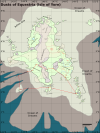
Nitan State, Nitanguo, or the Peatbog State, is a political subdivision of the Earth Kingdom, located in the far North. It borders The Soaring-Snow State, Yongganguo, and the West Shuizu State. Nitan State occupies a strip of the coast, separated by the North Sea from the Confederation of the Northern Water Tribes. The Northern Divide, a cliff which represents an active tectonic feature and a hot spot for mostly-placid vulcanism, forms the natural southern border. It is the main geographical feature separating it from the Yonggan State to the south.
Nitan State is named for its peatbogs, which cover most of the low-lying country.
History
Antiquity
The Beituzhu are the original inhabitants of the Nitan State, and evidence suggests the population is more closely related to the Beituzhu of the North Coast than the indigenous population of Chenbao. They have had frequent genetic contact with the upland mountain populations with other indigenous peoples of the North, such as the Yonggan and Yi, and also with the Water Tribes. Traders from the Water Tribes have been trading with the indigenous population of Nitan for thousands of years, and have not-infrequently settled there as well, either in their own villages, or among the earthbending tribes.
A somewhat unstable system of tribal confederation apparently prevailed in the region before the Earth Kingdom centralized, in which the Beituzhu allied themselves with the some Alarame people in the uplands against other, more bellicose, raiders from the South. Thus, they became loosely affiliated with the Elder Gong when they achieved suzerainty in the North. Much later, in 1802 BG, the Great Tu dynasty created the Nitan State as an organic part of the Earth Kingdom rather than a tributary, appointing its indigenous high chief as Duke Guarding the North Sea and making his descendants vassals within their feudal system. This was a disruption to the former indigenous systems of power, which were more consensus-based and matriarchal, but the new Dukes maintained power with the support of the Tu dynasty Earth Kings. When the Tu dynasty fell due to a succession crisis, the Nitanese duke aligned himself with the Western Tu against the Eastern Tu (the latter ruling in Ba Sing Se), but the centralized power of the dukedom diminished and decentralized indigenous power structures reasserted themselves. This change persisted even through the reunification under the Ganjinese ascendancy (1618 BG) its associated colonial projects in the Northwest.
Before the War
The Nitan state continued through the early modern era as an organic state of the Earth Kingdom, with varying mixtures of indigenous rule and appointed officials. It has been often troubled by pirates and other seaborne raiders in times of dynastic weakness. Its vast, complicated coastline, with numerous shallow rivers, secluded areas, and rocky tors amid hazardous bogs and swamps, coupled with a low population density, has also made it attractive to smugglers seeking to avoid Earth Kingdom tariffs. This has especially been so since the Great Qin Road was constructed during the Earth Kingdom Civil War, which gave Nitan some excellent connections to the inland trade. As a response, the Hao Ting has attempted to increase centralized control over Nitan, to varying degrees of success over the years.
Also as a consequence of the Civil War, some parts of Northern Yongganguo were transferred to Nitan State by the Hao Ting, and some cross-state vassal relationships to Yonggan lords were severed in favor of centrally-appointed scholar-officials.
Since the War
Nitan has become increasingly independent of the central government since the war, but, unlike nearby Chenbao and Yongganguo, its urban centers remained firmly under the governance of the Hao Ting, and remitting taxes to Ba Sing Se.
Lately, as part of the Fire Nation's North Sea Campaign to cut off Ba Sing Se from the North Sea trade and resupply via the Grand Canal and its overland road system, Prince-General Iroh's forces have occupied Nitan's major ports, Mukai and Temene Town. This has diminished central control, and the indigenous vassals have been largely left to their own devices. The uptick in smuggling and piracy this might be expected to provoke is tempered by the presence of the Fire Navy along the northern coast, with some pirates turning inward to prey on the Nitanese villages in the interior more.
With the Earth Kingdom central government too distracted by the war to mediate, much less enforce its preferred solutions, the Nitan State has been subject to unequal treaties with the Yonggan State. In return for continued supplies of staple grains and peace, Nitan has ceded some of its territory to the Yonggan State, given up control of the Crow River locks, and been forced to tolerate such incidents as Jumara Town electing to become an enclave of the Yonggan State. Although most of the lost territory was, historically, part of the Yonggan State, Nitanese nationalists have been frustrated by the inability of the Ba Sing Se government to resist such actions, and have sometimes made unilateral attacks on Yonggan or things associated with them.
Climate, Geography and Biology
Nitan State is named for its peatbogs, which cover most of the low-lying country. There are two major floristic provinces, regions which can be distinguished by their typical plant life. In the north are the unique Saline Fens, where salt water from the North Sea infiltrates many kilometers inland through the porous, karstic strata. The vegetation there is adapted for brackish water, and obtaining freshwater is a significant challenge that inhabitants must overcome. In the south, boreal peatbogs are perched on impermiable strata (mostly near the Northern Divide), or fed by the emergence of upland groundwater, which travels through permiable strata from as far away as the foothills of the Carki-Khan mountains. It sometimes emerges quite hot from this subterranean sojourn. The transition between the floristic provinces is sometimes abrupt, but can also be more gradual, opening into a wide mixed-type transitional zone in the East of the state. The hydric soils of Nitan do support a fair number of suitably-adapted trees and shrubs, but the peat is mostly derived from the grasses and forbs that dominate both provinces. Some isolated uplands in the South are forested, and some areas around towns have been drained for agriculture with ditches, mainly during the Hao Ting Renaissance.
Economy
Nitan State has a relatively underdeveloped economy, especially compared with the Yonggan State and Chenbao, but also compared to the extractive economy of the State of Yi or the politically and culturally similar West Shuizu State. It has been dealt a difficult hand geographically, with little arable land.
Peat, cut and dewattered by earthbenders and waterbenders working in tandem, is used for heating, cooking, and industry within the state. It is also exported, in limited quantities, to the Yonggan State, where some smiths and artisanal steelmakers swear by Nitanese peat charcoal. It is also used to make smoked sorghum ale, which is enjoyed regionally. Marine mammals are hunted and rendered on the coast, and fishing is a major industry. Dried fish is exported to the Yonggan and Yi states in significant quantity, in exchange for staple grains and preserved vegetables from Yongganguo, flux stones and specie from Yiguo, and metalwork from both.
Besides peat, lignite coal is also found in southern Nitan.
Agriculture
Farming is an underdeveloped sector. The amount of arable land is very small, owing to the prevalence of hydric soils. Most of it is done near towns in the Southern (freshwater) floristic province, where crops can be grown on drained land. No common food crop grows economically in the Northern floristic province, even if the soils are drained, though Beituzhu horticulture is practiced. Fenberries and saltpears are produced in this way, and mostly consumed locally.
Industry
Bog iron is found in Nitan, especially near Ketelvilich, where it is smelted. There is a limited steelmaking and metalwork industry there, but the greater portion of the pig iron is actually sent to the Yonggan State in exchange for food and textiles.
The metalwork trades are dominated by ethnic Yonggan guilds.
Trade
Nitan has significant ports serving the coastal and North Sea trades, in Temene Town and the capital, Mukai. Both have recently come under occupation by the Fire Nation, however, which has greatly discouraged traders.
Transportation
The Great Qin Road passes through Nitan State, and the northern terminus of the Ostrich Horse Road, which goes through Yongganguo all the way to the Ostrich Horse River, is located there. So is the northern end of Jaikan's Road. Nitan has many rivers, though only a few were navigable, in their natural state, by vessels able to safely cross the North Sea. Instead, shallow-bottomed coasters and small boats dominate the extensive rivers, lakes, and swamps of Nitan State. A few rivers have been dredged so that ships can access more interior settlements. Much of this activity took place during the Ri and early Hao Ting dynasties, but terminated shortly after the Hao Ting renaissance - later Hao Ting earth kings have viewed creating additional seaports in Nitan as an impediment to the efficient extraction of tariffs, and sought to make all foreign ships call at Mukai or Temene Town (where Hao Ting customs houses are located.)
A system of locks connects allows ships to cross the Northern Divide on the Crow River. These locks have lately come to be under the administrative control of the Yonggan State via a treaty, but the treaty obliges them to treat all ships in a nondiscriminatory fashion, a provision which is being upheld.
Culture and Anthropology
Ethnic Composition
Most inhabitants are Nitanese, a nationality unrecognized by the central government; they are installed classified as Beituzhu (Northern Aboriginals). They do share close cultural and linguistic affinities with other Beituzhu to the East, but consider themselves a distinct, but naturally allied, group.
Ganjinese colonists in Nitan, who often set up fur-trading factories and trading posts, remain in the country today. They also operate many inns and bathhouses, in common with the rest of the northern coast east of Yi State.
Unsurprisingly, given the geographical proximity and historical relationships, a number of Yonggan have come to live in Nitan State.
Some Zhongzu came to Nitan State to drain lands and farm during the Hao Ting renaissance, but remain a small minority concentrated near the prototype drainage projects in the South near the Great Qin Road.
Overall, the population is about 65% Nitanese Beituzhu and 10% other Beituzhu, 5-8% tributary Shuizu, and the other groups all less than 5%.
Languages Spoken
Most people in the Nitan State speak Nitanese, a dialect of Beituzhu heavily influenced by tributary Shuizu dialects. Common is also widely spoken, and is the language of administration and urban culture. Yonggan and Ganjinese are significant minority languages.
Cultural and Religious Institutions
Beituzhu traditional shamanism prevails among the Nitanese. Earth Kingdom folk religion is also common, especially in cities. The cult of the great bird-spirit Old Kutkh is entrenched in the South of the state, whereas the Moon Spirit is revered more in the North. In former times, there was a community of followers of the Air Nomad religion affiliated with the Northern Air Temple, mostly composed of Earth nation converts made by missionaries. They fled after the destruction of the Air Nomad community in Northern Yi nearby, and what became of them is not generally known.
There is a good scribal school in Mukai which also teaches the Classics, to prepare students to sit for the provincial civil service examinations. In Temene Town, there is a waterbending dojo, one of a very few in the Earth Kingdom. The master is an Uuyurat tribesman, though most of his students are Nitanese who have waterbending via their mixed elemental heritage.
The Yonggan National Mail connected with Mukai town, until it was occupied by the Fire Nation. The Earth Kingdom's royal messenger network reaches Mukai and Temene town, though it is also disrupted by Fire Nation activity.
Arts, Fashion and Cuisine
Nitanese crafters work in shell, mother of pearl, ivory, bone, tooth, and jet lignite, among other materials. Scrimshaw is a common medium for art. Clothes are made from fur and leather, with the fur of the Nitanese fenmink being especially prized for its natural water-repelling qualities and beauty. Ironwork, especially for tools and weapons, is mostly practiced in a pre-industrial setting in the larger villages.
Nitan has a tradition of professional storytellers and bards, in common with the Yonggan State and the Water Tribes, from which it may have ultimately originated.
Subdivisions and Politics
The Nitan state is divided into nine administrative counties with magistrates appointed by the central government in Ba Sing Se. Each settlement and village has a headman, generally a local, recognized by the state government, and devolves various powers on the headman. There are also indigenous chiefs who have parallel powers, relating to kinship groups more than geographical locations, and with historical tribute obligations to the Earth King (e.g. being required to collect and turn over a certain number of fenmink pelts or quantity of train oil per year.) In practice, village headmen and tribal chiefs are often answerable not only to the central government, but also to the matriarchs of important indigenous families, a holdover from the original structures of power among the Beituzhu. Some cities have home rule powers based on ancient treaty concessions or vassalage agreements made with either prior Earth Kingdom Dynasties, or with the various semi-nomadic khanates to the South.
Capital and Cities
The capital, and largest city, of the Nitan State is Mukai.
The largest cities are Mukai, Temene Town, Jumara Town (de jure; de facto, this town is now part of Yongganguo), and Utx-Utx on the Crow.
Governance
Nitan State is a state of the Earth Kingdom, considered to be under indigenous rule, but the local authorities operate with devolved powers as an organic part of the Kingdom and not as a tributary or vassal state. The Earth Kingdom's appointed governor in Mukai Town is currently missing, having fled when the Fire Nation invaded and not yet reappeared. This may represent an opportunity for Nitanese nationalists to assert themselves.