<<Card: execution failed [local variable 'page' referenced before assignment] (see also the log)>>
Overview
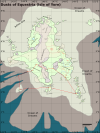
Nitan State, Nitanguo, or the Peatbog State, is a political subdivision of the Earth Kingdom, located in the far North. It borders The Soaring-Snow State, Yongganguo, and the West Shuizu State. Nitan State occupies a strip of the coast, separated by the North Sea from the Confederation of the Northern Water Tribes. The Northern Divide, a cliff which represents an active tectonic feature and a hot spot for mostly-placid vulcanism, forms the natural southern border. It is the main geographical feature separating it from the Yonggan State to the south.
Nitan State is named for its peatbogs, which cover most of the low-lying country. There are two major floristic provinces, regions which can be distinguished by their typical plant life. In the north are the unique Saline Fens, where salt water from the North Sea infiltrates many kilometers inland through the porous, karstic strata. The vegetation there is adapted for brackish water, and obtaining freshwater is a significant challenge that inhabitants must overcome. In the south, boreal peatbogs are perched on impermiable strata (mostly near the Northern Divide), or fed by the emergence of upland groundwater, which travels through permiable strata from as far away as the foothills of the Carki-Khan mountains. It sometimes emerges quite hot from this subterranean sojourn. The transition between the floristic provinces is sometimes abrupt, but can also be more gradual, opening into a wide mixed-type transitional zone in the East of the state. The hydric soils of Nitan do support a fair number of suitably-adapted trees and shrubs, but the peat is mostly derived from the grasses and forbs that dominate both provinces. Some isolated uplands in the South are forested, and some areas around towns have been drained for agriculture with ditches, mainly during the Hao Ting Renaissance.
History
Antiquity
The Beituzhu are the original inhabitants of the Nitan State, and evidence suggests the population is more closely related to the Beituzhu of the North Coast than the indigenous population of Chenbao. They have had frequent genetic contact with the upland mountain populations with other indigenous peoples of the North, such as the Yonggan and Yi, and also with the Water Tribes. Traders from the Water Tribes have been trading with the indigenous population of Nitan for thousands of years, and have not-infrequently settled there as well, either in their own villages, or among the earthbending tribes.
A somewhat unstable system of tribal confederation apparently prevailed in the region before the Earth Kingdom centralized, in which the Beituzhu allied themselves with the some Alarame people in the uplands against other, more bellicose, raiders from the South. Thus, they became loosely affiliated with the Elder Gong when they achieved suzerainty in the North. Much later, in 1802 BG, the Great Tu dynasty created the Nitan State as an organic part of the Earth Kingdom rather than a tributary, appointing its indigenous high chief as Duke Guarding the North Sea and making his descendants vassals within their feudal system. This was a disruption to the former indigenous systems of power, which were more consensus-based and matriarchal, but the new Dukes maintained power with the support of the Tu dynasty Earth Kings. When the Tu dynasty fell due to a succession crisis, the Nitanese duke aligned himself with the Western Tu against the Eastern Tu (the latter ruling in Ba Sing Se), but the centralized power of the dukedom diminished and decentralized indigenous power structures reasserted themselves. This change persisted even through the reunification under the Ganjinese ascendancy (1618 BG) its associated colonial projects in the Northwest.
Before the War
The Nitan state continued through the early modern era as an organic state of the Earth Kingdom, with varying mixtures of indigenous rule and appointed officials. It has been often troubled by pirates and other seaborne raiders in times of dynastic weakness. Its vast, complicated coastline, with numerous shallow rivers, secluded areas, and rocky tors amid hazardous bogs and swamps, coupled with a low population density, has also made it attractive to smugglers seeking to avoid Earth Kingdom tariffs. This has especially been so since the Great Qin Road was constructed during the Earth Kingdom Civil War, which gave Nitan some excellent connections to the inland trade. As a response, the Hao Ting has attempted to increase centralized control over Nitan, to varying degrees of success over the years.
Since the War
Nitan has become increasingly independent of the central government since the war, but, unlike nearby Chenbao and Yongganguo, its urban centers remaining firmly under the governance of the Hao Ting, and remitting taxes to Ba Sing Se.
Climate, Geography and Biology
Economy
Agriculture
Industry
Trade
Transportation
Culture and Anthropology
Ethnic Composition
Languages Spoken
Cultural and Religious Institutions
Arts, Fashion and Cuisine
Subdivisions and Politics
Capital