|
Size: 10157
Comment: Prince of Jin translates 金王 so "royal" isn't wrong in isolation, but this is more the translation precident.
|
Size: 19057
Comment:
|
| Deletions are marked like this. | Additions are marked like this. |
| Line 1: | Line 1: |
| The [[Avatar/Nara Clan|Nara Clan]] of [[Avatar/Yonggan Nationality|Yonggan people]] were exiled to the Hanwang Desert by the 46th Earth King of the [[Avatar/Dynastic History of the Earth Kingdom|Hao Ting dynasty]], an event which is widely remembered in [[Avatar/Yonggan State|the Yonggan State]] today. | The [[Avatar/Nara Clan|Nara Clan]] of [[Avatar/Yonggan Nationality|Yonggan people]] were exiled to the Hanwang Desert by the 41st Earth King of the [[Avatar/Dynastic History of the Earth Kingdom|Hao Ting dynasty]], an event which is widely remembered in [[Avatar/Yonggan State|the Yonggan State]] today. |
| Line 6: | Line 6: |
| After the defeat of a rump dynasty (the Northern Ri), relations between the Earth Kingdom under the Hao Ting and the Yonggan people returned to historical patterns, with the Hao Ting being suzerains to the Yonggan State and treating the Yonggan khagan as an indigenous vassal ruler, in common with many other Earth Nations. Descendants of some Yonggan leaders who had cooperated with the Hao Ting against the Ri during the dynastic succession continued to hold noble titles and fiefs through the Earth King, and although relations were not uniformly harmonious, from the late 500s BG, peace and stability prevailed. | After the defeat of a rump dynasty (the Northern Ri), relations between the Yonggan People and the Earth Kingdom under the Hao Ting returned to historical patterns, with the Hao Ting being suzerains to the Yonggan State and treating the Yonggan khagan as an indigenous vassal ruler, in common with many other Earth Nations. Descendants of some Yonggan leaders who had cooperated with the Hao Ting against the Ri during the dynastic succession continued to hold noble titles and fiefs through the Earth King. Although relations were not uniformly harmonious, from the late 500s BG, peace and stability prevailed. |
| Line 12: | Line 12: |
| Gainan, the capital of the Yonggan State, was finally taken by the Royal Earth Army not long after the suicide of Jierhalang, who killed himself after succumbing to despair with regard to the outcome of the war. | Gainan was finally taken by the Royal Earth Army not long after the suicide of Jierhalang, who killed himself after succumbing to despair with regard to the outcome of the war. |
| Line 16: | Line 16: |
| Gainan is an ancient city in the mountains of the Nemuland, and it had been transformed into a heavily fortified capital by the Aisin Nara princes of Jin. When the Royal Earth Army reached Gainan, it had been additionally fortified with wood-earth composite walls and traps, and was heavily defended. The Aisin Nara had intended to render the idea of taking Gainan by force sufficiently unpalatable to make a favorable negotiated settlement, in which the Nara leadership would retain their traditional lands and income in the Nemuland, more likely. However, under the direction of the Throne, the Hao Ting generals refused to negotiate and, at a tremendous cost in lives among both the defenders and the Royal Earth Army, took the city. Enraged by the heavy losses and the privation they had endured in the grueling Nemuland campaign, the Royal troops sacked and looted Gainan in 265. Rather than being the result of a breakdown in discipline, this was openly tolerated by their officers. About a third of the civilian population was killed or taken into slavery. Gainan was packed with treasures from the Nemuland, brought there by evacuees, and hundreds of thousands of taels in spoil was carried off as well. The war badgermoles of the defenders were slaughtered and eaten by the victorious invaders, who had been surviving mostly on grain rations with little protein. | Gainan is an ancient city in the mountains of the Nemuland, and it had been transformed into a heavily fortified capital by the Aisin Nara princes of Jin. When the Royal Earth Army reached Gainan, it had been additionally fortified with wood-earth composite walls and traps, and was heavily defended. The Aisin Nara had intended to render the idea of taking Gainan by force sufficiently unpalatable to make a favorable negotiated settlement, in which the Nara leadership would retain their traditional lands and income in the Nemuland, more likely. However, under the direction of the Throne, the Hao Ting generals refused to negotiate and, at a tremendous cost in lives among both the defenders and the Royal Earth Army, took the city. Enraged by the heavy losses and the privation they had endured in the grueling Nemuland campaign, the Royal troops sacked and looted Gainan in 265. Rather than being the result of a breakdown in discipline, this was openly tolerated by their officers. About a third of the civilian population was killed or taken into slavery. Gainan was packed with treasures from the Nemuland, brought there by evacuees, and hundreds of thousands of taels in spoil was carried off as well. The war badgermoles of the defenders were slaughtered and eaten by the victorious invaders, who had been surviving mostly on grain rations with little protein. Badgermole is a taboo meat to the Yonggan, so this was seen as an act of exceptional barbarism. |
| Line 27: | Line 27: |
| After the surrender, the Earth Kingdom decided to reorganize the Yonggan State as a directly-governed province rather than a vassal principality under the rule of a Yonggan khagan. This would enable more efficient taxation, and, it was hoped, bring the territory more closely into the cultural sphere of the Central Earth Kingdom and prevent it from aligning itself with the next rival for the Badgermole Throne. | After the surrender, the Earth Kingdom decided to reorganize the Yonggan State as a directly-governed province rather than a vassal principality under the rule of a Yonggan khagan. This would enable more efficient taxation, and, it was hoped, bring the territory more closely into the cultural sphere of the Central Earth Kingdom. It was further hoped that such cultural unity would prevent it from aligning itself with the next rival for the Badgermole Throne, as Qin had exploited ethnic fault lines to gain much of his support in the West. |
| Line 29: | Line 29: |
| News of the executions reached the Nemuland in 263, however, they became the inciting incident for an uprising by Yonggan. Many of the ringleaders were members of the Nara clan, who agitated against the occupation of the Yonggan State and demanded a prompt return to indigenous rule as a tributary state, essentially the ''status quo ante bellum'' with new leadership replacing the Aisin Nara. This uprising was not well organized, plagued by infighting by nobles of the Yulu Nara and Ayin Nara over who should be the new leadership, and it all came to naught after a few months of disorder. There were a few hundred fatalities on each side - very minor in comparison to the bloody war that ended in 265 - but it gave the Earth King an excuse to reconsider the current settlement. The council advised him that further resistance of this nature was likely to interfere with the plans for direct rule if more definitive measures were not taken to pacify the Yonggan State. | News of the executions reached the Nemuland in 263, however, and they became the inciting incident for an uprising by Yonggan. Many of the ringleaders were members of the Nara clan, who agitated against the occupation of the Yonggan State and demanded a prompt return to indigenous rule as a tributary state, essentially the ''status quo ante bellum'' with new leadership replacing the Aisin Nara. This uprising was not well organized - it was plagued by infighting by nobles of the Yulu Nara and Ayin Nara, who differed over who should be the new leadership. Without mass support among the war-weary population, it all came to naught after a few months of disorder. There were a few hundred fatalities on each side - very minor in comparison to the bloody war that ended in 265 - but it gave the Earth King an excuse to reconsider the current settlement. The council advised him that further resistance of this nature was likely to interfere with the plans for direct rule if more definitive measures were not taken to pacify the Yonggan State. |
| Line 38: | Line 38: |
| The extent to which the Earth King and his Court [[https://en.wikipedia.org/wiki/Genocidal_intent|intended to exterminate the Nara]] is debated - the estimates of the number of Nara in the Hao Ting Veritable Records are wild underestimates - but they were definitely aware of the inability of the Hanwang to support a human population many times larger than its then-current one. A system of trading posts were planned, in which staple foodstuffs would be traded to the Nara, but the supporting logistical infrastructure was not put in place to keep them supplied. Neither was there devised a sustainable way for a population of millions to produce enough goods from the limited resources of the desert to provide for themselves via such trade once their personal property was exhausted. The plight of the Hanwang's indigenous population of sandbender tribes was not discussed in council, and to what extent the distant decision makers were aware of the effect this plan would have on them is, at best, not clear. In the end, the final plan for the Pale of Banishment divided it into two zones, the "zone of residence" and the "zone of transience." The zone of residence is where the Nara may permanently reside, without restriction. The zone of transience is an area on the margins of the pale, often including settlements and trading posts. The Nara are permitted to visit the zone of transience, e.g. to trade, but not to reside there; the specifics of what constitutes "residing" vary from settlement to settlement. Generally, the Nara are forbidden to camp in the zone of transience, and may not build, rent, or own dwellings there. Government trading posts simply have a curfew; the Nara are not allowed to be there at night. Originally, the exile was on pain of death, and was enforced by beheading any Nara caught outside the pale of banishment. The Nara who went into exile were, additionally, branded with a 亡 on their foreheads to make them more recognizable if they tried to leave the pale. The boundaries of the pale and its zones are marked with stele, concentrated in settlements and along common routes; the stele may be extremely far apart on the trackless borders of the Hanwang. The large stele contain a description of the zones, the penalties for defying exile, and, notably, a rather long and mean-spirited denunciation of the Nara, which appears in three languages - the Central Earth Kingdom common language, The Yonggan language (written one on side of the stele in common ideographic characters, and on the other in the Yonggan alphabetic script), and the Hanwang dialect. |
|
| Line 40: | Line 46: |
| === The Nara Outside the Nemuland === | The edict propagated outward from Ba Sing Se though official channels, but many Nara learned of it in advance of enforcement by one means or another, and there was initially uncertainty over to whom exactly it applied. In some areas, officials who did not agree with the edict on various grounds frustrated enforcement deliberately, devised narrow interpretations to reduce the number of people to whom it was applied, or even allowed Nara to renounce clan membership before a magistrate and thereby avoid exile. In the militarily-occupied Nemuland, where the aims of the edict were generally desired by the occupation authorities and clan membership was officially registered, enforcement was faster and generally well-organized. By contrast, in other areas of the Earth Kingdom, many Nara simply abandoned their Nara identity and relocated to new communities. In some tributary Earth Nations, such as the West Shuizu State, the indigenous vassal rulers initially misunderstand the edict to apply only to families who had actively supported Qin's Rebellion, and so exiled only a fraction of their Nara population. Even in the Northwest, some Nara were able to fabricate new clan affiliation and evade the exile. It is estimated that 10-20% of the total Nara population of the Yonggan State at the time of the exile edict chose to give up their identity and integrate with other Yonggan or Abka groups instead of fighting or obeying. In other regions of the Earth Kingdom outside the central region, the estimate approaches 50%. Many were highly-assimilated people whose Nara heritage was not well-known. Most were never caught, though some were; they were either executed or escorted to the pale, depending on the particular circumstances. |
| Line 42: | Line 48: |
| === Colonization and Direct Rule in the Yonggan State === | Some of the people affected by the edict appealed to the Court for relief on the basis of their being loyal supporters of the Earth King. Almost none of these petitions in the occupied Nemuland were granted, except for the families of well-known turncoats, but outside the Yonggan State petitioners had better, if not good, success in at least delaying their banishment. Predictably, a rebellion was touched off by the edict's announcement in the Nemuland, as some Nara chose to fight to the death rather than go into exile. However, the Royal Earth Army had anticipated this and managed to crush the rebellion relatively quickly. It was still a bloody affair in which several thousand soldiers of the Royal Earth Army and allied non-Nara Yonggan were killed, and in which several times more of Nara died, the majority of them civilians. The first waves of Nara deposited in the pale of residence were mostly from the Nemuland. They were marched through the mountains to the Hanwang in the Autumn, when conditions were relatively favorable, and allowed to bring livestock and vehicles such as carts, as only their real property had been confiscated by the edict. Though some Yonggan nationalists have characterized this as a particularly brutal forced march, such conditions appear to have been the exception rather than the rule, and most of the Nara who died during deportation were old or sick; the overall mortality rate of the forced migration was around 1-2%. Groups of Nara continued to be transported to the Hanwang Desert for several years to come, unsurprising considering the size of the Earth Kingdom and the number of Nara within its Yonggan diaspora, and the time it took to resolve various legal questions and petitions for clemency for particular people or groups. The conditions and mortality rate of these various waves of transportation varied wildly, and some of them were indeed marked by higher mortality rates. Conflict between the transported Nara and the indigenous sandbender tribes began almost immediately. With the trading post supply system providing much less in the way of staple grains and supplies than was necessary to support the Nara, they quickly turned to violence to obtain resources from the indigenous people. The Nara included many skilled earthbenders and veterans of recent wars, and their casualties were constantly made up by the arrival of newly transported Nara. This overwhelming numerical superiority was able to overcome the home-territory advantage of the indigenous people, and many of their communities were looted or enslaved. Petitions from them to the Throne for relief were largely ignored, and many of them - not being forcibly confined to the Hanwang - chose to abandon their ancestral lands and migrate south into Abka or Nuogai territory. These sandbender migrations led to yet-further violence in the region. However, even with the displacement and looting of indigenous resources, the Hanwang simply did not have enough carrying capacity for human beings to sustain over a million people. As starvation set in and it became clear that the trading posts did not have sufficient supplies of food available at any price, there were many attempts by groups of Nara to "break out" of the pale by force. These were all sooner or later destroyed or forced back into the pale, though some effectively turned bandit and were a regional menace well into the Hao Ting renaissance, when the central government finally managed to suppress them. About 90-95% of the Nara exiles perished within a year of their arrival in the Hanwang. At the beginning of the exile, most fatalities were due to conflict with the indigenous people or the Royal Earth Army (i.e. when Nara who broke out were defeated and killed), but shortly thereafter starvation became the dominant cause of death. The last few waves of exiles did better, because they were few in number, and the existing Nara had better adapted to desert living by that time. |
| Line 59: | Line 75: |
| More recently, infractions have been usually dealt with more leniently; first-time offenders are branded and returned to the pale and only flagrant repeat violators are executed. Nara violating the zone of transience regulations are generally just expelled, repeat offenders might be jailed briefly or flogged, depending on the circumstances and disposition of the governing authority. |
The Nara Clan of Yonggan people were exiled to the Hanwang Desert by the 41st Earth King of the Hao Ting dynasty, an event which is widely remembered in the Yonggan State today.
Historical Context
The Nara clan are a group of Yonggan people originating as transhumant badgermole pastoralists in a region of the Northwestern Earth Kingdom called the Nemuland. From 788 BG - 620 BG, the Great Ri ruled the territories of the modern Earth Kingdom as the multiethnic Ri Empire; the Ri is considered a "conquest dynasty" because, although its rulers ruled from Ba Sing Se, they were not indigenous to the central Earth Kingdom, but were rather Yonggan people, from an Earth nation significantly northwest of Ba Sing Se. In time, this conquest dynasty fell into decline and was replaced by the Hao Ting, who originated in the central Earth Kingdom and overthrew the Ri with the help of disaffected members of the scholarly bureaucracy.
After the defeat of a rump dynasty (the Northern Ri), relations between the Yonggan People and the Earth Kingdom under the Hao Ting returned to historical patterns, with the Hao Ting being suzerains to the Yonggan State and treating the Yonggan khagan as an indigenous vassal ruler, in common with many other Earth Nations. Descendants of some Yonggan leaders who had cooperated with the Hao Ting against the Ri during the dynastic succession continued to hold noble titles and fiefs through the Earth King. Although relations were not uniformly harmonious, from the late 500s BG, peace and stability prevailed.
Towards the early 200s BG, and in particular as the Earth Kingdom Civil War approached, relations deteriorated. The Hao Ting was widely perceived as in decline, and, grasping for new sources of revenue, it infringed on many of the traditional prerogatives of its vassal indigenous rulers as it attempted to extract more income from them. In general, these extractive measures benefited the Central Earth Kingdom, and Ba Sing Se in particular, at the expense of other regions. At the same time, spending on these regions (such as for Royal Earth Army garrisons and infrastructure) declined, harming trade and allowing bandits to become a serious nuisance. Given the resentment these developments engendered in the Yonggan State, the Aisin-Nara Prince of Jin, Jierhalang, supported Qin Ji (i.e. Qin the Conqueror) in his rebellion against the Hao Ting. Under Nara leadership, the Yonggan contribution to Qin's military success was significant, and Qin betrothed his daughter Qin Fu to the grandson of the Prince of Jin, Prince Taiku, to secure Yonggan support for an unsuccessful campaign to take Ba Sing Se by force.
Ultimately, as is well known, Qin the Great perished in a confrontation with Avatar Kyoshi, and his attempt to create a new dynasty foundered on infighting between rival claimants to his succession. These claimants included the aforementioned Prince Taiku, generally considered a puppet of his grandfather Jierhalang. Prince Taiku's government controlled a coalition in the West which fought a grueling, bloody war with the resurgent Hao Ting. The Hao Ting made steady gains, with the final battle coming at the ancient mountain capital of the Yonggan State in the Nemuland, Gainan.
Gainan was finally taken by the Royal Earth Army not long after the suicide of Jierhalang, who killed himself after succumbing to despair with regard to the outcome of the war.
Sack of Gainan
Gainan is an ancient city in the mountains of the Nemuland, and it had been transformed into a heavily fortified capital by the Aisin Nara princes of Jin. When the Royal Earth Army reached Gainan, it had been additionally fortified with wood-earth composite walls and traps, and was heavily defended. The Aisin Nara had intended to render the idea of taking Gainan by force sufficiently unpalatable to make a favorable negotiated settlement, in which the Nara leadership would retain their traditional lands and income in the Nemuland, more likely. However, under the direction of the Throne, the Hao Ting generals refused to negotiate and, at a tremendous cost in lives among both the defenders and the Royal Earth Army, took the city. Enraged by the heavy losses and the privation they had endured in the grueling Nemuland campaign, the Royal troops sacked and looted Gainan in 265. Rather than being the result of a breakdown in discipline, this was openly tolerated by their officers. About a third of the civilian population was killed or taken into slavery. Gainan was packed with treasures from the Nemuland, brought there by evacuees, and hundreds of thousands of taels in spoil was carried off as well. The war badgermoles of the defenders were slaughtered and eaten by the victorious invaders, who had been surviving mostly on grain rations with little protein. Badgermole is a taboo meat to the Yonggan, so this was seen as an act of exceptional barbarism.
Gainan was left in such a state of desolation that it was considered unsuitable for the administration of the reconquered territory and a new capital was established elsewhere. However, the Aisin Nara ruling family and their elite guards fled via secret tunnels in the mountains to a mountain redoubt, one of many highly defensible fortresses still loyal to them. These fortresses posed a serious difficulty to controlling the mountains of the Yonggan State, and the Hao Ting generals were concerned about the possibility of a protracted and expensive campaign of mountain warfare similar to that waged by the Hao Ting against the Northern Ri centuries before.
Mediation by the Avatar
With the death of Prince Jierhalang and the fall of Gainan, it fell to his successor, Prince Mengtemu, to negotiate a surrender of his remaining forces to the Hao Ting. He requested, and received, the mediation of Avatar Kyoshi. The remaining Nara troops and mountain fortifications surrendered to the Royal Earth Army in accordance with the resulting agreement in 264. Per the terms of the surrender, the lives of the Aisin Nara ruling family were supposed to be spared, with them living under house arrest in the Inner Ring of Ba Sing Se. However, this agreement was not honored. Prince Mengtemu, Princess Fu, and Prince Taiku were all promptly beheaded after arriving in Ba Sing Se, with the 41st Earth King claiming that it had been due to a miscommunication. Other members of the Aisin Nara family were indeed confined -in the Inner Ring as agreed, including the one-year-old boy who was now the Prince of Jin, Hurhan the Elder (265-234). However, the situation was not to last.
Avatar Kyoshi considered deposing the 41st Earth King for his apparent perfidy in executing three of the surrendering Aisin Nara, but there was a dynastic dispute over who his successor should be, and the Earth Sages persuaded her to continue tolerating him.
Lead Up to the Edict
After the surrender, the Earth Kingdom decided to reorganize the Yonggan State as a directly-governed province rather than a vassal principality under the rule of a Yonggan khagan. This would enable more efficient taxation, and, it was hoped, bring the territory more closely into the cultural sphere of the Central Earth Kingdom. It was further hoped that such cultural unity would prevent it from aligning itself with the next rival for the Badgermole Throne, as Qin had exploited ethnic fault lines to gain much of his support in the West.
News of the executions reached the Nemuland in 263, however, and they became the inciting incident for an uprising by Yonggan. Many of the ringleaders were members of the Nara clan, who agitated against the occupation of the Yonggan State and demanded a prompt return to indigenous rule as a tributary state, essentially the status quo ante bellum with new leadership replacing the Aisin Nara. This uprising was not well organized - it was plagued by infighting by nobles of the Yulu Nara and Ayin Nara, who differed over who should be the new leadership. Without mass support among the war-weary population, it all came to naught after a few months of disorder. There were a few hundred fatalities on each side - very minor in comparison to the bloody war that ended in 265 - but it gave the Earth King an excuse to reconsider the current settlement. The council advised him that further resistance of this nature was likely to interfere with the plans for direct rule if more definitive measures were not taken to pacify the Yonggan State.
In the end, the King settled on a twofold plan for the pacification of the Yonggan State. He would have the Nara Clan removed, and resettle their lands with veterans of the campaign and other settlers from the loyal core of the Earth Kingdom. This plan was not discussed with the Avatar, who was informed only by a letter which was devoid of many of the onerous specifics of the plan, such as the location of the exile or the fact that the Nara outside of the Nemuland would be affected.
Edict and Establishment of the Pale of Banishment
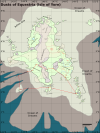
In 262 BG, the 41st Earth King issued an edict which banished all members of the Nara Clan to a "pale of banishment" established in the Hanwang Desert south of the Yonggan State. This is a region of high desert and badlands which are freezing cold during winter nights and very hot during summer afternoons, hitherto inhabited only by a small population of highly-adapted desert nomads. By contrast, the Nara numbered in the low millions and had a widely disseminated diaspora population in the Earth Kingdom, a legacy of the Ri Dynasty establishing Yonggan garrison towns throughout their empire. The low carrying capacity of the desert for human beings and the large number of Nara were a recipe for a humanitarian disaster.
The extent to which the Earth King and his Court intended to exterminate the Nara is debated - the estimates of the number of Nara in the Hao Ting Veritable Records are wild underestimates - but they were definitely aware of the inability of the Hanwang to support a human population many times larger than its then-current one. A system of trading posts were planned, in which staple foodstuffs would be traded to the Nara, but the supporting logistical infrastructure was not put in place to keep them supplied. Neither was there devised a sustainable way for a population of millions to produce enough goods from the limited resources of the desert to provide for themselves via such trade once their personal property was exhausted. The plight of the Hanwang's indigenous population of sandbender tribes was not discussed in council, and to what extent the distant decision makers were aware of the effect this plan would have on them is, at best, not clear.
In the end, the final plan for the Pale of Banishment divided it into two zones, the "zone of residence" and the "zone of transience." The zone of residence is where the Nara may permanently reside, without restriction. The zone of transience is an area on the margins of the pale, often including settlements and trading posts. The Nara are permitted to visit the zone of transience, e.g. to trade, but not to reside there; the specifics of what constitutes "residing" vary from settlement to settlement. Generally, the Nara are forbidden to camp in the zone of transience, and may not build, rent, or own dwellings there. Government trading posts simply have a curfew; the Nara are not allowed to be there at night.
Originally, the exile was on pain of death, and was enforced by beheading any Nara caught outside the pale of banishment. The Nara who went into exile were, additionally, branded with a 亡 on their foreheads to make them more recognizable if they tried to leave the pale. The boundaries of the pale and its zones are marked with stele, concentrated in settlements and along common routes; the stele may be extremely far apart on the trackless borders of the Hanwang. The large stele contain a description of the zones, the penalties for defying exile, and, notably, a rather long and mean-spirited denunciation of the Nara, which appears in three languages - the Central Earth Kingdom common language, The Yonggan language (written one on side of the stele in common ideographic characters, and on the other in the Yonggan alphabetic script), and the Hanwang dialect.
Immediate Effects
The edict propagated outward from Ba Sing Se though official channels, but many Nara learned of it in advance of enforcement by one means or another, and there was initially uncertainty over to whom exactly it applied. In some areas, officials who did not agree with the edict on various grounds frustrated enforcement deliberately, devised narrow interpretations to reduce the number of people to whom it was applied, or even allowed Nara to renounce clan membership before a magistrate and thereby avoid exile. In the militarily-occupied Nemuland, where the aims of the edict were generally desired by the occupation authorities and clan membership was officially registered, enforcement was faster and generally well-organized. By contrast, in other areas of the Earth Kingdom, many Nara simply abandoned their Nara identity and relocated to new communities. In some tributary Earth Nations, such as the West Shuizu State, the indigenous vassal rulers initially misunderstand the edict to apply only to families who had actively supported Qin's Rebellion, and so exiled only a fraction of their Nara population. Even in the Northwest, some Nara were able to fabricate new clan affiliation and evade the exile. It is estimated that 10-20% of the total Nara population of the Yonggan State at the time of the exile edict chose to give up their identity and integrate with other Yonggan or Abka groups instead of fighting or obeying. In other regions of the Earth Kingdom outside the central region, the estimate approaches 50%. Many were highly-assimilated people whose Nara heritage was not well-known. Most were never caught, though some were; they were either executed or escorted to the pale, depending on the particular circumstances.
Some of the people affected by the edict appealed to the Court for relief on the basis of their being loyal supporters of the Earth King. Almost none of these petitions in the occupied Nemuland were granted, except for the families of well-known turncoats, but outside the Yonggan State petitioners had better, if not good, success in at least delaying their banishment.
Predictably, a rebellion was touched off by the edict's announcement in the Nemuland, as some Nara chose to fight to the death rather than go into exile. However, the Royal Earth Army had anticipated this and managed to crush the rebellion relatively quickly. It was still a bloody affair in which several thousand soldiers of the Royal Earth Army and allied non-Nara Yonggan were killed, and in which several times more of Nara died, the majority of them civilians.
The first waves of Nara deposited in the pale of residence were mostly from the Nemuland. They were marched through the mountains to the Hanwang in the Autumn, when conditions were relatively favorable, and allowed to bring livestock and vehicles such as carts, as only their real property had been confiscated by the edict. Though some Yonggan nationalists have characterized this as a particularly brutal forced march, such conditions appear to have been the exception rather than the rule, and most of the Nara who died during deportation were old or sick; the overall mortality rate of the forced migration was around 1-2%. Groups of Nara continued to be transported to the Hanwang Desert for several years to come, unsurprising considering the size of the Earth Kingdom and the number of Nara within its Yonggan diaspora, and the time it took to resolve various legal questions and petitions for clemency for particular people or groups. The conditions and mortality rate of these various waves of transportation varied wildly, and some of them were indeed marked by higher mortality rates.
Conflict between the transported Nara and the indigenous sandbender tribes began almost immediately. With the trading post supply system providing much less in the way of staple grains and supplies than was necessary to support the Nara, they quickly turned to violence to obtain resources from the indigenous people. The Nara included many skilled earthbenders and veterans of recent wars, and their casualties were constantly made up by the arrival of newly transported Nara. This overwhelming numerical superiority was able to overcome the home-territory advantage of the indigenous people, and many of their communities were looted or enslaved. Petitions from them to the Throne for relief were largely ignored, and many of them - not being forcibly confined to the Hanwang - chose to abandon their ancestral lands and migrate south into Abka or Nuogai territory. These sandbender migrations led to yet-further violence in the region.
However, even with the displacement and looting of indigenous resources, the Hanwang simply did not have enough carrying capacity for human beings to sustain over a million people. As starvation set in and it became clear that the trading posts did not have sufficient supplies of food available at any price, there were many attempts by groups of Nara to "break out" of the pale by force. These were all sooner or later destroyed or forced back into the pale, though some effectively turned bandit and were a regional menace well into the Hao Ting renaissance, when the central government finally managed to suppress them.
About 90-95% of the Nara exiles perished within a year of their arrival in the Hanwang. At the beginning of the exile, most fatalities were due to conflict with the indigenous people or the Royal Earth Army (i.e. when Nara who broke out were defeated and killed), but shortly thereafter starvation became the dominant cause of death. The last few waves of exiles did better, because they were few in number, and the existing Nara had better adapted to desert living by that time.
Evolution, and Reforms of the 42nd Reign
41
鎮世 (Zhènshì)
294 BG - 227 BG
42
永寧 (Yǒngníng)
227 BG - 158 BG
More recently, infractions have been usually dealt with more leniently; first-time offenders are branded and returned to the pale and only flagrant repeat violators are executed. Nara violating the zone of transience regulations are generally just expelled, repeat offenders might be jailed briefly or flogged, depending on the circumstances and disposition of the governing authority.
The Cultural Evolution of the Nara in Exile
Present Situation