|
Size: 10161
Comment:
|
Size: 10218
Comment:
|
| Deletions are marked like this. | Additions are marked like this. |
| Line 1: | Line 1: |
| The [[Avatar/Nara Clan|Nara Clan]] of [[Avatar/Yonggan Nationality|Yonggan people]] were exiled to the Hanwang Desert by the 46th Earth King of the [[Avatar/Dynastic History of the Earth Kingdom|Hao Ting dynasty]], an event which is widely remembered in [[Avatar/Yonggan State|the Yonggan State]] today. | The [[Avatar/Nara Clan|Nara Clan]] of [[Avatar/Yonggan Nationality|Yonggan people]] were exiled to the Hanwang Desert by the 41st Earth King of the [[Avatar/Dynastic History of the Earth Kingdom|Hao Ting dynasty]], an event which is widely remembered in [[Avatar/Yonggan State|the Yonggan State]] today. |
| Line 6: | Line 6: |
| After the defeat of a rump dynasty (the Northern Ri), relations between the Earth Kingdom under the Hao Ting and the Yonggan people returned to historical patterns, with the Hao Ting being suzerains to the Yonggan State and treating the Yonggan khagan as an indigenous vassal ruler, in common with many other Earth Nations. Descendants of some Yonggan leaders who had cooperated with the Hao Ting against the Ri during the dynastic succession continued to hold noble titles and fiefs through the Earth King, and although relations were not uniformly harmonious, from the late 500s BG, peace and stability prevailed. | After the defeat of a rump dynasty (the Northern Ri), relations between the Yonggan People and the Earth Kingdom under the Hao Ting returned to historical patterns, with the Hao Ting being suzerains to the Yonggan State and treating the Yonggan khagan as an indigenous vassal ruler, in common with many other Earth Nations. Descendants of some Yonggan leaders who had cooperated with the Hao Ting against the Ri during the dynastic succession continued to hold noble titles and fiefs through the Earth King. Although relations were not uniformly harmonious, from the late 500s BG, peace and stability prevailed. |
| Line 12: | Line 12: |
| Gainan, the capital of the Yonggan State, was finally taken by the Royal Earth Army not long after the suicide of Jierhalang, who killed himself after succumbing to despair with regard to the outcome of the war. | Gainan was finally taken by the Royal Earth Army not long after the suicide of Jierhalang, who killed himself after succumbing to despair with regard to the outcome of the war. |
| Line 16: | Line 16: |
| Gainan is an ancient city in the mountains of the Nemuland, and it had been transformed into a heavily fortified capital by the Aisin Nara princes of Jin. When the Royal Earth Army reached Gainan, it had been additionally fortified with wood-earth composite walls and traps, and was heavily defended. The Aisin Nara had intended to render the idea of taking Gainan by force sufficiently unpalatable to make a favorable negotiated settlement, in which the Nara leadership would retain their traditional lands and income in the Nemuland, more likely. However, under the direction of the Throne, the Hao Ting generals refused to negotiate and, at a tremendous cost in lives among both the defenders and the Royal Earth Army, took the city. Enraged by the heavy losses and the privation they had endured in the grueling Nemuland campaign, the Royal troops sacked and looted Gainan in 265. Rather than being the result of a breakdown in discipline, this was openly tolerated by their officers. About a third of the civilian population was killed or taken into slavery. Gainan was packed with treasures from the Nemuland, brought there by evacuees, and hundreds of thousands of taels in spoil was carried off as well. The war badgermoles of the defenders were slaughtered and eaten by the victorious invaders, who had been surviving mostly on grain rations with little protein. | Gainan is an ancient city in the mountains of the Nemuland, and it had been transformed into a heavily fortified capital by the Aisin Nara princes of Jin. When the Royal Earth Army reached Gainan, it had been additionally fortified with wood-earth composite walls and traps, and was heavily defended. The Aisin Nara had intended to render the idea of taking Gainan by force sufficiently unpalatable to make a favorable negotiated settlement, in which the Nara leadership would retain their traditional lands and income in the Nemuland, more likely. However, under the direction of the Throne, the Hao Ting generals refused to negotiate and, at a tremendous cost in lives among both the defenders and the Royal Earth Army, took the city. Enraged by the heavy losses and the privation they had endured in the grueling Nemuland campaign, the Royal troops sacked and looted Gainan in 265. Rather than being the result of a breakdown in discipline, this was openly tolerated by their officers. About a third of the civilian population was killed or taken into slavery. Gainan was packed with treasures from the Nemuland, brought there by evacuees, and hundreds of thousands of taels in spoil was carried off as well. The war badgermoles of the defenders were slaughtered and eaten by the victorious invaders, who had been surviving mostly on grain rations with little protein. Badgermole is a taboo meat to the Yonggan, so this was seen as an act of exceptional barbarism. |
The Nara Clan of Yonggan people were exiled to the Hanwang Desert by the 41st Earth King of the Hao Ting dynasty, an event which is widely remembered in the Yonggan State today.
Historical Context
The Nara clan are a group of Yonggan people originating as transhumant badgermole pastoralists in a region of the Northwestern Earth Kingdom called the Nemuland. From 788 BG - 620 BG, the Great Ri ruled the territories of the modern Earth Kingdom as the multiethnic Ri Empire; the Ri is considered a "conquest dynasty" because, although its rulers ruled from Ba Sing Se, they were not indigenous to the central Earth Kingdom, but were rather Yonggan people, from an Earth nation significantly northwest of Ba Sing Se. In time, this conquest dynasty fell into decline and was replaced by the Hao Ting, who originated in the central Earth Kingdom and overthrew the Ri with the help of disaffected members of the scholarly bureaucracy.
After the defeat of a rump dynasty (the Northern Ri), relations between the Yonggan People and the Earth Kingdom under the Hao Ting returned to historical patterns, with the Hao Ting being suzerains to the Yonggan State and treating the Yonggan khagan as an indigenous vassal ruler, in common with many other Earth Nations. Descendants of some Yonggan leaders who had cooperated with the Hao Ting against the Ri during the dynastic succession continued to hold noble titles and fiefs through the Earth King. Although relations were not uniformly harmonious, from the late 500s BG, peace and stability prevailed.
Towards the early 200s BG, and in particular as the Earth Kingdom Civil War approached, relations deteriorated. The Hao Ting was widely perceived as in decline, and, grasping for new sources of revenue, it infringed on many of the traditional prerogatives of its vassal indigenous rulers as it attempted to extract more income from them. In general, these extractive measures benefited the Central Earth Kingdom, and Ba Sing Se in particular, at the expense of other regions. At the same time, spending on these regions (such as for Royal Earth Army garrisons and infrastructure) declined, harming trade and allowing bandits to become a serious nuisance. Given the resentment these developments engendered in the Yonggan State, the Aisin-Nara Prince of Jin, Jierhalang, supported Qin Ji (i.e. Qin the Conqueror) in his rebellion against the Hao Ting. Under Nara leadership, the Yonggan contribution to Qin's military success was significant, and Qin betrothed his daughter Qin Fu to the grandson of the Prince of Jin, Prince Taiku, to secure Yonggan support for an unsuccessful campaign to take Ba Sing Se by force.
Ultimately, as is well known, Qin the Great perished in a confrontation with Avatar Kyoshi, and his attempt to create a new dynasty foundered on infighting between rival claimants to his succession. These claimants included the aforementioned Prince Taiku, generally considered a puppet of his grandfather Jierhalang. Prince Taiku's government controlled a coalition in the West which fought a grueling, bloody war with the resurgent Hao Ting. The Hao Ting made steady gains, with the final battle coming at the ancient mountain capital of the Yonggan State in the Nemuland, Gainan.
Gainan was finally taken by the Royal Earth Army not long after the suicide of Jierhalang, who killed himself after succumbing to despair with regard to the outcome of the war.
Sack of Gainan
Gainan is an ancient city in the mountains of the Nemuland, and it had been transformed into a heavily fortified capital by the Aisin Nara princes of Jin. When the Royal Earth Army reached Gainan, it had been additionally fortified with wood-earth composite walls and traps, and was heavily defended. The Aisin Nara had intended to render the idea of taking Gainan by force sufficiently unpalatable to make a favorable negotiated settlement, in which the Nara leadership would retain their traditional lands and income in the Nemuland, more likely. However, under the direction of the Throne, the Hao Ting generals refused to negotiate and, at a tremendous cost in lives among both the defenders and the Royal Earth Army, took the city. Enraged by the heavy losses and the privation they had endured in the grueling Nemuland campaign, the Royal troops sacked and looted Gainan in 265. Rather than being the result of a breakdown in discipline, this was openly tolerated by their officers. About a third of the civilian population was killed or taken into slavery. Gainan was packed with treasures from the Nemuland, brought there by evacuees, and hundreds of thousands of taels in spoil was carried off as well. The war badgermoles of the defenders were slaughtered and eaten by the victorious invaders, who had been surviving mostly on grain rations with little protein. Badgermole is a taboo meat to the Yonggan, so this was seen as an act of exceptional barbarism.
Gainan was left in such a state of desolation that it was considered unsuitable for the administration of the reconquered territory and a new capital was established elsewhere. However, the Aisin Nara ruling family and their elite guards fled via secret tunnels in the mountains to a mountain redoubt, one of many highly defensible fortresses still loyal to them. These fortresses posed a serious difficulty to controlling the mountains of the Yonggan State, and the Hao Ting generals were concerned about the possibility of a protracted and expensive campaign of mountain warfare similar to that waged by the Hao Ting against the Northern Ri centuries before.
Mediation by the Avatar
With the death of Prince Jierhalang and the fall of Gainan, it fell to his successor, Prince Mengtemu, to negotiate a surrender of his remaining forces to the Hao Ting. He requested, and received, the mediation of Avatar Kyoshi. The remaining Nara troops and mountain fortifications surrendered to the Royal Earth Army in accordance with the resulting agreement in 264. Per the terms of the surrender, the lives of the Aisin Nara ruling family were supposed to be spared, with them living under house arrest in the Inner Ring of Ba Sing Se. However, this agreement was not honored. Prince Mengtemu, Princess Fu, and Prince Taiku were all promptly beheaded after arriving in Ba Sing Se, with the 41st Earth King claiming that it had been due to a miscommunication. Other members of the Aisin Nara family were indeed confined -in the Inner Ring as agreed, including the one-year-old boy who was now the Prince of Jin, Hurhan the Elder (265-234). However, the situation was not to last.
Avatar Kyoshi considered deposing the 41st Earth King for his apparent perfidy in executing three of the surrendering Aisin Nara, but there was a dynastic dispute over who his successor should be, and the Earth Sages persuaded her to continue tolerating him.
Lead Up to the Edict
After the surrender, the Earth Kingdom decided to reorganize the Yonggan State as a directly-governed province rather than a vassal principality under the rule of a Yonggan khagan. This would enable more efficient taxation, and, it was hoped, bring the territory more closely into the cultural sphere of the Central Earth Kingdom and prevent it from aligning itself with the next rival for the Badgermole Throne.
News of the executions reached the Nemuland in 263, however, and they became the inciting incident for an uprising by Yonggan. Many of the ringleaders were members of the Nara clan, who agitated against the occupation of the Yonggan State and demanded a prompt return to indigenous rule as a tributary state, essentially the status quo ante bellum with new leadership replacing the Aisin Nara. This uprising was not well organized, plagued by infighting by nobles of the Yulu Nara and Ayin Nara over who should be the new leadership, and it all came to naught after a few months of disorder. There were a few hundred fatalities on each side - very minor in comparison to the bloody war that ended in 265 - but it gave the Earth King an excuse to reconsider the current settlement. The council advised him that further resistance of this nature was likely to interfere with the plans for direct rule if more definitive measures were not taken to pacify the Yonggan State.
In the end, the King settled on a twofold plan for the pacification of the Yonggan State. He would have the Nara Clan removed, and resettle their lands with veterans of the campaign and other settlers from the loyal core of the Earth Kingdom. This plan was not discussed with the Avatar, who was informed only by a letter which was devoid of many of the onerous specifics of the plan, such as the location of the exile or the fact that the Nara outside of the Nemuland would be affected.
Edict and Establishment of the Pale of Banishment
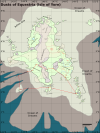
In 262 BG, the 41st Earth King issued an edict which banished all members of the Nara Clan to a "pale of banishment" established in the Hanwang Desert south of the Yonggan State. This is a region of high desert and badlands which are freezing cold during winter nights and very hot during summer afternoons, hitherto inhabited only by a small population of highly-adapted desert nomads. By contrast, the Nara numbered in the low millions and had a widely disseminated diaspora population in the Earth Kingdom, a legacy of the Ri Dynasty establishing Yonggan garrison towns throughout their empire. The low carrying capacity of the desert for human beings and the large number of Nara were a recipe for a humanitarian disaster.
Immediate Effects
The Nara Outside the Nemuland
Colonization and Direct Rule in the Yonggan State
Evolution, and Reforms of the 42nd Reign
41
鎮世 (Zhènshì)
294 BG - 227 BG
42
永寧 (Yǒngníng)
227 BG - 158 BG
The Cultural Evolution of the Nara in Exile
Present Situation